On This Day – Drivetime – Michael Collins takes possession of Dublin Castle 16 January 1922

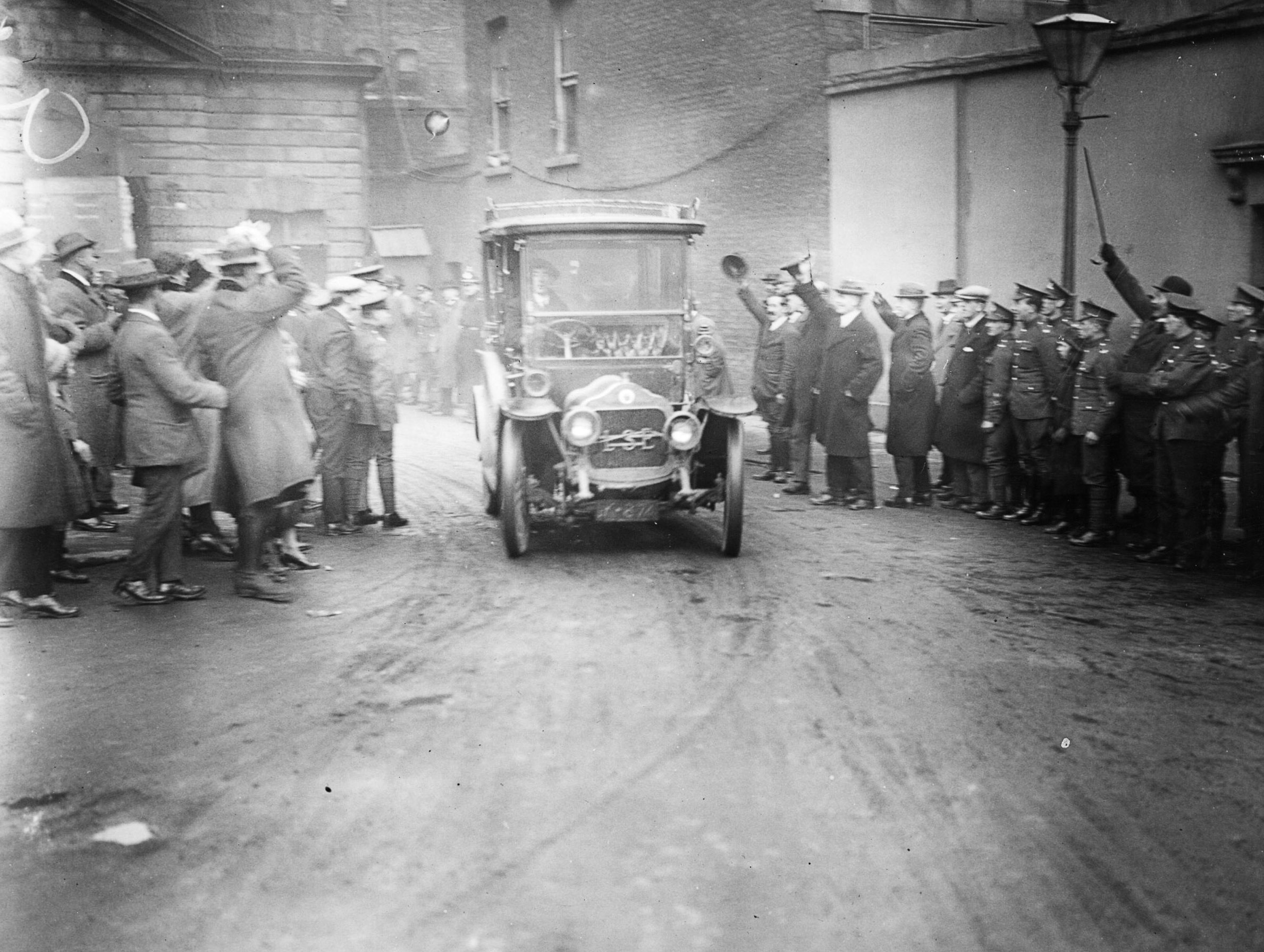
MichaelCollinsCarEnteringDublinCastleJanuary1922Unknown

Even though Michael Collins concluded, accurately, in December 1921, that, in agreeing to the terms of the Anglo Irish treaty, he had signed his own death warrant, without having appended his signature to the document on 6 December 1921 he would not have been able to participate in an event six weeks later that must have given him a great deal of satisfaction.

Once the Treaty was signed and ratified by Dail Eireann on 7 January, bar a port or two, the loan of some artillery to start the Civil War, and of course six counties, the British didn’t really hang about. The new rulers of Ireland were advised to be ready to take over Dublin Castle in mid January.

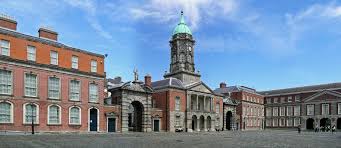
There could be no clearer indication of the actual intention of the British to leave the 26 county Irish Free State than the handing over of this sprawling monument to British rule in Ireland. For centuries Ireland had been governed from … ‘The Castle’. Members of the majority religion who co-operated with the British administration to their financial benefit were … ‘Castle Catholics’. Everything British that moved and had its being in Ireland emanated from … the Castle.

Built at the behest of King John in the 13th century to provide a base for the English conquest of the country from Dublin it had remained the nexus of English and then British rule and the abiding symbol of the colonization of Ireland.

It was from the Bermingham Tower in the Castle that the legendary escape of Red Hugh O’Donnell and Art O’Neill took place in the depths of the winter of January 1592. Art O’Neill perished in the Dublin Mountains but O’Donnell managed to make his way to the sanctuary of the O’Byrnes in Glenmalure, Co.Wicklow. Just over two hundred years later, in 1907, the Insignia of the Order of St.Patrick, known as the Irish Crown Jewels, were stolen from the Bedford Tower in an audacious robbery that has never been solved. Half of Dublin at the time knew who had stolen them. The problem was they nominated the other half of the city as the thieves.

The Castle might well have fallen during the upheavals of 1641, but it did not succumb to rebel control. Robert Emmett could conceivably have taken it in 1803 but dismally failed to do so. It was even more vulnerable in 1916 but the Volunteers failed to walk the ball into an open goal.

So Michael Collins, dressed impressively in his military uniform, must have savoured the moment when his staff car drove into the precincts of the complex of buildings whose fabric he had successfully managed to infiltrate during the Anglo-Irish war while, himself, managing to stay out of the clutches of its more sinister and homicidal operatives.

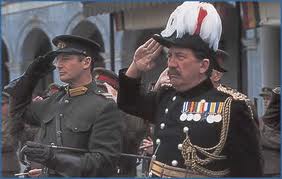
When Collins stepped out of his staff car he was greeted waspishly by the Lord Lieutenant, Lord Fitzalan. ‘You are seven minutes late, Mr.Collins’, observed His Majesty’s last Viceroy in Ireland. The Irish leader is said to have responded acidly, ‘We’ve been waiting over seven hundred years, you can have the seven minutes.’

Fitzalan, the first Catholic Lord Lieutenant since the reign of King James II then took Collins on an impromptu and largely irrelevant tour of the facility pointing out which keys opened which doors, before absenting himself and leaving Collins, literally, holding the fort.

Michael Collins took possession of Dublin Castle on behalf of the Irish provisional government 93 years ago, on this day.
images

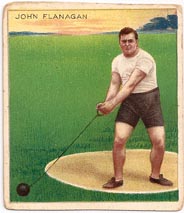
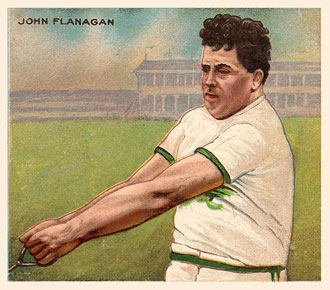
On This Day – Drivetime – 9.1.1873 Birth of John J.Flanagan, hammer thrower

Irish_Whales_John_Flanagan_Martin_Sheridan_James_MitchellJohn_Flanagan_1910_Mecca_card_front2

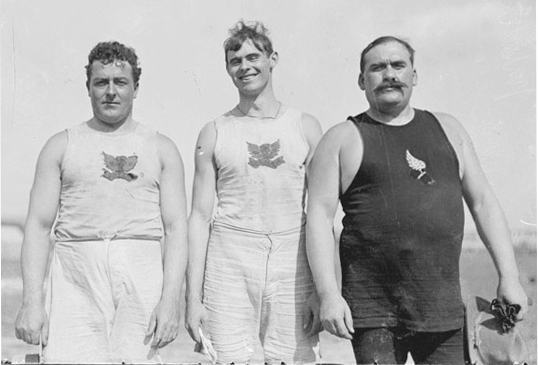
They were know, collectively, as the ‘Irish Whales’ John J. Flanagan, Matt McGrath, Jim Mitchell, Patrick J.Ryan and Con Walsh. In the early years of the 20th century these Irishmen, all domiciled in the USA, ruled the world of hammer throwing, winning five Olympic gold medals . But it was Flanagan, born in Kilbreedy, near Kilmallock, Co.Limerick, in 1873, who was primus inter pares.

Flanagan, who, for a successful field athlete, stood a relatively modest 5’10” tall, was something of an all-rounder who had already established his reputation in field sports before he emigrated to the USA in 1896. There he began to specialise in the hammer event which, in 1900, was included in the programme for the Paris Olympic Games. Flanagan, the world record holder, representing the USA, beat two other American throwers to take the first hammer gold with a throw of just over 51 metres. He was the only non-college American to win a medal at those games. Both the silver and bronze medallists in his event, Truxton Hare and Josiah McCracken were, for example, college football players.

He repeated the feat in the St.Louis games in 1904, taking gold, once again, from two Americans. His third and final gold medal, at the London Olympics in 1908, must have given him a great deal of satisfaction. An element in the crowd appeared to dislike the idea of an Irishman competing for the USA at the Olympic games, and made their feelings clear, vocally, by booing the Limerickman. Flanagan defied their disapproval to take the laurels with a throw of almost 52 metres. Fellow Irishman, Matt McGrath, took the silver, which must really have pleased the home crowd. There cup must have run over entirely when the bronze was hung around the neck of Con Walsh, competing for Canada.

Flanagan and McGrath (who won Olympic gold in 1912) were both members of the New York Police Department. Flanagan’s first posting was something of a sinecure. He worked in the Bureau of Licences where he had a lot of time on his hands which was mostly used for training at the Irish American Athletic Club in Queens.

Flanagan was a committed competitor no matter what the occasion. In 1905, for example, in a police sports meeting in New York he dominated the throwing events as expected. That, however, wasn’t enough for him, and to demonstrate that he possessed a turn of speed as well he entered and won the inelegantly titled Fat Man’s Race.

In 1910 he ended his career as one of New York’s finest after he was transferred to West 68th street and forced to walk a beat near Central Park.

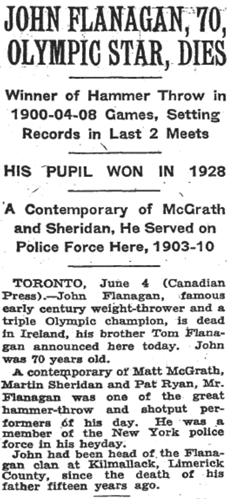
In all Flanagan, in addition to his three Olympic golds, won 9 US championships and set thirteen world records. In 1911 he returned to Ireland and a few years later took over the family farm on the death of his father. He died, aged 75, on 4 June 1938 in his native Limerick.

Inspired, no doubt, by his superhuman achievements there is a belief that Flanagan’s middle name was ‘Jesus’. This is how he appears on, for example, the Olympic.org website. But it seems his middle name was, in fact, the far humbler and more mundane, Joseph.

The first occasion on which the hammer event at the Olympic games was NOT won by an athlete competing for the USA was in 1928, when Pat O’Callaghan, throwing for Ireland, took the gold. That would have been an immensely satisfying moment for Flanagan, as he was O’Callaghan’s coach.

Irish-born Olympian, John J.Flanagan was born 141 years ago, on this day.

Flanagan_at_CP_cardFlanagan_obit

2014 in review

The WordPress.com stats helper monkeys prepared a 2014 annual report for this blog.

Here’s an excerpt:

The concert hall at the Sydney Opera House holds 2,700 people. This blog was viewed about 13,000 times in 2014. If it were a concert at Sydney Opera House, it would take about 5 sold-out performances for that many people to see it.

Click here to see the complete report.

On This Day – Drivetime – 12.12.1883 – Birth of Peadar Kearney, co-composer of the Irish national anthem.

amhran-na-bhfiann

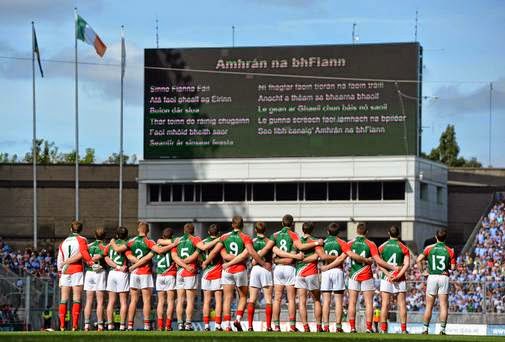
It’s probably the only song in existence whose lyrics are known by the majority of the Irish people in the first national language. Ask yourself, when was the last time you were at an international soccer match or a significant Gaelic Games event and heard anyone signing the lyric ‘Soldiers are we, whose lives are pledged to Ireland’ as opposed to ‘Sine Fianna Fail atá faoi gheall ag Eirinn’.

Which diminishes somewhat the acceptance of Peadar Kearney as the writer of the Irish National anthem. Kearney is the author of the lyrics of The Soldier’s Song which was adopted by the Irish Free State in July 1926 as our national anthem. It is said in some circles to have replaced God Save Ireland by Timothy Daniel Sullivan as the national anthem of the fledgling Irish state. However, this is a myth as, despite God Save Ireland’s iconic status, it was never formally adopted as anything other than a rousing, defiant, and frequently-sung Republican hymn. A Nation Once Again probably has equal claims to being the precursor of The Soldier’s Song but the fact is that the Irish Free State did not move to adopt a national anthem of any kind until 1926.

Neither is it entirely clear if the lyrics and music of the song, or just the melody itself, constitute the Irish national anthem. Or whether anything other than the chorus has official status. Kearney was not really responsible for the melody, this was largely written by frequent collaborator Patrick Heeney to Kearney’s lyrics. The other problem is that the English language version has been almost entirely superseded by the Irish translation, Amhrán na bFhiann, written by Liam O’Rinn in 1923. When the song was played at the Ryder Cup in the USA in 2004 in its English language form it caused something of a storm in a tin cup. Confusion also reigned in 1994 when an American band played the utterly unfamiliar verses of the song as well as the chorus at Irish World Cup games.

The Soldier’s Song appears to have been written in 1907, though Kearney himself suggested it was actually penned in 1909 or later. It became popular with members of the Irish Volunteers as a marching song. Kearney was a house painter by profession. His sister Kathleen would later marry another painter, Stephen Behan, making Kearney the uncle of Brendan and Dominic Behan.

He joined the Gaelic League in 1901 – Sean O’Casey was one of his pupils in Irish language classes – and he took the Irish Republican Brotherhood oath in 1903. He was actively involved in the 1916 Rising and the War of Independence, becoming a personal friend of Michael Collins. Later he would take the Free State side in the Civil War, a move that certainly did no harm in the choice of his song as national anthem by the Cumann na nGael government of W.T.Cosgrave. He was a witness to the death of Michael Collins in Beal na Blath in August 1922 while travelling in the lead vehicle in the ill-fated convoy.

There is some dispute as to whether Kearney earned royalties for the writing of The Soldier’s Song. He did receive some money from publishers for the original composition but not from the state when the song became the national anthem. Heeney, the composer of the music, had died in straitened circumstances in 1911. When Kearney applied for royalties he was informed by the state that it was the melody and not the lyrics that constituted the anthem. Later, under threat of a royalty suit from Kearney and Heeney’s brother the state agreed to buy out the copyright in 1933 for £1000. They had to do it all over again, this time for £2500, in 1965, after changes in copyright law.

But that was of no benefit to Kearney. He had, like his collaborator, Patrick Heeney, died in relative poverty in 1944. He is buried in Glasnevin cemetery with Thomas Ashe, who died on hunger strike in 1917, and Pearse Beasley.

Peadar Kearney, author of the, now rather unfamiliar, English language version of the Irish national anthem, The Soldier’s Song, was born 131 years ago, on this day.

On This Day – Drivetime – 5.12.21 – Ultimatum in Anglo-Irish Treaty negotiations

signing-the-anglo-irish-treaty-1922

In July 1921, after more than two years of sporadic, vicious and often ferocious violence the British government, under external and internal pressure, decided that Sinn Fein, Dail Eireann and its military wing, the Irish Republican Army, were not going to go away. They sought and secured a truce during which agreement might be reached on the future governance of the 26 counties of Ireland where the Anglo-Irish war had been raging.

That process began, inauspiciously from a Republican point of view, on 12 July 1921 when Eamon de Valera led a delegation to London for preliminary talks. In fact most of the talking took place in a series of bilaterals between de Valera and British Prime Minister Lloyd George. These encounters with the famous ‘Welsh Wizard’ may have been what prompted the Irish leader to absent himself from the full-blown talks that finally began in October. During their tete-a tetes Lloyd George had made it clear that the Irish sine qua non of a Republic, was not going to form part of any negotiations.

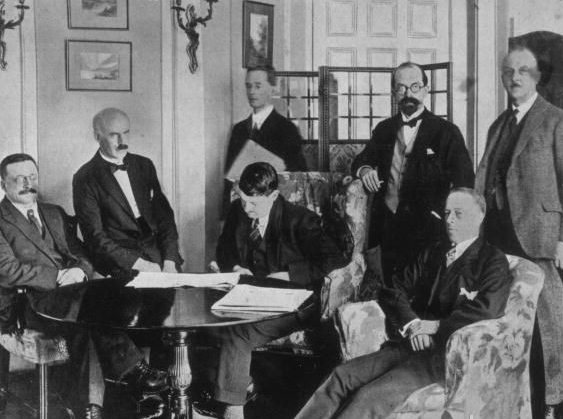
Whatever the most compelling reason was for his decision not to travel it was Michael Collins, increasingly being seen as a serious leadership rival to de Valera, who was given the task of leading the delegation, with Arthur Griffith as his principal associate. The delegates were given plenipotentiary powers to ‘negotiate and conclude … a treaty or treaties of settlement, association and accommodation between Ireland and the community of nations known as the British Commonwealth.’ However, Collins was also handed a note from Dev that reference had to be made to the Cabinet in Dublin before any agreement was signed.

Leading the formidable British delegation was Lloyd George himself, aided by, among others, future Prime Minister Winston Churchill. Offering valuable administrative and advisory support was the Prime Minister’s secretary Thomas Jones. Both men were Welsh speakers and were not averse to rattling the Irish delegation by breaking into Welsh with each other in the course of negotiations.

Lloyd George concentrated on developing a personal relationship with Collins and Griffith. The refusal of the British to concede a Republic had led de Valera to devise an ingenious form of external association that recognized the Crown while mimicking many of the attributes of an independent Republic. This approach, more or less, passed muster with the British delegation.

The issue of Ulster was more problematic. The Irish had been told to break off discussions on the issue of partition – which is somewhat ironic as it played a negligible part in the later treaty debates in Dail Eireann. However, Lloyd George managed to persuade Griffith in a private meeting, not to break on Ulster. He was later held to this guarantee at a crucial point in the talks.

Collins was also having problems with his delegation. The secretary, Erskine Childers, objected to any major concession on a Republic, while two of the delegates, his cousin Robert Barton and the London-based solicitor George Gavan Duffy, were getting restless at their exclusion from the many private meetings involving Collins and Griffith.

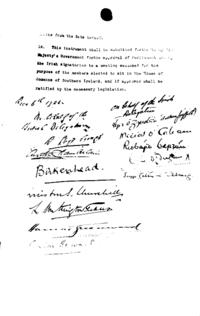
As the talks moved from November into December 1921 a combination of threats and cajolery began to wear down the Irish plenipotentiaries. Eventually, on the evening of 5 December, they were told by Lloyd George to take or leave what was on offer from Britain or risk bearing personal responsibility for the resumption of, in his own words, ‘immediate and terrible war’. The Irish delegation succumbed and signed the treaty the following day. Later Collins wrote prophetically to a friend ‘early this morning I signed my death warrant. I thought at the time how odd, how ridiculous —a bullet may just as well have done the job five years ago’.

The British delegation to the Anglo-Irish talks threatened to resume the Anglo-Irish war 93 years ago, on this day.

200px-Anglo-Irish_Treaty_signatures