On This Day – 4.11. 1908  The Irish Women’s Franchise League is established


image.jpg

What’s the difference between a suffragist and a suffragette? Apparently the latter is a more militant version of the former. In which case Ireland boasted plenty of suffragettes.


It is a slight misconception that Irish women didn’t get the vote until 1918. In 1898 they were granted the vote in local government elections. But the object of suffragists was to secure the franchise for adult women in parliamentary elections and the right of women to present themselves as candidates. In the self governing colony of New Zealand women had been entitled to vote since 1893 and full voting rights had also been secured in Australia in 1902. So the UK, which included Ireland, was well behind the colonies.


In the early 1900s a rather genteel organization with the ungainly name of  the Irish Women’s Suffrage and Local Government Association was in the vanguard of the struggle for votes for women. But it was not the kind of group that demanded universal suffrage. It preferred to ask politely. Male politicians liked politeness but that didn’t mean they listened to gentle persuasion.


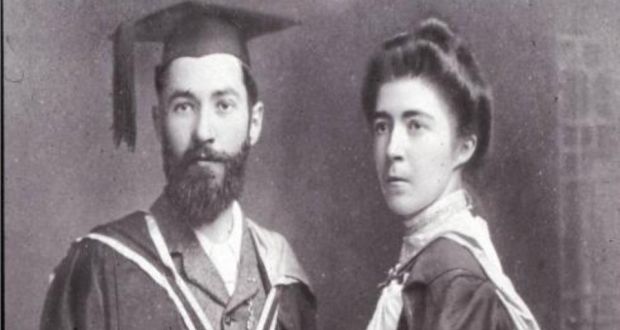
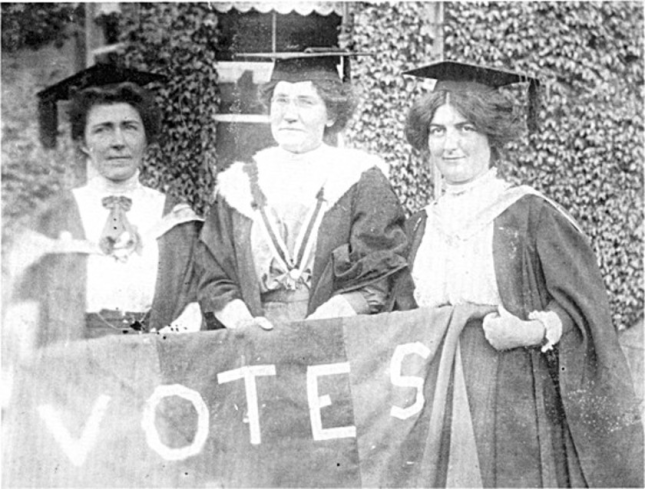
In 1908 a rather more muscular combination calling itself the Irish Women’s Franchise League was established by, among others, Hanna Sheehy Skeffington and Margaret Cousins. The latter was a remarkable woman who went on to greater fame in India where she composed the music for that country’s national anthem.  Sheehy Skeffington, a secondary teacher, a socialist and a nationalist  was from a political family. Her father, David Sheehy, was a nationalist MP. In 1903 she married Francis Skeffington and took his name. She insisted, however, that he take hers at the same time.  He was one of the co-founders of the IWFL.


The newly formed Irish Women’s Franchise League was based on the Pankhurst-led – and Pankhurst-ruled – Women’s Political and Social Union but the homage of imitation did not include any desire for affiliation. The Irish suffrage movement remained resolutely separate from its British counterpart. In part this distinctiveness was expressed in the use of the colours orange and green in the organisation’s insignia.


Their differences were seen most clearly at the outbreak of the Great War when the bulk of the British suffragists sided with the war effort. The same was, however, not true of the Irish Women’s Franchise League, which resolutely opposed the war and the drive for recruits in Ireland.


Irish suffragette leaders were required to address numerous public meetings. Margaret Cousins, to whom public speaking was as a closed book, described how she would practice in an open field with only a donkey looking on. There were obviously quite a few male donkeys who attended Irish women’s suffrage meetings because Sheehy Skeffington recalled in later life that speakers had to be  ‘capable of keeping their temper under bombardments of rotten eggs, over-ripe tomatoes, bags of flour [and] stinking chemicals ‘


Sheehy Skeffington was prominent in the militant actions carried out by members of the Franchise League. She was jailed in 1912 for breaking windows in government buildings. She threw a hatchet at British Prime Minister Herbert Asquith, though it probably did not have the effect of waking him up. She lost her teaching job for throwing stones at Dublin Castle and assaulting a policeman. Bear in mind, in relation to the latter charge, that your average member of the Dublin Metropolitan Police would have been close to six feet in height . Hanna was five foot two.


Like many other early 20th century feminists Sheehy Skeffington went on hunger strike while in jail. She was temporarily released under legislation especially devised for hunger striking suffragettes. It was officially entitled the Prisoner’s Temporary Discharge of Ill Health Act, but better known under its colloquial name, the Cat and Mouse Act. As the name suggests this allowed the authorities to release a hunger striker and then re-arrest her when her health recovered.


The Irish Women’s Franchise League was founded one hundred and eight years ago, on this day.
 

34632943e1b66ceaa8838e1724052dc5.jpg.png


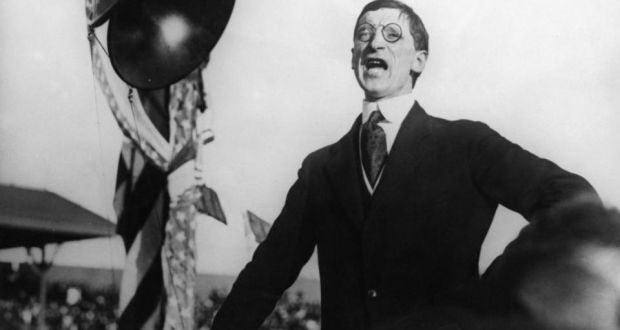
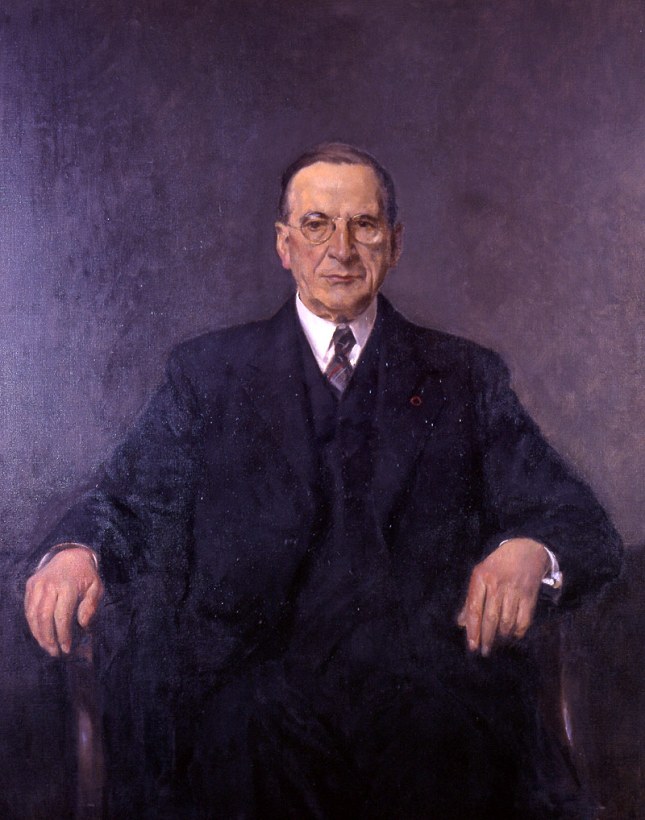
On This Day – 14 October 1882 – Birth of Eamon de Valera

image.jpg


One of the most successful Irish movies of the year has been the adaptation of Colm Toibín’s novel Brooklyn. But that borough of the city of New York has a much more compelling Irish association. It was the chosen destination of an Irish immigrant Catherine Coll, from Co. Limerick, and it was from there that she met a young Spanish sculptor, got married and had a son in 1882. That son, their only child, went on to become the dominant Irish political personality of the 20th century, Eamon de Valera.


Not that the young de Valera, named Edward by his parents, knew much about his mother Catherine and his father Vivion. The latter was dead by the time he was three and his mother was forced by economic circumstances to have her son sent to Ireland in 1885 to be brought up by relatives in Bruree, Co. Limerick. There he was known as Eddie Coll. He later became a scholarship boy in Blackrock College where he was to become a teacher. In the 1911 census he was still Edward de Valera but his involvement in the Gaelic League sparked an increased interest in Irish. Until the formation of the Irish Volunteers in 1913 his politics were those of Home Rule, but the transformation of his philosophy was ultimately to lead to his command of the 3rd Battalion of the Volunteers in the Easter Rising of 1916.


Despite the execution of men far more junior than he de Valera survived the violent aftermath of the Rising. There is a myth that his death sentence was commuted because of his American citizenship. In fact it was more to do with timing and happenstance. In the wake of the controversial execution of James Connolly when General Sir John Maxwell, British military governor in Ireland, asked the young Irish prosecutor William Wylie whether de Valera should be shot on the basis that he might cause trouble in the future, Wylie made the memorable but hardly clairvoyant observation ‘I wouldn’t think so, sir, I don’t think he is important enough. From all I can hear he is not one of the leaders.’


After 1916 his star was in the ascendant. He won the East Clare by-election in 1917, led Sinn Fein to a sweeping victory in the 1918 General Election and escaped from Lincoln Jail in 1919. But his personality often let him down. In Lincoln Prison he made few friends among his fellow Republican inmates. Famously, in the exercise yard, he played handball alone. When he went to the USA after his escape, to raise funds and awareness, he succeeded in falling out with the political leaders of Irish America, John Devoy and Daniel Cohalan.


Never too far from controversy his decision in late 1921 not to accompany the Irish delegation to the London peace talks has been condemned, justifiably or otherwise, as a convenient cop out designed to ensure he remained untarnished by the inevitable fudge of the Treaty. His subsequent rejection of the agreement signed by Collins and Griffith, and the counter proposals of his ‘Document Number 2’, have been criticized as Jesuitical and self-serving.


He was largely sidelined during the Civil War – notwithstanding the contrary evidence advanced by the plot of Neil Jordan’s film Michael Collins – and seemed to depart from the principles he had enunciated in January 1922 when, in 1926, he and his followers took their seats in the Dail. This was essentially the governing parliament of a state that fell far short of the Republic for which he had argued in the divisive debate over the Treaty.


1932 saw the perennial poacher turn long-term gamekeeper when Fianna Fail won the General Election that year. Bar two brief periods of multi-party coalition he led the country for the next twenty-seven years, wrote the constitution that still, more or less, governs us today, and can be accused of presiding over an economy only rescued from stagnation by his successor Sean Lemass.


But he also, arguably, had the nous and the courage to lead Ireland through an economic war with our nearest neighbor in the 1930s, and to keep the country neutral during World War Two, as well as a number of other significant achievements.


Like or loathe him you cannot ignore Eamon de Valera – a much more impressive name for a political leader, it has to be said, than Eddie Coll.


Eamon de Valera, was born in New York one hundred and thirty four years ago, on this day.


DeValera_800.jpg


On This Day – 7 October 1582 – The Gregorian Calendar

julius_caesar2.jpgPope-Gregory-XIIIZ.jpg


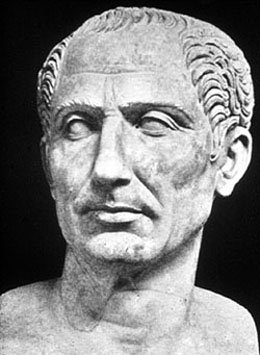
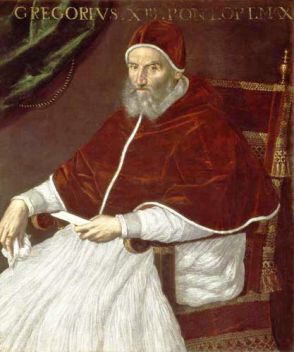
Depending on your point of view today is either 7 October 2016 or 27 September. If you are a big fan of Julius Caesar and swear by his mathematical calculations, then it’s the latter. If, however, you go along with Pope Gregory XIII, then it’s the former.


Without wishing to cause offence or any unnecessary hurt to Caesarians most of us tend to go along with the Pope on this one. It all depends on how you calculate time. In 45 BC Julius Caesar, the one who died on the Ides of March – whatever they were – introduced a calendar that had 365 days and allowed for a leap year every four years. And what’s wrong with that, you might ask?


Nothing, except that Caesar’s year was three hundred and sixty-five days and six hours long. Whereas the length of the year is actually three hundred and sixty-five days, five hours, forty-eight minutes and forty- six seconds. A difference of eleven minutes and fourteen seconds, so about as long as a heavy metal guitar solo.


Given that Julius Caesar was stabbed to death by Brutus, Cassius and one or two others the following year he never realised that because of this slight discrepancy, over the years that followed, time got a bit out of whack. For one thing Easter, the ultimate movable feast, was getting later every year. At some point it would inevitably coincide with Christmas Day. Action was required and Pope Gregory XIII got off his Vatican throne and did something about it. Accordingly, across most of Europe, people went to bed on 4 October, 1582 and woke up on the 15th.


However, in a rather significant Brexit the English decided that they would have nothing to do with a calendar devised by the Antichrist himself. Instead they decided to render unto Caesar the things that were Caesar’s – starting with his calendar. As the English Crown claimed Ireland, a gift from the Pope in 1155, we were stuck with the old calendar too.


Of course things got really confusing when it came to Irish rebellions. As the rebels were invariably Catholic their wars were fought according to the new calendar devised under the auspices of Pope Gregory. This, presumably, made it easier to identify an Irish Catholic rebel. You just asked him the date.


So, for example, the Battle of Kinsale was, according to the English side, fought on Christmas Eve 1601. But the clash contested and lost by the forces of Hugh O’Neill and Hugh O’Donnell, as well as their Spanish allies, didn’t even take place the same year. The Irish fought the Battle of Kinsale on 3 January 1602.


The English, and by extension the Irish, didn’t come into line with the Gregorian Calendar until 1752. Don’t be too shocked if they suddenly change their minds some day and revert to the Julian calendar.


Not that the Irish are wedded to ancient history or anything like that but the calendar switch is often cited as having huge philosophical significance in the context of the first day of the Battle of the Somme. On that occasion, 1 July 1916, the 36th Ulster Division went over the top at Thiepval. More than two thousand of them never came back. The date became part of Ulster Unionist folklore. However, it was pointed out at the time that if you ignored the Pope’s calendar – something your average unionist didn’t have much of a problem with – the 1 July 1916 was actually the anniversary of 12 July, 1690 when King William led his Protestant forces to victory against the Catholic Army of King James. The battle had actually had been fought on the First of July 1690, according to King Billy and his followers.


Because of his decision to toss out the calendar of Julius Caesar, and the consequent loss of ten days, Pope Gregory XIII ensured that absolutely nothing happened four hundred and thirty four years ago, on this day.


calendar.jpg


On This Day – 30 September 1598 – The English poet Edmund Spenser is appointed Sheriff of Cork


Edmund_Spenser_oil_painting.JPG

When someone uses the word ‘sheriff’ we tend to think of a tall, grizzled man with a wide brimmed hat and a revolver. Gary Cooper in High Noon. Now there was a sheriff. But closer to home the word itself originally comes from ‘shire’, meaning county and the role has had many different definitions over the years. Think ‘Sheriff of Nottingham’ – Robin Hood’s antagonist – at one end of the spectrum and the man who sends the bailiffs to take back that couch you can’t pay for, at the other.


Probably the most unfortunate sheriff in Irish history is a man who had a distinguished literary career in England. In his most celebrated work he spent six books brown nosing Queen Elizabeth 1. This was a very healthy thing for a poet to do. Less healthy was being an English planter in Ireland in the late 16th century living on land confiscated from Irish rebels.


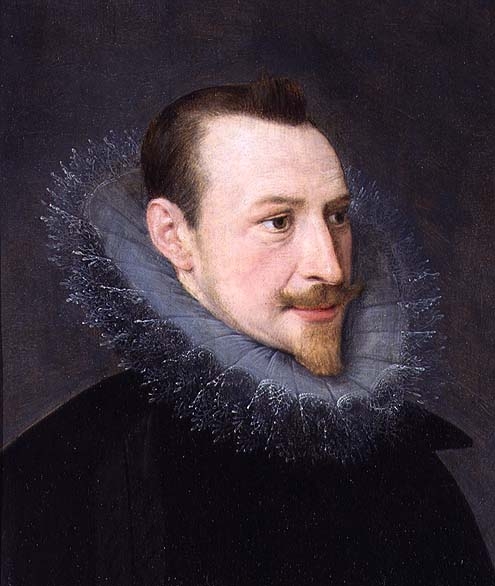
The sheriff in question was the writer Edmund Spenser whose long poem, The Faerie Queene, is still one of the most highly regarded works in the English language.


But Spenser had a whole other side to him, far removed from poetic sensibility. Born in London, probably in 1552, he came to Ireland at the age of twenty-eight in the service of the Lord Deputy, Lord Grey. He fought alongside Walter Raleigh at the siege of Smerwick in Kerry during the rebellion of James Fitzmaurice Fitzgerald in 1580. At the end of the siege Grey had five hundred of the Spanish and Italian defenders of Smerwick fort butchered. Only the officers were spared. Noblesse oblige, don’t you know.


Like and enterprising carpetbagger Spenser benefitted from the subsequent plantation of Munster. He settled on the Kilcolman estate near Doneraile in Cork. He also acquired land overlooking the Munster Blackwater where he is said to have written some of the Faerie Queen under an oak tree. The oak was destroyed by lightning in the 1960s.


Spenser published the first three volumes of his most famous work in 1590 and duly received a pension of £50 a year from the Faerie Queene herself. If he was hoping to get a job out of sucking up to Her Majesty he probably shouldn’t have antagonized her hatchet man Lord Burghley with his next piece of work Mother Hubberd’s Tale. Getting into Burghley’s bad books meant that it was back to Ireland for Spenser. There his first wife died in 1594 and he married Elizabeth Boyle, a relative of Richard Boyle, the 1st Earl of Cork, one of the great survivors of Irish Elizabethan history.


Just because most of Spenser’s income came from his Irish estates rather than his pension or his poetry didn’t mean he had to like the native Irish. And he duly obliged by disliking them and almost everything about them. In a pamphlet entitled A View of the Present State of Ireland he essentially adopted the position that the peasants were revolting and the only way to stop them revolting was to destroy their language and customs. He also had a high opinion of a scorched earth policy in the event of war with the Irish. This would helpfully deprive said revolting peasants of food and sustenance.


So it was ironic that Spenser himself was the one who was scorched in the Nine Years War. Shortly after his appointment as Sheriff of Cork in 1598 the forces of Hugh O’Neill burned the poet’s castle. He was obliged to return to London. There he fell on hard times and died at the age of forty-six. He is buried in Poet’s Corner in Westminster Abbey.


Although the author of many celebrated works he’s possibly best remembered for a quatrain written when his annual pension was overdue, it goes …


I was promis’d on a time,

To have a reason for my rhyme:

From that time unto this season,

I receiv’d nor rhyme nor reason.


Edmund Spenser was appointed Sheriff of Cork four hundred and eighteen years ago, on this day.


On This Day – 23 September 1875 – Billy the Kid is arrested for the first time

Unknown.jpegSheriff-pat-garrett.jpg

While he has Irish connections of his own it is the involvement of William Henry McCarty in an Anglo-Irish war that is of most Irish interest. Not THE Anglo-Irish war, also known as  the War of Independence, you understand but AN Anglo-Irish war – of sorts. This one was fought out in New Mexico in the 1880s.


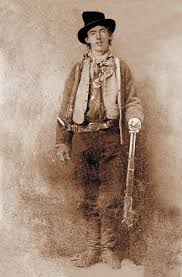
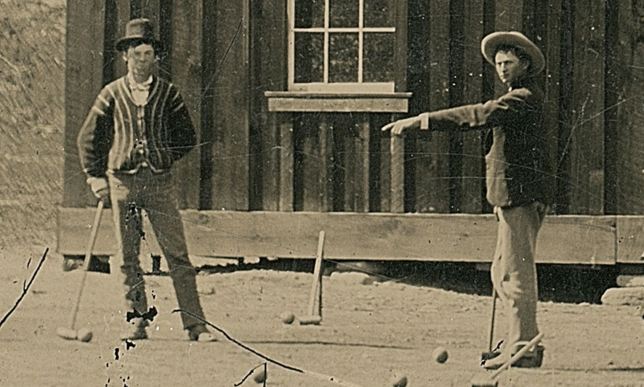
So who is William Henry McCarty? Well he also went under the name of William Bonney. And if that doesn’t ring any bells his nickname probably will. He was best known as Billy the Kid.  It’s hardly unusual in the USA that a violent antihero and probable psychopath should be viewed with reverence. But the Kid has had more books written about him,  more films made about him, and more porkies told about him – some by himself –  than any other Western outlaw.


He was born in New York City, probably in 1859, to an Irishwoman, Catherine McCarty, whose maiden name was Devine. No other parent’s name is listed on his birth certificate though his father may have been a Patrick McCarty.  Billy was brought up in the lower east side of the city in the area known as the Five Points – made famous in the Martin Scorsese movie Gangs of New York.


By 1873 Catherine McCarty and her new husband, William Antrim were living in New Mexico. In 1874 Catherine Antrim died. The following year her son became involved in petty crime. In September 1875 he robbed a Chinese laundry in Silver City, New Mexico, was arrested, escaped from jail and went on the run. He was fifteen years old. He didn’t have long left.


The most celebrated and persistent myth about the Kid is that he killed a man for every year of his short life (he was dead by the age of twenty-one). This tall tale may have come from the Kid himself to counteract his youthful appearance and enhance his aura of invincibility but it is well wide of the mark. He is known to have been personally responsible for the deaths of four men and was complicit in the killing of four more.


His first victim was a thirty-two-year-old Irishman, Frank Cahill, a native of Galway.  The two men met, and fought, in Arizona. Cahill came off worse. The Kid was immediately arrested but, once again, displayed his knack for escaping custody. Facing a murder charge in Arizona, he returned to New Mexico. There he became involved in what is known today as the Lincoln County War. This was a power struggle for economic and political domination of southern New Mexico fought out between a group of dodgy Irish businessmen, farudsters and rustlers, Lawrence Murphy, John Riley and Jimmy Dolan on the one side, and an equally dubious young English opportunist  John Henry Tunstall as well as his Scottish-American partner Alexander McSween. The Kid enlisted on the ‘British’ side of the conflict when he took a job as one of Tunstall’s hired thugs.


His career as a practicing psychopath reached new depths in February 1878 when Tunstall was murdered by members of a posse sent out by the Sheriff of Lincoln County, William Brady from Cavan. The Kid claimed his second Irish victim a few days later when he, and at least two more of Tunstall’s former employees, gunned down Sheriff Brady in Lincoln.


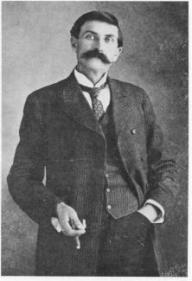
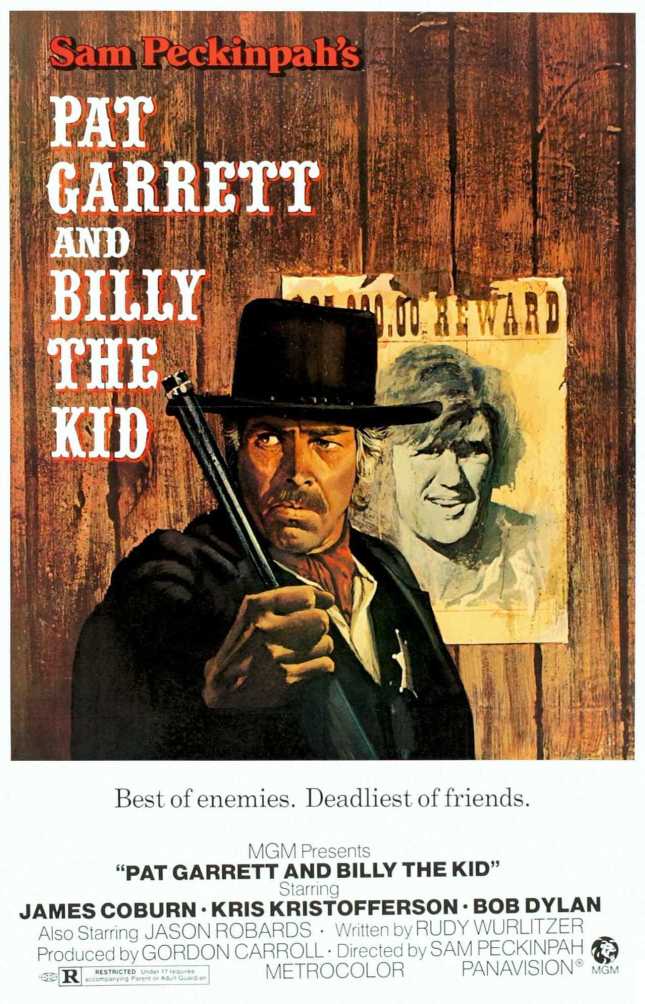
The Kid went on the run again but after numerous brushes with the law, and a lot more violence, he was captured by the new Lincoln County Sheriff, Pat Garrett. He was tried and found guilty of the murder of Brady in April 1881. He was taken to Lincoln jail to await hanging but escaped yet again, this time killing two of Garret’s deputies, Bob Ollinger and James Bell as he made his getaway.


New Mexico Governor Lew Wallace, the author of Ben Hur, put a $500 reward on Billy the Kid’s head and Garrett went in pursuit again. He tracked the Kid down in July 1881 and shot him dead in Fort Sumner, New Mexico. Later Garrett, who had been a friend of McCarty – or Bonney, or Antrim – capitalized on their association by writing a suitably self-serving biography, The Authentic Life of Billy the Kid. As with Jesse James, Jim Morrison and Elvis Presley, there were many reports of sightings of the Kid after his apparent demise. As he would now be more than one hundred and fifty years old we can be fairly confident that he is actually dead. But his legend lives on. So far he’s been played by Audie Murphy, Roy Rogers, Paul Newman, Kris Kristofferson and Emilio Estevez, among many others.


Billy the Kid was arrested for the first time after robbing a laundry one hundred and forty one years ago, on this day.


Photo_of_Billy_the_Kid_(left).JPG

PAT-GARRETT-BILLY-EL-NIÑO-Sam-Peckinpah-1973-Pat-Garrett-Billy-el-Niño.jpg