On This Day -8.1.1871 Birth of James Craig


James_Craig_Viscount_Craigavon.jpg

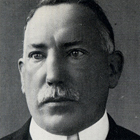
The most familiar photograph of James Craig is of a rather startled looking but steely-eyed elderly man with rapidly receding hair and a thick prominent grey moustache. He looks like someone you wouldn’t want to mess with. In this instance looks were not deceptive.


Craig was born in Belfast in 1871, son of a distiller. He was a millionaire by the age of 40 – much of his money coming from his adventures in stockbroking. This meant that he had plenty of opportunity and resources to devote to his favourite pastime, keeping Ulster out of the Union. This he was very good at indeed.


As did many a younger son of a well-established family he first distinguished himself in the Army. Everybody had enjoyed the first Boer War so much that they decided to do it all over again and from 1899 Craig served as an officer in the 3rd Royal Irish Rifles. He was, at one point, imprisoned by the Boers and was finally forced home by dysentery in 1901.


His name is, of course, as indelibly associated with that of Edward Carson as is Butch Cassidy’s with that of the Sundance Kid. Craig came into his own in 1912 in the organisation of unionist opposition to the prospect of Irish Home Rule. He was central to the creation of the Ulster Volunteer Force and the promulgation of the Ulster Solemn League and Covenant in which Ulster said ‘no’ with an emphatic flourish. While Carson made the speeches and was the most public opponent of Irish devolution Craig was seen as the organizational genius who developed the muscular element to back up Carson’s rhetoric. Craig was, for example, one of the men behind the Larne gun running of 1914, which brought 20,000 rifles to the UVF.


Unlike Carson, Craig was perfectly content at the exclusion from Home Rule of the six counties of what became, in 1920, Northern Ireland. The Government of Ireland Act that year gave Ulster, somewhat ironically, a Home Rule parliament of its own. In February 1921 Craig succeeded Carson as leader of the Ulster Unionist party. He fought the 1921 election later that year asking unionist supporters to ‘Rally round me that I may shatter our enemies and their hopes of a republic flag. The Union Jack must sweep the polls. Vote early, work late.’ If you were expecting ‘vote often’ there … well that wasn’t Craig’s style. In June 1921 he became the first Prime Minister of Northern Ireland.


His most famous speech was made in the Northern Ireland parliament in 1934 and, we are told, is often misquoted. He did not actually refer to that assembly as a ‘Protestant parliament for a Protestant people’. What he did say was ‘my whole object [is] in carrying on a Protestant Government for a Protestant people.’ You might well be forgiven for wondering what’s the difference.


He also reflected on one occasion in the Northern Ireland House of Commons that ‘It would be rather interesting for historians of the future to compare a Catholic State launched in the South with a Protestant State launched in the North and to see which gets on the better and prospers the more. It is most interesting for me at the moment to watch how they are progressing. I am doing my best always to top the bill and to be ahead of the South.’ Arguably he achieved that ambition during his tenure as Prime Minister, though large-scale fiscal transfers from London and the Anglo-Irish Economic War of the 1930s undoubtedly helped the Northern Irish economy keeps its nose ahead of that of the under-performing Irish Free State.


Craig was almost obsessive about having Northern Ireland treated as an integral part of the United Kingdom, to such an extent that he occasionally acted contrary to the apparent interests of its population. This can be seen most clearly in his insistence in 1940 that conscription be introduced in Northern Ireland when WW2 broke out. Wisely Winston Churchill passed on that particular poisoned chalice, fearing the inevitable backlash from the sizeable nationalist population – not to mention the reaction in the Irish Free State.


Towards the end of his days Craig began to take on an uncanny physical resemblance to the man who, in later life, would become the Rev. Ian Paisley. When he died in November 1940, aged 69, he was still Northern Ireland Prime Minister.


Captain James Craig, later 1st Viscount Craigavon, was born 144 years ago, on this day.
Unknown.jpeg


On this day – 18.12.1878 Hanging of John Kehoe of the Molly Maguires


marchpottsville.jpg

Their Irish origins are mysterious, though they were almost definitely a 19th century agrarian secret society. Their name may have emanated from a tradition that was not just Irish – the Welsh were party to it as well in the so-called Rebecca riots – where male activists disguised themselves as women before engaging in illegal activity up to and including murder. They may have also have been associated with the main Roman Catholic rival to the Orange Order, the Ancient Order of Hibernians.


But it wasn’t in Ireland that the Molly Maguires made a name for themselves. It was in the anthracite mines and on the rail-roads of Pennsylvania. Here, the tactics used against landlords and land agents in Ireland, were applied in bitter labour disputes, with the Ancient order of Hibernians, an organisation that originated in the USA, acting as a legitimate front for the illegal activities of the Mollies. Then again there are historians who do not believe this shadowy conspiracy ever existed on the scale that was claimed by the owners and shareholders of the mines and railways in late 19th century Pennsylvania. That is a point of view that was widely held at the time as well.


Immigrant labour offered a glorious opportunity for Pennsylavania capitalists to undercut the wages being paid to American-born miners. Wages for Irish migrants were low and conditions were brutal. ‘On the job’ fatalities and injuries ran into the hundreds each year. The so-called ‘panic of 1873’ – not a million miles removed from the stock market crash of 1929 and the sub-prime crisis of 2007 made a bad situation even worse for the mine and railroad workers.


Just as every crisis brings opportunity, mostly for the unscrupulous, the President of the Philadelphia and Reading Coal and Iron company, Franklin Gowen, son of an Irish immigrant and the richest man in the region, decided it was high time to crush the burgeoning trade union activity in the state, represented by the Workingmen’s Benevolent Association. While the ‘Molly Maguires’ may have been the convenient invention of Gowen himself there is no doubt that perceived enemies of the Pennsylvania mineworkers were being killed by the dozen. In one of the six main anthracite-mining counties there had been 50 such murders between 1863-67.


Gowen, with the co-operation of his fellow mine owners, engaged the services of the yet-to-be-famous detective agency run by Scottish immigrant Allan Pinkerton, to help break a general strike in the anthracite fields. In 1875 he despatched an agent, Armagh-born James McParland, to the area. Posing as ‘James McKenna’ the Pinkerton detective infiltrated the Benevolent Association and claimed also to have insinuated himself into the confidence of the Molly Maguires. Information gathered by McParland was, in the first instance, passed on to vigilante elements who happened to share Gowen’s union-bashing objectives. When suspected ‘Mollies’ were murdered in their own homes McParland threatened to resign from the Pinkerton organisation but was persuaded to remain in place. After six months the strike ended and most of the miners returned to work having agreed to a 20% wage cut. However, Irish-born members of the Ancient Order of Hibernians refused to concede and fought on. Attacks on overseers, strike-breakers and police continued until information supplied by McParland led to a number of arrests.


The Armagh Pinkerton, who had, by his own account, been a trusted collaborator of the leadership of the Mollies, testified against a number of those accused of murder. Demonstrating the extent of his political power within the state of Pennsylvania Gowen managed to have himself made special prosecutor and actually conducted some of the cases against the Mollies. The accused included the alleged ringleader of the organisation John ‘Black Jack’ Kehoe. McParland’s testimony sent ten men to the gallows. Many of them, including Kehoe, loudly proclaimed their innocence of the crimes of which they had been convicted. In 1979 the state of Pennsylvania pardoned Kehoe posthumously after an investigation by its Board of Pardons at the behest of one of his descendants.


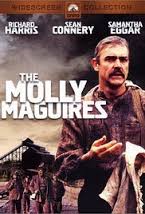
The Molly Maguires have passed into legend. Arthur Conan Doyle based a Sherlock Holmes mystery, The Valley of Fear on their alleged activities. The 1970 film The Molly Maguires, starred Sean Connery as Kehoe and Richard Harris as McParland.


John ‘Black Jack’ Kehoe, the last of the Molly Maguire defendants was hanged in Pennsylvania 137 years ago, on this day.

mollymaguire.jpg


Unknown.jpeg


Two ‘On This Day’ reading sessions in Meath


Bookmarket Café, Kells – 6.30 Tuesday 15 December

Blackbird Books, Navan – 6.00 Tuesday 22 December


On this Day cover idea no rte logo.jpg

On This Day – Drivetime – 11 December 1920 – The burning of Cork by the Auxiliaries with the assistance of the Black and Tans.

Burningof_cork.jpg


The events of the night of 11/12 December 1920 in Cork probably had their origins in the killing of seventeen members of the Royal Irish Constabulary on 28 November in Kilmichael. Of course these were not any ordinary members of the RIC, an organisation not greatly beloved of the plain people of Ireland in the first place.


The victims of Tom Barry’s flying column at Kilmichael were members of the RIC Auxiliary force, recruited in the summer of 1920 from former and serving British Army officers and touted as an elite counter-insurgency group. Counter insurgents they undoubtedly were but their elite status took something of a drubbing as an IRA unit with a fraction of their military experience wiped out a detachment of the force, that became reviled in Ireland as ‘the Auxies’, a week after Bloody Sunday in Dublin.


What happened in Cork on 11 December, however, had a more proximate cause. The local IRA had observed that a force of Auxiliaries always left Victoria barracks on the outskirts of Cork and headed for the city centre at 8.00 pm. every evening. An ambush was laid for them at Dillon’s Cross which led to the death of one of the RIC ‘Temporary Cadets’, as they were formally known.


In the first wave of retaliation the Auxiliaries entered a local pub, terrorized the occupants, seized one of them, and in an egregious exhibition of military valour, stripped him naked and forced him to sing God save the King in the middle of the road. That was only the start of their nocturnal frolic.


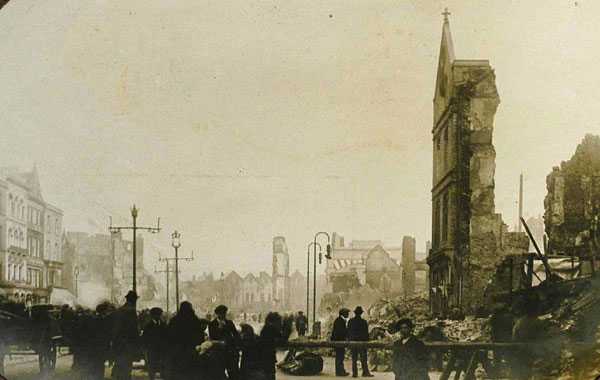
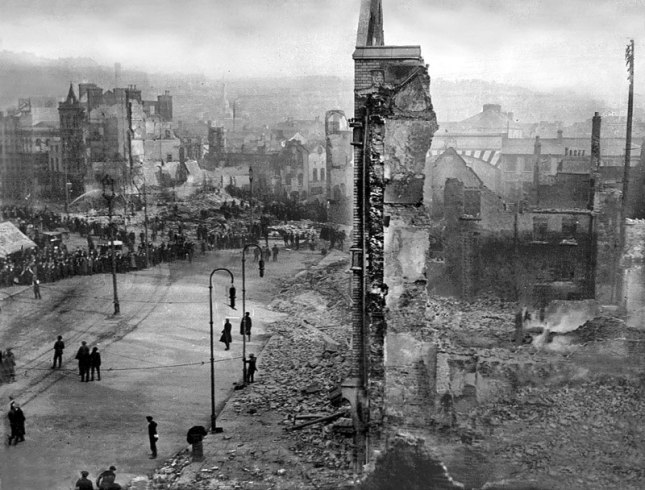
At 9.30 they returned to Dillon’s Cross, raided a number of houses, forced the occupants into the street and burned down their homes. The spree of mindless violence then continued in the city centre. There the Auxiliaries were joined by their only slightly more wholesome cousins, the Black and Tans. Together, in and out of uniform, they went on the rampage. Among other notable establishments, Grant’s department store was set alight. When the fire brigade arrived to fight the blaze the firemen were prevented from doing their jobs by the Temporary Cadets and their allies – nicknamed, appropriately, after a pack of hounds.   The fire fighters were threatened, shot at, and their hoses were cut.


At 4.00 am. Cork City Hall and the Carnegie Library went up in flames. In terms of historical records this did for Cork what Ernie O’Malley later allegedly accomplished on a national scale when the Public Record Office in the Four Courts was atomized during the Civil War. When more fire brigade units arrived they were denied access to water by the security forces and were also fired upon when they attempted to do their jobs. At some point that night two members of the IRA, the brothers Con and Jeremiah Delany were taken from their beds and shot out of hand.


In all five acres of the city were destroyed, comprising forty business premises and three hundred homes. Over three million pounds worth of damage was done – which equates to around two hundred million euros today. Two thousand people were left out of work.


The British government blamed the entire episode on the IRA and were aided and abetted in this by the Roman Catholic Bishop of Cork, Daniel Cohalan, who threated to excommunicate IRA volunteers who continued their involvement in the War of Independence. His Grace was accused by Cork politicians of ‘adding insult to injury’. Ironically the only report into the affair, sanctioned by the British government, took the opposite tack and pointed the finger at K Company of the Auxiliaries based at Victoria Barracks. When the British government refused to publish the so-called ‘Strickland’ report the Prime Minister and Irish Secretary were berated in the House of Commons by one of the few remaining Irish Party MPs, T.P.O’Connor, who sat for one of the Liverpool constituencies.


K Company of the Auxiliaries thereafter sported burnt corks in their hats as a provocative reminder of their penchant for pyromania and wreaking havoc. The unit was, to the regret of none, other than its members, disbanded in March 1921, four months before the War of Independence truce.


Much of the centre of the city of Cork was razed to the ground by the British security forces ninety-five years ago, on this day.


cork-burning-1.jpg


On This Day – Drivetime – 4.12.1879 Birth of Hamilton Harty


67676-004-5D304601.jpg

How do you respond to the description ‘the prince of accompanists’? With delight if you want to spend your working life playing piano chords while an opera or lieder performs downstage of you and takes all the accolades. But perhaps not so ardently if your ambition in life is to be a composer and conductor.


The Irish composer Hamilton Harty, born in Hillsborough Co. Down in 1879, was so described by the Musical Times in 1920. He was something of a musical prodigy – becoming a church organist in Co.Antrim at the age of 12 and holding down similar posts in Belfast and Bray, Co.Wicklow while still a teenager. He moved to London in his early twenties where he was seen as a ‘promising composer and outstanding accompanist’ – there it is again, second fiddle.


However, he was good enough as a composer to have his Comedy Overture performed at the 1907 Proms by an orchestra under the direction of Sir Henry Wood himself. In addition he didn’t do too badly out of being an accompanist in that one of the soloists with whom he worked was the soprano Anges Nicholls. She later became Mrs. Harty.


As a composer he devoted much of his time to reworking Irish themes. This is evident in his Irish symphony, first performed at the Feis Ceoil in Dublin in 1904 with Harty himself conducting. That same year the third place finisher in the singing competition was one James Joyce.


Harty also began conducting with the London Symphony Orchestra in 1911. In 1913 he conducted the orchestra in his own composition Variations on a Dublin Air. He was also invited to conduct at Covent Garden at around that time but Harty and Grand Opera never really hit it off. The composer wrote of opera that it was a medium in which ‘clumsy attempts are made at defining the indefinable suggestions of music’. There is no record of what opera thought of Harty but the Times wrote of his efforts that he made the music of Bizet and Wagner sound like ‘quotations from some forgotten German score’. Ouch!


Harty finally found his niche as a conductor with the Hallé Orchestra in Manchester. He made his debut with the Hallé in April 1914. Unfortunately his career was interrupted by the small matter of a global war. He sensibly joined the Navy, where casualties were considerably lighter than on dry land and survived to be demobilized in 1918. He became the Hallés permanent conductor in 1920 and restored the reputation to the levels it had experienced under its founder Charles Hallé.


Harty and the Hallé came to fit each other like a pair of old gloves. On one occasion the famous Austrian pianist Artur Schnabel was performing a Brahms concerto with the Hallé. He overlooked two bars, enough to throw any conductor and orchestra into total confusion. Harty and the Hallé didn’t so much as miss a beat. Later Schnabel, by way of a compliment to the conductor, suggested that the Hallé was ‘second only to the Berlin Philharmonic’. Harty was having none of it – pointing out with some asperity that the Hallé was ‘better by two bars’.


Harty was knighted in 1925 but his career in Manchester did not come to a happy end. When, in 1932, he accepted the post of conductor in chief with the London Symphony Orchestra the Hallé dropped him like a hot bassoon. He took some measure of revenge by poaching a number of their key players for his new band. However his tenure with the LSO was brief and chastening. He didn’t bring in the crowds and was dumped unceremoniously after only two years.


Towards the end of his life he suffered ill health but still managed to adapt a number of Irish songs and create a new tone poem The Children of Lir. He did a lot of work in his final years with the BBC Symphony Orchestra. He was only 61 when he died in 1940. His ashes were scattered in Hillsborough parish church.


Hamilton Harty, accompanist, composer, and conductor was born 136 years ago, on this day.


pasc282.jpg