On this day – The great Irish pickpocket, George Barrington

On this day – 14 May 1755

00017765f234-m


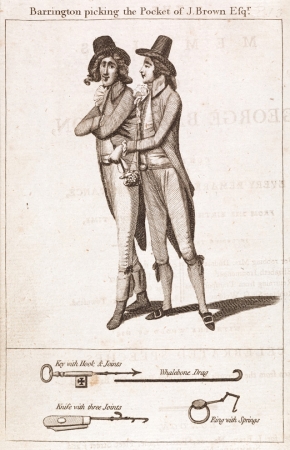
In fictional terms one of the most successful London pickpockets was the juvenile criminal creation of Charles Dickens, the Artful Dodger. In reality the most celebrated, and for a long time the most successful, was the society pickpocket, Irishman George Barrington.

Born in Maynooth, Co.Kildare, as George Waldron, son of a silversmith and a midwife, Barrington received a good education at the expense of a wealthy patron. He rewarded this patronage by stabbing a fellow-student, robbing his schoolmaster and fleeing to join a troupe of travelling players, all by the age of 16.

After one of his earliest criminal mentors was caught in Limerick and sentenced to transportation Barrington fled to London where his education, charms and plausibility enabled him to prey on the wealthy. One of his most celebrated early victims was a Russian nobleman, Count Orlov, whom he robbed, in Covent Garden opera house in 1775, of a gold snuff-box set with diamonds worth £30,000. He was caught in possession of the box but Orlov refused to press charges and Barrington was released. Later he was recognized while in the House of Lords and was turned out before he could do any damage.  Shortly thereafter he was caught in the act of robbing a woman in Drury Lane theatre and sentenced to five years hard labour on the infamous ‘hulks’ – prison ships lining the Thames in the years between the end of transportation to the Americas and the commencement of the removal of convicts to Australia.

The intervention of influential friends meant that he only served twelve months on that occasion. On his release he returned to his lucrative craft, dividing his time between London, Dublin and Edinburgh. When he was caught and tried, and that was more than once, he always sought to influence juries with eloquent speeches from the dock denying his guilt and charging his sinister accusers with conspiracy.

Finally, in 1791, he was transported to Australia. The story goes that while on board a prison ship bound for Botany Bay he got wind of a planned mutiny by a number of the convicts. When he reported this to the ship’s captain the latter spoke up on his behalf on landing in Australia and Barrington was appointed superintendent of convicts in Paramatta, now a suburb of Sydney.  He retained this position after he obtained the first emancipation order issued in Botany Bay and went on to become High Constable of Paramatta. He died in 1804, the same year in which Irish political convicts unsuccessfully rebelled against the harshness of the colonial regime in New South Wales.

In Australia the Kildare man is most famous for a single line of poetry ascribed to him but which he may not have written. It’s the final line in a stanza contained in the prologue of his book A History of New South Wales . It reads …

From distant climes, o’er wide-spread seas, we come,

Though not with much éclat or beat of drum,

True patriots all: for, be it understood:

We left our country for our country’s good.

Whether or not he actually wrote the prologue, it certainly reeks of the sort of rhetorical humbug that was his calling card. George Barrington, the so-called ‘Gentleman pickpocket’ was born in Maynooth 258 years ago on this day.

Extract from The Newgate Calendar

Century Ireland: The History Show, 12 May 2013

Ed1---Adv---InspectorWantedIND_H_0009_Redmond_Ed_1


Catriona Crowe, Paul Rouse, Mark Duncan, and Mike Cronin talk about the amazing new Boston College-based Century Ireland project which is, in essence, a news aggregator from 100 years ago. The website (hosted by RTE) will provide news stories collated from a variety of sources and present them without the benefit of hindsight from now until the end of the decade of commemoration in 2023.

Visit the Century Ireland website here  


About Century Ireland

The Century Ireland project is an online historical newspaper that tells the story of the events of Irish life a century ago.

Century Ireland is published on a fortnightly basis, beginning in May 2013, and is the main online portal for the Irish decade of commemorations, 1912-23.

News reporting on life in Ireland 100 years ago is supported by a wealth of visual, archival and contextual material to facilitate an understanding of the complexities of Irish life in the year between 1912 and 1923.

Century Ireland is produced by a team of researchers at Boston College Ireland and the project is funded by the Department of the Arts, Heritage and the Gaeltacht.

Century Ireland is hosted by RTÉ and the site is complimented by their broadcast schedule and material from the RTÉ archives.

At the core of Century Ireland is a collaborative partnership between the major cultural and educational institutions in Ireland. By working so fruitfully together, the various partners are making a range of rarely (or never) seen material available that will bring the events of a century ago to life.

The Century Ireland team comprises:

Professor Mike Cronin (Project Director)

Mark Duncan (Project Director)

Dr Paul Rouse (Project Director)

Ben Shorten (Research and Production)

Matt Stapleton (Research and Production)

Ed Mulhall (Editorial Advisor)

Catríona Crowe (Archival Advisor)

Collaborating Partners:

National Library of Ireland

National Archives of Ireland

National Museum of Ireland

National Gallery of Ireland

Dublin City Gallery:

The Hugh Lane

Dublin City Library and Archives

University College Dublin

NUI Galway

Dictionary of Irish Biography

Century Ireland can be contacted via:
Post: Century Ireland, 42 St Stephen’s

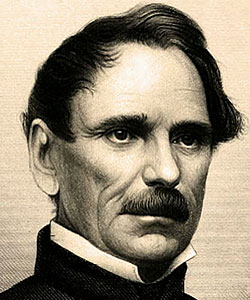
On this day – 12 May 1806, Senator, Senator, Senator James Shields and his non duel with Lincoln

On this day – 12 May 1806

HD_shieldsJ4c

James Shields from Co.Tyrone was an extraordinary Irishman. He had an uncle of the same name who emigrated from Ireland and became a U.S. senator for Ohio. Not to be outdone James Shields Jr. left Ireland at the age of twenty and went on to represent not one but three states in the U.S. Senate.  A unique achievement unlikely ever to be repeated.

He started in Illinois, in 1849 and served one term. His election was helped by what came to be known as the ‘lucky Mexican bullet’ he had stopped while a brigadier general in the Mexican-American war in 1846.  His opponent was the incumbent  Sydney Breese, a fellow Democrat. A political rival wrote of Shields’s injury “What a wonderful shot that was!  The bullet went clean through Shields without hurting him, or even leaving a scar, and killed Breese a thousand miles away.” Failing to be re-elected six years later he moved to the Minnestoa territory from where he was returned as one of the new state’s first two senators in 1858. Later, during the Civil War he distinguished himself as a Union General and then settled in Missouri.

He had obviously taken a liking to the Senate chamber because he contrived to get re-elected to that house from Missouri in 1879 at the age of 73. He died shortly after taking office.

But Shields is possibly even more important for something he didn’t do.

In 1842 Shields was already well known in his adopted home of Illinois. He was a lawyer and was serving in the state legislature as a Democrat. After a periodic economic recession hit the nation in the 1840s Shields, as state auditor, issued instructions that paper money should no longer be taken as payment for state taxes. Only gold or silver would be acceptable. A prominent member of the Whig party, one Abraham Lincoln, took exception to the move and wrote an anonymous satirical letter to a local Springfield, Illinois newspaper in which he called Shields a fool, a liar and a dunce. This was then followed up by his wife-to-be Mary Todd, with an equally scathing letter of her own. When Shields contacted the editor of the newspaper to find out who had written the second letter Lincoln himself took full responsibility. A belligerent Shields, accordingly, challenged the future US president to a duel. The venue was to be the infamous Bloody Island in the middle of the Mississippi river, dueling being illegal in Illinois.

Lincoln, having been challenged, was allowed to choose the weapons and set the rules. He did this to his own considerable advantage, opting for broadswords as opposed to pistols. While Shields was a crack shot he was only 5’9” in height, as opposed to Lincoln’s towering 6’4”. When the rivals finally met on 22 September 1842 Lincoln quickly demonstrated his huge reach advantage to Shields by ostentatiously lopping off a branch above the Irishman’s head with his weapon of choice.

When the seconds, and other interested parties, intervened peace was negotiated between the two men, though it took some time to placate the pugnacious Shields and persuade him to agree to shake hands with Lincoln.

The man who might have abruptly ended the life and career of Abraham Lincoln, and radically changed the course of American history, James Shields from Co.Tyrone, was born 207 years ago, on this day.

On this day – 6 May 1882 – The Phoenix Park Murders


180px-Lord_Frederick_Charles_Cavendish_-_PolitikerThomas_Henry_Burke

Lord Frederick Cavendish  Thomas H.Burke

https://soundcloud.com/irishhistory/on-this-day-6-may-1882-the


Had it not been for a tight and uncomfortable new pair of boots late 19th century Irish history might have been very different. The boots belonged to Superintendent John Mallon, head of detectives at Dublin Castle. He was on his way to meet an informer near the Viceregal Lodge in Phoenix Park on the afternoon of 6 May. It was warm, and his feet were sore. When he was met near the eastern entrance to the park by one of his officers who told him not to go in as he had spotted some well-known Fenians in the area, Mallon succumbed to the offending footwear, and the warning, and headed home instead of going to meet his informant.

Had he walked on into the Park, more than likely with his associate, his presence might have prevented one of the most vicious and notorious murders in Irish history. A short while after Mallon did his about-turn the new chief secretary for Ireland, Lord Frederick Cavendish, a nephew by marriage of prime minister William Gladstone, decided, on his first day in Dublin, to walk from his office in Dublin Castle, to his new lodgings in Phoenix park – today it’s the U.S. Embassy. While en route he was passed by the carriage of his under secretary, the Galwayman Thomas H.Burke, effectively the head of the Irish civil service and a figure not greatly beloved in his own country at a time of repressive measures during the so-called Land War.

When Burke recognized the lone walker he stopped his carriage and offered Cavendish a lift. The chief secretary declined and Burke sealed both their fates by offering to walk with him. As the two approached the Viceregal Lodge they were accosted by a group of four men who produced surgical knives and proceeded to attack Burke. When Cavendish intervened to defend his under secretary he, in turn, was attacked and murdered. Later that night notes were posted through the letter boxes of the main Dublin newspapers claiming that the assassinations were the work of a shadowy new organisation, the Irish National Invincibles.

It took almost a year to apprehend and punish the killers of Cavendish and Burke. Six men were hanged for the crime, including two of the main ringleaders, Joe Brady and Daniel Curley. One of the other masterminds behind the assassination escaped with his life by informing on his colleagues. James Carey was one of a number of informers produced by the Crown in the case against his fellow Invincibles, but his evidence was crucial. Superintendent Mallon essentially hoodwinked Carey into confessing and turning states evidence. As a case was built against about a dozen suspects they were incarcerated in Kilmainham jail.  Mallon organized that the cell next to Carey be left vacant. Over a couple of days however a stream of familiar establishment legal figures trooped in and out of the cell. Eventually Carey’s curiosity and anxiety got the better of him. He asked a warder who was in the cell beside him. The jailer had been primed to tell Carey that it was occupied by Daniel Curley. This had the desired effect. Assuming that Curley was turning informer Carey realized that he had to be quick. He sent for Mallon and turned states evidence against his Invincible colleagues before Curley’s evidence – which, of course, did not exist, could be used to hang him.

Carey’s freedom was short-lived. He was smuggled out of Ireland destined for South Africa a few weeks after the six Invincible hangings. Recognised on board ship he was shot dead by one Patrick O’Donnell when they reached dry land. O’Donnell, was, in turn, hanged for his own crime.

The Phoenix Park murders took place 131 years ago on this day.

QJY3D00Z

French ‘penny dreadful’ representation of the murders

The Story of Cannes and its wee festival – The History Show, 5 May.

Cannes-film-festival

Since the Cannes Film Festival first started in the 1930s, it has become the major annual meeting place for the international film industry as billionaire actors, porn stars and art house directors throw shapes and sell their wares on the coastline of this glamorous French city.


I’ll be talking to film lecturer and History Show regular, Steven Benedict, about Cannes and the movies.


Of course, Cannes was around for a long time before the festival itself and joining us to give us a potted history of the city will be Trinity College historian, Laura O’Brien.


Up to the early part of the nineteenth century Cannes was just a small town that was best known for only for two things: fishing, and a large prison on a nearby off-shore island. This had once paid host to the infamous ‘Man in the Iron Mask’ during the late 17th century.


Cannes owes its popularity as a tourist destination to the deadly disease of cholera and to a Scot! In 1834 Henry Brougham, the British Lord Chancellor and erstwhile campaigner against the slave trade, was bringing his daughter Eleanor-Louise to Italy. However, because of a cholera outbreak the Italian border was temporarily closed. Brougham had no choice but to remain in France and spent the night in Cannes. So enchanted was he with the town that he built a holiday home in the area. His house-warming party attracted the great and the good of fashionable London and Cannes was on its way.


Brougham, or 1st Baron Brougham and Vaux to give him his full title, died in Cannes in 1868 and is buried there. He has a street named after him and merits a large statue near the Palais des Festivals. He also has a type of carriage named after him, which he either designed or, more likely, inspired.


The further development of Cannes as a resort was aided by an influx of Russian aristocrats, not to be confused with the new 21st century Russian aristocracy which tends to favour the Costa del Sol. But it was the spread of the railway system that finally turned Cannes into one of the premier resorts in Europe. As the French network spread to the south of the country and to the Cote d’Azur you could travel there from France by the early 1860s in a rapid twenty-two hours. Unacceptable today but lightning fast in 1863. Sadly, this also had the effect of making Cannes accessible to the Parisian hoi polloi, a serious blow to the aristocrats who had been having a hard time from the sans culottes since the invention of the guillotine. Ah Quel dommage!


Cannes overtook Nice as a chic holiday destination in the 1920s and 30s when many American movie stars like Fairbanks, Chaplin and Valentino were drawn to the city.  The Film Festival was, in part at least, a response to the awarding of the Grand Prize at the Venice Film Festival in 1938, to the Leni Riefenstahl Nazi-fest film of the Berlin Olympics of 1936, Olympia and an Italian film produced by Mussolini’s son. In the process Jean Renoir’s La Grande Illusion was ignored by the jury. The first Cannes Film Festival was to have taken place on 1 September 1939. Many major American filmmakers were due to attend. But Hitler had other ideas. The German invasion of Poland forced the cancellation of the Festival after one night, so 1946 is the official start date.


The sequence of Cannes festivals has not been unbroken, however, since that date. There were no events in 1948 or 1950. The 1968 festival was closed down as ‘les evenments’ (political riots to you and me) proceeded in Paris.


With a budget of over €20m the Festival is now one of a number of film and TV events staged annually in Cannes, but for glamour and regular controversy it generally leaves local and international rivals and pretenders in the shade.