Cue the mushy music, break out the chocolates, take a wee moment to smell that garland of roses, and count those cards again, because, if you didn’t know that it’s St. Valentine’s day you’re either out of luck, or an incurable grouch.
We’ll get to the sad fate of the man after whom the day is named, a little later.
One thing you can say about St. Valentine—purveyor of love and affection, hero to card-makers, chocolatiers, intimate restaurants, the Post Office, and maternity hospitals around the middle of November—is that the various Churches in which he is revered, work the man very hard indeed. The afterlife doesn’t necessarily mean a restful retirement for holy men. Valentine is not just the patron saint of lovers you see. He doesn’t get any downtime after mid-February. In addition to his patronage of love, amour, amore, liebe, STDs and lovebites, he is also the patron saint of beekeepers. He is charged with their protection and with the sweetness of honey. Not only that but he is patron saint AGAINST epilepsy, fainting and the bubonic plague. He’s been doing quite well on the latter in recent years.
The man himself was a Christian martyr who met a sad and violent end around the year 270 AD in Rome, where his skull is still exhibited to this day. But, fear not, apparently a small vessel containing some of his blood—which has survived remarkably well after one thousand seven hundred and fifty odd years—is on display in the Carmelite Church in Whitefriar Street in Dublin. Hopefully it’s the blood of the correct Valentine, because apparently there are around a dozen saints and martyrs of that name who feature in regional Christian church lists. The most recent one was canonised in 1988. There is even a Pope Valentine, but he only lasted in office for forty days, in 827, so, wisely perhaps, no pontiff has assumed the name since the ninth century.
Is it significant, one wonders, that, apparently, there are no churches dedicated to St. Valentine in buttoned-down England, while there are dozens in his name in amorous Italy? Which brings to mind the title of that long-running 1970s farce No Sex Please We’re British. It ran in the West End for sixteen years. One of the Italian churches named after him was situated in the 1960 Rome Olympic village, though, by all accounts, the presence of St. Valentine is not essential for lustful carry-on in Olympic villages.
The problem with Valentine and all the saccharine of the day associated with his name, is that he was a Christian martyr. There is no getting away from the fact, as you sip your first prosecco of the night and dive into the Quality Street, that poor Valentine, to whom you owe tonight’s date with your outrageously handsome or beautiful escort, came to a very bad end indeed.
As regards the poor man’s demise, there is some clubbing involved, but not of the type that you might hope to be indulging in later tonight if that romantic dinner goes well. As with most of the early saints and martyrs, the precise details of his passing are disputed. But the consensus seems to be that he fell foul of the Roman Emperor Claudius, not the I Claudius of the Robert Graves books, who was a good egg, but Claudius the Second, who was more of a hard-boiled type. Valentine, or Valentinus to give him his Roman name, was accused of marrying Christian couples, hence his designation as patron saint of lovers. But Claudius the Second was a tad unsentimental about Christian nuptials. In fact he didn’t approve of Christians of any stripe. Aiding and abetting Christianity was a capital offence in third century Rome.
Claudius ordered that Valentine should be beaten to death with clubs—not the sort of end that we would associate with such a mushily romantic figure. The good news is that the beating failed to kill him. The bad news is that he was then beheaded, which did the job. Spare a thought for his dreadful end as the maitre d’escorts you to your table tonight. Actually … maybe save your reflections until tomorrow. Contemplating beatings and beheadings as you order the starter might spoil your appetite, or ruin that all-important frisson as you gaze rapturously into the eyes of your dinner date.
So, it appears that Rep. Anna Paulina Luna (surely there must be room for a MAGA in there somewhere?) has introduced a bill to add Donald Trump’s face to Mount Rushmore. What a spiffing idea. And what a shame John Gutzon de la Mothe Borglum died in 1941 and won’t be around to finish the job he started in 1927. He would have wanted to be there so much.
The original funding for the monument came via the Mount Rushmore National Memorial Act, signed into law by Calvin Coolidge—they probably had to wake him up to sign it—in 1927. The presidential heads are 18 metres high (that’s 60 feet in American money), employed 400 workers to get the job done and, required the transfer of more than 400,000 tons of dynamited rock to other destinations. But, hey, you can get all this stuff on Wikipedia so go look there for more statistical information.
It took Borglum seventeen years to get the job done so, sadly, it’s unlikely that former President Trump will be around to see his face alongside George Washington, Thomas Jefferson, Teddy Roosevelt and Abraham Lincoln. Unless he lives to be 95. He might need to lay off the burgers if that’s going to happen.
BEFORE
AFTER
Politically the most obvious place to put Trump would be to the right of George Washington. Sadly that’s not possible, unless it becomes a sort of Snapchat head, i.e it disappears shortly after it appears. Thomas Jefferson was supposed to go there, and they started work on him before they discovered the rock was unsuitable. They scrubbed poor Tom 1.0 and restarted him to Washington’s left. That would mean Trump would have to go to the left of Teddy Roosevelt (who smashed the big corporate trusts in the early 1900s) and Abraham Lincoln (something of a DEI champion given that he emancipated the slaves in 1862)
Alternatively why not simply scrape over Washington and just Trumpify his head. The first president has surely had his day by now. And he’s already got a wig! So the construction crew (Proud Boy volunteers maybe? Come on, they owe him) would be a-head of the game. (See what I did there? Wasn’t it utterly puerile? A bit like … never mind).
The very best of luck to Rep. Luna when it comes to securing from Congress the appropriation for this well-thought-out project. I’m sure the National Endowment for the Humanities would happy to stump up at least some of the cost. It’s for a sculpture, right? And a non-woke one at that. Perfect. Or maybe the tech bros might pass the hat around, once they find their way out of the President’s back passage. However, bear in mind that even when the dynamite and the man-hours have all been accounted for, there will still be ongoing maintenance costs. Who is going to pay for the annual re-bronzing? A ton of Leichner Camera Clear Tinted Foundation Blend of Orange doesn’t come cheap.
A word of warning to Rep. Luna, however. It’s only fair she be reminded that the Supreme Court, in 1980, back in the day when it was still a court of law, rather than The Court of King Donald, acknowledged the validity of the 1868 Treaty of Fort Laramie in the case of United States v Sioux Nation of Indians. This Fort Laramie treaty should not to be confused with the 1851 treaty of the same name, which was negotiated by an Irishman, Thomas Fitzpatrick. You’re welcome USA.
The verdict in United States v Sioux Nation of Indians. recognised that the Lakota nation (‘Sioux’ is, apparently what their enemies called them) had not been compensated adequately for the illegal seizure of the sacred Black Hills of Dakota when gold was discovered there in the 1870s and Colonel George Armstrong Custer was sent in to protect the trespassing gold-diggers. A sum of $102m was awarded by SCOTUS, which the Lakota politely declined. They just wanted the land back. So it was deposited for them should they change their minds. That initial sum has now grown to more than $2 billion. By the time the Trumphead is completed it should be worth twice that. At this rate the Lakota will be able to just buy the land back. Who knows what they might do with John Gutzon de la Mothe Borglum’s playground if they do. None of the current heads housed there have any reason to feel beloved of the indigenous peoples of north America.
Based on the 1980 SCOTUS decision the Lakota must have some moral right to intervene in any plan to add even more heads to the national monument (what price Rep. Luna is looking for more cash to include President Vance on the mountain when his term finishes in 2037?). Let’s face it, the Lakota might not be thrilled at the idea of honouring someone who tosses the name ‘Pocahantas’ around as if it’s some sort of side-splitting slur.
If the Lakota do object (and who knows, maybe they love him, just like 49.8% of the 63.9% of voters who turned up on 5 November) perhaps President Trump could Sioux them. He’s really good at that. (See what I did there? Wasn’t it utterly puerile?).
How about this for the Fifth Head instead? OK, maybe not. You probably have to be a US citizen (and not from Hawaii).
Sightings of the Lesser-Spotted American Journalist (auctor Americanus) in Land War Ireland were so frequent as to be without scarcity value. Most (Henry George, James Redpath) came down firmly, or gently, on the side of the Irish tenant. This is what makes the observations of William Hurlbert, one-time editor of the New York World, more provocative. He took the opposite tack to most of his fellow American scribes during the Second Land War. He was described by Michael Davitt (whom he interviewed in 1888) as ‘a coercionist chronicler for Mr. Balfour’[1] and clearly set out his stall in the introduction to his narrative, the two-volume Ireland Under Coercion: The Diary of an American, published in 1888.
The class war between the tenantry and their landlords … which is now undoubtedly waging in Ireland, cannot be attributed to the historical grievances of the Irish people. The tradition and the memory of these historical grievances may indeed be used by designing or hysterical traders in agitation to inflame the present war. But the war itself … has the characteristics no longer of a defensive war, nor yet of a war of revenge absolutely, but of an aggressive war, and of a war of conquest.[2]
Given their experience of crusading American journalists ‘going native’ and siding with tenant against landlord, the leadership of the National League must have wondered what they had done to deserve the attentions of William Henry Hurlbert.
The most obvious question prompted by William Henry Hurlbert’s employment of a literary wrecking ball in his coverage of the Second Land War, aka the Plan of Campaign is: did he begin his journalistic quest (if indeed it can be described as such) with certain pre-conceptions, or is his work based on observation and an ex post facto assessment of what he witnessed? Was his mind made up before he started, or was it still open to argument and observation?
Most Irish nationalists firmly believed that Hurlbert’s cards had been marked well in advance of his arrival in the country, either by self-interested champions of Tory policy or by his own innate political prejudices. Davitt asserted that Hurlbert’s anti-Plan malice derived from an earlier failure to obtain Irish nationalist support in a bid to secure a posting as US ambassador to London. It also had a clear ideological basis. The socialist dogma of his fellow (and more successful) New York-based journalist, Henry George, was anathema to the politically conservative Hurlbert. In his introduction to Ireland Under Coercion, the former New York World editor fulminated against George’s creed of land nationalisation, describing it as ‘confiscation’ and going on to compare George’s template to the manner in which ‘the State proceeded against the private property of rebels and traitors’.[3]
Henry George
That he came from a staunch ‘Dixie’ Protestant family (he had a brief stint as a Unitarian minister) may have coloured his attitude to Irish Catholic nationalism and its tributary agrarian campaigns. But Hurlbert was not necessarily philosophically entrenched and incapable of changing his mind. Take his very name, for example. He was born William Hurlbut in Charleston, South Carolina in 1827 and was educated at Harvard. However, when a printer made a mistake in creating a business card—designating him as ‘Hurlbert’—instead of insisting that the offending objects be immediately immolated, he was so taken with the misprint that he changed his name in accordance with the error. Despite his birth in the ‘deep South’, he was an opponent of slavery, albeit he was an anti-slavery Democrat rather than a Lincoln-supporting Republican. After a lifetime of bachelordom, he obviously reconsidered his position on connubial bliss and married at the advanced age, even for a bridegroom, of fifty-seven. Neither, while on his Irish travels, did he exclusively seek out the sort of opinions he seems to have most wanted to hear. Although it is clear from his narrative that he preferred the company of landlords, like Richard Stacpoole in Clare and Charles Ponsonby in Cork, he also sought out the views of Michael Davitt and the fiery Donegal priest, Father James McFadden.
The title of the work derived from his visit to Ireland might suggest to the unwary that Hurlbert was completely ad idem with his journalistic compatriots from the First Land War, otherwise why highlight the word ‘coercion’ in the title? However, Hurlbert, in his use of this freighted codeword is not referencing the stringent provisions of Balfour’s Crimes Act, but the intimidatory tactics of the Irish National League and its local enforcers. United Ireland described Hurlbert’s work as ‘libellous’ and ‘fit to take its place amongst other grotesque foreign commentaries’.[4] To that sublime journal of the British establishment, The Times, however, fresh from its own ‘Parnellism and Crime’ accusations of thuggery against the Irish party leader and his associates, it was ‘entertaining as well as instructive’.[5]
Hurlbert’s work is exhaustive (two volumes and 653 pages in length) and highly partisan. He includes masses of minute polemical detail—amounts held in savings accounts in banks located near Plan estates, or the (scarcely relevant) number of public houses in the main urban centres of County Clare—but his twin tomes are also clearly influenced in style by gossipy contemporary travellers’ tales. With an eye to a more commercial market, he frequently branches off into detailed descriptions of some of the exquisite landscapes through which he travelled.
The first ‘tell’ when it comes to the political slant of Ireland Under Coercion (after his combative introduction) is his account of a visit to Balfour within hours of his arrival in Dublin in late January 1888. The chief secretary was in ‘excellent spirits’ and displayed much of the nonchalance that consistently aggravated the native antagonism of nationalist politicians towards him. Hurlbert opines, tongue affixed in cheek, that Balfour was ‘certainly the mildest-mannered and most sensible despot who ever trampled in the dust the liberties of a free people’.[6] From the bourn of that ironic swipe—within the first twenty pages of the opening of Volume One—there was no possibility of return for this traveller. It may even have been the case that Hurlbert arrived in Ireland with an entirely open mind and left Dublin Castle charmed by the affable side of Balfour’s nature. If so, his subsequent failure to secure an early balancing interview with Davitt in Dublin might have compounded his hostility to the Plan. He eventually tracked down Davitt in London and conducted an oddly ‘soft focus’ interview that seems to have had as much to do with the latter’s commercial schemes—the development of a wool export business and the opening of granite quarries in Donegal and Mayo—as it did with the renewed agrarian conflict, in which, of course, Davitt was not directly involved. Hurlbert did not include in his itinerary any of the acknowledged leaders of the Plan. He did, however, as noted above, interview and accept the hospitality of a number of the major landlord targets of Plan activists.
It is impossible to encapsulate a work of more than 600 pages in a few paragraphs but it is worthwhile highlighting Hurlbert’s visits to Donegal and Clare, and his treatment of two assertive Roman Catholic priests, Father James McFadden, parish priest of Gweedore, and Father Patrick White, parish priest of Milltown Malbay. He appears to have developed a considerable rapport with McFadden, despite their obvious ideological differences. White he did not meet in person, but his account of the latter’s activities caused the priest to threaten Hurlbert with a libel suit.
Fr. James McFadden of Gweedore
James McFadden was forty-six years of age in 1888. He was a thick-set, bulldog-like man from a comfortable family background with a very sure sense of his own importance (‘I am the law in Gweedore’[7]) and a history of loyalty to agrarian causes stretching back to his involvement with the Land League. McFadden had been radicalised as a witness to the activities in Donegal of those two notorious evicting landlords, William Sydney Clements, 3rd Earl of Leitrim (murdered by his tenants in 1878) and John George Adair (responsible for the Derryveagh mass evictions in 1861). In 1880 McFadden had also been witness to a much-publicised tragedy when five of his parishioners drowned after a flash storm flooded the Gweedore church in which he was saying mass. McFadden himself managed to escape death only by jumping from the altar through a closed window. McFadden did not brook dissent or opposition from his parishioners and was known locally, in suitably hushed tones, as ‘An Sagart Mór’ (The Big Priest) despite his small stature.
In the year of Hurlbert’s visit to Gweedore, McFadden spent six months in jail in Derry for a seditious speech and for organising boycotts and a rent strike—the initial sentence had been three months but was doubled on appeal. In 1889 he would be at the centre of a far more serious episode when an attempt by an RIC Inspector, William Martin, to arrest him after Sunday mass on 3 February, resulted in a number of McFadden’s parishioners beating Martin to death. McFadden was among those charged with murder arising out of the killing but was allowed to plead guilty to the lesser offence of obstruction of justice. At which point McFadden’s bishop intervened and moved him to a new parish out of harm’s way and banned any further involvement by the priest in agrarian activity.
But that controversial tragedy was in the future when Hurlbert arrived in Gweedore, one of the most immiserated parts of an impoverished county, in early 1888. Most of the land in the area had been acquired in 1838 by Lord George Hill, an improving landlord (with all the negative as well as positive connotations of that designation). In 1845, just as the Great Famine was about to take hold, Hill published a self-regarding memoir, Facts about Gweedore, which outlined many of the changes he had brought about in the area. These included the acquisition of almost half of his estate land for his own purposes. This was a regular feature of landlord ‘improvement’ and was bitterly resented by evicted or potential tenants who were obvious losers in such scenarios. In 1889 McFadden published a riposte entitled The Present and the Past of the Agrarian Struggle in Gweedore,in which he ridiculed Hill’s book as a publication, ‘which might, perhaps, with more regard to truth and accuracy be called ‘Fictions from Gweedore’.[8] The parish priest claimed that the landlord’s ‘improvements’ had failed to benefit anyone but himself. Hill died in 1879, as the First Land War was gathering force in Mayo. In 1888 the Gweedore land, an estate of 24,000 acres, was owned by Hill’s heir, Captain Arthur Hill.
Lord George Hill
In a letter to the Derry Journal in September 1887, McFadden threw down the gauntlet to Captain Hill, twitting the latter with the observation that ‘he may, by the aid of his Winchester repeater and a Coercion government, hope to make gold from granite, but it takes little fore-knowledge to prophesy that the effort will fail him’.[9] McFadden proved a determined and energetic adversary for Hill and the RIC. He appears to have had little in common with the aristocratic Hurlbert, yet, when they met, the two men got on famously, with the American journalist enjoying the hospitality as well as the company of the turbulent priest.
Hurlbert’s initial assessment of McFadden was of a man with ‘great freedom and fluency … sanguine by temperament, with an expression at once shrewd and enthusiastic, a most flexible persuasive voice.’ McFadden laid the blame for the problems in Gweedore and neighbouring Falcarragh (where the troubled estate of Wybrants Olphert was located and where the protective RIC complement had been raised from six to forty) not at the door of the landlords, but at their agents. Because, the priest observed, the land agents were paid by commission based on the amount of rental money actually collected, ‘the more they can screw either out of the soil, or out of any other resources of the tenants, the better it is for them’.
In the course of their conversation, McFadden made one startling concession to Hurlbert. He acknowledged that, even if the tenants themselves owned the land they were working, not all of them would be able to live off their holdings. The admission, of itself, was hardly more than a pragmatic assessment of the economics of subsistence farming in Donegal from a man rooted in reality. The surprising element is that he would have been so candid with a visiting correspondent such as Hurlbert. Clearly the latter had not tipped his hand to the priest, who would also have been aware that much of the income earned in the remoter parts of Donegal did not come from subsistence farming but from the fruits of seasonal migration.
McFadden did, however, offer a solution to the conundrum. Government investment in land reclamation, he claimed, would enable more tenants to make a decent living from their holdings. ‘The district could be improved’, he continued, ‘by creating employment on the spot, establishing factories, developing fisheries, giving technical education, and encouraging cottage industries.’ In outlining this plan, McFadden was anticipating the Congested Districts Board, one of the staging posts in the Conservative government’s strategy in the 1890s of ‘killing Home Rule with kindness’ – creating a contented peasantry (while still maintaining landlord supremacy) that would forswear grievance politics and abandon the cause of legislative independence in favour of enjoying and augmenting their newly acquired creature comforts. (Spoiler alert – it didn’t work.)
As the conversation wound down, Hurlbert tackled McFadden on what he may have perceived as the cleric’s weak spot: the issue of a priest encouraging his flock to ignore the moral responsibility to pay their rent. McFadden, who must have anticipated the question, had his response well-prepared: ‘If a man can pay a fair year’s rent out of the produce of his holding, he is bound to pay it. But if the rent be a rack-rent, imposed on the tenant against his will, or if the holding does not produce the rent, then I don’t think that is a strict obligation in conscience’.
In the case of Gweedore, McFadden was, essentially, making the point that a tenant should not be obliged to subsidise his own rent from income derived while working as a farm labourer in Scotland or elsewhere. Hurlbert demurred, citing the United States as his precedent, and noting that: ‘If a tenant there cannot pay his first quarter’s rent (they don’t let him darken his soul by a year’s liabilities) they promptly and mercilessly put him out’.[10]
The interview at an end, Hurlbert rose to go, but before his departure he was offered ‘a glass of the excellent wine of the country’. Since nineteenth century Irish viticulture was sparse, this might well be taken as a sly reference to the local poitín (poteen). However, McFadden was as much of a thorn in the side of the local illicit distillers as he was of landlords, having waged a dogged campaign against local poteen-makers. Interestingly, the priest declined to join his guest in his own hospitality, pleading that he was ‘almost a teetotaller’. Hurlbert was later advised that it was Captain Hill’s refusal of a similar offer of hospitality that sparked the quarrel with McFadden. This was a classic example of Irish reductionism. There was rather more at issue between priest and landlord than a glass of contraband ‘uiscebaugh’.
Ballyconnell House, Falcarragh, Co. Donegal
Hurlbert’s next host was Wybrants Olphert of Ballyconnell House in nearby Falcarragh. This was an altogether different experience for the American journalist. Before he sat down to lunch with the Falcarragh landlord, Hurlbert noticed the man’s son enter the house and toss a revolver on the hall table, prompting the American to make comparisons with the ‘Wild West’. While McFadden had blamed the landlords’ agents (Hewson and Dopping) for the local unrest, Olphert did not reciprocate the courtesy. He held McFadden, and the Falcarragh curate, Father Daniel Stephens, largely responsible, along with his younger tenants, for the annoyance being visited upon him. Olphert was especially aggrieved because he had agreed to a 20 per cent reduction in rent and insisted to Hurlbert that there had been no evictions on his estate. That situation would soon change, and with a vengeance. In January 1889 Olphert dug in his heels, and Hewson began a series of ejectments that continued for two years. By December 1890 more than 350 families had been evicted, and only 10 per cent were readmitted to their holdings.[11]
In his account of his conversation with Olphert, Hurlbert introduced a trope to which he often returned over the next 500 pages of Ireland Under Coercion, namely the question of the ability of supposedly immiserated tenants to pay their rent. Hurlbert’s thesis was that Plan tenants were agitators with a political agenda, as opposed to subsistence farmers no longer able to pay even arbitrated rents because of continued agricultural depression. In a series of QED moments throughout the book, he makes reference to the total amounts held in Post Office savings accounts in areas where the Plan was at its most belligerent. The implication was that the very existence of savings accounts indicated a considerable degree of local prosperity and that the money being squirrelled away belonged to tenants who should have been remitting it to their landlords, a somewhat dubious line of logic. Hurlbert also made frequent reference to substantial increases in the level of banked savings in the course of the 1880s.
For example, in the case of Falcarragh he observed that the Olphert tenants ‘are not going down in the world’ because bank deposits that stood at £62.15s in 1880 had risen to £494.11s in 1887.[12] In the second volume of his work he makes a similar argument regarding Sixmilebridge in County Clare, Killorglin in County Kerry, and Gorey in County Wexford.[13] However, he offers no evidence that local tenant farmers were the beneficial owners of the bulk of those savings accounts. Neither does he take into consideration the sums being saved by Plan adherents in rent which were being banked locally by the trustees of the fighting funds. This might well account for at least some of the increases noted between 1880 and 1887.
Hurlbert’s visit to Gweedore and Falcarragh took place in early February 1888. Towards the end of that month, he found himself in County Clare, often accompanied on his travels there by Resident Magistrate Colonel Alfred Turner, who, arguably, had more sympathy for the predicament of Irish tenant farmers than did the American journalist. Arriving on 18 February, after an unexplained side trip to Paris, he put up at the ‘spacious goodly house’ of Edenvale, the Ennis home of local landlord Richard Stacpoole. One of his first observations on walking through the town was the ubiquity of public houses. So impressed was he by the preponderance of drinking establishments that he sought some statistical backup and was told that the town (population 6,307) boasted more than 100 (legal) alehouses. This was by way of a prelude to the announcement that 23 of the 36 publicans of Milltown Malbay had been tried at Ennis assizes for boycotting the RIC. One charge was dismissed, one publican was acquitted, ten (‘the most prosperous’) signed a guarantee in court ‘not to further conspire’, while the remainder were despatched to prison to serve a month’s hard labour.
The case allowed Hurlbert to introduce another of the leading protagonists of his narrative, Father Patrick White, parish priest of Milltown Malbay, who, we are told, admitted in open court to being ‘the moving spirit of all this local boycott’. White had persuaded the other merchants of Milltown Malbay to close their premises—to make the village ‘as a city of the dead’—while the case was being conducted in Ennis. After the eleven non-penitent publicans were conducted to jail, White had gone to the home of each to offer support to their families. Mistakenly, however, he had entered the house of one of the ten signatories of the guarantee to be of good behaviour. When he realised his error, according to Hurlbert, he had quickly emerged from the traitorous premises ‘using rather unclerical language’. Hurlbert then tut-tutted that, although this was a ‘tempest in a tea-pot … it is a serious matter to see a priest of the Church assisting laymen to put their fellow men under a social interdict’.
When Hurlbert asked an RIC sergeant about the likely fate of the recanting publicans he got an interesting primer in rural economics. He was told that, although there had been suggestions that the erstwhile boycotting bar-owners would, in their turn, be ostracised by the local ‘butchers and bakers … it’s all nonsense, they are the snuggest publicans in this part of the country, and nobody will want to vex them … the best friend they have is that they can afford to give credit to the country people’.
By way of illustration of his perennial argument that many Plan tenants desperately wanted to come to terms with their landlords, Hurlbert repeated an anecdote that he had picked up from Stacpoole about a ‘good’ tenant who came to the landlord to tell him that he dare not pay his rent. When Stacpoole challenged the man, accusing him of rank cowardice: ‘The man turned rather red, went and looked out of all the windows, one after another, lifted up the heavy cloth of the large table in the room and peeped under it nervously, and finally walked up to Mr. Stacpoole and paid the money’.
In the second volume of Ireland Under Coercion Hurlbert includes Father White among ‘a certain class of the Irish clergy [associated] with the most violent henchmen of the League’ and also implies that such clerics ‘regard the assassination of “bailiffs and tax-collectors” as a pardonable, if not positively amusing, excess of patriotic zeal’.[14]
White considered suing Hurlbert for defamation, but was advised against it and contented himself with writing a pamphlet entitled Hurlbert Unmasked: an exposure of the thumping English lies of William Henry Hurlbert in his ‘Ireland Under Coercion’, in which White accused Hurlbert of having ‘libelled me unsparingly’. In addition to accusing Hurlbert of ‘cowardly and contemptible’ tactics in his ‘stream of contempt and scorn … which must have been pleasant reading, indeed, for all unionists’, White offered his justification for a Christian minister supporting the palpably un-Christian act of boycotting. Validation of his approval of the practice is summed up in his observation that ‘Desperate diseases require desperate remedies’.[15] White also retaliated by drawing attention to the number of ‘anonymous informants’ in Hurlbert’s work. These included such political insiders as a jarvey with a ‘knowing look’, a ‘sarcastic nationalist’ and a ‘shrewd Galway man’. The priest questioned their credentials and, by implication, their very existence.[16] Hurlbert, however, had anticipated some level of scepticism when it came to his protection of confidential sources and used the guarding of their identities as ammunition. He had been urgently requested, he footnoted, by an anonymous ‘friend’, who had introduced him to a number of farm labourers, to expunge their names from the manuscript of the book. This had been done at great inconvenience after the relevant chapter had gone to press. Hurlbert observed of this request: ‘What can be said for the freedom of a country in which a man of character and position honestly believes it to be “dangerous” for poor men to say the things recorded in the text of this chapter about their own feelings, wishes, opinions, and interests?’[17]
There is a bitter irony associated with Hurlbert’s later life. Having, or so it would appear, come to Ireland on a mission to discredit the supporters of Charles Stewart Parnell, he was to suffer a similar fate to that of the Irish parliamentarian. His involvement in a scandalous court case in 1891, in which evidence of an adulterous affair was introduced, left his reputation in tatters. He died, at the age of sixty-eight, in exile in Italy, far from the city of New York where, until relinquishing the editor’s spike on the World newspaper, he had been a major force.
His partisan desire to see Irish landlordism endure was not, even in the medium term, to be granted. Within fifteen years of the publication of Ireland Under Coercion, even the Tories made it clear—with the land purchase legislation introduced by chief secretary George Wyndham in 1903—that they no longer saw any agreeable future in the tea leaves for the Irish landed class.
Was Ireland Under Coercion the legacy of a journalistic spent force seeking redemption and relevance, or the observations of a cold-eyed truth-teller made without fear or favour? That verdict really depended on which side of the nationalist/unionist or tenant/landlord divide you happened to find yourself when the two-volume memoir was published in 1888.
[1] Michael Davitt, The Times Parnell Commission speech delivered by Michael Davitt in defence of the Land League (London, 1890), 152.
[2] William Henry Hurlbert, Ireland Under Coercion: The Diary of an American (London, 1888) Vol. 1, xxxvi.
[3] Hurlbert, Ireland Under Coercion, vol. 1, lvii.
[15] Patrick White, Hurlbert Unmasked: an exposure of the thumping English lies of William Henry Hurlbert in his ‘Ireland Under Coercion’ (New York, 1890), 18.
A variety of remedial land legislation was introduced in the 19th century, mostly in the last three decades, initially by William E. Gladstone in 1870 and 1881 and later by the Tory government of Lord Salisbury (and his nephews Arthur and Gerald Balfour) in 1887 and the 1890s.
Land Commission
Established in 1881 after the passage of the second Gladstone Land Act, its role went from the arbitration of rents between tenant and landlord, to direct involvement in the land purchase process when it acquired the power to buy estates and re-distribute the land to tenants who were offered loans to enable the purchases. It was re-constituted by the Irish Free State government in 1923, continued the work of land re-distribution until the 1980s, and was dissolved in 1999.
Land Courts
Established by the 1881 Land Act as an arbitrator between tenant and landlord whereby a tenant could apply to the court for a reduction in rent and the decision of the Land Court would be binding on both parties. Initial scepticism about the body gave way to a sudden wave of enthusiasm among tenant farmers when its early decisions reduced rents by an average of 15-20%.
Land League, the
From its origins in Mayo in 1879, the Irish National Land League quickly developed, under the leadership of agrarian activists like Michael Davitt and Patrick Egan, and the presidency of Charles Stewart Parnell, into a vibrant and cohesive national pressure group intent on achieving ‘tenant right’ as well as a reduction of rent and an end to evictions. With agrarian crime levels rising in 1881 the organisation was banned in October of that year and most of its leadership arrested. Their release followed the conclusion of the unofficial ‘Kilmainham Treaty’ (qv)
Ladies Land League, the
Established by Parnell’s sisters Fanny and Anna in 1880 with the latter as the primary motivating force, the Ladies Land League (LLL) came into its own in October 1881 after the Liberal government proscribed the Land League. Anna Parnell’s organisation essentially took over the functions of its ‘brother’ organisation and did so with great efficiency and tenacity. Anna Parnell, who was far more radical than her brother Charles, and the rest of the LLL became surplus to requirements after the conclusion of the so-called ‘Kilmainham Treaty’ and the release from jail in May 1882 of her brother and the Land League leadership cadre. The LLL, because of its inherent agrarian radicalism, also became a political embarrassment to a Parnell whose focus had now shifted to the issue of Home Rule.
Anna Parnell
Land purchase
The transfer of land from landlord to tenant. A small element was contained in the Church Disestablishment Act of 1869 and Gladstone’s 1870 Land Act (‘The Bright Clause’). The Ashbourne Act of 1885 offered terms to landlord and tenant to encourage the process, but this was only marginally successful. The Conservative party chief secretary Arthur Balfour made another attempt in 1891 legislation but it was not until the Wyndham Act of 1903 and its subsequent amendment by Liberal chief secretary Augustine Birrell in 1909 that generous government funding led to the sale by landlords, and the subsidised purchase by tenants, on a vast scale.
Land War, the
A campaign against excessive rents and evictions that began in Mayo in 1879. While the Land League was the public face of tenant opposition to landlord exactions during a period of worldwide economic depression, in the background secret agrarian ‘ribbon’ societies also played a significant role in forcing the passage of the 1881 Land Act and bringing William E. Gladstone to the negotiating table in the formulation of the so-called ‘Kilmainham Treaty’ (qv) which effectively brought the ‘War’ to an end.
Landed Estates Court
The 1858 successor to the Encumbered Estates Court (qv) which took over the sale of the estates of bankrupt landlords.
Land grabbers
The undesirable epithet applied to tenant-farmers who took up land from which the prior tenant had been evicted and, from 1919-23 to ‘squatters’ engaged in the illicit seizure of land. See also ‘grabbers’.
Latitat
A writ or summons generally issued on the assumption that the object of the summons is in hiding.
Middlemen
Someone who rented land from a landlord and then sub-let to others. Some middlemen were wealthy minor gentry, some were businessmen or professionals, others were farmers who worked their own land as well as subletting. On some estates there were ‘layers’ of middlemen, with, perhaps, a single middleman sub-letting to other members of a species that had become seriously endangered by the end of the 19th century and was close to extinction a hundred years later..
Molly Maguires
A secret society suspected of the murder of Roscommon landlord, Denis Mahon. The term was later applied to the fraternal Ancient Order of Hibernians (a Roman Catholic counterpart of the Orange Order) and to a secret society based in the anthracite fields of the US state of Pennsylvania.
Major Denis Mahon
Newtownbarry
Today known as Bunclody, it was the scene in June 1831 of an affray that led to the killing of at least eighteen anti-tithe protestors by members of the Yeomanry militia. It was also the last time a Yeomanry company was used in a policing operation.
Oakboys (see Hearts of Oak)
Ordnance Survey
Beginning in 1825, and employing, among others, future Irish under-secretaries Thomas Drummond and Thomas Larcom, the Ordnance Survey mapped the country thoroughly for the first time since the Down Survey.
Pastorini
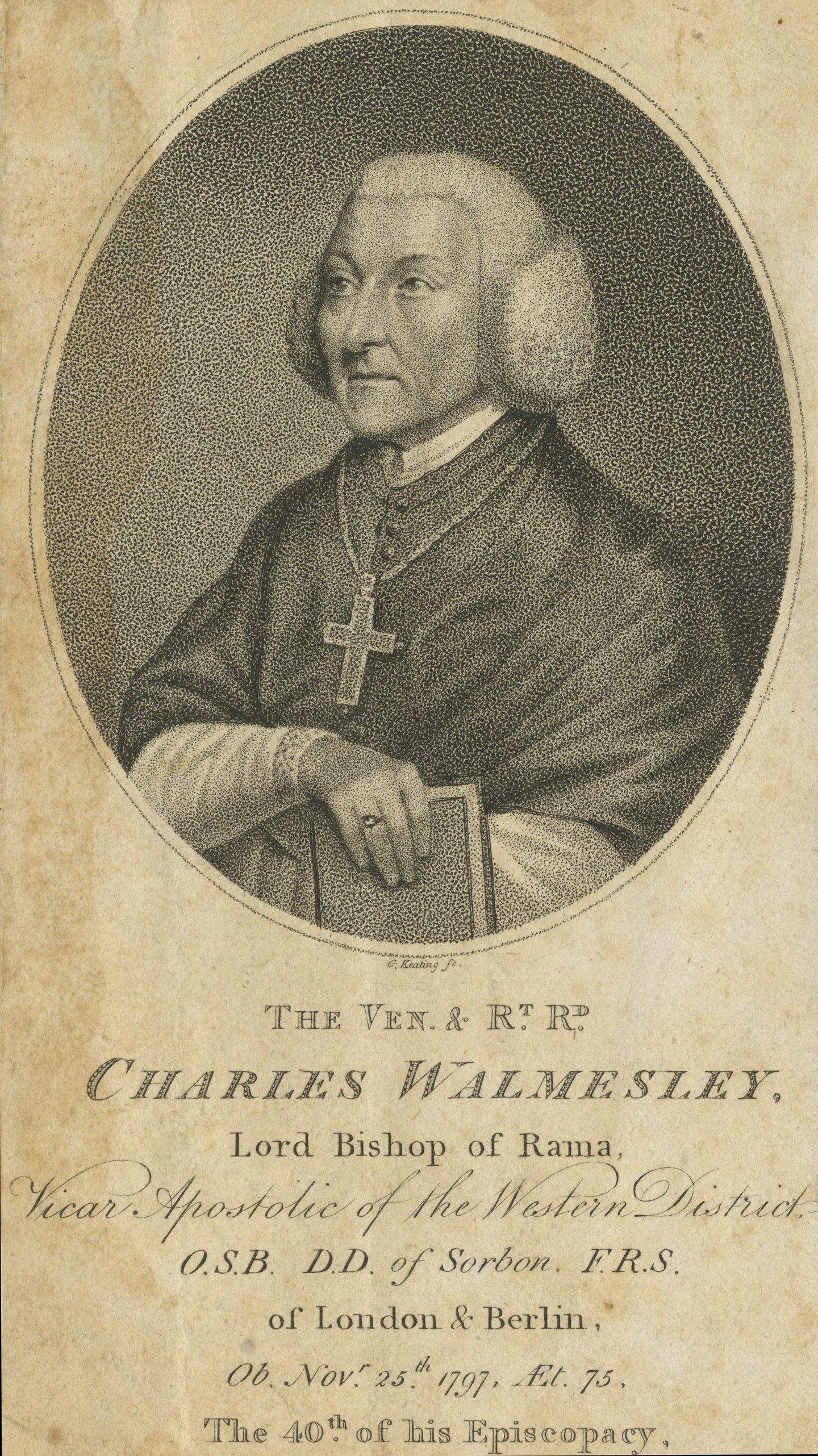
The 18th century millenarian prophecies of Bishop Charles Walmsley (‘Pastorini’ was his pen-name) which predicted the demise of Protestantism in the 1820s. Walmsley’s writings influenced many of those who participated in the Rockite insurgency of the 1820s.
Bishop Charles Walmsley
Pound
An area of confinement where distrained livestock were kept prior to being auctioned. Also a unit of currency rarely if ever seen by Irish landless labourers or cottiers.
Process server
An agent employed to serve eviction notices on tenants in arrears. As well liked and respected as a serious case of leprosy.
Property Defence Association
A largely unionist landlord organisation established during the Land War to protect the interests of landlords against the rival tenants combination, the Land League.
Ranch War, the
The outcome, from 1906-09, of a movement composed largely of small farmers and landless labourers, and led by Irish Parliamentary Party politicians, such as Laurence Ginnell, who campaigned against the move from tillage to pasture and the consequent reduction in the number of farms for purchase or rent. Often characterised by the illicit activity of cattle ‘driving’ (qv)
Laurence Ginnell MP
Replevy
To re-deliver distrained goods to their original owner after receiving financial guarantees. In Castle Rackrent Maria Edgeworth writes of Sir Murtagh, ‘he was always … replevying and replevying.’
Ribbonmen, the
The name by which members of secret agrarian societies came to be known by the middle of the 19th century, largely replacing the term ‘Whiteboy’. However, the Ribbonmen were, initially at least, more politicised, and emerged from the ‘Defender’ tradition in Ulster. Ribbonism also had a foothold in Dublin, unlike any of its purely rural predecessors.
Rockites, the
A well-coordinated agrarian secret society, often driven by anti-Protestant millenarianism (see ‘Pastorini), which posed a major threat to the authorities in Munster in the 1820s. Named after the mythical ‘Captain Rock’ (qv) who ‘signed’ many of the threatening letters issued to agents, landlords and non-compliant tenants.
‘The Installation of Captain Rock’, Daniel Maclise 1834
Rundale
A co-operative tenurial system based on a clachán (qv)or small community in which land was held collectively and its distribution settled by local agreement.
Rightboys, the
A largely Munster-based agrarian secret organisation of the 1780s whose main grievance was the obligation to pay tithes. The name derives from their allegiance to the mythical ‘Captain Right’.
Shanavests, the
The rivals of the Caravat (qv) secret society in a class-based conflict in Munster and south Leinster from 1806-11. The Shanavests were prosperous farmers who combined to resist the antagonism of small farmers and labourers.
Sive (Sieve) Oultagh
The mythical guiding light of the Whiteboys whose signature was often appended to threatening letters from the organisation. Other exotic names used in this context included Joanna, Shevane Meskill and the more masculine Lightfoot, Slasher, Cropper, Echo, Fearnot and Burnstack.
Steelboys, the (see Hearts of Steel)
Terry Alts, the
A secret society that emerged in County Clare in the late 1820s, post-Rockite and pre-Tithe War and was responsible for a number of murders, the most celebrated being the killing of Captain William Blood, land agent of Lord Stradbrooke in 1831.
Three Fs
‘Fair rent, Free sale. Fixity of tenure’. An ongoing slogan since the days of the Tenant League. Finally given legal status in Gladstone’s 1881 Land Act.
Tithes
A form of taxation payable to the clergy of the Established Church and a frequent bone of contention, especially with members of the Roman Catholic and Presbyterian faiths. The nature of the tax varied from region to region and, for a long time, livestock farmers were exempted from the levy. The so-called ‘Tithe War’ of the 1830s led to the Tithe Rentcharge Act of 1838 which ended the anti-tithe agitation.
Tithe proctor
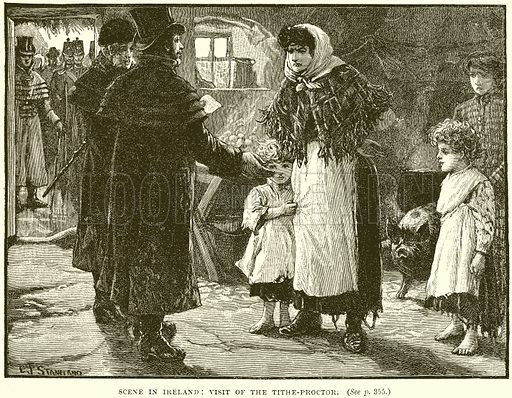
An agent who established crop valuations and collected tithe contributions on behalf of a Church of Ireland rector for a commission of around 10%. As welcome as gout.
A visit from the tithe proctor
Tithe farmer
Someone who reached agreement with a local rector to take on the collection of tithes on payment of an agreed sum to the clergyman. How he then made a profit was dependent on how much he could extract from those in the local parish liable for the tax. As popular as syphilis.
Tithe War
A conflict that spawned theeffective, but relatively uncoordinated movement which led to the transfer of direct responsibility for the payment of tithes from tenants to landlords. The ‘war’ began in Kilkenny in 1830 and included two notable atrocities, at Newtownbarry, Co. Wexford (qv) in June 1831 where yeomanry killed fourteen protestors and at Carrigshock, Co. Kilkenny (qv) in December 1831 where a process server and twelve policemen were killed.
Ulster Custom
The right of a tenant to be compensated for improvements when vacating land (either voluntarily, or as a result of eviction proceedings) or to sell his ‘interest’ in the land. Also known as ‘tenant right’ it was supposed to exist throughout Ulster, although this was often disputed by landlords, as the incoming tenant was expected to pay for the interest or fund the compensation and this tended to reduce the potential rent.
Whiteboys.
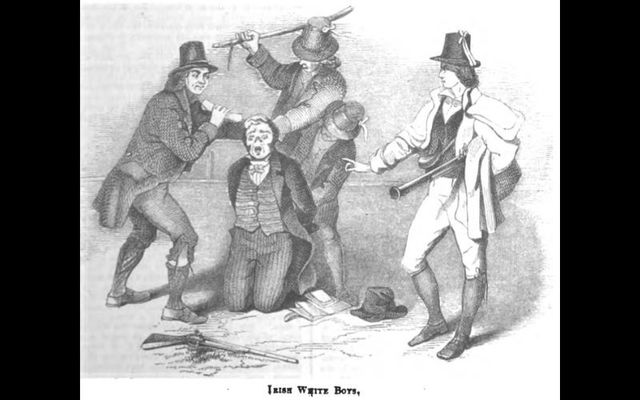
An agrarian secret society that originated in Tipperary in 1761 in opposition to the enclosures of common land. The movement then spread into neighbouring counties with an expanded agenda. Named for the white shirts worn over workday clothing. The movement died away by 1765 but re-emerged in 1769 in opposition to high rents, evictions and excessive levels of tithe payments. The term ‘Whiteboy’ continued to be used in the early 19th century as an umbrella term for violent agrarian activity, until it was gradually supplanted by the term ‘Ribbonism’. The 18th century legislation against agrarian crime passed in 1766, 1776 and 1787 became known as the ‘Whiteboy Acts’.
Whiteboy activity
Whitefeet
An offshoot of the Whiteboys, in that this was a secret agrarian society which emerged in the Carlow-Kilenny area in the 1830s in imitation of the 18th century Whiteboys.
The process of bringing livestock to pasture. In 1735 the House of Commons effectively removed the ‘tithe of agistment’ thus ensuring that beef and milch cattle were exempt from tithes. This had the effect of shifting the burden from wealthy graziers to tillage and subsistence farmers.
Approver
An accused party offering evidence against his co-conspirators in a crime, in return for full or partial amnesty.
Back to the Land
A co-operative movement that emerged in the early years of the 20th century, raised its own finance, and purchased estates for division among small farmers and landless labourers.
Bailiff
An official whose function was to effect the eviction of a tenant and, if required, sequestration of the tenant’s ‘removables’ (furniture etc.).
Bessborough Commission
Appointed in 1881 to inquire into the working of the 1870 Land Act and chaired by Frederick Ponsonby, 6th Earl of Bessborough. Its books of evidence offer a valuable insight into rural Ireland during the Land War. The Commission essentially offered support for the Land League (qv) demands for the 3Fs (qv), the only dissenting commissioner being the landlord representative, the idiosyncratic Arthur McMurough Kavanagh, the limbless former MP and Lord Lieutenant of Carlow.
Frederick Ponsonby, 6th Earl of Bessborough
Blackfeet
A Whiteboy variant that emerged in south Leinster in the 1830s.
Board of Works
Established in 1831 the Board of Works spent £49m on public works projects up to 1914.
Boycotting
The despatch of an obnoxious tenant, agent, landlord or ‘grabber’ (qv) to a ‘moral Coventry’. A process of ostracization generally seen to have been initiated in 1881 but actually a longstanding tactic in Irish agrarian campaigns. Individuals were cut off by their neighbours from all social and economic intercourse. Named for the Mayo land agent Captain Charles Boycott who was its most prominent victim during the Land War of 1879-82 (qv).
Captain Charles Boycott
Canting
The sale by auction to the highest bidder of a farm with a recently evicted tenant or a tenant in the process of being evicted.
‘Captain Moonlight’
A (mostly) 19th century euphemism for agrarian outrages. On being jailed in October 1881 Charles Stewart Parnell famously said that his place at the helm of agrarian agitation would be taken by ‘Captain Moonlight’.
‘Captain Rock’
The mythical figure supposedly behind the Rockite disturbances of the 1820s. During that period many threatening letters bore the signature of ‘Captain Rock’ or ‘John Rock’.
Caravats, the
An agrarian secret society whose antagonism was aimed not at landlords as such, but at large farmers. Their activities from 1806-11 were based in south Leinster (Kilkenny) and east Munster (Limerick, Tipperary, Waterford and Cork) and were opposed by a society of wealthy farmers known as the Shanavests (qv).
Carders, the
An early 19th century agrarian secret society that took its name from the vicious practice of carding (qv).
Carding
An atrocious punishment meted out by members of agrarian secret societies in which nails are driven through a board and this is then drawn across the back of a victim. This method was so extreme that it was eventually abandoned as it was deprecated by most of the supporters of even militant agrarian activism.
Caretaker
A person or persons left to occupy a house after an eviction. The function was sometimes undertaken by bailiffs (qv) or ‘emergency men’ (qv) but often, where an eviction had been carried out largely as a warning to a tenant in arrears, the tenant himself would be left in situ as caretaker. This practice partly accounted for the disparity between permanent evictions and tenant readmissions.
Carrickshock
A townland in County Kilkenny, near Knocktopher where a fracas in December 1831 during the Tithe War led to the deaths of a process server, a dozen policemen and three anti-tithe protestors.
Cattle driving
The practice, particularly notable during the Ranch War (19060-09) (qv), of stealing cattle and ‘driving’ them a considerable distance. Used as a form of protest and intimidation during the Ranch War.
Cess
A tax levied by county Grand Juries for the upkeep of roads and bridges. Excess levels of cess in certain counties or baronies often sparked militant action by agrarian secret societies. The word is still a term of abuse in some parts of rural Ireland, as in ‘bad cess to you!’
Clachán
The community at the centre of land held under the rundale system (qv).
Conacre
The act of renting a small area of land and planting a single crop, generally potatoes.
Congested Districts Board
Established by Tory chief secretary, Arthur Balfour, in 1891 to alleviate poverty in ‘congested’ regions of high population density and few resources in the west and northwest of Ireland. The CDB was dissolved by the new Irish Free State in 1923. An integral element of the Tory policy of ‘killing Home Rule with kindness’ in the 1890s.
‘Congests’
The name often applied to impoverished tenants in general, but in particular to those from areas under the aegis of the Congested Districts Board (qv).
Cottier
Sometimes represented as ‘cottar’, these were generally agricultural labourers or small farmers who rented small plots (c. 1 acre) and planted potatoes thereon in return for their labour. Almost wiped out by the Great Famine.
Cowper Commission
A commission of inquiry into Irish land tenure named for its chair, the former Lord Lieutenant, Earl Cowper, and established by the Tory government of Lord Salisbury. It reported in 1887, recognising that the fall in agricultural prices since the passage of the 1881 Land Act had reduced the ability of tenants to pay even Land Court arbitrated rents.
7th Earl Cowper
Deasy’s Act
Legislation passed in 1860 which altered the relationship of landlord and tenant, to the benefit of the latter. Passed through parliament without amendment, its central principle was that ‘The relation of landlord and tenant shall be deemed to be founded on the express or implied contract of the parties, and not upon tenure or service.’
Devon Commission, the
Its full title was the ‘Royal Commission on the state of the law and practice relating to the occupation of land in Ireland’. It was chaired by the Co. Limerick landlord, William Courtney, 10th Earl of Devon. The commission gathered evidence and compiled its report between 1843 and 1845. Its central recommendation, that ‘tenant right’ be formally recognised by the payment of compensation to outgoing tenants for any improvements made to their farm, was not enacted into law.
Distraint
The seizure of farm produce or implements, for subsequent sale at auction to meet the financial obligations of tenants in arrears to their landlords.
Down Survey
The Cromwellian-era mapping of Ireland under the supervision of Sir William Petty.
Sir William Petty
Driver
A bailiff employed to drive distrained cattle to the pound. The term could also apply to a Ranch War-era moonlighter (qv) who ‘drives’ a grazier’s cattle from pasture land onto the roads. The former was generally reviled by small tenant farmers, but operated within the law. The latter did not, but was generally revered by small tenant farmers.
Duty days
An obligation sometimes owed by a tenant to a landlord. The tenant was required to work on a set number of days per annum. A particularly vindictive landlord would demand his duty days at a time when a tenant needed to bring in his own harvest, in order to pay his rent. The fictional Thady Quirk refers to such punishments in Castle Rackrent by Maria Edgeworth.
‘Eleven month’ system
A device frequently used to get around the tenant-oriented land legislation of the 1880s and 1890s. Land was auctioned on an annual basis and the highest bidder was then allowed the use of the land for eleven months. The system encouraged wealthy merchants and professionals to purchase, graze and sell herds of livestock.
Emergency men
A generic term for those offering their services as bailiffs (qv), or often as caretakers left in the houses of evicted tenants to ensure that their former occupants were unable to re-possess. The name is derived from one of the landlord bodies, the Orange Emergency Committee, which opposed the activities of the Land League during the Land War, and those of the Irish National League during the Plan of Campaign.
Enclosure
The act of fencing off common land previously available to all members of a community. Most common land in Ireland and Britain had been enclosed by landowners by the end of the eighteenth century.
Encumbered Estates Acts
Passed in 1848 and 1849 this legislation established the Encumbered Estates Court, which allowed the sale of the estates of landlords rendered insolvent by the Great Famine. Designed to encourage a new wave of British owners of Irish land, in fact much of the almost five million acres that changed hands went to wealthy Irish Roman Catholic landlords, often Dublin-based professional men.
‘English tenant’
This has nothing to do with nationality but referred to a tenant who was required to pay his rent on the day it was due, rather than on a ‘gale day’ (qv) six month in arrears, as was the Irish custom. It could be used, for example, as a punishment by a landlord in the case of a tenant who had not voted as instructed in an election. He could be required to become an ‘English tenant’, i.e. immediately pay six months arrears of rent.
Gale days
The bi-annual period during which tenants paid their rent, generally to a landlord’s agent. The two annual gale days tended to be in May and November.
‘Grabber’
Or ‘land grabber’. Generally a tenant farmer who took over the land vacated by an evicted tenant. Many were threatened, injured or murdered. The phrase acquired particular currency during the Land War (1879-82). It later came to be applied to those illicitly seizing land during the Anglo Irish War and the subsequent Civil War.
Graziers
Farmers (and non-farmers) who rented extensive tracts of pasture land and raised cattle or sheep. This type of husbandry was anathema to small farmers and landless labourers because of the usage of what might otherwise have been arable land, available to rent. Graziers were also known (and not in a positive way) as ‘ranchers’.
‘Griffith’ valuation
Named after Richard Griffith, Commissioner of Valuation in Ireland from 1827 until 1868. Griffith was the man primarily responsible for mapping and valuing, for taxation purposes, the land of Ireland from the 1830s to the 1860s.
Richard Griffith, Commissioner of Valuation (1827-68)
Hanging gale
The first six month period (May-November or November-May) of a tenancy after which the tenant was obliged to pay his first portion of rent.
Hearts of Oak
An 18th century agrarian secret society that emerged in Armagh in 1763 in opposition, at first, to a legal obligation on the part of tenants to work on road construction. After a few weeks of protest activities and muted violence the ‘Oakboys’ disbanded in the face of military opposition.
Hearts of Steel
A more sustained—it continued in existence for three years—and coherent movement than the ‘Oakboys’ which emerged in Antrim and Down and was originally founded in opposition to ‘fines’ imposed on the estate of Lord Donegall on tenants who wanted to renew their leases. The ‘Steelboys’ often operated openly and they successfully attacked a Belfast barracks (1770) and Gilford Castle (1772).
Heriot
A landlord right, deriving from an old medieval custom, to the use of a tenant’s horse at short notice.
Houghers
An early agrarian secret society (1711-12) based in Connacht and opposed to the use of land for the purpose of grazing livestock. Named for one of their favoured methods of protest, the maiming of cattle.
Houghing
Maiming cattle in order to intimidate their owner. The cattle would be lamed by severing their hamstring tendons.
Improving landlords
Something of a ‘catch-all’ phrase covering everything from landlords wishing to divest themselves of tenants in order to ‘work’ their own estates, to landlords intent on either enhancing the lot of their tenants by undertaking ‘improvements’ to their land, or the introduction of progressive and more scientific farming methods. ‘Improving’ landlords (the term often appears in quotation marks to suggest a degree of historiographical scepticism of the breed) were often as welcome to the tenant as a bad toothache.
‘Kilmainham Treaty, the’
An unofficial agreement brokered by Captain William O’Shea between the incarcerated Charles Stewart Parnell and British prime minister William E. Gladstone. The Liberal government agreed to introduce an act of parliament allowing tenants in arrears access to the newly established Land Courts, and Parnell agreed to use his ‘influence’ to end agrarian disorder and ‘outrage’.








 Myles Dungan
You must be logged in to post a comment.