LAND IS ALL THAT MATTERS: THE AUTHORS CUT 3

THE AMERICAN JOURNALIST 

William Henry Hurlbert under coercion

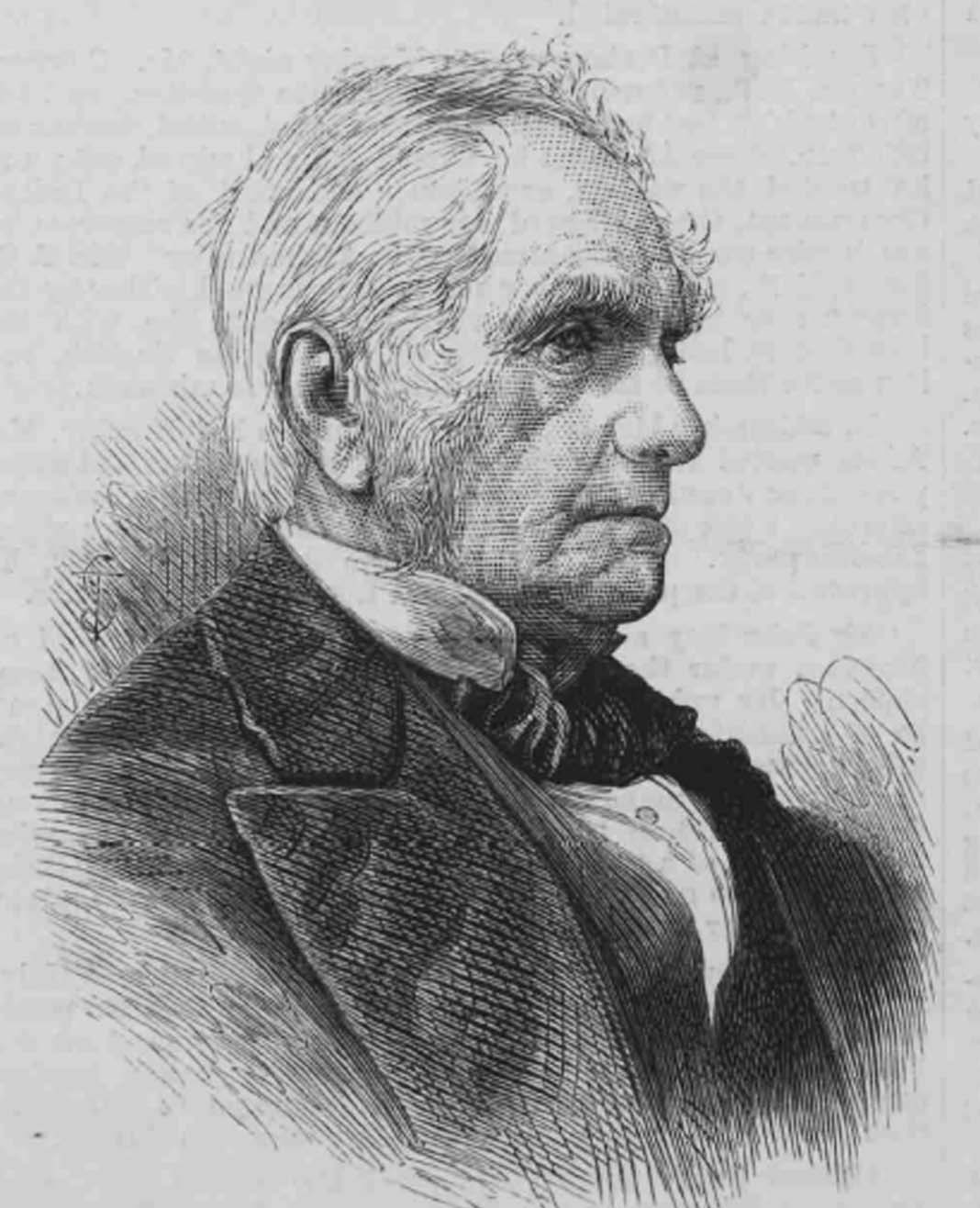
William Henry Hurlbert

Sightings of the Lesser-Spotted American Journalist (auctor Americanus) in Land War Ireland were so frequent as to be without scarcity value. Most (Henry George, James Redpath) came down firmly, or gently, on the side of the Irish tenant. This is what makes the observations of William Hurlbert, one-time editor of the New York World, more provocative. He took the opposite tack to most of his fellow American scribes during the Second Land War. He was described by Michael Davitt (whom he interviewed in 1888) as ‘a coercionist chronicler for Mr. Balfour’[1] and clearly set out his stall in the introduction to his narrative, the two-volume Ireland Under Coercion: The Diary of an American, published in 1888.    

The class war between the tenantry and their landlords … which is now undoubtedly waging in Ireland, cannot be attributed to the historical grievances of the Irish people. The tradition and the memory of these historical grievances may indeed be used by designing or hysterical traders in agitation to inflame the present war. But the war itself … has the characteristics no longer of a defensive war, nor yet of a war of revenge absolutely, but of an aggressive war, and of a war of conquest.[2]

Given their experience of crusading American journalists ‘going native’ and siding with tenant against landlord, the leadership of the National League must have wondered what they had done to deserve the attentions of William Henry Hurlbert.

The most obvious question prompted by William Henry Hurlbert’s employment of a literary wrecking ball in his coverage of the Second Land War, aka the Plan of Campaign is: did he begin his journalistic quest (if indeed it can be described as such) with certain pre-conceptions, or is his work based on observation and an ex post facto assessment of what he witnessed? Was his mind made up before he started, or was it still open to argument and observation? 

            Most Irish nationalists firmly believed that Hurlbert’s cards had been marked well in advance of his arrival in the country, either by self-interested champions of Tory policy or by his own innate political prejudices. Davitt asserted that Hurlbert’s anti-Plan malice derived from an earlier failure to obtain Irish nationalist support in a bid to secure a posting as US ambassador to London. It also had a clear ideological basis. The socialist dogma of his fellow (and more successful) New York-based journalist, Henry George, was anathema to the politically conservative Hurlbert. In his introduction to Ireland Under Coercion, the former New York World editor fulminated against George’s creed of land nationalisation, describing it as ‘confiscation’ and going on to compare George’s template to the manner in which ‘the State proceeded against the private property of rebels and traitors’.[3]

Henry George

            That he came from a staunch ‘Dixie’ Protestant family (he had a brief stint as a Unitarian minister) may have coloured his attitude to Irish Catholic nationalism and its tributary agrarian campaigns. But Hurlbert was not necessarily philosophically entrenched and incapable of changing his mind. Take his very name, for example. He was born William Hurlbut in Charleston, South Carolina in 1827 and was educated at Harvard. However, when a printer made a mistake in creating a business card—designating him as ‘Hurlbert’—instead of insisting that the offending objects be immediately immolated, he was so taken with the misprint that he changed his name in accordance with the error. Despite his birth in the ‘deep South’, he was an opponent of slavery, albeit he was an anti-slavery Democrat rather than a Lincoln-supporting Republican. After a lifetime of bachelordom, he obviously reconsidered his position on connubial bliss and married at the advanced age, even for a bridegroom, of fifty-seven. Neither, while on his Irish travels, did he exclusively seek out the sort of opinions he seems to have most wanted to hear. Although it is clear from his narrative that he preferred the company of landlords, like Richard Stacpoole in Clare and Charles Ponsonby in Cork, he also sought out the views of Michael Davitt and the fiery Donegal priest, Father James McFadden.   

            The title of the work derived from his visit to Ireland might suggest to the unwary that Hurlbert was completely ad idem with his journalistic compatriots from the First Land War, otherwise why highlight the word ‘coercion’ in the title? However, Hurlbert, in his use of this freighted codeword is not referencing the stringent provisions of Balfour’s Crimes Act, but the intimidatory tactics of the Irish National League and its local enforcers. United Ireland described Hurlbert’s work as ‘libellous’ and ‘fit to take its place amongst other grotesque foreign commentaries’.[4] To that sublime journal of the British establishment, The Times, however, fresh from its own ‘Parnellism and Crime’ accusations of thuggery against the Irish party leader and his associates, it was ‘entertaining as well as instructive’.[5]

            Hurlbert’s work is exhaustive (two volumes and 653 pages in length) and highly partisan. He includes masses of minute polemical detail—amounts held in savings accounts in banks located near Plan estates, or the (scarcely relevant) number of public houses in the main urban centres of County Clare—but his twin tomes are also clearly influenced in style by gossipy contemporary travellers’ tales. With an eye to a more commercial market, he frequently branches off into detailed descriptions of some of the exquisite landscapes through which he travelled.  

            The first ‘tell’ when it comes to the political slant of Ireland Under Coercion (after his combative introduction) is his account of a visit to Balfour within hours of his arrival in Dublin in late January 1888.  The chief secretary was in ‘excellent spirits’ and displayed much of the nonchalance that consistently aggravated the native antagonism of nationalist politicians towards him. Hurlbert opines, tongue affixed in cheek, that Balfour was ‘certainly the mildest-mannered and most sensible despot who ever trampled in the dust the liberties of a free people’.[6] From the bourn of that ironic swipe—within the first twenty pages of the opening of Volume One—there was no possibility of return for this traveller. It may even have been the case that Hurlbert arrived in Ireland with an entirely open mind and left Dublin Castle charmed by the affable side of Balfour’s nature. If so, his subsequent failure to secure an early balancing interview with Davitt in Dublin might have compounded his hostility to the Plan. He eventually tracked down Davitt in London and conducted an oddly ‘soft focus’ interview that seems to have had as much to do with the latter’s commercial schemes—the development of a wool export business and the opening of granite quarries in Donegal and Mayo—as it did with the renewed agrarian conflict, in which, of course, Davitt was not directly involved. Hurlbert did not include in his itinerary any of the acknowledged leaders of the Plan. He did, however, as noted above, interview and accept the hospitality of a number of the major landlord targets of Plan activists. 

            It is impossible to encapsulate a work of more than 600 pages in a few paragraphs but it is worthwhile highlighting Hurlbert’s visits to Donegal and Clare, and his treatment of two assertive Roman Catholic priests, Father James McFadden, parish priest of Gweedore, and Father Patrick White, parish priest of Milltown Malbay. He appears to have developed a considerable rapport with McFadden, despite their obvious ideological differences. White he did not meet in person, but his account of the latter’s activities caused the priest to threaten Hurlbert with a libel suit. 

Fr. James McFadden of Gweedore

James McFadden was forty-six years of age in 1888. He was a thick-set, bulldog-like man from a comfortable family background with a very sure sense of his own importance (‘I am the law in Gweedore’[7]) and a history of loyalty to agrarian causes stretching back to his involvement with the Land League. McFadden had been radicalised as a witness to the activities in Donegal of those two notorious evicting landlords, William Sydney Clements, 3rd Earl of Leitrim (murdered by his tenants in 1878) and John George Adair (responsible for the Derryveagh mass evictions in 1861). In 1880 McFadden had also been witness to a much-publicised tragedy when five of his parishioners drowned after a flash storm flooded the Gweedore church in which he was saying mass. McFadden himself managed to escape death only by jumping from the altar through a closed window. McFadden did not brook dissent or opposition from his parishioners and was known locally, in suitably hushed tones, as ‘An Sagart Mór’ (The Big Priest) despite his small stature. 

            In the year of Hurlbert’s visit to Gweedore, McFadden spent six months in jail in Derry for a seditious speech and for organising boycotts and a rent strike—the initial sentence had been three months but was doubled on appeal. In 1889 he would be at the centre of a far more serious episode when an attempt by an RIC Inspector, William Martin, to arrest him after Sunday mass on 3 February, resulted in a number of McFadden’s parishioners beating Martin to death. McFadden was among those charged with murder arising out of the killing but was allowed to plead guilty to the lesser offence of obstruction of justice. At which point McFadden’s bishop intervened and moved him to a new parish out of harm’s way and banned any further involvement by the priest in agrarian activity. 

            But that controversial tragedy was in the future when Hurlbert arrived in Gweedore, one of the most immiserated parts of an impoverished county, in early 1888. Most of the land in the area had been acquired in 1838 by Lord George Hill, an improving landlord (with all the negative as well as positive connotations of that designation). In 1845, just as the Great Famine was about to take hold, Hill published a self-regarding memoir, Facts about Gweedore, which outlined many of the changes he had brought about in the area. These included the acquisition of almost half of his estate land for his own purposes. This was a regular feature of landlord ‘improvement’ and was bitterly resented by evicted or potential tenants who were obvious losers in such scenarios. In 1889 McFadden published a riposte entitled The Present and the Past of the Agrarian Struggle in Gweedore, in which he ridiculed Hill’s book as a publication, ‘which might, perhaps, with more regard to truth and accuracy be called ‘Fictions from Gweedore’.[8] The parish priest claimed that the landlord’s ‘improvements’ had failed to benefit anyone but himself.  Hill died in 1879, as the First Land War was gathering force in Mayo. In 1888 the Gweedore land, an estate of 24,000 acres, was owned by Hill’s heir, Captain Arthur Hill.

Lord George Hill

            In a letter to the Derry Journal in September 1887, McFadden threw down the gauntlet to Captain Hill, twitting the latter with the observation that ‘he may, by the aid of his Winchester repeater and a Coercion government, hope to make gold from granite, but it takes little fore-knowledge to prophesy that the effort will fail him’.[9] McFadden proved a determined and energetic adversary for Hill and the RIC. He appears to have had little in common with the aristocratic Hurlbert, yet, when they met, the two men got on famously, with the American journalist enjoying the hospitality as well as the company of the turbulent priest. 

            Hurlbert’s initial assessment of McFadden was of a man with ‘great freedom and fluency … sanguine by temperament, with an expression at once shrewd and enthusiastic, a most flexible persuasive voice.’ McFadden laid the blame for the problems in Gweedore and neighbouring Falcarragh (where the troubled estate of Wybrants Olphert was located and where the protective RIC complement had been raised from six to forty) not at the door of the landlords, but at their agents. Because, the priest observed, the land agents were paid by commission based on the amount of rental money actually collected, ‘the more they can screw either out of the soil, or out of any other resources of the tenants, the better it is for them’. 

            In the course of their conversation, McFadden made one startling concession to Hurlbert. He acknowledged that, even if the tenants themselves owned the land they were working, not all of them would be able to live off their holdings. The admission, of itself, was hardly more than a pragmatic assessment of the economics of subsistence farming in Donegal from a man rooted in reality. The surprising element is that he would have been so candid with a visiting correspondent such as Hurlbert. Clearly the latter had not tipped his hand to the priest, who would also have been aware that much of the income earned in the remoter parts of Donegal did not come from subsistence farming but from the fruits of seasonal migration. 

            McFadden did, however, offer a solution to the conundrum. Government investment in land reclamation, he claimed, would enable more tenants to make a decent living from their holdings. ‘The district could be improved’, he continued, ‘by creating employment on the spot, establishing factories, developing fisheries, giving technical education, and encouraging cottage industries.’ In outlining this plan, McFadden was anticipating the Congested Districts Board, one of the staging posts in the Conservative government’s strategy in the 1890s of ‘killing Home Rule with kindness’ – creating a contented peasantry (while still maintaining landlord supremacy) that would forswear grievance politics and abandon the cause of legislative independence in favour of enjoying and augmenting their newly acquired creature comforts. (Spoiler alert – it didn’t work.)    

            As the conversation wound down, Hurlbert tackled McFadden on what he may have perceived as the cleric’s weak spot: the issue of a priest encouraging his flock to ignore the moral responsibility to pay their rent. McFadden, who must have anticipated the question, had his response well-prepared: ‘If a man can pay a fair year’s rent out of the produce of his holding, he is bound to pay it. But if the rent be a rack-rent, imposed on the tenant against his will, or if the holding does not produce the rent, then I don’t think that is a strict obligation in conscience’.

In the case of Gweedore, McFadden was, essentially, making the point that a tenant should not be obliged to subsidise his own rent from income derived while working as a farm labourer in Scotland or elsewhere. Hurlbert demurred, citing the United States as his precedent, and noting that: ‘If a tenant there cannot pay his first quarter’s rent (they don’t let him darken his soul by a year’s liabilities) they promptly and mercilessly put him out’.[10]

            The interview at an end, Hurlbert rose to go, but before his departure he was offered ‘a glass of the excellent wine of the country’. Since nineteenth century Irish viticulture was sparse, this might well be taken as a sly reference to the local poitín (poteen). However, McFadden was as much of a thorn in the side of the local illicit distillers as he was of landlords, having waged a dogged campaign against local poteen-makers. Interestingly, the priest declined to join his guest in his own hospitality, pleading that he was ‘almost a teetotaller’. Hurlbert was later advised that it was Captain Hill’s refusal of a similar offer of hospitality that sparked the quarrel with McFadden. This was a classic example of Irish reductionism. There was rather more at issue between priest and landlord than a glass of contraband ‘uiscebaugh’. 

Ballyconnell House, Falcarragh, Co. Donegal

            Hurlbert’s next host was Wybrants Olphert of Ballyconnell House in nearby Falcarragh. This was an altogether different experience for the American journalist. Before he sat down to lunch with the Falcarragh landlord, Hurlbert noticed the man’s son enter the house and toss a revolver on the hall table, prompting the American to make comparisons with the ‘Wild West’. While McFadden had blamed the landlords’ agents (Hewson and Dopping) for the local unrest, Olphert did not reciprocate the courtesy. He held McFadden, and the Falcarragh curate, Father Daniel Stephens, largely responsible, along with his younger tenants, for the annoyance being visited upon him. Olphert was especially aggrieved because he had agreed to a 20 per cent reduction in rent and insisted to Hurlbert that there had been no evictions on his estate. That situation would soon change, and with a vengeance. In January 1889 Olphert dug in his heels, and Hewson began a series of ejectments that continued for two years. By December 1890 more than 350 families had been evicted, and only 10 per cent were readmitted to their holdings.[11]

            In his account of his conversation with Olphert, Hurlbert introduced a trope to which he often returned over the next 500 pages of Ireland Under Coercion, namely the question of the ability of supposedly immiserated tenants to pay their rent. Hurlbert’s thesis was that Plan tenants were agitators with a political agenda, as opposed to subsistence farmers no longer able to pay even arbitrated rents because of continued agricultural depression. In a series of QED moments throughout the book, he makes reference to the total amounts held in Post Office savings accounts in areas where the Plan was at its most belligerent. The implication was that the very existence of savings accounts indicated a considerable degree of local prosperity and that the money being squirrelled away belonged to tenants who should have been remitting it to their landlords, a somewhat dubious line of logic. Hurlbert also made frequent reference to substantial increases in the level of banked savings in the course of the 1880s.   

            For example, in the case of Falcarragh he observed that the Olphert tenants ‘are not going down in the world’ because bank deposits that stood at £62.15s in 1880 had risen to £494.11s in 1887.[12] In the second volume of his work he makes a similar argument regarding Sixmilebridge in County Clare, Killorglin in County Kerry, and Gorey in County Wexford.[13] However, he offers no evidence that local tenant farmers were the beneficial owners of the bulk of those savings accounts. Neither does he take into consideration the sums being saved by Plan adherents in rent which were being banked locally by the trustees of the fighting funds. This might well account for at least some of the increases noted between 1880 and 1887. 

Hurlbert’s visit to Gweedore and Falcarragh took place in early February 1888. Towards the end of that month, he found himself in County Clare, often accompanied on his travels there by Resident Magistrate Colonel Alfred Turner, who, arguably, had more sympathy for the predicament of Irish tenant farmers than did the American journalist. Arriving on 18 February, after an unexplained side trip to Paris, he put up at the ‘spacious goodly house’ of Edenvale, the Ennis home of local landlord Richard Stacpoole. One of his first observations on walking through the town was the ubiquity of public houses. So impressed was he by the preponderance of drinking establishments that he sought some statistical backup and was told that the town (population 6,307) boasted more than 100 (legal) alehouses. This was by way of a prelude to the announcement that 23 of the 36 publicans of Milltown Malbay had been tried at Ennis assizes for boycotting the RIC. One charge was dismissed, one publican was acquitted, ten (‘the most prosperous’) signed a guarantee in court ‘not to further conspire’, while the remainder were despatched to prison to serve a month’s hard labour. 

            The case allowed Hurlbert to introduce another of the leading protagonists of his narrative, Father Patrick White, parish priest of Milltown Malbay, who, we are told, admitted in open court to being ‘the moving spirit of all this local boycott’. White had persuaded the other merchants of Milltown Malbay to close their premises—to make the village ‘as a city of the dead’—while the case was being conducted in Ennis. After the eleven non-penitent publicans were conducted to jail, White had gone to the home of each to offer support to their families. Mistakenly, however, he had entered the house of one of the ten signatories of the guarantee to be of good behaviour. When he realised his error, according to Hurlbert, he had quickly emerged from the traitorous premises ‘using rather unclerical language’. Hurlbert then tut-tutted that, although this was a ‘tempest in a tea-pot … it is a serious matter to see a priest of the Church assisting laymen to put their fellow men under a social interdict’.    

            When Hurlbert asked an RIC sergeant about the likely fate of the recanting publicans he got an interesting primer in rural economics. He was told that, although there had been suggestions that the erstwhile boycotting bar-owners would, in their turn, be ostracised by the local ‘butchers and bakers … it’s all nonsense, they are the snuggest publicans in this part of the country, and nobody will want to vex them … the best friend they have is that they can afford to give credit to the country people’. 

            By way of illustration of his perennial argument that many Plan tenants desperately wanted to come to terms with their landlords, Hurlbert repeated an anecdote that he had picked up from Stacpoole about a ‘good’ tenant who came to the landlord to tell him that he dare not pay his rent. When Stacpoole challenged the man, accusing him of rank cowardice: ‘The man turned rather red, went and looked out of all the windows, one after another, lifted up the heavy cloth of the large table in the room and peeped under it nervously, and finally walked up to Mr. Stacpoole and paid the money’. 

            In the second volume of Ireland Under Coercion Hurlbert includes Father White among ‘a certain class of the Irish clergy [associated] with the most violent henchmen of the League’ and also implies that such clerics ‘regard the assassination of “bailiffs and tax-collectors” as a pardonable, if not positively amusing, excess of patriotic zeal’.[14]

            White considered suing Hurlbert for defamation, but was advised against it and contented himself with writing a pamphlet entitled Hurlbert Unmasked: an exposure of the thumping English lies of William Henry Hurlbert in his ‘Ireland Under Coercion’, in which White accused Hurlbert of having ‘libelled me unsparingly’. In addition to accusing Hurlbert of ‘cowardly and contemptible’ tactics in his ‘stream of contempt and scorn … which must have been pleasant reading, indeed, for all unionists’, White offered his justification for a Christian minister supporting the palpably un-Christian act of boycotting. Validation of his approval of the practice is summed up in his observation that ‘Desperate diseases require desperate remedies’.[15] White also retaliated by drawing attention to the number of ‘anonymous informants’ in Hurlbert’s work. These included such political insiders as a jarvey with a ‘knowing look’, a ‘sarcastic nationalist’ and a ‘shrewd Galway man’. The priest questioned their credentials and, by implication, their very existence.[16]  Hurlbert, however, had anticipated some level of scepticism when it came to his protection of confidential sources and used the guarding of their identities as ammunition. He had been urgently requested, he footnoted, by an anonymous ‘friend’, who had introduced him to a number of farm labourers, to expunge their names from the manuscript of the book. This had been done at great inconvenience after the relevant chapter had gone to press. Hurlbert observed of this request:  ‘What can be said for the freedom of a country in which a man of character and position honestly believes it to be “dangerous” for poor men to say the things recorded in the text of this chapter about their own feelings, wishes, opinions, and interests?’[17]

There is a bitter irony associated with Hurlbert’s later life. Having, or so it would appear, come to Ireland on a mission to discredit the supporters of Charles Stewart Parnell, he was to suffer a similar fate to that of the Irish parliamentarian. His involvement in a scandalous court case in 1891, in which evidence of an adulterous affair was introduced, left his reputation in tatters. He died, at the age of sixty-eight, in exile in Italy, far from the city of New York where, until relinquishing the editor’s spike on the World newspaper, he had been a major force. 

            His partisan desire to see Irish landlordism endure was not, even in the medium term, to be granted. Within fifteen years of the publication of Ireland Under Coercion, even the Tories made it clear—with the land purchase legislation introduced by chief secretary George Wyndham in 1903—that they no longer saw any agreeable future in the tea leaves for the Irish landed class.  

            Was Ireland Under Coercion the legacy of a journalistic spent force seeking redemption and relevance, or the observations of a cold-eyed truth-teller made without fear or favour? That verdict really depended on which side of the nationalist/unionist or tenant/landlord divide you happened to find yourself when the two-volume memoir was published in 1888.


[1] Michael Davitt, The Times Parnell Commission speech delivered by Michael Davitt in defence of the Land League (London, 1890), 152. 

[2] William Henry Hurlbert, Ireland Under Coercion: The Diary of an American (London, 1888) Vol. 1,  xxxvi. 

[3] Hurlbert, Ireland Under Coercion, vol. 1, lvii. 

[4] United Ireland, 22 August, 1888.

[5] The Times, 18 August, 1888.

[6] Hurlbert, Ireland Under Coercion, vol. 1, 15.

[7] James McFadden The Present and the Past of the Agrarian Struggle in Gweedore (Derry, 1889), 18.

[8] McFadden, Agrarian Struggle in Gweedore, 85. 

[9] Derry Journal, 14 September 1887.

[10] Hurlbert, Ireland Under Coercion, vol. 1, 91-103. 

[11] L.Perry Curtis Jr., ‘Three Oxford Liberals and the Plan of Campaign in Donegal, 1889’, History Ireland, May/June 2011, Volume 19. 

[12] Hurlbert, Ireland Under Coercion,  vol. 1, 117.

[13] Hurlbert, Ireland Under Coercion, vol 2, 5, 12, 248.

[14] Hurlbert, Ireland Under Coercion, Vol.2, 86.

[15] Patrick White, Hurlbert Unmasked: an exposure of the thumping English lies of William Henry Hurlbert in his ‘Ireland Under Coercion’ (New York, 1890), 18. 

[16] White, Hurlbert Unmasked, 24-28. 

[17] Hurlbert, Ireland Under Coercion, Vol.ii, 249. 

Land Is All That Matters – GLOSSARY OF TERMS L-Z

Land Acts

A variety of remedial land legislation was introduced in the 19th century, mostly in the last three decades, initially by William E. Gladstone in 1870 and 1881 and later by the Tory government of Lord Salisbury (and his nephews Arthur and Gerald Balfour) in 1887 and the 1890s.

Land Commission

Established in 1881 after the passage of the second Gladstone Land Act, its role went from the arbitration of rents between tenant and landlord, to direct involvement in the land purchase process when it acquired the power to buy estates and re-distribute the land to tenants who were offered loans to enable the purchases. It was re-constituted by the Irish Free State government in 1923, continued the work of land re-distribution until the 1980s, and was dissolved in 1999.

Land Courts

Established by the 1881 Land Act as an arbitrator between tenant and landlord whereby a tenant could apply to the court for a reduction in rent and the decision of the Land Court would be binding on both parties. Initial scepticism about the body gave way to a sudden wave of enthusiasm among tenant farmers when its early decisions reduced rents by an average of 15-20%. 

Land League, the

From its origins in Mayo in 1879, the Irish National Land League quickly developed, under the leadership of agrarian activists like Michael Davitt and Patrick Egan, and the presidency of Charles Stewart Parnell, into a vibrant and cohesive national pressure group intent on achieving ‘tenant right’ as well as a reduction of rent and an end to evictions. With agrarian crime levels rising in 1881 the organisation was banned in October of that year and most of its leadership arrested. Their release followed the conclusion of the unofficial ‘Kilmainham Treaty’ (qv)

Ladies Land League, the

Established by Parnell’s sisters Fanny and Anna in 1880 with the latter as the primary motivating force, the Ladies Land League (LLL) came into its own in October 1881 after the Liberal government proscribed the Land League. Anna Parnell’s organisation essentially took over the functions of its ‘brother’ organisation and did so with great efficiency and tenacity. Anna Parnell, who was far more radical than her brother Charles, and the rest of the LLL became surplus to requirements after the conclusion of the so-called ‘Kilmainham Treaty’ and the release from jail in May 1882 of her brother and the Land League leadership cadre. The LLL, because of its inherent agrarian radicalism, also became a political embarrassment to a Parnell whose focus had now shifted to the issue of Home Rule. 

Anna Parnell

Land purchase 

The transfer of land from landlord to tenant. A small element was contained in the Church Disestablishment Act of 1869 and Gladstone’s 1870 Land Act (‘The Bright Clause’). The Ashbourne Act of 1885 offered terms to landlord and tenant to encourage the process, but this was only marginally successful. The Conservative party chief secretary Arthur Balfour made another attempt in 1891 legislation but it was not until the Wyndham Act of 1903 and its subsequent amendment by Liberal chief secretary Augustine Birrell in 1909 that generous government funding led to the sale by landlords, and the subsidised purchase by tenants, on a vast scale. 

Land War, the

A campaign against excessive rents and evictions that began in Mayo in 1879. While the Land League was the public face of tenant opposition to landlord exactions during a period of worldwide economic depression, in the background secret agrarian ‘ribbon’ societies also played a significant role in forcing the passage of the 1881 Land Act and bringing William E. Gladstone to the negotiating table in the formulation of the so-called ‘Kilmainham Treaty’ (qv) which effectively brought the ‘War’ to an end.   

Landed Estates Court

The 1858 successor to the Encumbered Estates Court (qv) which took over the sale of the estates of bankrupt landlords. 

Land grabbers

The undesirable epithet applied to tenant-farmers who took up land from which the prior tenant had been evicted and, from 1919-23 to ‘squatters’ engaged in the illicit seizure of land. See also ‘grabbers’. 

Latitat

A writ or summons generally issued on the assumption that the object of the summons is in hiding. 

Middlemen

Someone who rented land from a landlord and then sub-let to others. Some middlemen were wealthy minor gentry, some were businessmen or professionals, others were farmers who worked their own land as well as subletting. On some estates there were ‘layers’ of middlemen, with, perhaps, a single middleman sub-letting to other members of a species that had become seriously endangered by the end of the 19th century and was close to extinction a hundred years later.. 

Molly Maguires 

A secret society suspected of the murder of Roscommon landlord, Denis Mahon. The term was later applied to the fraternal Ancient Order of Hibernians (a Roman Catholic counterpart of the Orange Order) and to a secret society based in the anthracite fields of the US state of Pennsylvania. 

A drawing of a person sitting in a chair

Description automatically generated

Major Denis Mahon

Newtownbarry

Today known as Bunclody, it was the scene in June 1831 of an affray that led to the killing of at least eighteen anti-tithe protestors by members of the Yeomanry militia. It was also the last time a Yeomanry company was used in a policing operation. 

Oakboys (see Hearts of Oak) 

Ordnance Survey

Beginning in 1825, and employing, among others, future Irish under-secretaries Thomas Drummond and Thomas Larcom, the Ordnance Survey mapped the country thoroughly for the first time since the Down Survey.  

Pastorini

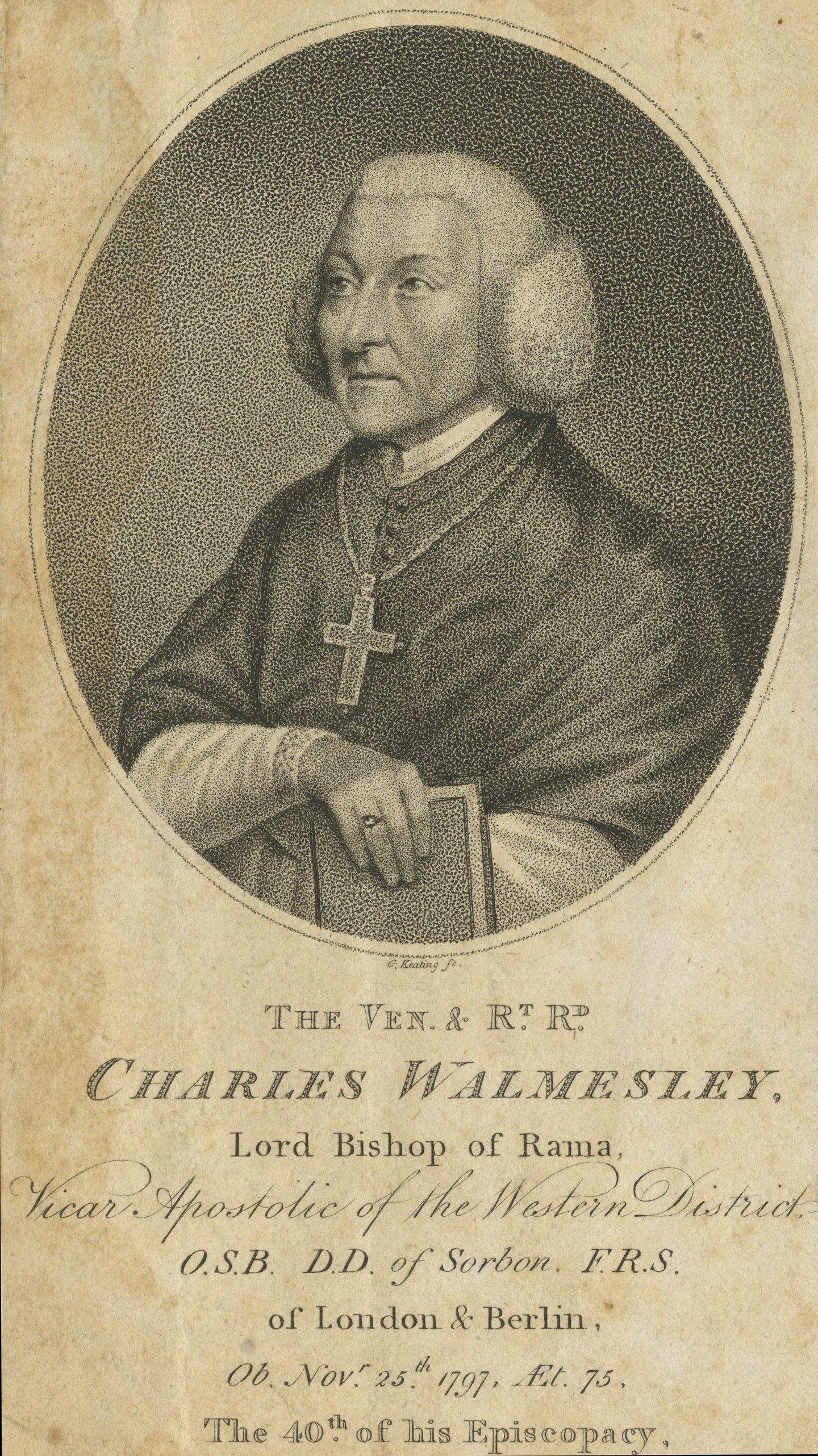
The 18th century millenarian prophecies of Bishop Charles Walmsley (‘Pastorini’ was his pen-name) which predicted the demise of Protestantism in the 1820s. Walmsley’s writings influenced many of those who participated in the Rockite insurgency of the 1820s.

Bishop Charles Walmsley

Pound

An area of confinement where distrained livestock were kept prior to being auctioned. Also a unit of currency rarely if ever seen by Irish landless labourers or cottiers. 

Process server

An agent employed to serve eviction notices on tenants in arrears. As well liked and respected as a serious case of leprosy. 

Property Defence Association

A largely unionist landlord organisation established during the Land War to protect the interests of landlords against the rival tenants combination, the Land League. 

Ranch War, the

The outcome, from 1906-09, of a movement composed largely of small farmers and landless labourers, and led by Irish Parliamentary Party politicians, such as Laurence Ginnell, who campaigned against the move from tillage to pasture and the consequent reduction in the number of farms for purchase or rent. Often characterised by the illicit activity of cattle ‘driving’ (qv)

Laurence Ginnell MP

Replevy

To re-deliver distrained goods to their original owner after receiving financial guarantees. In Castle Rackrent Maria Edgeworth writes of Sir Murtagh, ‘he was always … replevying and replevying.’

Ribbonmen, the

The name by which members of secret agrarian societies came to be known by the middle of the 19th century, largely replacing the term ‘Whiteboy’. However, the Ribbonmen were, initially at least, more politicised, and emerged from the ‘Defender’ tradition in Ulster. Ribbonism also had a foothold in Dublin, unlike any of its purely rural predecessors. 

Rockites, the

A well-coordinated agrarian secret society, often driven by anti-Protestant millenarianism (see ‘Pastorini), which posed a major threat to the authorities in Munster in the 1820s. Named after the mythical ‘Captain Rock’ (qv) who ‘signed’ many of the threatening letters issued to agents, landlords and non-compliant tenants.    

undefined

‘The Installation of Captain Rock’, Daniel Maclise 1834

Rundale

A co-operative tenurial system based on a clachán (qv) or small community in which land was held collectively and its distribution settled by local agreement. 

Rightboys, the

A largely Munster-based agrarian secret organisation of the 1780s whose main grievance was the obligation to pay tithes. The name derives from their allegiance to the mythical ‘Captain Right’.

Shanavests, the

The rivals of the Caravat (qv) secret society in a class-based conflict in Munster and south Leinster from 1806-11. The Shanavests were prosperous farmers who combined to resist the antagonism of small farmers and labourers. 

Sive (Sieve) Oultagh

The mythical guiding light of the Whiteboys whose signature was often appended to threatening letters from the organisation. Other exotic names used in this context included Joanna, Shevane Meskill and the more masculine Lightfoot, Slasher, Cropper, Echo, Fearnot and Burnstack.

Steelboys, the (see Hearts of Steel)

Terry Alts, the

A secret society that emerged in County Clare in the late 1820s, post-Rockite and pre-Tithe War and was responsible for a number of murders, the most celebrated being the killing of Captain William Blood, land agent of Lord Stradbrooke in 1831. 

Three Fs

‘Fair rent, Free sale. Fixity of tenure’. An ongoing slogan since the days of the Tenant League. Finally given legal status in Gladstone’s 1881 Land Act. 

Tithes

A form of taxation payable to the clergy of the Established Church and a frequent bone of contention, especially with members of the Roman Catholic and Presbyterian faiths. The nature of the tax varied from region to region and, for a long time, livestock farmers were exempted from the levy. The so-called ‘Tithe War’ of the 1830s led to the Tithe Rentcharge Act of 1838 which ended the anti-tithe agitation.

Tithe proctor

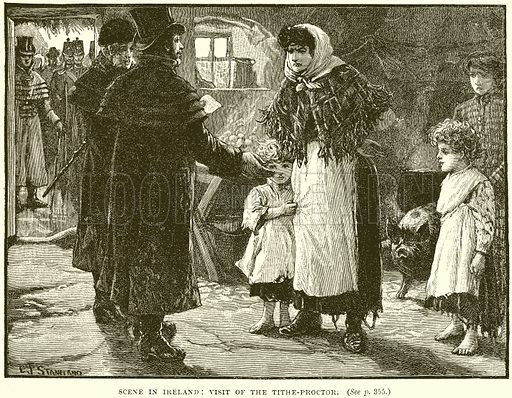
An agent who established crop valuations and collected tithe contributions on behalf of a Church of Ireland rector for a commission of around 10%. As welcome as gout.

A visit from the tithe proctor

Tithe farmer

Someone who reached agreement with a local rector to take on the collection of tithes on payment of an agreed sum to the clergyman. How he then made a profit was dependent on how much he could extract from those in the local parish liable for the tax. As popular as syphilis.

Tithe War 

A conflict that spawned the effective, but relatively uncoordinated movement which led to the transfer of direct responsibility for the payment of tithes from tenants to landlords. The ‘war’ began in Kilkenny in 1830 and included two notable atrocities, at Newtownbarry, Co. Wexford (qv) in June 1831 where yeomanry killed fourteen protestors and at Carrigshock, Co. Kilkenny (qv) in December 1831 where a process server and twelve policemen were killed.     

Ulster Custom 

The right of a tenant to be compensated for improvements when vacating land (either voluntarily, or as a result of eviction proceedings) or to sell his ‘interest’ in the land. Also known as ‘tenant right’ it was supposed to exist throughout Ulster, although this was often disputed by landlords, as the incoming tenant was expected to pay for the interest or fund the compensation and this tended to reduce the potential rent.  

Whiteboys. 

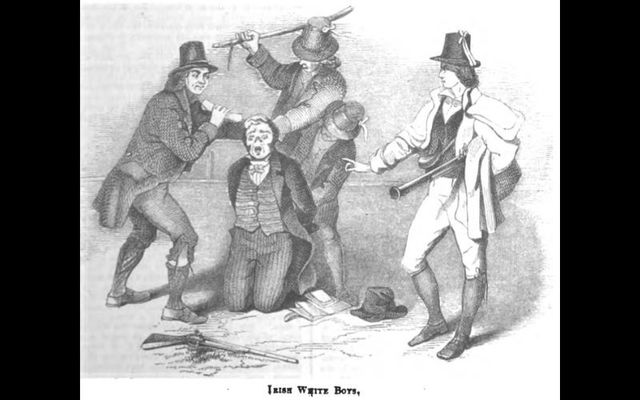
An agrarian secret society that originated in Tipperary in 1761 in opposition to the enclosures of common land. The movement then spread into neighbouring counties with an expanded agenda. Named for the white shirts worn over workday clothing. The movement died away by 1765 but re-emerged in 1769 in opposition to high rents, evictions and excessive levels of tithe payments. The term ‘Whiteboy’ continued to be used in the early 19th century as an umbrella term for violent agrarian activity, until it was gradually supplanted by the term ‘Ribbonism’. The 18th century legislation against agrarian crime passed in 1766, 1776 and 1787 became known as the ‘Whiteboy Acts’. 

A group of men in clothing

Description automatically generated

Whiteboy activity

Whitefeet

An offshoot of the Whiteboys, in that this was a secret agrarian society which emerged in the Carlow-Kilenny area in the 1830s in imitation of the 18th century Whiteboys. 

GLOSSARY: A-K ‘Land is all that matters: the struggle that shaped Irish history’.

Agistment

The process of bringing livestock to pasture. In 1735 the House of Commons effectively removed the ‘tithe of agistment’ thus ensuring that beef and milch cattle were exempt from tithes. This had the effect of shifting the burden from wealthy graziers to tillage and subsistence farmers.

Approver

An accused party offering evidence against his co-conspirators in a crime, in return for full or partial amnesty.

Back to the Land

A co-operative movement that emerged in the early years of the 20th century, raised its own finance, and purchased estates for division among small farmers and landless labourers. 

Bailiff 

An official whose function was to effect the eviction of a tenant and, if required, sequestration of the tenant’s ‘removables’ (furniture etc.). 

Bessborough Commission

Appointed in 1881 to inquire into the working of the 1870 Land Act and chaired by Frederick Ponsonby, 6th Earl of Bessborough. Its books of evidence offer a valuable insight into rural Ireland during the Land War. The Commission essentially offered support for the Land League (qv)  demands for the 3Fs (qv), the only dissenting commissioner being the landlord representative, the idiosyncratic Arthur McMurough Kavanagh, the limbless former MP and Lord Lieutenant of Carlow.  

Frederick Ponsonby, 6th Earl of Bessborough

Blackfeet

A Whiteboy variant that emerged in south Leinster in the 1830s. 

Board of Works

Established in 1831 the Board of Works spent £49m on public works projects up to 1914.

Boycotting

The despatch of an obnoxious tenant, agent, landlord or ‘grabber’ (qv)  to a ‘moral Coventry’. A process of ostracization generally seen to have been initiated in 1881 but actually a longstanding tactic in Irish agrarian campaigns. Individuals were cut off by their neighbours from all social and economic intercourse. Named for the Mayo land agent Captain Charles Boycott who was its most prominent victim during the Land War of 1879-82 (qv). 

Captain Charles Boycott

Canting

The sale by auction to the highest bidder of a farm with a recently evicted tenant or a tenant in the process of being evicted. 

‘Captain Moonlight’

A (mostly) 19th century euphemism for agrarian outrages. On being jailed in October 1881 Charles Stewart Parnell famously said that his place at the helm of agrarian agitation would be taken by ‘Captain Moonlight’. 

‘Captain Rock’

The mythical figure supposedly behind the Rockite disturbances of the 1820s. During that period many threatening letters bore the signature of ‘Captain Rock’ or ‘John Rock’. 

Caravats, the

An agrarian secret society whose antagonism was aimed not at landlords as such, but at large farmers. Their activities from 1806-11 were based in south Leinster (Kilkenny) and east Munster (Limerick, Tipperary, Waterford and Cork) and were opposed by a society of wealthy farmers known as the Shanavests (qv).  

Carders, the

An early 19th century agrarian secret society that took its name from the vicious practice of carding (qv). 

Carding

An atrocious punishment meted out by members of agrarian secret societies in which nails are driven through a board and this is then drawn across the back of a victim. This method was so extreme that it was eventually abandoned as it was deprecated by most of the supporters of even militant agrarian activism. 

Caretaker

A person or persons left to occupy a house after an eviction. The function was sometimes undertaken by bailiffs (qv) or ‘emergency men’ (qv) but often, where an eviction had been carried out largely as a warning to a tenant in arrears, the tenant himself would be left in situ as caretaker.  This practice partly accounted for the disparity between permanent evictions and tenant readmissions.

Carrickshock

A townland in County Kilkenny, near Knocktopher where a fracas in December 1831 during the Tithe War led to the deaths of a process server, a dozen policemen and three anti-tithe protestors.

Cattle driving

The practice, particularly notable during the Ranch War (19060-09) (qv), of stealing cattle and ‘driving’ them a considerable distance. Used as a form of protest and intimidation during the Ranch War. 

Cess

A tax levied by county Grand Juries for the upkeep of roads and bridges. Excess levels of cess in certain counties or baronies often sparked militant action by agrarian secret societies. The word is still a term of abuse in some parts of rural Ireland, as in ‘bad cess to you!’

Clachán

The community at the centre of land held under the rundale system (qv).  

Conacre

The act of renting a small area of land and planting a single crop, generally potatoes. 

Congested Districts Board 

Established by Tory chief secretary, Arthur Balfour, in 1891 to alleviate poverty in ‘congested’ regions of high population density and few resources in the west and northwest of Ireland. The CDB was dissolved by the new Irish Free State in 1923. An integral element of the Tory policy of ‘killing Home Rule with kindness’ in the 1890s.  

Congests’

The name often applied to impoverished tenants in general, but in particular to those from areas under the aegis of the Congested Districts Board (qv).

Cottier

Sometimes represented as ‘cottar’, these were generally agricultural labourers or small farmers who rented small plots (c. 1 acre) and planted potatoes thereon in return for their labour. Almost wiped out by the Great Famine. 

Cowper Commission

A commission of inquiry into Irish land tenure named for its chair, the former Lord Lieutenant, Earl Cowper, and established by the Tory government of Lord Salisbury. It reported in 1887, recognising that the fall in agricultural prices since the passage of the 1881 Land Act  had reduced the ability of tenants to pay even Land Court arbitrated rents.  

7th Earl Cowper

Deasy’s Act

Legislation passed in 1860 which altered the relationship of landlord and tenant, to the benefit of the latter. Passed through parliament without amendment, its central principle was that ‘The relation of landlord and tenant shall be deemed to be founded on the express or implied contract of the parties, and not upon tenure or service.’

Devon Commission, the  

Its full title was the ‘Royal Commission on the state of the law and practice relating to the occupation of land in Ireland’. It was chaired by the Co. Limerick landlord, William Courtney, 10th Earl of Devon. The commission gathered evidence and compiled its report between 1843 and 1845. Its central recommendation, that ‘tenant right’ be formally recognised by the payment of compensation to outgoing tenants for any improvements made to their farm, was not enacted into law.   

Distraint

The seizure of farm produce or implements, for subsequent sale at auction to meet the financial obligations of tenants in arrears to their landlords.

Down Survey

The Cromwellian-era mapping of Ireland under the supervision of Sir William Petty. 

Sir William Petty

Driver

A bailiff employed to drive distrained cattle to the pound. The term could also apply to a Ranch War-era moonlighter (qv) who ‘drives’ a grazier’s cattle from pasture land onto the roads. The former was generally reviled by small tenant farmers, but operated within the law. The latter did not, but was generally revered by small tenant farmers.  

Duty days

An obligation sometimes owed by a tenant to a landlord. The tenant was required to work on a set number of days per annum. A particularly vindictive landlord would demand his duty days at a time when a tenant needed to bring in his own harvest, in order to pay his rent. The fictional Thady Quirk refers to such punishments in Castle Rackrent by Maria Edgeworth.

‘Eleven month’ system

A device frequently used to get around the tenant-oriented land legislation of the 1880s and 1890s. Land was auctioned on an annual basis and the highest bidder was then allowed the use of the land for eleven months. The system encouraged wealthy merchants and professionals to purchase, graze and sell herds of livestock.  

Emergency men

A generic term for those offering their services as bailiffs (qv), or often as caretakers left in the houses of evicted tenants to ensure that their former occupants were unable to re-possess. The name is derived from one of the landlord bodies, the Orange Emergency Committee, which opposed the activities of the Land League during the Land War, and those of the Irish National League during the Plan of Campaign.   

Enclosure

The act of fencing off common land previously available to all members of a community. Most common land in Ireland and Britain had been enclosed by landowners by the end of the eighteenth century. 

Encumbered Estates Acts

Passed in 1848 and 1849 this legislation established the Encumbered Estates Court, which allowed the sale of the estates of landlords rendered insolvent by the Great Famine. Designed to encourage a new wave of British owners of Irish land, in fact much of the almost five million acres that changed hands went to wealthy Irish Roman Catholic landlords, often Dublin-based professional men. 

‘English tenant’

This has nothing to do with nationality but referred to a tenant who was required to pay his rent on the day it was due, rather than on a ‘gale day’ (qv) six month in arrears, as was the Irish custom. It could be used, for example, as a punishment by a landlord in the case of a tenant who had not voted as instructed in an election. He could be required to become an ‘English tenant’, i.e. immediately pay six months arrears of rent.  

Gale days

The bi-annual period during which tenants paid their rent, generally to a landlord’s agent. The two annual gale days tended to be in May and November. 

‘Grabber’

Or ‘land grabber’. Generally a tenant farmer who took over the land vacated by an evicted tenant. Many were threatened, injured or murdered. The phrase acquired particular currency during the Land War (1879-82). It later came to be applied to those illicitly seizing land during the Anglo Irish War and the subsequent Civil War.

Graziers

Farmers (and non-farmers) who rented extensive tracts of pasture land and raised cattle or sheep. This type of husbandry was anathema to small farmers and landless labourers because of the usage of what might otherwise have been arable land, available to rent. Graziers were also known (and not in a positive way) as ‘ranchers’.

‘Griffith’ valuation

Named after Richard Griffith, Commissioner of Valuation in Ireland from 1827 until 1868. Griffith was the man primarily responsible for mapping and valuing, for taxation purposes, the land of Ireland from the 1830s to the 1860s.

Richard Griffith, Commissioner of Valuation (1827-68)

Hanging gale

The first six month period (May-November or November-May) of a tenancy after which the tenant was obliged to pay his first portion of rent.  

Hearts of Oak

An 18th century agrarian secret society that emerged in Armagh in 1763 in opposition, at first, to a legal obligation on the part of tenants to work on road construction. After a few weeks of protest activities and muted violence the ‘Oakboys’ disbanded in the face of military opposition.  

Hearts of Steel

A more sustained—it continued in existence for three years—and coherent movement than the ‘Oakboys’ which emerged in Antrim and Down and was originally founded in opposition to ‘fines’ imposed on the estate of Lord Donegall on tenants who wanted to renew their leases. The ‘Steelboys’ often operated openly and they successfully attacked a Belfast barracks (1770) and Gilford Castle (1772).   

Heriot

A landlord right, deriving from an old medieval custom, to the use of a tenant’s horse at short notice. 

Houghers

An early agrarian secret society (1711-12) based in Connacht and opposed to the use of land for the purpose of grazing livestock. Named for one of their favoured methods of protest, the maiming of cattle.

Houghing 

Maiming cattle in order to intimidate their owner. The cattle would be lamed by severing their hamstring tendons. 

Improving landlords

Something of a ‘catch-all’ phrase covering everything from landlords wishing to divest themselves of tenants in order to ‘work’ their own estates, to landlords intent on either enhancing the lot of their tenants by undertaking ‘improvements’ to their land, or the introduction of progressive and more scientific farming methods. ‘Improving’ landlords (the term often appears in quotation marks to suggest a degree of historiographical scepticism of the breed) were often as welcome to the tenant as a bad toothache.   

‘Kilmainham Treaty, the’

An unofficial agreement brokered by Captain William O’Shea between the incarcerated Charles Stewart Parnell and British prime minister William E. Gladstone. The Liberal government agreed to introduce an act of parliament allowing tenants in arrears access to the newly established Land Courts, and Parnell agreed to use his ‘influence’ to end agrarian disorder and ‘outrage’. 

Captain William O’Shea

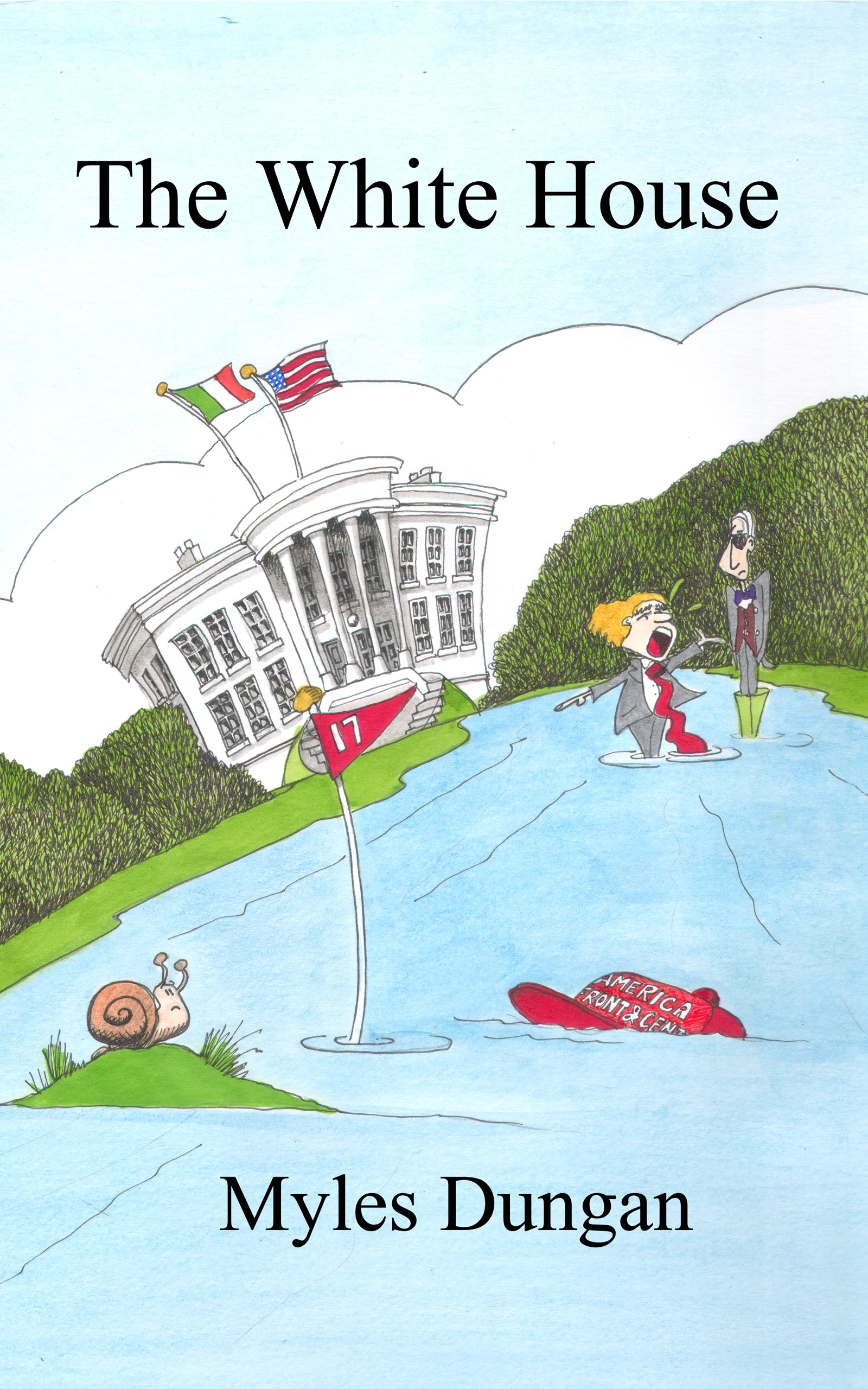
‘The White House’ – barely fiction!

Hardback copies now available. Send me an email (see ‘Contact’)’

Now available on Apple Books, Barnes and Noble,  Smashwords and on Kindle

Smashwords coupon code YU78H for a 33% price reduction until 21 May. 

U.S. President Tyrone Bentley Trout has a problem. His exclusive Irish golf course is falling victim to climate change and rising sea levels. He wants the Irish to build a wall, and he wants Ireland to pay for it. This is a tale of Russian interference, a tenacious Special Prosecutor, three ex-wives, a frustrated assassin, Ireland’s first female Taoiseach and a climactic golf match.

standard.pngiu.jpegiu.pngiu-1.jpeg

myles dungan final copy


Here’s a slightly longer preview. Strictly between ourselves. Don’t tell anyone. 

PROLOGUE


A future, of sorts, in a barely tangential universe…


The spaniel heard the limo approach and stopped licking his testicles. Fleetingly it occurred to him not to bother giving chase. After all only vassals pursued cars, and he was a feudal Lord. A High King. But the limo was sleek, interminable and enigmatic. Despite the intense cold, and his aristocratic lethargy, the chance to assert his mastery over a chrome and steel Titan was irresistible.

Agamemnon had a rigid modus operandi when it came to chasing cars. Some dogs bark and never leave the kerb. But where was the fun in that? Aggie had an appetite for physical and moral hazard. He really should have been shorting the euro on Wall Street, with his dealer on speed dial.

Agamemnon—his human was a history professor— had inherited his technique from his mother, Athena. Her style was an homage to her own mater, Aphrodite. Both had long since made the journey across the Styx, aged, obese and diabetic, but unmarked by a single car track. So why try and reinvent the hubcap?

As the limo swept past, its black windows impenetrable, splashing brackish water onto the hedgerows of his County Meath domain, Agamemnon sprang into action. He was the Hound of the Baskervilles. He was Cujo. He was Vishnu’s familiar, Death, destroyer of tyres. At least he would be if he ever caught one.

He set off after the vehicle with a surprising turn of speed for an animal who, with a certain physiological inevitability, was tending towards the avoirdupois of his ancestors. His neglected skills quickly reasserted themselves and his enthusiasm for the chase mounted. As the limo approached a pair of imposing gates it slowed down and, to his astonishment, he began to gain ground. Then it stopped altogether. He now held the monstrous beast in thrall. For Agamemnon, the prospect of imminent victory posed a dilemma. He had no idea what to do next. What do you do with an overpowered Leviathan whose body parts were composed entirely of aluminium, rubber, glass, tungsten and PVC?

As Agamemnon pondered his next move, the door opened on the front passenger’s side. A man with a crew cut and designer sunglasses emerged. He began talking aggressively to his sleeve.

‘Hey, dumbass. Why isn’t the gate open? Godammit, POTUS is a sitting duck here.’

Agamemnon became excited at the mention of ducks. Then a rasping voice came from the driver’s seat.

‘Stop with the POTUS, Schmidt. We’re not even supposed to be here.’

‘Sorry sir,’ said the sleeve-talker. He resumed the tête-a-tête with his clothing. ‘Repeat. Golden Eagle is a sitting duck here.’

Agamemnon was puzzled. How could an eagle be a duck, he wondered? He knew he was only a dog, but still, the proposition sounded absurd. Sleevetalker, who clearly had an interest in birds, now approached the entrance and began to press the buttons of a silver pad on the gate’s pillar. After punching the same four keys half a dozen times he reached into an inside pocket, took something out, and pointed it at the pad. He spread his feet a shoulder length apart, extended his arms, and secured his right wrist with his left hand. Then he had second thoughts. He abandoned his awkward stance, reached his left hand into another inside pocket and pulled out a piece of paper. He studied it for a moment, then tried some more buttons. There was an immediate response.  A bored voice issued from the metallic grille underneath the buttons.

‘Welcome to Beltra Country Club, how can I help you?’

‘You can open these goddamn gates and get POT … Golden Eagle out of harm’s way, numbnuts.’

Just then the rear window of the limo opened a few inches and a new voice, strident and high-pitched, intervened. To the superstitious dog, it sounded like the whine of the Banshee. An anxious Agamemnon began to whimper and look around for an escape route.  ‘What the merry fuck is going on here?’ rat-tat-tatted the Banshee. ‘Is this a negotiation?’

‘Did you hear that, asshole?’ Sleevetalker shouted at the pillar. There was a smooth whirring noise and the gates began to open. The engine of the car started up again. As it did so, Agamemnon feared that his quarry was about to elude him. Before Golden Eagle had time to disappear the black spaniel cocked his leg and urinated on the gleaming hubcap of the limo’s rear wheel.  Then the vehicle sped off down what looked to Aggie like an interesting driveway, one with lots of rabbit holes to either side and no obvious badger setts—badgers were trouble. Contented with his lot the little dog strutted back down the country road. He was returning home for another session with a copy of Edmund Burke’s Reflections on the Revolution in France.  It belonged to his history professor and, so far, hadn’t been missed. He had already chewed his way through a superior chapter on the gruesome reign of the guillotine and the depredations of Robespierre.


BOOK ONE – THE SEA

‘Cast thy bread upon the waters …’

Ecclesiastes 11:1

That smug patrician, Adrian Breakspear, had plenty to smirk about, thought President Trout. His face must be permanently fixed in one of his lop-sided leers. It was as if he had conjured the waters himself, like some tweedy Anglo-Irish Sea God. This thought, however fanciful, served to increase Trout’s agitation. He imagined Breakspear, a flop-haired Neptune, directing the acquiescent waves of the Irish sea, across the sands of Beltra beach, towards the fescue grass of the ‘White House’ green.

‘There must be some sort of blacklist I can put the bastard on?’ the President mused, staring vacantly out the window of the Oval Office at the bare branches of the crabapple trees in the Rose Garden. They were being pruned by a small army of well-muffled gardeners.

While he doodled on yet another unread daily CIA briefing, Trout couldn’t help feeling that, in spite of everything, Breakspear might ultimately have triumphed. The thought exasperated him. All the more so because the Breakspears, in all their horsey decrepitude, had oozed buttery condescension.  They liked to remind everybody that they were descended from the only English Pope. They had seized the Beltra lands by force majeure after their saintly ancestor sent his fellow countrymen to invade Ireland in 1169. In the circumstances, it was hardly surprising that the natives hadn’t taken kindly to the Breakspears. The disdain was entirely mutual and the twain rarely met. An inevitable consequence was centuries of spectacular in-breeding, exemplified by the ubiquity of the famous Breakspear unibrow. While their neighbours were impervious to the Breakspear pheromones, they had a stimulating effect within the extended family. Such a rate of consanguinity meant it was inevitable that a genetic glitch—someone like Adrian— would eventually lose the plot. In fact, he had managed to squander all four thousand acres of it.

Only someone as hapless as a Breakspear, however, Trout pondered with quiet satisfaction, could have fallen foul of pirates in the 21stcentury. Adrian had wagered the entire County Meath estate on a precarious Lloyds syndicate, being spectacularly mismanaged by some of his chinless old Etonian schoolmates. In 2010 the consortium took one punt too many on the insurance of cargo ships sailing off the Horn of Africa. The Breakspears, who had survived the Black Death, Cromwell, the Land League, a plethora of IRAs, and a substantial shareholding in Anglo Irish Bank, finally succumbed to Somali buccaneers with speedy motor boats, garish headbands, and a persuasive arsenal.

Then, from the west, a white knight had galloped to the rescue. Tyrone Trout was a humble New York billionaire hedge fund manager. He had amassed his wealth by failing to lose the entire fortune bequeathed him by his father, and by avoiding tax like most avoid stepping in dog shit. The Fall of the House of Breakspear had coincided with an epidemic of status anxiety on Wall Street. Clifton Cathcart III had begun the stampede of bankers and traders anxious to avoid the social stigma associated with the failure to acquire some heavily encumbered Irish real estate. Warren Buffet’s tide had gone out, and Ireland’s bankers had been caught swimming in the altogether. Wall Street’s Finest were snapping up Irish properties like crocodiles. If the degenerate Cathcart was buying Irish, then so was Tyrone Bentley Trout. The acquisition of the Beltra demesne (‘fabulous sea views, ripe for development’ – Real Estate Alliance) became a sacred mission.

Trout successfully gazumped an attempted purchase by the Irish state, when he offered the Breakspears twice what the Office of Public Works couldn’t afford anyway. This minor coup had added the all-important hint of lemon juice to his mayonnaise. The word ‘public’ offended him, and he had promised his billionaire father on the latter’s death bed that he would never flinch in the fight against briefcase socialism. What clinched his triumph was the ‘sweetheart’ deal he dangled before the Breakspears. The family could remain in situ in Beltra House, while their knight errant doffed his armour and constructed two championship golf courses in the demesne land around them.

Breakspear and Trout had sealed the transaction with a gentlemanly handshake. Unhappily for Breakspear, however,  he neglected to count his fingers after pressing the flesh. Had Trout been a man of his word he would have been a mere hedge fund millionaire.

The official photographer who recorded the happy event had difficulty framing his shot. The Anglo-Norman Breakspear was tall and slender, yet to manifest the famous family stoop. The cross-bred Trout was squat. His father and mother had been squat, his younger brother was squatter still. Trout was also a sixty-something, cantankerous, florid alpha male who liked to tell photographers—and most other service providers—how to do their jobs. Trout’s priority was a favourable camera angle, this was essential to avoid drawing unnecessary public attention to the jaw-dropping wig whose very existence he consistently denied.

At first, the deal had worked unexpectedly well for the Breakspears. The discovery of a thriving colony of protected whorl snails on their former estate delayed the start of course construction. After a congenial visit to New York, however, the incumbent Taoiseach, Austin Purcell, had come to see things from the billionaire’s point of view. His considered judgment was that having a ‘signature’ Trout leisure development in Ireland was well worth the inconvenience of flouting the European Union Habitats Directive—at a cost to the state of €20,000 a day.  There were unpalatable, and unprovable rumours that Purcell had been well recompensed for his own inconvenience.

Having now accounted for the wildlife, Trout had built his two Jack Nicklaus-designed golf courses—Beltra (Links) and Beltra (Park)—while the Breakspears slumbered. But as soon as the designer’s helicopter had taken to the air at the end of the exhibition match marking the opening of the two courses, the Breakspears had been unceremoniously shunted out. A couple of ostentatious suits of armour were imported for the lobby and their Beltra mansion became a ‘Blue Book’ country house hotel, specialising in upmarket weddings.

After their humiliating eviction, there was one final, despairing throw of the dice from the Breakspears. A shadowy organisation calling itself the New Irish Land League emerged from the snooker room of the Merrion Street Club to fight the eviction. In response, Trout International hired half a dozen sinewy members of the Drogheda Mixed Martial Arts club to act as their champions. Facing a dialogue with six ‘wannabe’ Conor McGregors, the New Irish Land League had discretely ‘called stumps’ and had never been heard of again.

Then, just a few weeks after the disaster of the Presidential victory, came more bad news from Ireland. Nature had chosen to demonstrate its abhorrence of a vacuum, and its support for climate change science, by sending a tempest against his property. The ‘signature’ seventeenth hole of Beltra (Links) had been in the eye of the storm. This was Nicklaus’s personal favourite. He had named it the ‘White House’ in honour of Trout’s maverick run for the Presidency. After an impressive winter storm, all that remained of his verdant ‘White House’ was a partially submerged flagstick. Even this had quickly been claimed by an enterprising souvenir hunter in a kayak.  Defying the wishes of the Secret Service, Trout, in the midst of the presidential transition, had gone to have a look for himself. What he saw on his clandestine mission dismayed him. Having started life as a classic dogleg left—with three fairway bunkers in the shape of a shamrock—the ‘White House’ was now an expensive water hazard.

Trout recalled to mind a lesson that his father had once taught him after ‘Junior’ had crashed one of ‘Senior’s’ Mercs. Someone would pay for the damage, and it was not going to be Daddy.


Edward Rothko, United States Commerce Secretary, was a trim, elegant, vigorous looking athlete of early middle age. The former merchant banker was a grizzled, non-smoking, Marlboro’ Man, squeezed into the sharpest of Armani suits. In his previous life, for which he was beginning to yearn already, he had haunted the gym of the New York Athletic Club. His daily 6.00 a.m. workout—always accompanied by two competing personal trainers—was the chisel that had chipped out the angles and shallow recesses of his attenuated face. He liked to think of his body as a temple, though, in truth, it was little more than a modest synagogue.  He encouraged both Angelo and Jalen to call him ‘The Beast of the Bourse’ hoping that the nickname would reach the executive washrooms of Wall Street. So far, it hadn’t caught on, and now that he had relocated to DC he would have to start from scratch.

The Presidential Transition Team had plucked him from Price Waterhouse Cooper and deposited him in a swimming pool-sized office on 1401 Constitution Avenue, a few blocks from the White House. Rothko had sat beside a Stanford academic at Trout’s inauguration. She chatted about the charms of eugenics, the elegance of the Bell curve, and her loathing for John Maynard Keynes (‘I’m told he was a compulsive onanist!’), while Rothko shivered in the dry freezing air and wondered what an onanist was. So far he had spent the first three days of his tenure doing little more than conducting job interviews with beetle-browed economists far to the right of the late Milton Friedman while nursing his attendant migraine, and sneaking a nostalgic look at the Hang Seng Index on Bloomberg TV. His tightening hamstrings reminded him of how much he missed Angelo and Jalen.

Today he had been peremptorily summoned to the White House. He had been greeted on his arrival at 1600 Pennsylvania Avenue by the carnivorous Buchanan. Trout’s sentinel handed him a (temporary) laminated White House pass.

‘The first of many, I’m sure,’ said the Chief of Staff jovially, in the manner of one of Pavlov’s dogs who has heard a bell ring. The man made Rothko nervous, and it wasn’t just the infamous black eye patch either. The cadaverous Buchanan always looked as if he hadn’t eaten for weeks, and was sizing you up as a potential snack. He had, thought Rothko, the balls of Satan, and the charms of a funnel web spider.

‘Any idea what this is about?’ Rothko inquired, trying not to sound too diffident. He was, after all, tenth in line of succession to the Oval office. He’d looked it up on Wikipedia before agreeing to take the job.

‘It must be about you, I suppose. Just be yourself,’ replied Buchanan unhelpfully. ‘And an occasional display of fawning deference wouldn’t go amiss.’

The laconic Chief of Staff had then ushered Rothko into the Oval office without offering any further enlightenment.  As he entered the room the Commerce Secretary detected a musky but vaguely familiar odour. Trout was finishing off what looked like a helping of chicken nuggets. Rothko hadn’t seen a chicken nugget face to face since finishing a teenage internship in a Brooklyn McDonald’s at the insistence of his autocratic father. He immediately understood why the White House Chef had already handed in his notice.

Rothko was motioned by the Falstaffian Trout, his mouth brimming with capon, towards the opposite side of the huge Oval Office Resolute desk. The proffered seat looked extraordinarily like an electric chair with truncated legs. When the Secretary sat, his head barely appeared above the top of the oaken writing table. He was looking almost directly into a carving of a bald eagle with an E Pluribus Unum scroll billowing from its beak.

Without swallowing the remnants of his lunch the President had dived right in,  berating his Secretary of Commerce for obscure sins of omission. Rothko did his best to be sycophantic but lacked any bearings. Worse still he became fatally distracted by a sliver of white chicken lodged between the President’s yellowing upper incisors. He studied it attentively as the rant continued, wondering when it would dislodge. Should he say something? What if the President’s next meeting involved lots of hand-holding and congenial grins?  Deflected from the message by the medium, he missed the thrust of the President’s diatribe. He gathered that vital American commercial interests in Ireland were at stake, but then became confused by militaristic references to ‘flags’ and ‘bunkers’. His bewilderment had accumulated just enough octane to fuel an interruption when the President curtailed his tirade to swallow a mouthful of something dark and bubbly from a red aluminium can. It had no effect on the sliver of chicken, which still clung to greatness.

‘I’m sorry Mr. President but I wasn’t aware that we had bases in the Republic of Ireland,’ the Secretary ventured. His speech was so rapid that he feared his sudden lack of diffidence might be construed as insubordination. His dental preoccupation also meant that he had no inkling what a military crisis in the North Atlantic had to do with the Commerce Department.

Trout grunted, opened a drawer and produced a toothpick. A tsunami of relief washed over the Commerce Secretary. He was off the orthodontic hook.

‘Who said anything about military bases?’ hissed Trout ‘ We’re discussing an endangered American facility on Irish soil – soil, I might add, which is eroding at an alarming rate and is rearranging the boundaries of a US overseas dependency.’

‘Eh … overseas dependency Mr. President?’

‘Yeh! Like Guam … or Hawaii. US sovereign territory is shrinking by the day and the Commerce Department is doing nothing about it.’

Just then Rothko felt a sharp pain in the meaty part of his right thigh. He jerked upwards. He’d been correct about the chair, he thought. There must be a button under the desk. How many more volts did Trout have at his disposal? The first jolt had only been a warning. Then, looking down, he spied what appeared to be a matted blob of orange marmalade perched on his lap. It had flamboyant whiskers and two malevolent walleyes.

‘Aww,’ murmured Trout affectionately, ‘I see you’ve made friends with Supreme Court.’

‘The Supreme Court, sir?’ Rothko was, by now, so far out to sea that he might have been a minor character in a Patrick O’Brian novel.

‘Not THE Supreme Court, you moron. MY Supreme Court. The cat sitting in your lap. A magnificent specimen, don’t you think?’ purred Trout.

Rothko couldn’t have agreed less, barring the probability that Supreme Court’s magnificence could be measured in litres of pure evil.  While Rothko eyed the cat warily, and surreptitiously rubbed his smarting thigh, the President had returned to the matter in hand.

‘You’re my Commerce Secretary, right? Rubenstein … or something like that.’

‘Rothko, sir.’

The President looked at him with sudden interest.

‘Rothko … didn’t my wife—not this one … Number Two … the one with the weird accent—buy some piece of crap painting from you, for my kitchen?’

‘I think you’re mistaken Mr Pres—’

‘You’re right. Maybe it’s the one in the john. Lots of straight lines and boxes.’

‘I think you’ll find …’

‘Doesn’t matter. Moved on already. So you ARE my Commerce secretary …?’

‘Absolutely, sir. However, might I suggest, Mr President, that this may not be within my bailiwick?’ He considered making a joke about waging a trade war but thought better of it. He had already heard rumours about how policy was being made in the Oval Office.

Trout speared a post-it note on his desk with the toothpick. He began to twirl it between thumb and index finger as if it was a square yellow cocktail umbrella.

‘Your … bailiwick?’ he inquired, menacingly. Too late, Rothko remembered that Trout had no grasp of multisyllabic English. He spoke what he called ‘American’, and carved short cuts through language like a Deliveroo cyclist.  Rothko took a deep breath and tried again. ‘My province.’ And again. ‘My sphere of responsibility.’ A slight upward movement of Trout’s jowls indicated that he had finally understood. Rothko wondered whether it was the ‘province’ or the ‘sphere’ that had captured the heights.

‘So, who do I need to talk to that can put the shits up the Irish?’ asked the President, stabbing the air with the toothpick, which, to the Secretary’s dismay, had yet to be applied to the purpose for which it was designed.

‘Probably the Secretary of State, Mr President.’

‘State? That scrawny motherfucker. Maybe I should just go straight to the Joint Chiefs of Staff?’

‘That might be a shade provocative, don’t you think, Mr President? I don’t believe Ireland has much of a standing army worth talking about.’

Trout laid the toothpick on the table and opened a second drawer. From this to Rothko’s surprise, he produced a packet of cigarettes and proceeded to light one. Instinctively the Commerce Secretary’s eyes sought out the nearest smoke alarm. Trout intercepted the glance and smirked.

‘They’re all gone. Sprinklers too. Obama got rid of them. Sly bastard.’

Rothko smiled wanly. That explained the strange but oddly familiar aroma, he thought.

‘OK, we’re done here,’ barked Trout. ‘You can go now. Put down Supreme Court and send in Buchanan. Chop chop!’

As Rothko gingerly extracted himself from underneath the ginger tom and beat a welcome retreat, the President suddenly changed his mind and called him back. With a sinking feeling in the pit of his stomach, Rothko returned to the huge oaken desk, by now denuded of everything other than a phone, a hideously mutilated post-it note, and a leaf of discarded iceberg lettuce from the President’s chicken nuggets that had been pressed into service as an ashtray.

Rothko knew instinctively that he was about to be fired. Angelo and Jalen beckoned. He wondered what the previous record was for the shortest tenure as Commerce Secretary.

‘I remember now’, said Trout. In his head, Rothko was already composing his resignation letter. Abrupt or apologia? Terse and enigmatic, he decided. Mostly verbs.

‘It was the john,’ said Trout, thoroughly pleased with himself.

‘Eh … what was, sir?’

‘Where I hung that painting of yours. The reason I remember is that bar a couple of random lines of beige, it was the colour of shit.’

With a flourish, he extracted the sliver of chicken with the nail of his index finger, studied it for a moment, returned it to his mouth, and swallowed it.

As the last shard of Presidential nugget slipped down the Commander in Chief’s throat he turned his attention, once again, to the man he took to be an abstract expressionist.

‘Do you play golf?’ he asked.


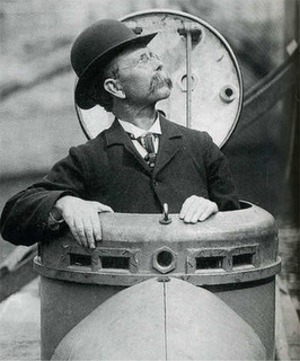
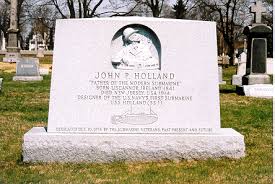
On This Day 24 February 1841 – Birth of John Philip Holland

John_Philip_Holland.jpgimages.jpeg


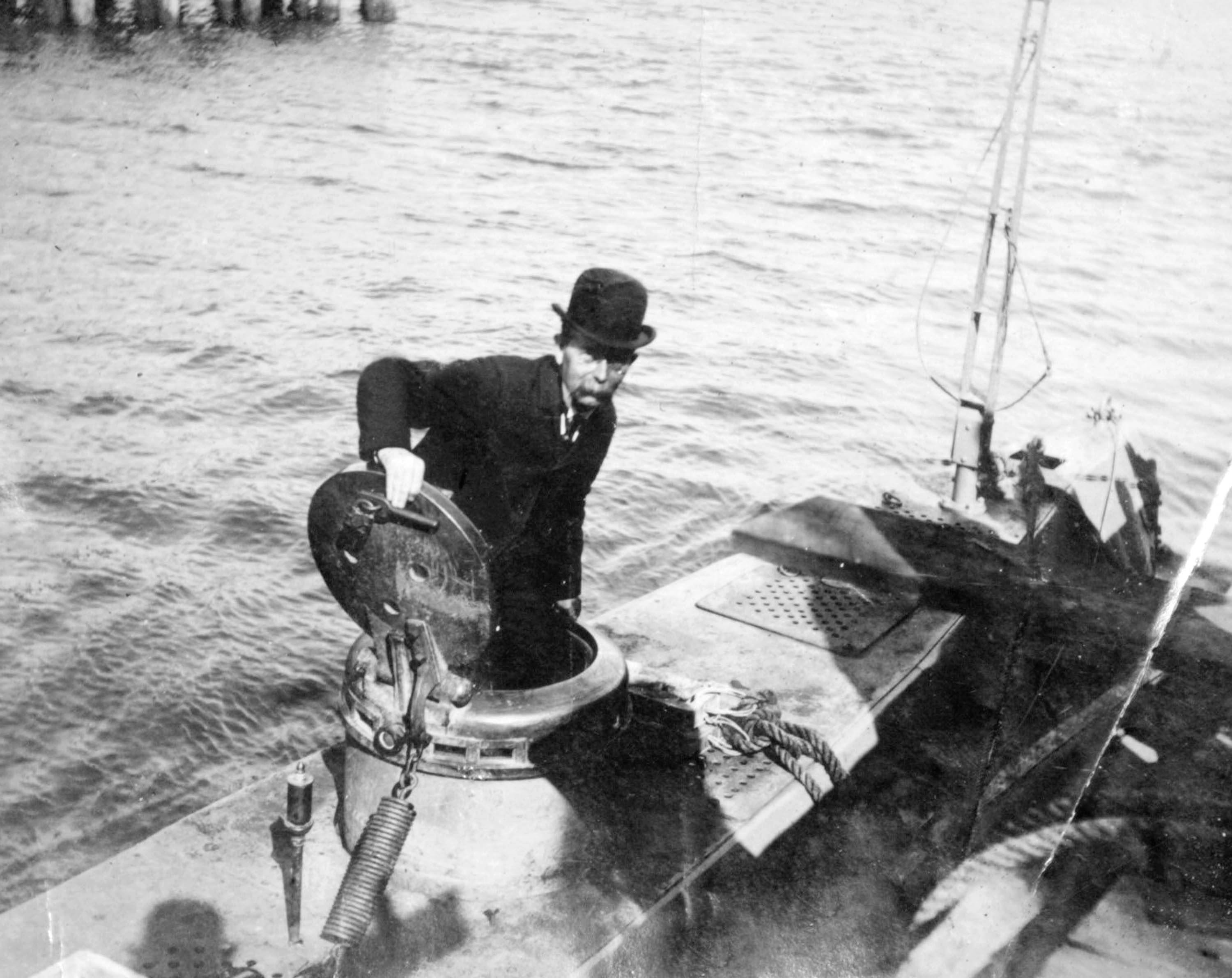
The next time a Royal Navy submarine engages in one of the force’s favourite pastimes, namely ‘snag an Irish trawler’, its crew might pause to reflect on the fact that the man who invented their vessel was brought up speaking Irish, and was once a Christian Brother.

John Philip Holland didn’t start to learn English until he went to national school in Liscannor, Co. Clare, just as the Famine was beginning to take hold in the west of Ireland.

His father, an employee of the British Coastguard Service, would probably not have approved of the first intended use of his new invention—it was built at the behest of the Fenians to blow up British shipping.

Holland was born in 1841 and left Ireland in 1873, after a stint as a schoolteacher in a variety of locations, including the North Monastery in Cork. It seems that he had already been working on his invention before he left Ireland. He settled down in Paterson, New Jersey and started to develop a patent, which he first offered to the US Navy in 1875. They rejected it as ‘a fantastic scheme of a civilian landsman’.

Holland’s brother, who lived in Boston, happened to be a member of the Irish Republican Brotherhood, and it was through his sibling that Holland met John Devoy and Jeremiah O’Donovan Rossa. Devoy was impressed by Holland’s nationalism, and by the potential for havoc of his invention. Money was appropriated from O’Donovan Rossa’s infamous ‘Skirmishing Fund’—collected from Irish-American nationalists for use in freeing the ‘old sod’—and Holland was engaged to build a prototype.

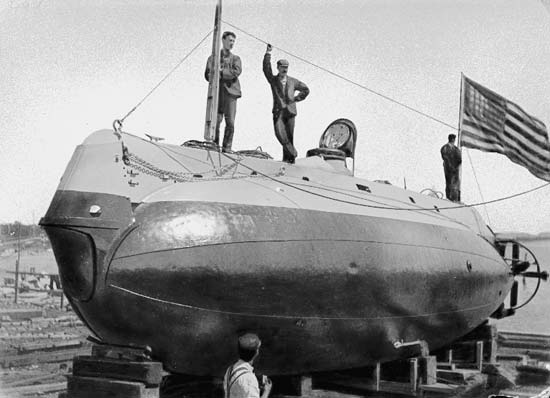
114359-004-9A5352E4.jpg

Holland was enabled by the Fenians to give up his teaching job, and work on the project full time. He used Rossa’s fund to develop his first model in 1878, the Holland 1, a one-man, fourteen-foot craft, with a two-cylinder engine.

By 1881 he had refined his original design, and produced a three-man vessel, thirty-one feet long, which became known as The Fenian Ram, but which could not sustain extended periods of use underwater.

While he was working for the Fenians, Holland could never seem to get it absolutely right. If he designed a submarine that could remain underwater for long periods, it would develop engine trouble. He also got into difficulties with port authorities in New York and New Haven, who considered him, quite literally, a danger to shipping. After an investment of sixty thousand dollars, with little or nothing to show for it, other than three interesting models, the Clan and Holland parted company. Fortunately Clan na Gael had no Comptroller and Auditor General among their ranks to issue a negative report about the waste of good Skirmishing Fund money, funds that might have been better used in the dynamite campaign then going on in London.

Holland continued to experiment. He developed a fourth prototype, which didn’t seem to excite anybody too much either, until he attracted the attention of a wealthy lawyer, J.B.Frost, who staked him until he got it right. He hit pay dirt with ‘Model No. 6’. It was fifty-three feet long, had a six-man crew, could dive to sixty feet, and stay under for nearly two days. It was also armed with torpedoes. The US Navy gave him one hundred and fifty thousand dollars for it, named it the USS Holland, and asked for six more please. Oh, yes—then they really annoyed the inventor by selling the plans to the British Navy.

Holland died in 1914, barely a week after the beginning of the global war that was to see his invention kill thousands of people, including women and children, on board commercial vessels like the Lusitania.

John Philip Holland, Clare man, ex-Christian Brother, native Irish speaker, and inventor of one of the most lethal weapons in military history, was born one hundred and seventy-six years ago, on this day.

John-P-Holland.jpg