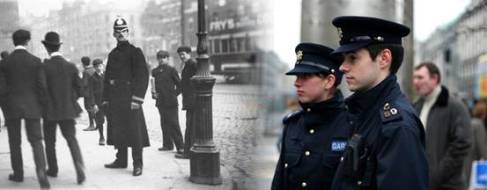
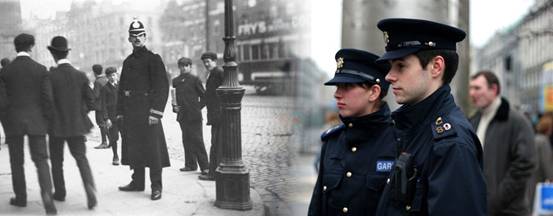
An Garda Siochana are in the jobs market again. Although only 250 trainees will be taken on, already there is no shortage of young men and women keen to join.
There was no doubt, in early 1922, in the minds of the country’s founding fathers that one of the first colonial institutions to go would be the paramilitary Royal Irish Constabulary. The Dublin Metropolitan Police, an unarmed force, some of whose members had provided Michael Collins with valuable intelligence, was left intact for the time being. Among the agents of Collins was Ned Broy – who subsequently became Garda Commissioner –making a remarkable recovery from having been murdered in Neil Jordan’s Michael Collins movie. The DMP wasn’t subsumed into the newly created an Garda Siochana until 1925.
New recruits had to sit an exam in reading, spelling and arithmetic. They had to be 5 foot 9 inches tall and between 19 and 27 years of age to become cadets. The very first Civic Guard – the name originally chosen for the force – was, as it happens, an ex-RIC man P.J.Kerrigan.
The second Garda Commissioner was the infamous Eoin O’Duffy, founder of the Blueshirts. O’Duffy was dismissed by the newly elected Fianna Fail govt in 1933. There have been 19 Commissioners to date.
Perhaps the most famous Guard was Dubliner Jim ‘Lugs’ Branigan, who regularly used his fists, officially and unofficially, in the course of his duties. Branigan was in his pomp at the time of the so-called Animal Gangs in 1930s and 40s. In May 1940 at the so-called Battle of Baldoyle, Branigan (and other Guards) were forced to wade in and disarm gang members equipped with bayonets, butchers knives, swords and razors. Challenged on their way to the confrontation they had claimed to be going to a wedding. Injuries included a knife through the lung of one gang member and a rusty bayonet through the thigh of another. It appears that while there were plenty of grooms and best-men the bride never showed.
Branigan retired on 6 January 1973. He received many tributes, but was particularly touched by a canteen of cutlery and a set of Waterford glass from a group of Dublin prostitutes, who regarded him as something of a father figure.[ii]
According to the Garda Roll of Honour a surprising 86 members of the Force have died on active duty. While some deaths were accidental many Guards have been murdered since the force was established. One of the earliest was Henry Phelan on 14 November 1922. Garda Phelan was killed by armed men when he went to a shop in Mullinahone, Co. Tipperary to purchase hurleys.
In the early days of the Troubles, in 1970, Garda Richard Fallon pursued armed members of the Republican splinter group Saor Eire and was fatally wounded when shot by one of the raiders. Two years later Inspector Sam Donegan was conducting searches on the Cavan/Fermanagh border when he was killed by a booby-trap bomb in a country lane.
The Scott medal, awarded to Gardai for bravery, has become something of a yardstick of troubled times in Ireland. In the 1970s when paramilitary activity was at its height there were 96 Scott Medals awarded. Contrast that with a total of six between 1951-60
A recruitment drive for the Civic Guards began 92 years ago, on this day.

 Myles Dungan
You must be logged in to post a comment.