On This Day 9.3.1931  Birth of Jackie Healy Rae 


Unknownoriginal

He actually shares a name with one of Ireland’s best known journalists, the great political columnist John Healy, a noted champion of rural Ireland. Which is oddly appropriate, because the man we know as Jackie Healy Rae had similar affinities, albeit largely to his own small part of the Irish countryside.

He was born in 1931, one of six children who grew up on a farm in Kerry. The ‘Rae’ in his surname, the bit after the unlikely hyphen, comes from the area in which he grew up, Reacaisleach. He was a prominent member of the local GAA in his youth. But his prowess would be of little use to him when it came to winning votes at elections. Because Jackie Healy-Rae, as well as sporting an aristocratic hyphen, was a hurler. Now who would vote for a hurler in Kerry? Who can even name a single Kerry hurler?  He was also an accomplished musician. Accordion perhaps? Maybe the flute? Neither. Jackie Healy-Rae, always a contrarian, shared a passion for the instrument made famous by John Coltrane, Charlie Parker and Lisa Simpson. He was a saxophone player.

Starting in the early 1970s Healy-Rae was a dedicated member of the Fianna Fail party, working assiduously and effectively at election times to get local supremo John O’Leary into the Dail over and over again. Under his guiding hand as director of elections and a county councillor Fianna Fail regularly claimed two seats out of three in his South Kerry bailiwick.

Then came the 1997 general election and it was Jackie’s turn to stand for the Dail after John O’Leary announced he was retiring. Except that it wasn’t. Despite all his hard work over the previous thirty years he was passed over for selection. Fianna Fail would go on to rue the day they messed with Jackie Healy-Rae. He stood as an independent, was given no chance, but did what far too many politicians are doing today, and defied the pollsters, by taking a seat. Not only that but he topped the poll. The seat has been in the family ever since.

He got lucky—though in politics you make your own luck—when the putative Fianna Fail/Progressive Democrat coalition was a few nails short of a governing tool box. Bertie Ahern’s government needed the support of four independents. Jackie—by now becoming known to a wider and not altogether welcoming public for his impenetrable Kerry accent and glued on cap—drove a hard bargain for his constituents, and they loved him for it. He arrived in Dublin after the election stand-off with a shopping list of road-building, pier, harbour and hospital construction, spiced with a tincture of agricultural grants, and job creation projects, for South Kerry.

His reward, during the 2002 general election, was a surprise call for a recount when the second Fianna Fail candidate, Tom Fleming, finished just over two hundred votes behind him. That did not go down well in Healy-Rae-ville. He was returned to the Dail, but the new government didn’t need his vote any longer, so the shopping list went back into his pocket. He did not get to produce it again.

Never renowned as an orator, his contributions to Dail debates were infrequent, and his attendance rate at the Oireachtas committee which he chaired left a lot to be desired. But that didn’t greatly bother his constituents. And he was nothing if not colourful. Among his most memorable Rae-isms are his immortal threat to pull the plug on the FF/PD coalition with the observation that ‘the fellas inside there [he was referring to the Dail] can be getting oil for the chains of their bikes.’ On his less affluent constituents he remarked that, ‘some people coming to me are so poor they couldn’t buy a jacket for a gooseberry.’

Though seen as a conservative political force he was no backwoodsman, and often adopted a libertarian, ‘live and let live’ approach. His attitude to a proposal for a nude beach in Ballybunion, for example, was ‘If people want to go without clothes, why should they be made wear them.’ When asked about the fate of Bishop Eamon Casey, he pointed out that the prelate had ‘got a raw deal, and what the man did was very light indeed compared with things that emerged about other churchmen afterwards.’

Jackie Healy-Rae, an independent voice, but a politician from the Fianna Fail gene pool, was born eighty-seven years ago, on this day.
 

On This Day 2 March 1948  – Birth of Rory Gallagher


original.jpeg

He was the first Liam Gallagher, albeit with a hundred times more talent than the former Oasis lead singer. That’s because he was christened William Rory Gallagher. The William bit never caught on and we all know him simply as ‘Rory’.  In this country, if you just use his first name, everyone knows who you mean.

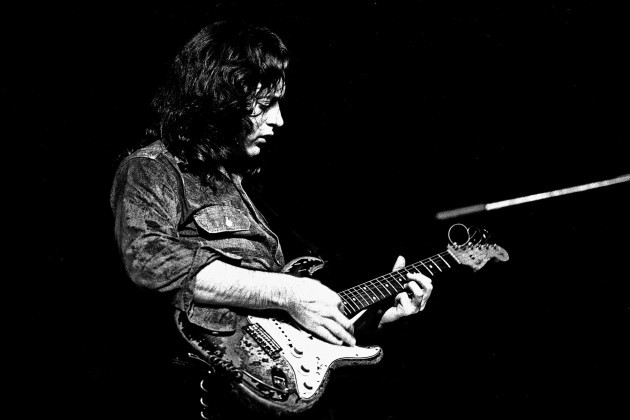
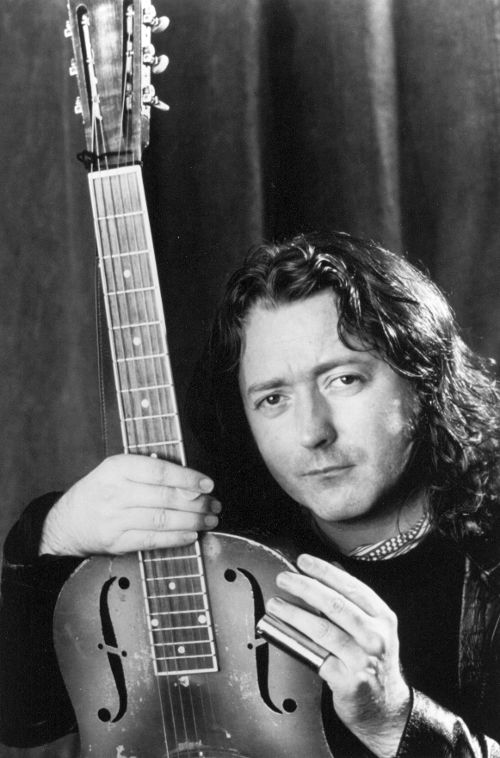
He was the Siamese twin of a sunburst 1961 Fender Stratocaster—Serial Number 64351—  purchased for around £100, second hand, in Crowley’s Music Store in MacCurtain Street in Cork in 1963, when he was fifteen.  He wanted a guitar like Buddy Holly’s. As a kid, he loved Lonnie Donegan and skiffle, graduated to Muddy Waters and the blues, and played the music of Eddie Cochran and Buddy Holly, before he found his own unique voice. He couldn’t afford to buy records, so he listened a lot to Radio Luxembourg and the American Armed Forces Network, drifting in and out of coverage, on the family radio. Eventually, as a guitarist and, arguably, as a singer and songwriter, he would eclipse all his early influences. Because Rory Gallagher was the business. He was also shy, charming, engaging, modest, and an out and out gentleman.

Just to rewind a little. William Rory Gallagher was born in Ballyshannon, Co. Donegal—I would be justifiably slaughtered if I omitted to mention that—but was raised in the city of Cork, from where he got his accent, as well as his first electric guitar, which, by the way, was once stolen from the back of his van, and found in a ditch a few days later.

As a music crazy teen-ager, he earned the money to pay for the Fender Stratocaster by playing with the Fontana showband, but pop music covers were not his thing and, in 1966 he formed the R&B trio Taste, along with Norman Damery and Eric Kitteringham, also from Cork. Two albums later, he went solo, and began a twenty-year association with bass player Gerry McAvoy. By 1971 he was topping the Melody Maker’s Guitarist of the Year list, ahead of someone called Eric Clapton.

In a career that lasted more than thirty years he sold an average of a million albums a year, but it was his live performances that got his juices going, and endeared him to a generation of air-guitar playing fans. Alongside Van Morrison and Phil Lynott—to both of whom lead guitar was anathema—Gallagher became a bona fide Irish rock superstar, without ever courting or exploiting that status. His check shirts, blue jeans, flowing hair, battered Fender, and passion, set him apart from the posers, pranksters and piss-artists who populated rock music in the 1970s and 80s, just as they do today.

Rory always remained true to himself and his music. He was asked to replace the legendary Ritchie Blackmore as lead guitarist with Deep Purple, and, allegedly, Mick Taylor of the Rolling Stones, but opted to stay solo. Throughout his career there is little doubt that, despite his notorious perfectionism, he placed far less value on his own abilities than did his legion of fans, and music industry admirers. Sometimes you can be just a little too modest and self-deprecating.

He also had time for everyone. One young guitarist recalls asking Rory how he achieved his unique sound. Gallagher sat him down and showed him. The young man went on become Brian May, so Queen owe at least some of their distinctive sound to Rory.

Although never your stereotypical recreational drug-taking rock star Gallagher had a fondness for alcohol which, over the years, adversely affected his liver. In 1995, he was admitted to King’s Hospital in London for treatment, and while awaiting a liver transplant contracted an MRSA infection, and died at the age of forty-seven.

Jimi Hendrix was once asked who was the greatest guitarist in the world, he responded, with becoming modesty, ‘I don’t know, go ask Rory Gallagher.’

Ireland’s greatest guitarist, Rory Gallagher, was born in Ballyshannon—there, I’ve said it again—seventy years ago, on this day.

MI0001404906.jpg


On This Day 23 February 1943 – St. Joseph’s Orphanage fire in Cavan


cavan-orphanage-fire.jpghqdefault.jpg

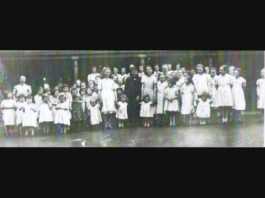
Long before the Stardust—where forty-eight young people lost their lives in the 1981—there was the Poor Clares fire in Cavan! This is a story very much in keeping with the illustrious Irish tradition of religious run orphanages, mother and baby homes, reform schools and Magdalene laundries.

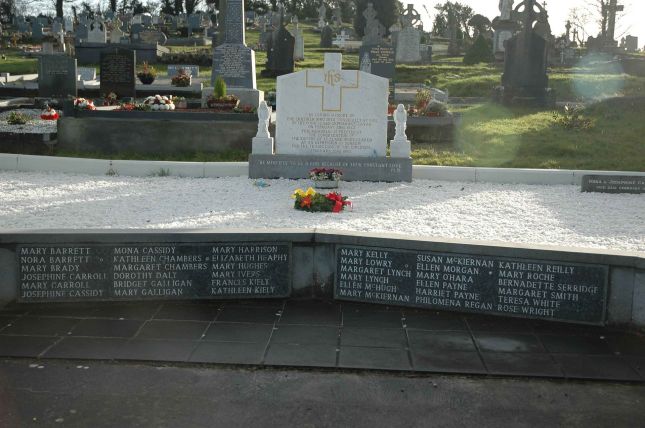
It was a disaster that could so easily have been avoided, a tragedy of errors, and it cost the lives of thirty-five young orphan girls, and one adult employee, in February 1943.

St. Joseph’s Orphanage and Industrial School, run by the enclosed and contemplative order of Poor Clare nuns, had been a fixture in the centre of the town of Cavan since its establishment in 1869. By 1943 it was a grim, austere building where, on the night of 23 February, a small fire broke out in the basement laundry. This wasn’t noticed until after midnight on the morning of the 24th.

Once the alarm was raised, everyone in the building could have been evacuated immediately. There was still plenty of time to get all the girls, nuns and staff down to the street below. Instead the nuns decided to move all their young charges into one dormitory, and wait until someone put the fire out. The received wisdom at the time was that the Poor Clare sisters were prepared to risk the lives of more than eighty young girls, in order to avoid the embarrassment of them being seen in public in their nightgowns.

Two local men, John Kennedy and John McNally, took it upon themselves to attempt to put the fire out at source. They barely escaped from the laundry with their lives. McNally collapsed and had to be dragged out by Kennedy. As the fire took hold it now became impossible for the girls to be evacuated from their upstairs dormitory through the main entrance.

The town of Cavan in 1943 lacked a formal fire service. Dundalk Fire Brigade was notified, but by the time the fire tender had come from almost fifty miles away it was far too late. It appears that no one thought to contact Enniskillen fire station which was closer to Cavan than Dundalk.

What there was of a local fire service in the town in 1943 did not have ladders long enough to reach the girls in their dormitory. They were encouraged to jump. Three did so, incurring injuries, but surviving. The others, mostly younger children, were too scared to attempt the leap. A number of children managed to escape by a variety of hazardous routes, including a burning fire escape. Five were rescued when a ladder, adequate to the task, was finally found. The rest died when the flames reached the dormitory.

Afterwards there was a public inquiry, which found that the disaster had taken place due to an electrical fault. No one was held responsible. Locals, in the main, blamed the inaction, panic or rumoured prurience of the Poor Clare nuns. Secretary to the Inquiry was one Brian O’Nolan, a Dublin-based civil servant, better known as the writer Flann O’Brien. Along with one of the barristers at the inquiry, future Fine Gael TD and Presidential candidate, Tom O’Higgins, he penned a limerick which captured local feeling on the proper attribution of blame. It went:


In Cavan, there was a great fire

Judge McCarthy was sent to inquire

It would be a shame

If the nuns were to blame

So, it had to be caused by a wire.


Two of the dead girls, Mary Elizabeth and Susan McKiernan, had been placed in the Orphanage at the insistence of a local priest, after the death of their mother. The alternative was being raised by their father, or willing Protestant neighbours. The youngest orphan fatality was Elizabeth Heaphy from Swords, aged four, the eldest was eighteen-year old Mary Galligan from Drumcassidy in Cavan. None of the members of the Poor Clare order died in the fire, despite their own reluctance to leave the building. As members of an enclosed order many of the nuns apparently felt that to do so was a violation of their vows. The only adult fatality was the eighty-year old cook, Mary Smith. Rescuers found enough remains to fill eight coffins, these were then buried in a mass grave.

A fire that claimed the lives of thirty-six people, mostly young orphan girls, began to take hold in the laundry of St. Joseph’s Orphanage in Cavan, seventy-five years ago, on this day.


cavan_orphanage_grave.jpg

On This Day- 16.2.1902  Birth of Delia Murphy


maxresdefault.jpg

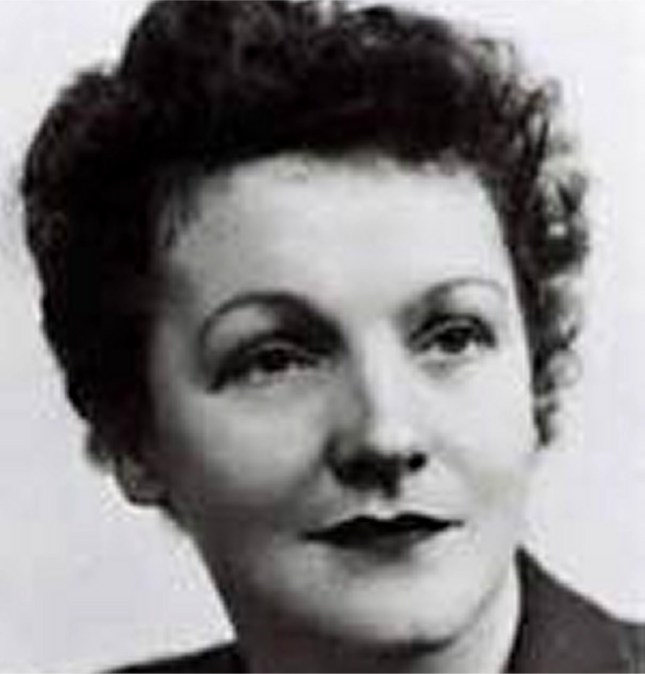
She was ‘The Ballad Queen’ whose voice and presentation would probably not conform to modern tastes, but, in a parallel and hazardous life, she also helped save hundreds of Jews and Allied soldiers from imprisonment, or the gas chambers. Delia Murphy may not have been Enya, but she was a courageous and remarkable woman nonetheless.

She had a relatively privileged upbringing in rural Ireland in the early 1900s. She was born in Mayo on the Mount Jennings Estate in Hollymount, in 1902. Her father, John Murphy, was one of those rarities, a returned emigrant who had made a fortune in North America. He had struck it rich during the Klondike gold fever of the 1890s, married a woman from Tipperary, and came back to Mayo. Despite his wealth, John Murphy was an exceptional individual in his own right, not least because he was happy for members of the travelling community to camp in the grounds of his newly acquired estate. This had beneficial consequences for his daughter, who learned many of the ballads that would later make her famous, around the campfires of the travellers.

Delia was fortunate, and somewhat unusual for a woman in those days, in receiving an education up to, and including, third level. She studied Commerce in University College, Galway, where she met and married fellow student, Tom Kiernan when she was twenty-two years old.

DeliaPoster.jpg

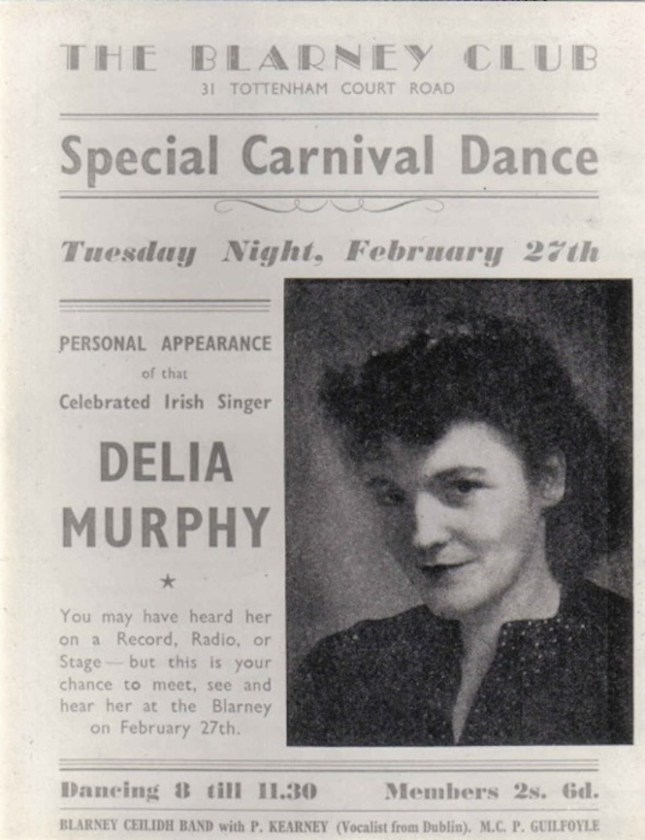
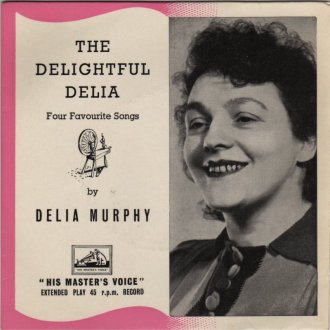
Kiernan then joined the Irish diplomatic service and was posted to London. That was where Delia’s career really began to take off. The huge Irish emigré population in pre-war London took to her singing, and her rise in popularity led to the recording in 1939, by His Master’s Voice—shortened in more recent days to the more familiar HMV—of some of her best-known songs, such as, If I Were a Blackbird, The Spinning Wheel and Three Lovely Lassies. Her popularity was probably based as much on her personality and charm as it was on her singing, because, truth be told, she was no female John McCormick.

And that might have been all there was worth saying about Delia Murphy, had Tom Kiernan not been transferred in 1941, by the Department of External Affairs, from London to Rome, as Irish Chargé d’Affaires (or Minister) to the Vatican. After the Japanese attack on Pearl Harbour in December 1941, and US entry into the war, the Irish legation in Rome became the only English-speaking diplomatic mission left in the city.

In 1943 Mussolini was deposed and Allied POWs in Italy were released. Nazi Germany, however, rapidly reasserted fascist dominance, and the POWs were in danger of re-capture. Enter the extraordinary Monsignor Hugh O’Flaherty, an Irish priest based in the Vatican City. For the next two years, he led a network which sheltered Allied soldiers on the run, and Jews in danger of being dispatched to Nazi death camps. They were hidden in dozens of safe houses in Rome and elsewhere. Delia Murphy was one of O’Flaherty’s closest associates in this hazardous enterprise. When in Rome O’Flaherty did as the Romans did, assuming a variety of disguises so that he could pass as Italian. But, as the SS grew more aware of his activities, and attempted to assassinate him, he was compelled to remain inside the confines of the politically independent enclave of the Vatican City, where the Germans couldn’t touch him.

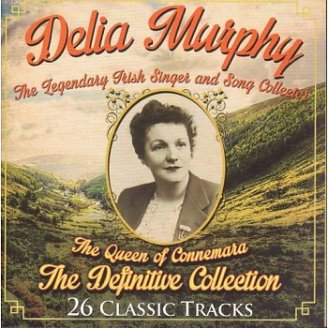
delia-murphy-the-definitive-collection-cd.jpgdelia-murphy-the-spinning-wheel-his-masters-voice.jpg

After the war, Delia Murphy travelled with her diplomat husband to Australia, Germany, Canada and the USA where she continued to record and perform. In 1962, she recorded her only LP, The Queen of Connemara, in New York. Two years after the death of her husband, she returned to Ireland, and lived in Chapelizod outside Dublin. She died there in 1971 at the age of sixty-nine.

Delia Murphy, friend of the Irish traveller, ballad singer, and audaciously altruistic people smuggler, was born one hundred and sixteen years ago, on this day.
 

https://www.youtube.com/watch?v=aQoxdTFprvg

On This Day 9.2.1983 Kidnapping of Shergar


130201173845-shergar-epsom-derby-2-horizontal-large-gallery.jpg


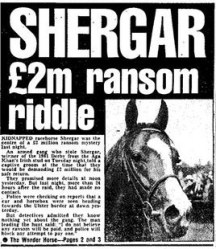
Would the name Cresswell mean anything to you? If it does, perhaps you should keep that to yourself, in case you become implicated in one of the greatest unsolved crimes in Irish history.

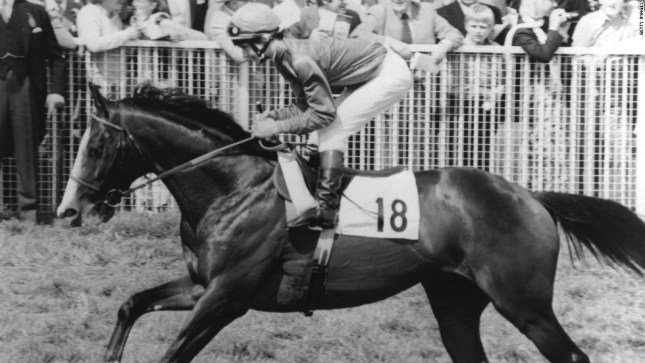
The main victim, who probably lost his life, was one of the most successful athletes of the 1980s, winning the blue riband event of his sport by the greatest margin ever recorded. In June 1981, at the running of the two hundred and first Epsom Derby, Shergar, with a teenage Walter Swinburn on board, showed a clean pair of heels to the field, in winning by ten lengths. So far ahead was he, that John Mathias, rider of the runner up, Glint of Gold, thought he was actually winning, until he spotted Shergar up ahead in the distance.

Shergar re-asserted his dominance a few weeks later in the Irish Derby at the Curragh, but the longer fourteen furlong trip of the final classic of the year, the St. Leger, was too much for him. The dual Derby winner only managed to finish fourth, and was retired to stud. His career as a stallion would be short.

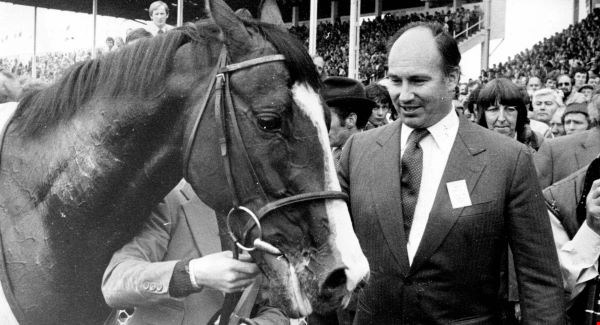
Shergar had been owned by the Aga Khan. Before the horse’s stud career began, however, he had cashed in some of his chips, and sold shares in the horse to a few very interested buyers. Shergar had a syndicated value of £10m when he began to have sex with other horses for a living. Life as an equine gigolo was certainly preferable to being whipped by undersized men. Shergar the racehorse had been trained by Michael Stoute in England, Shergar the sire was based in Ballymanny Stud in Kildare. If you wanted him to get together with your favourite mare it would set you back at least a cool fifty grand.

In his only season as a professional Dad he sired thirty-five foals. They only ever produced one classic winner between them, and that was in the lowly Irish St. Leger. We never got to find out if the next crop would be any better, because there was none.

On the night of the 8 February 1983 a gang of at least six men, all apparently calling each other ‘Cresswell’, kidnapped Shergar’s groom James Fitzgerald, forced him to identify the Derby-winning colt’s stable, and stole the horse. Fitzgerald was released around midnight, after being given the code phrase—King Neptune—the gang intended to use in ransom negotiations.

article-0-1768FDB9000005DC-354_306x423.jpg

What happened next was such a comedy of errors that had Shakespeare been around, he would have changed the plot of  his eponymous play. When Fitzgerald managed to raise the alarm in the early hours of 9 February the manager of the Ballymany Stud phoned the horse’s vet Stan Cosgrove, one of the members of the shareholding syndicate. So, obviously, Stan Cosgrove phoned the Gardai. Well, not exactly, he phoned a friend, as if he was a contestant in Who Wants to Be a Millionaire rather than the victim of a serious crime. The friend then phoned the Minister for Finance, Alan Dukes … as you would. Dukes, probably became part of the chain because he was TD for Kildare and TDs, as we know, have all the answers. Alan Dukes, very sensibly referred the distraught shareholders to the Minister for Justice, Michael Noonan. Why not the Minister for Agriculture, one wonders, surely he would have more to do with horses.

Anyway, after the gang was safely home, having breakfast, and looking forward to reading about their exploits in the morning papers, before making that all important first call, someone told the cops.

1f25a98f-50ef-4a9d-be21-a192d4765a91_800.jpg2e6bd6788482ce9c60dd3b2c2007c681.jpg

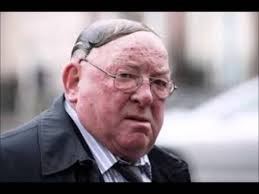
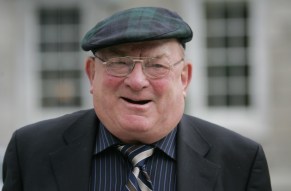
That was when Chief Superintendent James Murphy got involved. Here was a man who knew he was a detective, because he wore a trilby hat. During one press interview Chief Superintendent Murphy is supposed to have uttered the immortal phrase ‘A clue … that is what we haven’t got.’ Philip Marlowe he was not, despite the trilby. The lack of clues persuaded Murphy to act on information supplied by psychics and clairvoyants. If you made this stuff up and put it in a story you would spend the rest of your life trying to find an agent for your work.

No one ever found poor Shergar. When last seen he was being ridden by Elvis Presley in the Adolf Hitler stakes in Atlantis. The IRA were blamed for the theft at the time, this theory being reinforced by the 1999 memoir written by the IRA informer Sean O’Callaghan.

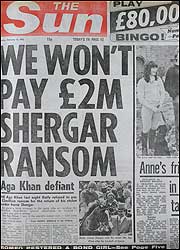
Whoever stole Shergar probably overlooked two salient facts. Firstly, horses are bigger, stronger and more highly strung than human kidnap victims. The fashionable theory is that the kidnpappers were forced to kill their victim within hours because they had no clue how to handle him. Secondly, the Aga Khan didn’t own Shergar anymore, having sold thirty-three of the forty shares in the horse. This made ransom negotiations a little bit like a White House press conference. No ransom was ever paid and Shergar has not been seen since. If still alive he would be approaching human middle-age.

Somebody finally told the Garda Siochana that Shergar had been kidnapped, thirty five years ago, on this day.

ShergarAgaKhan1981_large.jpg