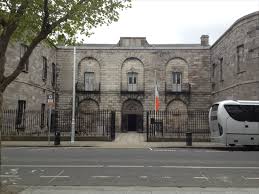
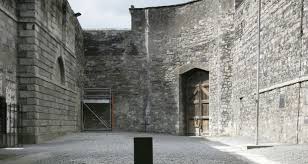
On This Day – 11 August 1796 Kilmainham Gaol in Dublin prepares to receive its first prisoners


images.jpegUnknown.jpeg


It’s such a huge tourist attraction today that it’s quite shocking to realise there were proposals as recently as the 1950s to demolish much of it. But Kilmainham Gaol survived intact to play a huge part in the current decade of centenaries.

It opened in 1796 and even then, it was a grim place, housing men, women, and children as young as twelve. Some were held there prior to transportation to Australia, others were lodged in the prison before their executions, some served many years there in dreadful conditions, often sharing a cell with up to four others.

Almost every self-respecting nationalist, including some far removed from revolutionary politics, spent a spell at their Majesties’ pleasure in Kilmainham.  A number did so prior to being hanged or shot. The list of guests constitutes a distinguished club, Henry Joy McCracken, Oliver Bond, Napper Tandy, Robert Emmet, Michael Dwyer, William Smith O’Brien, Thomas Francis Meagher, Jeremiah O’Donovan Rossa, Charles Stewart Parnell, and Michael Davitt.

Attached to the Gaol was a magistrates’ court where cases would be despatched, or, if a serious crime was involved, the preliminary process leading to indictment would take place. It was here that the alleged killers of the Chief Secretary, Frederick Cavendish and his Under Secretary, Thomas Henry Burke, in Phoenix Park in 1882—the so-called Invincibles—appeared for remand hearings before being committed to Green Street court for trial. And it was here that they first realised the game was up, when one of their number, James Carey, presented himself as a prosecution witness. He had opted to turn state’s evidence to save his own skin. His first appearance at Kilmainham Magistrates’ Court was greeted with roars of rage from the dock. A reporter observed that one of the accused, Joe Brady:


Glared at him and stretched forward towards him [had he] been able to reach him, I believe he would have been torn to pieces, for Brady was a powerful young fellow, and for the moment he was for all the world like a tiger on the spring.


The prisoners were returned to their cells and a few weeks later Carey’s evidence sent five of them to the hangman, a seasoned veteran named William Marwood. His customary advice to his victims before they met their maker was, ‘Now then, hold your head back and you’ll die easy’. They were all executed in the Kilmainham Prison Yard, and their bodies were interred under the scaffold erected to hang them.

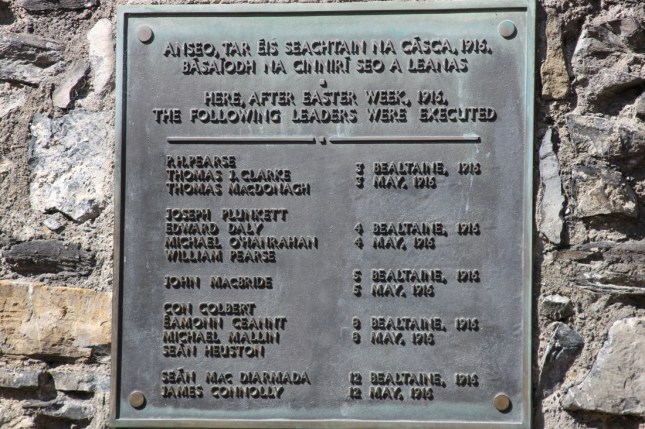
Three decades later it was the turn of the leaders of the 1916 Rising. Fourteen were executed there over a nine-day period in May. The first to die, on 3 May, were Patrick Pearse, Thomas Clarke and Thomas MacDonagh. They faced firing squads of twelve British soldiers, mostly drawn from the Sherwood Foresters, who had been badly cut up on Mount Street Bridge the previous week. There was little regard to sensitivities on either side. No Catholic priest was allowed to be present to minister to the prisoners, and the same firing squad—consisting mainly of young recruits—was expected to execute all three men. A number of female prisoners, including Countess Markievicz, were rudely awoken by the volleys from the stone-breakers’ yard.

After the establishment of the Irish Free State the prison continued to be used during the Civil War. Around six-hundred Republican prisoners were incarcerated there, many of them women. One of the last to be released was Eamon de Valera.

The prison was closed by the Free State government in 1929, and might well have been demolished in the 1930s, except it was deemed too expensive to do so. The work of organisations, like the Kilmainham Gaol Restoration Society, ensured that it was eventually taken over by the Office of Public Works, and became one of the most visited historical sites in Dublin.

It has also been a useful location for a number of films. These include the adaptation of Brendan Behan’s prison drama, The Quare Fellow, as well as the Michael Caine film The Italian Job, and Neil Jordan’s Michael Collins. Collins himself was fortunate, he never actually served time there.

Kilmainham Gaol was finally completed and prepared to accept its first prisoners two hundred and twenty-one years ago, on this day.
 

5284871_orig.jpg


On This Day – 14 July 1798 The Sheares brothers are hanged in Dublin

1798.jpg


Irish rebellions should probably all come equipped with something we could call an IQ. That’s an Informer Quotient. This is a scientific measure of how many British agents from among the ranks of the rebels it took to betray the insurrection.

The scale would go all the way from ‘Genius’ at one hundred and fifty, to Witless Imbecile at zero. Let’s take a couple of examples. Obviously the 1798 rebellion was so riddled with spies and informers that if it had been a boat it would have sunk in a calm and windless cup of tea. So, we’ll call that one hundred and fifty. Then, right at the other end of the scale, there’s the 1916 Rising. Here the rebels desperately tried to tip their hand repeatedly, even to the extent of calling the whole thing off in a newspaper advertisement, but the exceptionally dim British authorities had no idea what was going on under their noses. We’ll call that an IQ of zero.

Totally off the scale of course is the War of Independence where Michael Collins’s own spies and informers were tripping over each other in Dublin Castle. That would be a minus IQ of about fifty for the rebels.

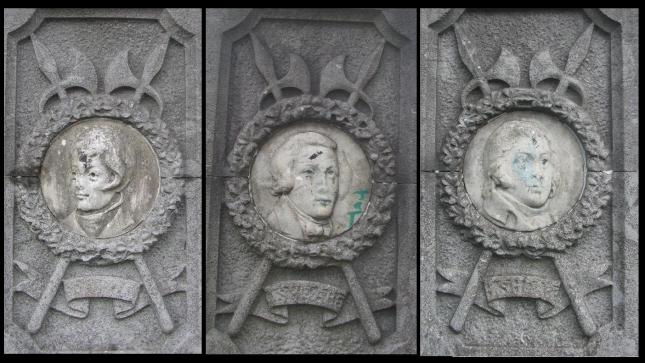
But the prize for individual revolutionaries most beset by informers has to go to the United Irishmen, the Sheares brothers. It took not one, not two, but three spies to bring them down. Given the going rate for intelligence information in 1798 it must have cost the authorities almost as much as the bribes paid to pass the Act of Union two years later.

The brothers Sheares, John and Henry, from Cork were both lawyers who had witnessed the French revolution and the frequent use of the guillotine. On the boat back home from Calais they met an utterly disillusioned Daniel O’Connell, pledged to non-violent political action, based on the bloodthirsty slaughter he had observed in Paris. The Sheares brothers were not so easily put off. When they got back to Dublin in 1793 they joined the United Irshmen. Both began organizing in their native Cork.

Enter Spy Number 1. His name was Conway and he kept the Castle well informed of the activities of the brothers, while passing himself off as an enthusiastic supporter.  He gets the bronze medal.

While busying themselves in Cork the brothers were also part of the Dublin Society of the United Irishmen. Here their nemesis was Thomas Collins, another apparent republican fanatic but, in reality, a well-embedded British spy. Because he ratted on so many other prominent revolutionaries he gets the silver medal.

But the gold unquestionably goes to Captain Warnesford Armstrong. You’d think his name would have given him away. How could you be called Warnesford and not be a British spy? After the capture of most of the members of the United Irishmen’s Directory (note the French influence) in March 1798, John Sheares took over and ordained the date of 23 May for a nationwide uprising. Armstrong insinuated himself into the confidence of the brothers, to the point where he was a regular visitor to their house on Baggot street, and dandled the children of Henry Sheares on his treacherous knee. He recorded that he didn’t even have to take an oath in order to become a member of the United Irishman. Not that he would have let something as silly as an oath get in the way. John Sheares himself actually warned Armstrong not to come to the house on one occasion, because certain activists believed him to be in the act of betraying the movement, and were intent on murdering him!

Two days before the planned rising John and Henry Sheares were arrested, on information supplied by Armstrong, and put on trial. Armstrong himself, clearly pleased at his handiwork, testified against them. Despite being defended by the great advocate John Philpot Curran, it took the jury a mere seventeen minutes to convict.

John and Henry Sheares, victims of three separate informers, were hanged, drawn and quartered, two hundred and nineteen years ago, on this day.


On This Day – 7 July 1930   Death of Sir Arthur Conan Doyle

Unknown.jpeg220px-Sherlock_Holmes_Portrait_Paget.jpg


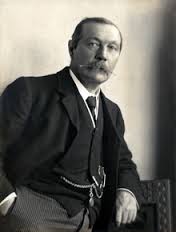
He is such a quintessentially English writer, that it is still something of a surprise to discover that he was actually born in Scotland, of an Irish mother, and with a paternal Irish grandfather. Though he himself was a master of the written word he came from a long line of cartoonists. He was the nephew of the famous Punch magazine illustrator, Richard ‘Dickie’ Doyle, and another uncle, Henry, became director of the National Gallery of Ireland. As a writer, he was drawn towards his own historical novels, but nobody really cares for them that much and today, even fans of his work would be hard put to name a single one of them.

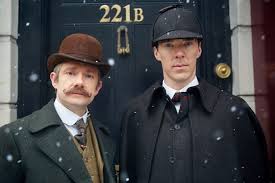
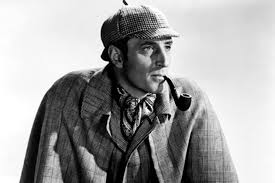
That’s because, in 1886, he created the immortal detective Sherlock Holmes. The first appearance of the master-sleuth, and his affable but somewhat dim-witted companion and chronicler, Dr. John Watson, netted Arthur Conan Doyle the not terribly princely sum of £25, though it was probably the best twenty-five quid the publishing company Ward Lock & Co ever spent.  A Study in Scarlet united the two heroes of Doyle’s most enduring fictions. Subsequent stories, like The Sign of Four, The Valley of Fear and The Hound of the Baskervilles made him the best paid author of his day.  By that time Watson’s old war wound, incurred in the Afghan war, had miraculously migrated from his arm to his leg.

Within five years Doyle was already profoundly sick of his creation. In 1891 he wrote to his mother. ‘I think of slaying Holmes,… and winding him up for good and all. He takes my mind from better things.’ His anguished mother wrote back, ‘You won’t! You can’t! You mustn’t!’ He didn’t! She was, after all, an Irish mammy who must be obeyed in all things.

But two years later he defied even his poor Irish mother by having the cleverest Kerryman ever invented, Professor James Moriarty, toss Holmes over the Reichenbach Falls. ‘Good riddance’, said Doyle, ‘time to get back to the character who will really establish my reputation, Brigadier Gerard.’ Sadly, it wasn’t to be and today few people would even remember the estimable French Brigadier had a rather decent thoroughbred racehorse from the 1970s not been named after him.

After killing off his supersleuth Doyle had to endure the opprobrium normally reserved for figures like Rasputin, Kaiser Wilhelm and Dr. Crippen, the infamous wife killer. Reaction to the demise of Holmes was a bit over the top, apparently extending as far as death threats. But, ever the stoic, Doyle resisted all temptation for a Holmesian return. However, if the Stone Roses can make a comeback, so could Sherlock, and in 1901 Doyle reintroduced him in a pre-Moriarty novel, the gothic Hound of the Baskervilles. This was a prelude to bringing him back to life in a new series of stories in 1903. Mammy Doyle was beside herself.

In addition to his novels and short stories, Doyle was, of course, a medical doctor. He was also a failed politician, a Liberal Unionist—a fancy name for a Tory. Not even the creator of Sherlock Holmes could get elected in the two Scottish constituencies in which he stood in 1900 and 1906. He was also an accomplished sportsman, playing soccer for Portsmouth, and cricket for the MCC.

Doyle was also a noted mystic and spiritualist, whose unfortunate gullibility led him to accept the bona fides of one Elsie Wright in 1917 when, as a sixteen-year old, she took an infamous photograph of her nine-year old cousin Frances Griffiths with four alleged fairies. In the ensuing controversy surrounding the so-called Cottingley fairies, Doyle came down emphatically on the side of fairy-ness. He chose to believe that Elsie had managed to do what no one else had ever done before, to catch those shy and elusive creatures on camera. He was more than half a century dead before Elsie admitted, in the 1980s that it was all a hoax and that the fairies were cardboard cut-outs.

By the way, ‘Conan’ was his middle name, not part of a compound surname. His knighthood went to plain ‘Arthur Doyle’, though the man himself had begun to add the second barrel to his surname at an early age.

There is a commemorative statue in Edinburgh outside the location of the house—long since demolished—in which he was born. It’s of Sherlock Holmes. Doyle would have loved that!

Sir Arthur Conan Doyle, creator of the immortal Brigadier Gerard, and the barely remembered Sherlock Holmes, died eighty-seven years ago, on this day.


Unknown-1.jpegUnknown-2.jpeg

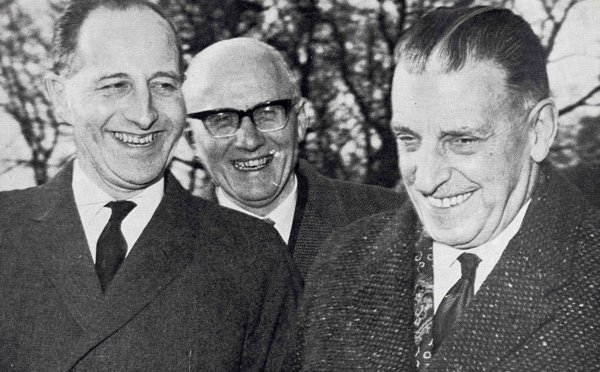
On This Day – 23 June 1959 Seán Lemass becomes Taoiseach

1101630712_400.jpg


It was a long apprenticeship. Not quite on a par with that of the current Prince of Wales as he waits to become King of England, but not far off. Sean Lemass was elected to the Dail in 1927 as a member of the newly created Fianna Fail party. The previous year he had resigned from Sinn Fein, along with Eamon de Valera, because of Sinn Fein’s insistence on retaining its abstentionist policy. Dev contemplated leaving politics altogether. Instead Lemass persuaded him to form a new political party.

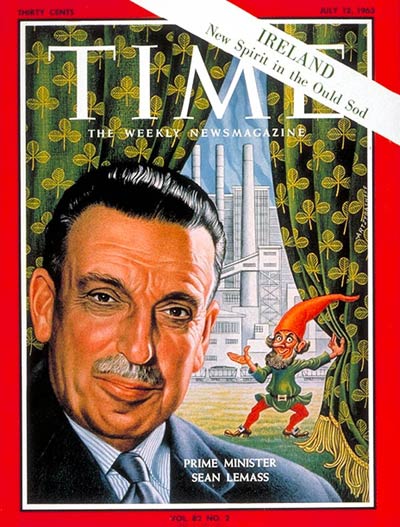
Thus began that long apprenticeship. It finally ended thirty-two years later, and within a further four years Lemass had reached the dizzy heights of the cover of Time magazine, and an article entitled ‘New spirit in the ould sod’. Can it possibly get any better?

Lemass was just sixteen years old when he, and his brother Noel, had taken part in the 1916 Rising. Ironically they had been told it had begun by the sons of Eoin MacNeill and headed straight for the GPO. So, theirs was a sort of countermanding order in reverse.

Sean was sent up to the roof of the building, and armed with a shotgun. A fat lot of use a shotgun was on the roof of the GPO. He continued in the service of the Irish Volunteers / IRA during the War of Independence. There is still historical controversy about whether Lemass was one of the IRA hitmen who murdered a number of British agents on the morning of what would become known as ‘Bloody Sunday’. It was not something he ever talked about.

He and his brother—still only in their early twenties— took the anti-Treaty side in the Civil War. Sean Lemass was second-in-command of the force that occupied the Four Courts in defiance of the new Free State Government. But the Civil War ended in defeat and personal tragedy. In 1923 Noel Lemass was kidnapped and murdered. His body was dumped in the Dublin Mountains. The following year Sean Lemass was elected Sinn Fein TD for Dublin South City.

In 1932, three years after Lemass had famously described them as a ‘slightly constitutional party’, Fianna Fail went into government for the first time. Lemass was given responsibility for Industry and Commerce and that was, more or less, where he remained for much of the next three decades. Although he has been lauded as the ‘architect of modern Ireland’ during his tenure in Industry and Commerce, he was responsible for a tariff policy that, ultimately, did little for Irish industrial development.

It’s hard to say exactly when he became heir apparent. Perhaps he always was, or maybe he didn’t get the noble call until 1945, when de Valera made him Tanaiste. He was promoted over the heads of older men after having spent much of the ‘Emergency’—our colourful euphemism for World War Two—as Minister for Supplies. In that department, he was responsible for the production and distribution of vital goods, at a time of huge shortages. So, no great pressure there.

While he waited for de Valera to retir,e he had the great good sense to become the father in law of one Charles J. Haughey, in 1951. You may have heard of him.  Eventually the Long Fellow opted to move to the Park in 1959. De Valera became President and the interminable internship of Sean Lemass was at an end. Ireland’s greatest civil servant, T.K. Whitaker, beckoned and the rest is economic history. The two would drag the country into economic modernity as the orthodoxy of de Valera was abandoned. The first and second programmes for economic expansion, launched in 1958 and 1963, kick-started a moribund economy. Ireland, under Lemass, became a more industrialised and urbanised society. In 1965 he took the unprecedented step of travelling across the border for talks with the Prime Minister of Northern Ireland, Terence O’Neill. If this was Russia it would have been called ‘perestroika’. Under Lemass Ireland was, at last, open to the outside world rather than just populating it.

Sean Lemass became Ireland’s fourth Taoiseach, in succession to Eamon de Valera, fifty-eight years ago, on this day.


lemassoneill-meeting-jan196.jpg


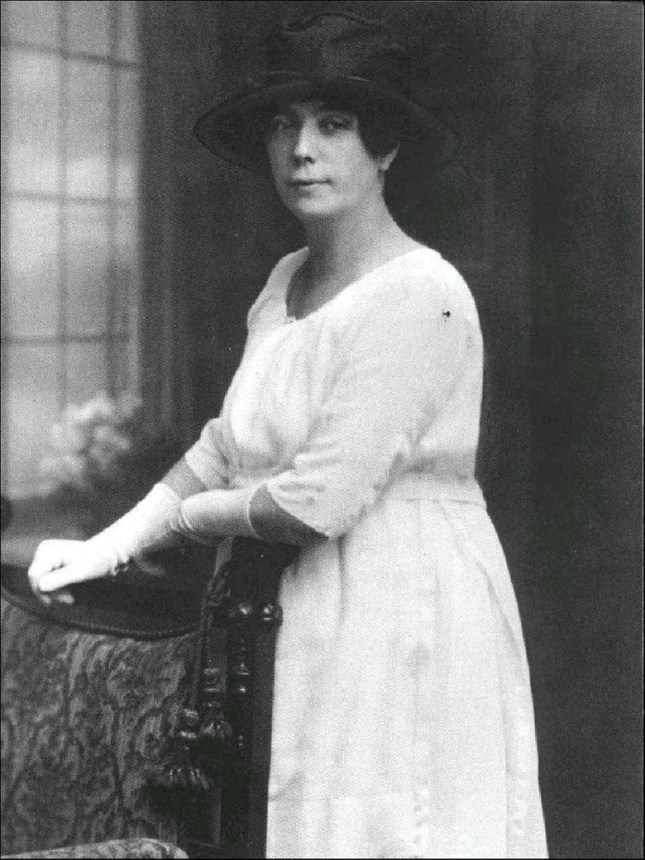
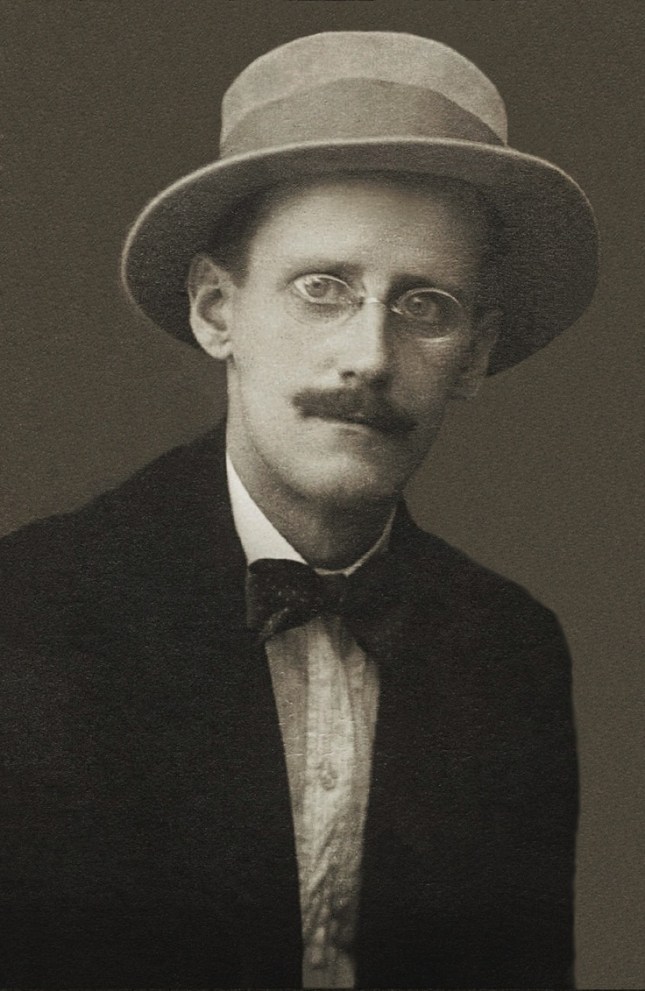
On This Day 16 June 1904 James Joyce has his first date with Nora Barnacle


Nora20Joyce-Big.jpg

Even though Ted Hughes and Sylvia Plath chose to get married on this particular day, their tragic romance was not the most notable to have had its genesis on 16th June. That honour goes to James Joyce and Nora Barnacle, who first ‘stepped out’ together on the day in question, causing it to be immortalized by Joyce in his greatest work, Ulysees.

Now, according to those in the know, James and Nora did quite a bit more than ‘step out’ that day, but as we are at least two and a half hours before the traditional ‘watershed’ we will draw a veil over what exactly happened.

Joyce went on to set the events of his ground-breaking novel on the day of that fateful assignation, 16 June 1904. In his fictionalized version of the auspicious anniversary Leopold Bloom goes about his business, reflecting on being cuckolded by the charismatic Blazes Boylan. Meanwhile Joyce’s own alter ego, Stephen Dedalus, is in conflict with his flatmate Buck Mulligan, a virtually undisguised Oliver St. John Gogarty—though the ‘flat’ in question is actually the rather more striking Martello Tower in Sandycove. Ultimately Bloom and Dedalus meet, after parallel odysseys around the city of Dublin, ending in what Joyce called ‘Nighttown’ but was known at the time as ‘Monto’. They head for Bloom’s house on Eccles Street. The climax of the novel, and I use the word advisedly, is left to Bloom’s wife Molly, who, among other things, reflects on cuckolding her husband with the charismatic Blazes Boylan.

At some point in the course of the novel the ninety-seventh running of the Ascot Gold Cup takes place, and Bloom is presumed to have had money on the nose of a horse called Throwaway who, in Joyce’s novel, romps home at long odds. The repeated use that the author makes of the name of the horse means that the colt has to have been a fictional winner. Except that he wasn’t. Lo and behold, if you check the honour roll of the Ascot Gold Cup, you will find that it was indeed won in 1904 by a horse called Throwaway, ridden, for the record, by Willie Lane, trained by Herbert Braime, in the colours of Mr. Fred Alexander.

Of course, it was never on the cards that we, the people of the nation which forced Joyce into exile, would ever be able to leave 16 June 1904 well enough alone. Instead, we created the benign literary monster that has become Bloomsday, so-called, one presumes, because it is considerably more difficult to say ‘Dedalus’s Day’. Although, in truth, the day more truly belonged to Stephen than it did to Leopold.

The first iteration of Bloomsday took place on its fiftieth anniversary, when a merry bunch of Dublin’s literati, which included authors Brian O’Nolan and Anthony Cronin, poet Patrick Kavanagh, critic John Ryan, and Joyce’s cousin Tom, engaged two horse-drawn cabs, assumed the identities of some of the novel’s characters (Cronin played Stephen for example) and pledged to visit all the more notable sites featuring in the novel. That, however, was the only ‘pledge’ in evidence on this Bloomsday debut. The merry band of devotees got no further than the Bailey public house, then owned by Ryan, where they were overwhelmed by thirst, and were unable to continue the pilgrimage.

Since that inauspicious, if celebrated, inauguration, other aficionados have more than made up for the failure of O’Nolan, Kavanagh et al to complete their self-ordained marathon. It appears the only time since that Dubliners have denied themselves the pleasure of commemorating Bloomsday, was in 2006, when the festivities would have clashed with the funeral of former Taoiseach, Charles J. Haughey. Many of those involved in the festivities would, no doubt, have benefitted from the artists’ tax relief scheme begun in the 1960s by that latter-day charismatic political Blazes Boylan.

James Joyce went on his first date with Nora Barnacle, and Throwaway won his first and only Ascot Gold Cup, one hundred and thirteen years ago, on this day.


9a07c0d4c38997521bebd8e6f8f135c1.jpg