On This Day – 5 May 1916 William Evelyn Wylie and the court-martial of William Corrigan


william-evelyn-wylie.jpg

There were many unsung heroes of the 1916 Rising. The courageous Nurse Elizabeth O’Farrell, for example, who risked her life to carry Pearse’s flag of truce along Moore Street, and then took his surrender note, under heavy fire, to the remaining Volunteer garrisons. Or Sean McLoughlin, the ‘boy commandant’, promoted to that rank by James Connolly, who was twenty years of age when he played a pivotal role in the evacuation of the GPO.

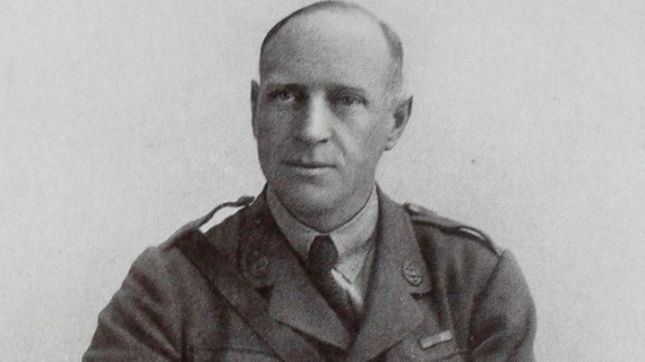
William Evelyn Wylie may be ‘unsung’, ‘deeply flawed’ or just an anti-hero, depending on your point of view. He was a successful barrister who, when the Rising began, helped to seal off Trinity College, and deny that strategic position to the rebels. As it turned out the Volunteers didn’t really have much interest, whether they should have or not.

After Pearse’s surrender Wylie was tapped to participate in the court martial process as lead attorney. He prosecuted ‘Prisoner No. 1’, Pearse himself, and was hugely impressed with the Volunteer commander’s conduct at his brief trial. At the court martial of one of the most tragic figures of the rebellion, Thomas McDonagh, Wylie pulled up the presiding Judge, whose name was—I kid you not—General Charles Blackader.  Blackader sought to use the 1916 Proclamation as conclusive evidence against the prisoner. Wylie, who actually had a copy of the document in his possession, pointed out that it was inadmissible. Although McDonagh’s name was appended to the printed version, the court would require the presentation of the original signed copy in order to convict him.

As the courts martial proceeded Wylie, a unionist and a strong opponent of the principles underlying the rebellion, became increasingly concerned at the overriding of due process. He wrote a memoir of that week, which was left to his daughter after his death. In this he described how he took matters into his own hands. Although no defence attorney had been appointed in any of the one hundred and sixty abbreviated trials—an illegal procedure  in itself—Wylie took it upon himself to act as both prosecution and defence. While the three presiding military judges were considering their verdict in a case, Wylie would step outside to see who was coming next. He would then advise the accused of their rights, and inquire whether or not they wanted any witnesses to be present. Pearse, McDonagh and Thomas Clarke had not been made aware that such a facility was available.

It was while engaged in this Janus-like activity, on the fourth day of the courts martial, that Wylie realised, to his intense surprise, the next prisoner was a Dublin solicitor, William Corrigan, who had briefed him on many occasions in the recent past.  Corrigan had been taken prisoner at the South Dublin Union. When the court-martial began, with Blackader presiding, Wylie took the unusual step of arguing the case for and against the prisoner. When Blackader asked why Wylie had adopted this unorthodox  approach, the barrister revealed the nature of Corrigan’s profession. He then added that he had an uncashed cheque from the accused Volunteer in his pocket which might be void were he to be executed.

Corrigan was one of more than ninety prisoners to be sentenced to death, but in his case the court martial recommended clemency, and Wylie’s brief fee was thus secured.

Later, according to his own account, Wylie was consulted by the commander of Crown Forces in Ireland, General Sir John Maxwell, about the need to carry out the death sentence passed down on one Eamon de Valera, Third Battalion commandant. Wylie told Maxwell that he didn’t see any need to execute de Valera, as he was unlikely to cause trouble in the future. ‘I don’t think he’s very important’ said the clearly misinformed barrister.

Wylie, a keen cyclist, who is mentioned in this context in James Joyce’s Ulysees, went on to defend Sinn Fein prisoners during the War of Independence, despite his strong unionist sympathies. He was appointed to the High Court by the first Free State government, and served there until 1936.

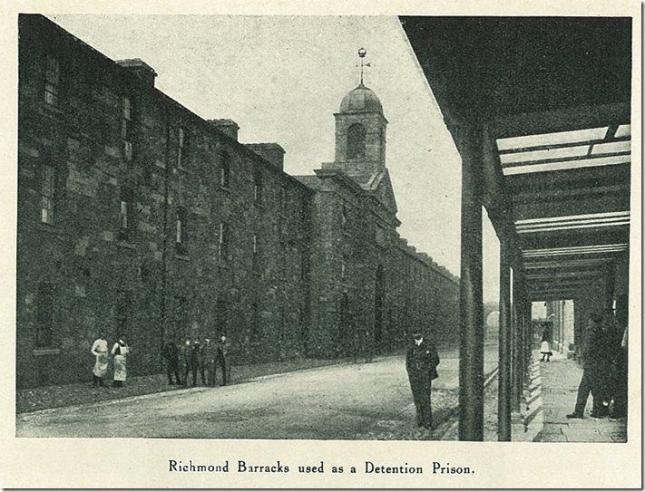
William Evelyn Wylie prosecuted and defended Lieutenant William Corrigan of the Irish Volunteers, before a court martial in Richmond barracks, one hundred and one years ago, on this day.
Richmond_Barracks,_Dublin.jpg


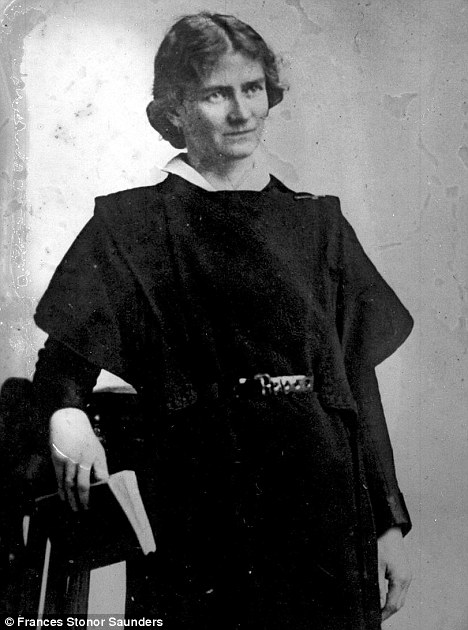
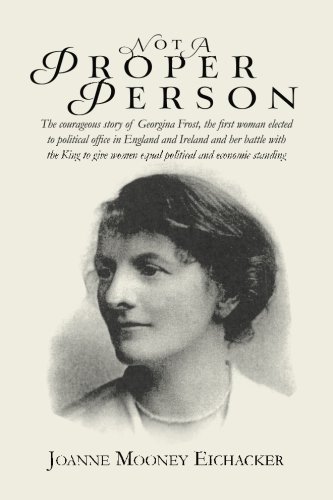
On This Day – 28 April 1920 – ‘Not a proper person’: The tribulations and triumphs of Georgina Frost

41BuGevAtiL.jpg


Georgina Frost was both an unremarkable, and yet a quite remarkable woman. She was the daughter of a Petty Sessions clerk from County Clare. She helped out her father in administering two of the courts presided over by the Resident Magistrates of the county before the advent independence in 1922.

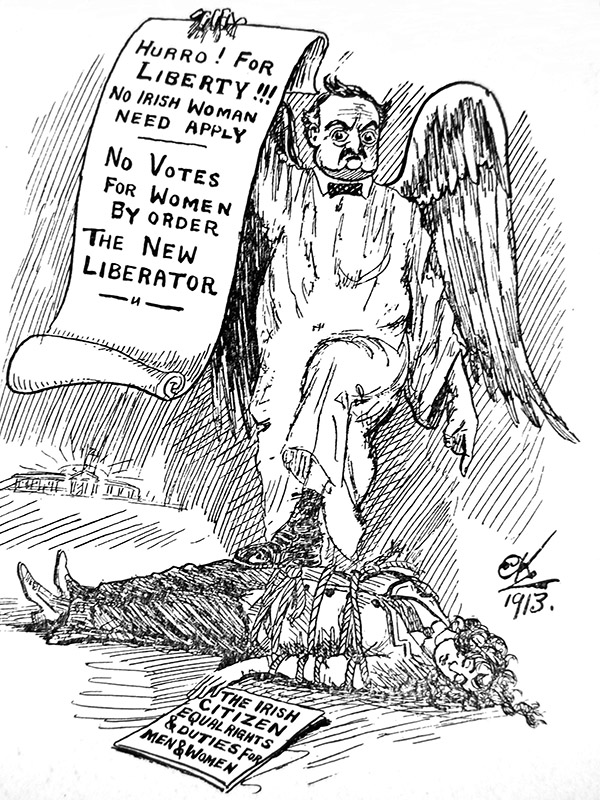
Born in 1879, and motherless from the age of eight, Georgina Frost was no Countess Markievicz, nor a Hannah Sheehy-Skeffington. She would be royally shafted by the ‘conservative revolutionaries’ of the Free State government. But, in 1920, she struck her own small blow for Irish women, when her tenacity and perseverance, as well as the justice of her cause, extracted a minor but highly significant concession from the male-dominated establishment.

She was known to one and all as ‘Georgie’, and when her father, Thomas Frost, retired in 1915, as Petty Sessions clerk for Sixmilebridge and Newmarket on Fergus, the County Clare Resident Magistrates sensibly decided that, as she had already been doing the job for a number of years, Georgie was the right person to take over from her Dad. The position was the equivalent of a District Court clerk today

wm_4617.jpg

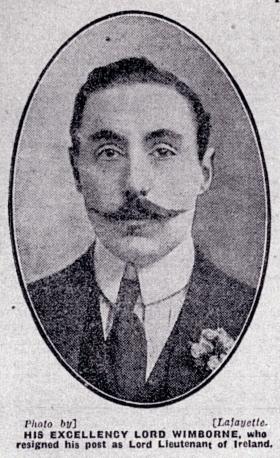
But when their decision was conveyed to the Lord Lieutenant, Lord Wimborne, he objected on the grounds that ‘Georgie’, was actually Georgina. It wasn’t that she couldn’t do the job, clearly she was very good at it. But, according to Wimborne, there were issues of decorum at stake, what was described in a court case ‘the unfitness of certain painful and exacting duties in relation to the finer qualities of women’

Now, undoubtedly Georgie Frost had many fine qualities, but she was keen to retain those qualities, as well as the job, for which she was eminently suited and experienced. So, she sued, and lost. The case was entitled Frost v The King, which has a certain meteorological flavor to it. It was heard in 1919, and the judge agreed with the Lord Lieutenant that court work was not appropriate for such a delicate flower as a woman.

At which point Georgie should have taken her ‘finer qualities’ and gone back to the family kitchen.

But she was made of sterner stuff. Obviously one of her ‘finer qualities’ was a refusal to kow-tow to the authorities, all of whose members happened to be men. She appealed. And lost again. Surely now she would get the message and not pursue her attempt to inflict those ‘painful and exacting duties’ on her feeble feminine frame?

No such luck. Georgie wasn’t having any of it, and appealed to the House of Lords! At this point the British government threw up its hands and cried ‘mercy’. In December 1919, the King signed a new piece of legislation called the Sex Disqualification (Removal) Act into law. The first section of the new legislation read as follows:

A person shall not be disqualified by sex or marriage from the exercise of any public function, or from being appointed to or holding any civil or judicial Office or post, or from entering or assuming or carrying on any civil profession or vocation, or for admission to any incorporated society.

What that meant in proper English was that Georgina Frost had won. Not that the law had been introduced because the government feared that Georgie might impress their Lordships, and win her second appeal. Perish the thought!

The Lord Lieutenant relented, and the appointment of Miss Georgina Frost as Sixmilebridge Petty Sessions clerk was confirmed, and made retrospective. Her tenure was brief but exciting, and included an IRA raid where she was held at gunpoint.

In 1923 the new Free State government abolished Petty Session courts and Resident Magistrates. Out with the RMs went the clerks. Georgina lost the job which she had fought so hard to secure. Although District Courts replaced the Petty Sessions she didn’t get her job back. Of course, this had nothing whatever to do with the fact that she was a woman. Perish the thought! She was a mere lackey of the British establishment. The one she had taken on and beaten. She did get a pension of four pounds a week, which she enjoyed up to her death in 1939 at the age of fifty-nine.

The unassuming, but obviously steely Georgina Frost, became, retrospectively, the first woman to hold paid public office in the UK, ninety-seven years ago, on this day.


Womens_Suffrage_-_Redmond_as_Hypocrite_by_EK_Irish_Citizen_15_Mar_1913.jpg

On This Day -21 April 1874  Birth of tank designer Walter Gordon Wilson


_71802772_waltergordonwilson_pullen.jpg

368-20131031111032_540x360.jpg

A century ago the Great War was still raging, still deadlocked. Two inventions would play a huge role in the resolution of the conflict, and both were originally designed by Irishmen. John Philip Holland, a Fenian sympathiser from Clare, had invented the submarine in the late nineteenth century as a way of attacking British shipping. Walter Gordon Wilson, on the other hand, developed the tank with a view to assisting the cause of his adoptive country against Germany in World War One.

Wilson was born in Blackrock, Co. Dublin in 1874. The son of a barrister, he trained as a British naval cadet, before completing his education at King’s College, Cambridge, where he got a first in mechanical science.

His story includes one of the great ‘what ifs’ of aviation history. In 1897 he formed a partnership with Percy Pilcher, a gliding enthusiast. Their aim was simple, to be the first to achieve controlled, powered, heavier-than-air flight, by developing an aero-engine. They nearly made it, and might have done so had Pilcher not been killed in a glider accident in 1899. Shocked at the death of his charismatic partner, Wilson abandoned the project, although he had already designed a prototype engine.  Four years later Orville and Wilbur Wright made aeronautical history with their flying machine at Kitty Hawk, North Carolina.

300px-Wilson-PilcherCar.jpg

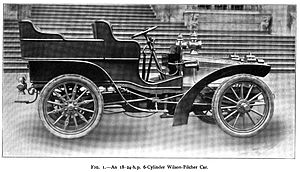
Wilson next moved into the burgeoning automobile industry, adapting his aeronautic engine for the new ‘horseless carriage’. Although Percy Pilcher was dead, Wilson paid homage to his partner in naming the Wilson-Pilcher motor car in 1900. He continued to develop the design—which included a revolutionary gearbox—until the outbreak of World War One.

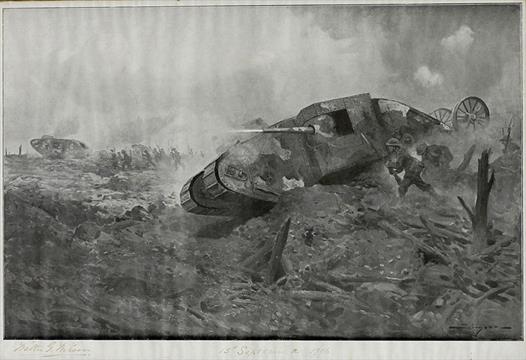
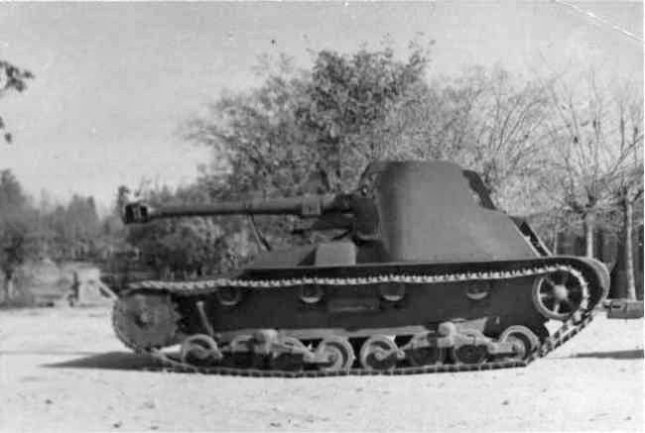
Wilson re-joined the Navy in 1914. He was sent to Belgium and France to protect British aircraft using armoured vehicles. He was also expected to build them. He was then taken on by the highly secretive Landships Committee, to develop what would become the tank. The Committee wanted nothing more or less than an armoured vehicle capable of withstanding German machine guns and small arms, sailing through barbed wire, and over trenches. So no pressure there.

But Wilson, and his new partner, fellow engineer, William Tritton, were up to the task. Their first effort was nicknamed—no sniggering at the back, please—‘Little Willie’. It was called after Wilson or the Kaiser—depending on who you believe—and was chronically unstable. So probably the Kaiser then.  A high mid-section meant it had a tendency to keel over when sent into experimental action. Wilson went back to the drawing board and developed an armoured vehicle with a lower centre of gravity, and tracks running around the whole body. It’s official name was ‘The Wilson’. Then it was renamed ‘The Centipede’. But it was better known by its nickname, ‘Big Willie’. I kid you not. It went into production in February 1916, and the first models were ready for action during the second phase of the Somme offensive.

Well, sort of anyway. They just weren’t very good in 1916. They were unbelievably hot, and noisy, and tended to break down long before they got near the enemy trenches. Wilson and Tritton kept at it, and continued to improve the design, until the tank, by 1918, was a vital and integral part of the Allied victory over Germany. Its most successful appearance was probably at the Battle of Cambrai in 1917. One of Wilson’s great contributions was something called epicyclic steering, which allowed the tank to turn, a rather useful characteristic in a war.

Wilson transferred from the Navy to the Army in 1916, was promoted to Major, mentioned in dispatches twice, and, in 1917, was appointed Companion of the Order of St. Michael and St. George, or a CMG to you and me.

After the war he continued his career as an innovative engineer, developing and exploiting the Wilson self-changing gearbox, and setting up his own company in Coventry to manufacture it.

Walter Gordon Wilson, the man who designed one of the most lethal and decisive weapons of the Great War, the tank, was born in Blackrock, Co. Dublin, one hundred and forty-three years ago, on this day.


other tank.jpg

On This Day – 7 April 1926 – Violet Gibson tries to assassinate Mussolini


Violet Gibson's prison ID card, 1926.jpg


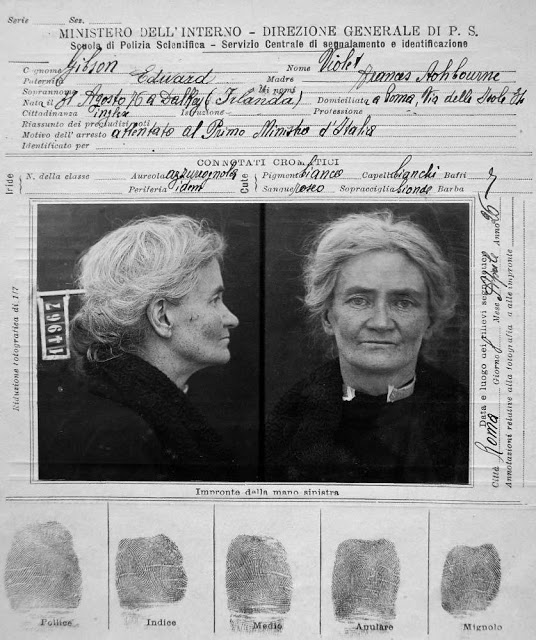
The former Italian international soccer player, Paolo di Canio, may be a fan, but the modest Irishwoman, the Honorable Violet Albina Gibson, was certainly not. In 1926 she linked Irish nineteenth century land purchase with twentieth century Italian fascism when, around the time he assumed absolute power in Italy, Violet Gibson unsuccessfully attempted to assassinate Benito Mussolini.

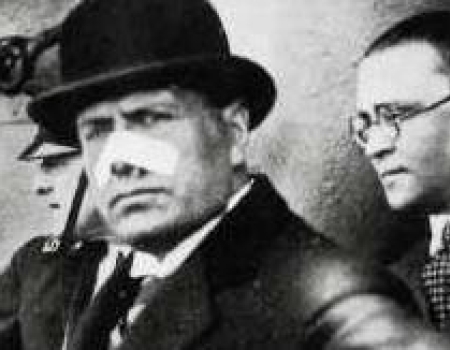
At the time Il Duce was saluting his public in the Piazza del Campodoglio in Rome. He had just addressed the International Congress of Surgeons, so he was probably in a good place had Violet Gibson been a better shot. As he sat in his Duce-mobile, waiting to be whisked away, the car was approached by a petite, bespectacled, and somewhat shabby fifty-year old woman. Instead of smiling and waving at the Italian prime minister, she took out a gun and shot him at almost point blank range.

Gibson, a member of an Irish aristocratic family, was, unfortunately, not a particularly good shot, and pistols are notoriously inaccurate in the hands of a novice. She hit Mussolini in the nose, twice, causing a spectacular nosebleed, but leaving him otherwise unscathed. At least one bullet went right through both nostrils.  A third attempt to fire led to the gun jamming. Had Mussolini not turned his head at the wrong moment—or the right moment if you’re a lover of Fascist dictators—Violet Gibson might not have failed in her one and only attempt at killing someone other than herself. Mussolini’s recorded reaction was one of surprise, that his assailant was a mere woman.

zcVYnplgPUyPMwJ2jVD5CHpX63hDS4+U0vr91YSW344=--mussolini_ferito_al_naso_attentato_1926.jpg

Gibson was immediately set upon by enthusiastic Fascist spectators, eager to demonstrate their devotion to Il Duce, and was almost lynched. The police intervened, and she was quickly overpowered and arrested. She can probably consider herself fortunate. A few months later a teenager tried to kill Mussolini in Bologna, he was captured by a vengeful mob, strangled, knifed, and then shot.

The middle-aged Irish aristocrat was from a celebrated Anglican and Unionist family, but had converted to nationalism and Christian Science, before eventually becoming a Catholic, in 1902. Her Catholicism, however, did not prevent her from once threatening to shoot the Pope, whom she accused of betraying her beloved Italy. The year before her attempt to end prematurely the illustrious career of Il Duce, she had tried to kill herself with a gunshot to the chest. She missed on that occasion too, her inaccuracy probably explaining her inability to kill the Fascist leader from the much greater range of a couple of feet, the following year.

After the attempt to take her own life she had spent her days living quietly in a convent in Rome, mostly doing jigsaws. She gave no indication of what she had in mind when she stepped out on 7 April 1926. Neither did she tell any of the nuns that she was armed.

Although she claimed to have been ordered to kill Mussolini by God himself, in the case made to the Military court that tried her, the prosecution held that ‘the deed was not attempted in an unconscious frenzy of delirium, terror or hallucination’. However, when she was released on Il Duce’s orders, and deported to Britain, she was committed to the same asylum where James Joyce’s daughter Lucia spent the last thirty years of her life. She died in 1956 at the age of seventy-nine, and is buried in Northampton in England.

Violet’s action would actually not have gone down too well in official circles in Britain in 1926, as the King of England had just awarded Mussolini the Order of the Bath. But his own lynching in 1945 prompted calls for her to be released. By then, however, her mental state had deteriorated, and she suffered from the delusion that her moods were responsible for the weather. With most of us it’s the other way around. On her return to England she had written many letters to Winston Churchill, and much later, to the future Queen Elizabeth. None were ever posted.

Incidentally, the obscure reference in the first paragraph to Irish land purchase was based on the fact that Violet Gibson was the daughter of Edward Gibson, Baron Ashbourne, the Tory Lord Chancellor whose 1885 legislation speeded up the acquisition of the land of Ireland by its tenant farmers, in what became known as the Ashbourne Land Act.

The Honourable Violet Gibson came within inches of changing European history ninety-one years, on this day.


article-0-08F33204000005DC-672_468x630.jpg

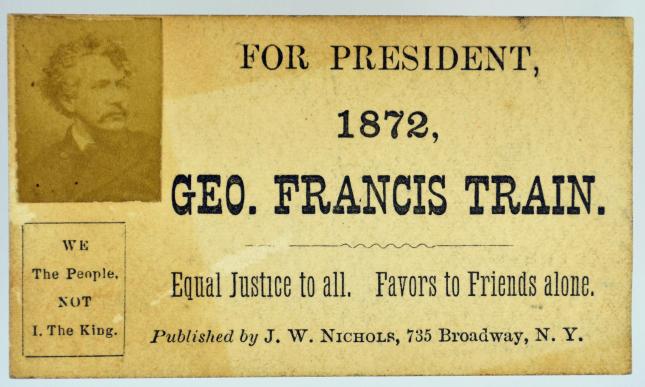
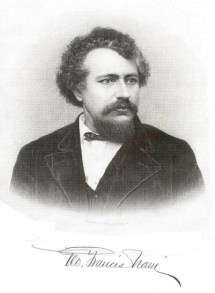
On This Day – 24 March 1829 Birth of George Francis Train 


21453_lg.jpeg

Strange times are these, in which we live, forsooth ;
When young and old are taught in Falsehood’s school:–
And the man who dares to tell the truth,
Is called at once a lunatic and fool.

George Francis Train

He was an exceptionally wealthy eccentric who stood for the American Presidency. When making stump speeches he spoke mostly about himself and his exploits, often repeated himself, and wandered off the subject. He was also a racist who, when he failed to become President, decided a better option was to become the nation’s dictator.

If that all sounds familiar, then perhaps you’ve already heard of George Francis Train, one of the most appropriately named mavericks in nineteenth century America. That’s because Train made his fortune from building a railway line. He was one of the men behind the Union Pacific, which built the east/west section of the American transcontinental railroad in the 1860s, and ripped off America royally in the process.

But what makes Train even more interesting is that he campaigned for more Irish migrants to enter the USA in the 1840s—not a very popular position to adopt—he got involved in the building of a horse-tramway in Cork—which didn’t succeed—became an advocate for Fenianism, wrote a book in 1865 called Irish Independency, and got himself imprisoned in Dublin for ten months in 1868, for carrying pro-Fenian literature on board a ship which landed in Ireland.

George Francis Train was either a conman supreme, a fraudster par excellence, a deluded maniac, a feminist, a vegetarian, a communist, a capitalist leech, a pacifist, or the ‘Great American Humbug’—he was called all of the above, and a lot more besides. Oh, yes, lest we forget, he was also the model for the character of Phileas Fogg in Jules Verne’s Around the World in Eighty Days.

He made his first fortune in shipping in the USA and Australia, before returning to America in the 1860s, and throwing in his lot with one of the most crooked business cabals in the long an undistinguished history of American crooked business cabals, the Union Pacific railroad corporation. Train and his associates realised that there were huge sums of money to be made from building their half of the transcontinental railroad, but only if they helped themselves to as much of the available funds as they could lay their grubby hands on. This is where Train’s neat idea of the Credit Mobilier paid off handsomely. It may sound like a French bank but, in fact, it was a company set up to actually build their half of the transcontinental railroad for the Union Pacific.

Naturally the construction costs were inflated, and the Union Pacific insiders, including Train, pocketed the difference between the actual cost of building the railroad and the prices being charged by Credit Mobilier for its construction. By the time the scam was exposed, in 1873, by the New York Sun newspaper, Train had long since taken his profit and moved on. He had become a Fenian fellow traveller, a supporter of equal rights for women, and a vegetarian.

His progressive credentials, however, did not extend as far as advocating equal rights for freed slaves, which became apparent when he sought the Democratic party nomination for the Presidency in 1864, 1868 and 1872.

Train’s exploits in shipping had influenced Jules Verne in the creation of Phileas Fogg in Around the World in Eighty Days and when, in 1890, the New York World newspaper despatched its ace reporter Nellie Bly to circumnavigate the globe—she did it in seventy-two days—the real George Train rose to the challenge on behalf of the fictional Fogg, and did the same journey in sixty-seven days. Two years later he did it all over again, this time in sixty days.

Towards the end of his life Train used the columns of his newspaper, The Revolution, to defend a campaigner for free love who had been arrested for obscenity. In the process, he was charged with the same offence himself. His lawyers got him off by pleading insanity. Train was not best pleased. But he was probably the victim of some form of mental debilitation that went well beyond so-called ‘eccentricity’, a euphemism for mental illness as long as you were wealthy.

He died in 1904 of smallpox. Sadly, fear of the infectious nature of the disease, led to many of his personal papers being destroyed after his death.

The extraordinary George Francis Train, American robber baron, suffragist and Irish nationalist, was born one hundred and eighty-eight years ago, on this day.


51FZATKE35L._SX195_.jpg9462330_1409474144.jpg