On This Day – 7 April 1926 – Violet Gibson tries to assassinate Mussolini


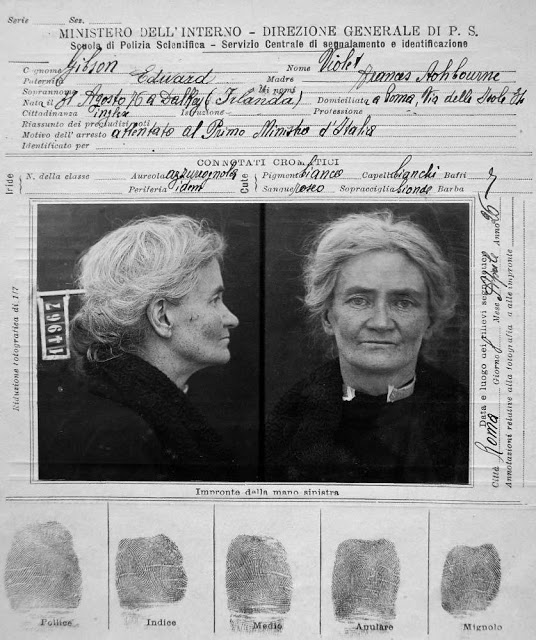
Violet Gibson's prison ID card, 1926.jpg


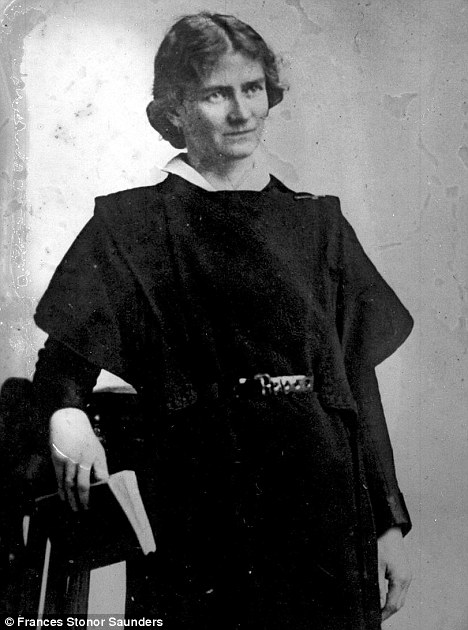
The former Italian international soccer player, Paolo di Canio, may be a fan, but the modest Irishwoman, the Honorable Violet Albina Gibson, was certainly not. In 1926 she linked Irish nineteenth century land purchase with twentieth century Italian fascism when, around the time he assumed absolute power in Italy, Violet Gibson unsuccessfully attempted to assassinate Benito Mussolini.

At the time Il Duce was saluting his public in the Piazza del Campodoglio in Rome. He had just addressed the International Congress of Surgeons, so he was probably in a good place had Violet Gibson been a better shot. As he sat in his Duce-mobile, waiting to be whisked away, the car was approached by a petite, bespectacled, and somewhat shabby fifty-year old woman. Instead of smiling and waving at the Italian prime minister, she took out a gun and shot him at almost point blank range.

Gibson, a member of an Irish aristocratic family, was, unfortunately, not a particularly good shot, and pistols are notoriously inaccurate in the hands of a novice. She hit Mussolini in the nose, twice, causing a spectacular nosebleed, but leaving him otherwise unscathed. At least one bullet went right through both nostrils.  A third attempt to fire led to the gun jamming. Had Mussolini not turned his head at the wrong moment—or the right moment if you’re a lover of Fascist dictators—Violet Gibson might not have failed in her one and only attempt at killing someone other than herself. Mussolini’s recorded reaction was one of surprise, that his assailant was a mere woman.
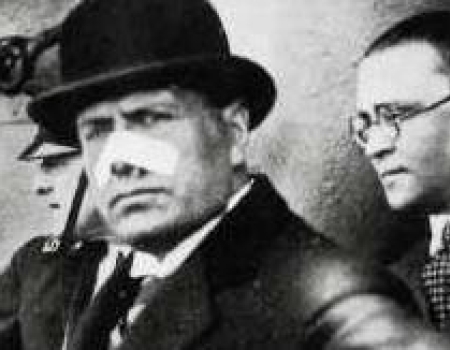
zcVYnplgPUyPMwJ2jVD5CHpX63hDS4+U0vr91YSW344=--mussolini_ferito_al_naso_attentato_1926.jpg

Gibson was immediately set upon by enthusiastic Fascist spectators, eager to demonstrate their devotion to Il Duce, and was almost lynched. The police intervened, and she was quickly overpowered and arrested. She can probably consider herself fortunate. A few months later a teenager tried to kill Mussolini in Bologna, he was captured by a vengeful mob, strangled, knifed, and then shot.

The middle-aged Irish aristocrat was from a celebrated Anglican and Unionist family, but had converted to nationalism and Christian Science, before eventually becoming a Catholic, in 1902. Her Catholicism, however, did not prevent her from once threatening to shoot the Pope, whom she accused of betraying her beloved Italy. The year before her attempt to end prematurely the illustrious career of Il Duce, she had tried to kill herself with a gunshot to the chest. She missed on that occasion too, her inaccuracy probably explaining her inability to kill the Fascist leader from the much greater range of a couple of feet, the following year.

After the attempt to take her own life she had spent her days living quietly in a convent in Rome, mostly doing jigsaws. She gave no indication of what she had in mind when she stepped out on 7 April 1926. Neither did she tell any of the nuns that she was armed.

Although she claimed to have been ordered to kill Mussolini by God himself, in the case made to the Military court that tried her, the prosecution held that ‘the deed was not attempted in an unconscious frenzy of delirium, terror or hallucination’. However, when she was released on Il Duce’s orders, and deported to Britain, she was committed to the same asylum where James Joyce’s daughter Lucia spent the last thirty years of her life. She died in 1956 at the age of seventy-nine, and is buried in Northampton in England.

Violet’s action would actually not have gone down too well in official circles in Britain in 1926, as the King of England had just awarded Mussolini the Order of the Bath. But his own lynching in 1945 prompted calls for her to be released. By then, however, her mental state had deteriorated, and she suffered from the delusion that her moods were responsible for the weather. With most of us it’s the other way around. On her return to England she had written many letters to Winston Churchill, and much later, to the future Queen Elizabeth. None were ever posted.

Incidentally, the obscure reference in the first paragraph to Irish land purchase was based on the fact that Violet Gibson was the daughter of Edward Gibson, Baron Ashbourne, the Tory Lord Chancellor whose 1885 legislation speeded up the acquisition of the land of Ireland by its tenant farmers, in what became known as the Ashbourne Land Act.

The Honourable Violet Gibson came within inches of changing European history ninety-one years, on this day.
 

article-0-08F33204000005DC-672_468x630.jpg

On This Day – 24 March 1829 Birth of George Francis Train 


21453_lg.jpeg

Strange times are these, in which we live, forsooth ;
When young and old are taught in Falsehood’s school:–
And the man who dares to tell the truth,
Is called at once a lunatic and fool.

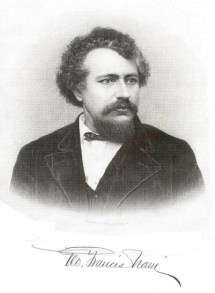
George Francis Train

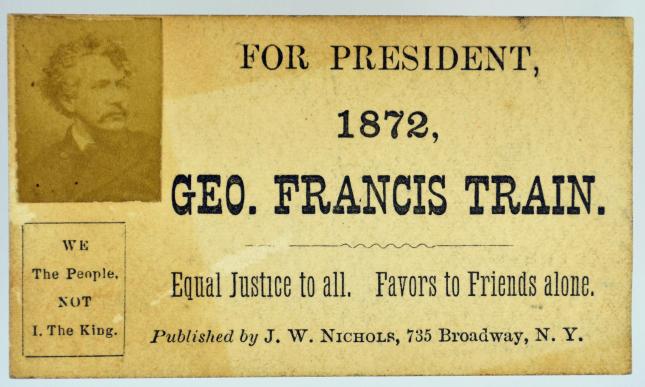
He was an exceptionally wealthy eccentric who stood for the American Presidency. When making stump speeches he spoke mostly about himself and his exploits, often repeated himself, and wandered off the subject. He was also a racist who, when he failed to become President, decided a better option was to become the nation’s dictator.

If that all sounds familiar, then perhaps you’ve already heard of George Francis Train, one of the most appropriately named mavericks in nineteenth century America. That’s because Train made his fortune from building a railway line. He was one of the men behind the Union Pacific, which built the east/west section of the American transcontinental railroad in the 1860s, and ripped off America royally in the process.

But what makes Train even more interesting is that he campaigned for more Irish migrants to enter the USA in the 1840s—not a very popular position to adopt—he got involved in the building of a horse-tramway in Cork—which didn’t succeed—became an advocate for Fenianism, wrote a book in 1865 called Irish Independency, and got himself imprisoned in Dublin for ten months in 1868, for carrying pro-Fenian literature on board a ship which landed in Ireland.

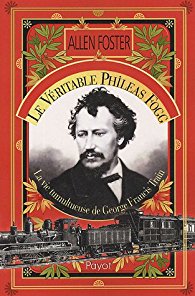
George Francis Train was either a conman supreme, a fraudster par excellence, a deluded maniac, a feminist, a vegetarian, a communist, a capitalist leech, a pacifist, or the ‘Great American Humbug’—he was called all of the above, and a lot more besides. Oh, yes, lest we forget, he was also the model for the character of Phileas Fogg in Jules Verne’s Around the World in Eighty Days.

He made his first fortune in shipping in the USA and Australia, before returning to America in the 1860s, and throwing in his lot with one of the most crooked business cabals in the long an undistinguished history of American crooked business cabals, the Union Pacific railroad corporation. Train and his associates realised that there were huge sums of money to be made from building their half of the transcontinental railroad, but only if they helped themselves to as much of the available funds as they could lay their grubby hands on. This is where Train’s neat idea of the Credit Mobilier paid off handsomely. It may sound like a French bank but, in fact, it was a company set up to actually build their half of the transcontinental railroad for the Union Pacific.

Naturally the construction costs were inflated, and the Union Pacific insiders, including Train, pocketed the difference between the actual cost of building the railroad and the prices being charged by Credit Mobilier for its construction. By the time the scam was exposed, in 1873, by the New York Sun newspaper, Train had long since taken his profit and moved on. He had become a Fenian fellow traveller, a supporter of equal rights for women, and a vegetarian.

His progressive credentials, however, did not extend as far as advocating equal rights for freed slaves, which became apparent when he sought the Democratic party nomination for the Presidency in 1864, 1868 and 1872.

Train’s exploits in shipping had influenced Jules Verne in the creation of Phileas Fogg in Around the World in Eighty Days and when, in 1890, the New York World newspaper despatched its ace reporter Nellie Bly to circumnavigate the globe—she did it in seventy-two days—the real George Train rose to the challenge on behalf of the fictional Fogg, and did the same journey in sixty-seven days. Two years later he did it all over again, this time in sixty days.

Towards the end of his life Train used the columns of his newspaper, The Revolution, to defend a campaigner for free love who had been arrested for obscenity. In the process, he was charged with the same offence himself. His lawyers got him off by pleading insanity. Train was not best pleased. But he was probably the victim of some form of mental debilitation that went well beyond so-called ‘eccentricity’, a euphemism for mental illness as long as you were wealthy.

He died in 1904 of smallpox. Sadly, fear of the infectious nature of the disease, led to many of his personal papers being destroyed after his death.

The extraordinary George Francis Train, American robber baron, suffragist and Irish nationalist, was born one hundred and eighty-eight years ago, on this day.


51FZATKE35L._SX195_.jpg9462330_1409474144.jpg

On This Day 24 February 1841 – Birth of John Philip Holland

John_Philip_Holland.jpgimages.jpeg


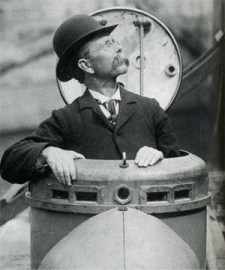
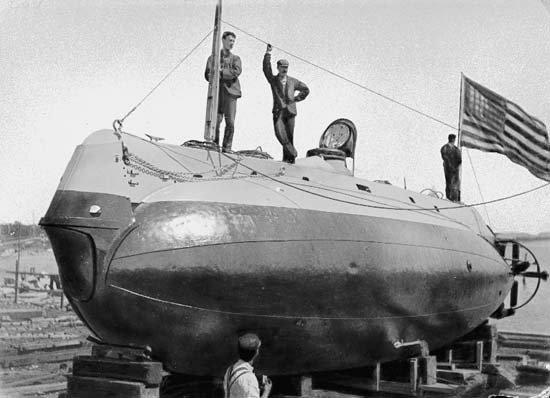
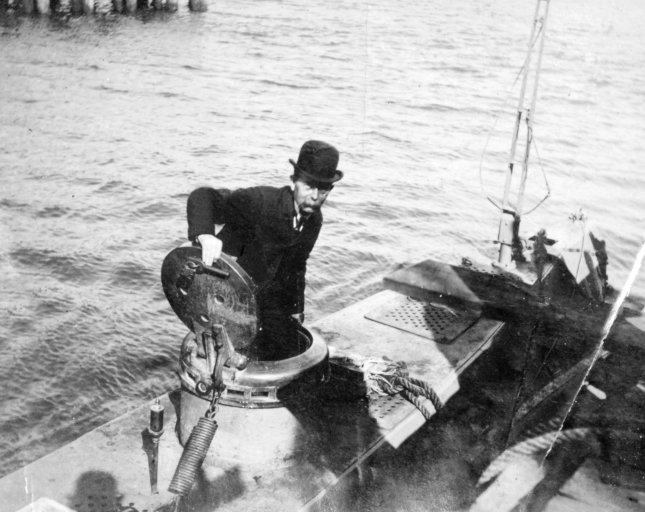
The next time a Royal Navy submarine engages in one of the force’s favourite pastimes, namely ‘snag an Irish trawler’, its crew might pause to reflect on the fact that the man who invented their vessel was brought up speaking Irish, and was once a Christian Brother.

John Philip Holland didn’t start to learn English until he went to national school in Liscannor, Co. Clare, just as the Famine was beginning to take hold in the west of Ireland.

His father, an employee of the British Coastguard Service, would probably not have approved of the first intended use of his new invention—it was built at the behest of the Fenians to blow up British shipping.

Holland was born in 1841 and left Ireland in 1873, after a stint as a schoolteacher in a variety of locations, including the North Monastery in Cork. It seems that he had already been working on his invention before he left Ireland. He settled down in Paterson, New Jersey and started to develop a patent, which he first offered to the US Navy in 1875. They rejected it as ‘a fantastic scheme of a civilian landsman’.

Holland’s brother, who lived in Boston, happened to be a member of the Irish Republican Brotherhood, and it was through his sibling that Holland met John Devoy and Jeremiah O’Donovan Rossa. Devoy was impressed by Holland’s nationalism, and by the potential for havoc of his invention. Money was appropriated from O’Donovan Rossa’s infamous ‘Skirmishing Fund’—collected from Irish-American nationalists for use in freeing the ‘old sod’—and Holland was engaged to build a prototype.

114359-004-9A5352E4.jpg

Holland was enabled by the Fenians to give up his teaching job, and work on the project full time. He used Rossa’s fund to develop his first model in 1878, the Holland 1, a one-man, fourteen-foot craft, with a two-cylinder engine.

By 1881 he had refined his original design, and produced a three-man vessel, thirty-one feet long, which became known as The Fenian Ram, but which could not sustain extended periods of use underwater.

While he was working for the Fenians, Holland could never seem to get it absolutely right. If he designed a submarine that could remain underwater for long periods, it would develop engine trouble. He also got into difficulties with port authorities in New York and New Haven, who considered him, quite literally, a danger to shipping. After an investment of sixty thousand dollars, with little or nothing to show for it, other than three interesting models, the Clan and Holland parted company. Fortunately Clan na Gael had no Comptroller and Auditor General among their ranks to issue a negative report about the waste of good Skirmishing Fund money, funds that might have been better used in the dynamite campaign then going on in London.

Holland continued to experiment. He developed a fourth prototype, which didn’t seem to excite anybody too much either, until he attracted the attention of a wealthy lawyer, J.B.Frost, who staked him until he got it right. He hit pay dirt with ‘Model No. 6’. It was fifty-three feet long, had a six-man crew, could dive to sixty feet, and stay under for nearly two days. It was also armed with torpedoes. The US Navy gave him one hundred and fifty thousand dollars for it, named it the USS Holland, and asked for six more please. Oh, yes—then they really annoyed the inventor by selling the plans to the British Navy.

Holland died in 1914, barely a week after the beginning of the global war that was to see his invention kill thousands of people, including women and children, on board commercial vessels like the Lusitania.

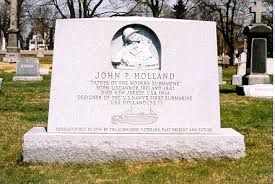
John Philip Holland, Clare man, ex-Christian Brother, native Irish speaker, and inventor of one of the most lethal weapons in military history, was born one hundred and seventy-six years ago, on this day.

John-P-Holland.jpg


On This Day – 17 February 1857 Birth of Samuel McClure

mcclures-cover-ss.jpgPortrait_of_S._S._McClure.jpg

Campaigning investigative journalism, or ‘muckraking’ in American parlance, came into its own in the USA during what is known as the Gilded Age, towards the end of the 19th century. As with all halcyon eras, it was ‘gilded’ only for the privileged few. Such fabulously wealthy individuals often had few compunctions about how the acquired their gold.

Newspapers and magazines uncovered and exposed the excesses of corrupt politicians, and the illegal and unethical activities of the so-called ‘robber barons’ of the period, staggeringly rich men, as well as major corporations, who wished to become even wealthier. The ‘muckrakers’—the term was originated by President Theodore Roosevelt, he meant it as a compliment—held corporate and political America up to close scrutiny, and generally found it wanting.

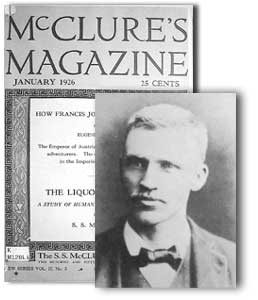
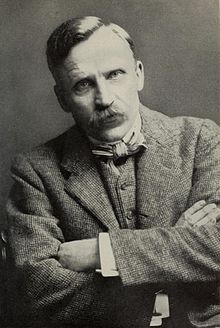
At the centre of this tsunami of investigative journalism, was a magazine called McClures, which employed some of the greatest campaigning writers of the 19th and early 20th centuries. It was owned and edited by an Irishman, Samuel McClure. McClure was from Ballymoney, County Antrim. He was the son of a carpenter, whose mother was forced to take him, and his siblings to the USA, after her husband died in an industrial accident when young Sam was nine years old. McClure had a tough childhood, but his mother was determined that he would get a good education. This eventually brought him to one of the best liberal arts academies in the USA, Knox College in Illinois, and after that into a career in New York journalism.

He was already well-established when he started the monthly magazine McClure’s, in 1893. It sold for ten cents a copy, or a dollar a year. Among his achievements was the nurturing of new literary voices, like Jack London and Willa Cather. He also introduced the teaching methods of Maria Montessori to the American public. But McClure’s enduring significance lies in the fact that he championed an entirely new form of writing, the well-researched exposé. McClure was almost unique among editors in not demanding instant and regular copy from his employees. Instead, he was prepared to finance painstaking, thoroughly researched reporting, that would reveal the corruption and injustice of late 19th century American society. He did this with the help of the so-called ‘Big Four’, the talented, tenacious and courageous quartet, Lincoln Steffens, William Allen White, Ida Tarbell, and Ray Stannard Baker.

Steffens, once said of his editor that:

He was a flower that did not sit and wait for the bees to come and take his honey and leave their seeds. He flew forth to find and rob the bees.

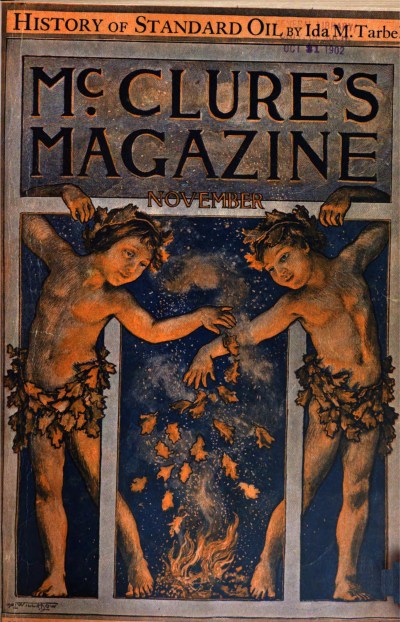
1902-november-history-of-standard-oil-mcclures-magazine.jpg

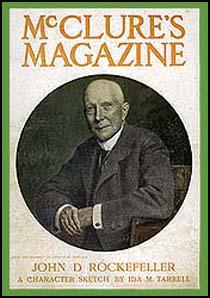
The bees McClure robbed were amongst the wealthiest, most ruthless, and powerful individuals in early twentieth century America. Men like John D. Rockefeller, whose Standard Oil company was a particular target for Ida Tarbell in a series of articles between 1902-04. Rockefeller dismissed her as ‘Ida Tarbarrel’, a sure sign that she was getting under his skin. Or Andrew Carnegie, the activities of whose U.S. Steel Corporation were laid bare by Ray Stannard Baker in 1901.  Steffens, who became editor of McClures in 1902, tended to focus his attention on crooked politicians and corrupt civic administrations, many of whom were in the pockets of the ‘robber barons’.

The muckrakers challenged the overt and the hidden power of an apparently invulnerable class of super-rich industrialists, and their allies in urban machine politics. The turn of the 19th century in the USA was a period, on the one hand, of unregulated capitalism, but on the other of a burgeoning progressive reform movement. McClures magazine was in the vanguard reform, providing progressive politicians with the ammunition they needed to curtail the power of a monopolistic oligarchy.

None of which made the mercurial Sam McClure easy to work with. He was often idiosyncratic and inconsistent, though highly supportive of his invaluable contributors. Finally, in 1906, Tarbell, Baker, White and Steffens, having had enough of his eccentricities, departed from what they called McClure’s ‘house of bondage’, and founded the equally radical American Magazine. To the astonishment of all, McClure, who parted with his stars on generous terms, simply dusted himself off, and started over again, as a dangerous pest to the elites he had already been stinging for years.

At its height McClure’s was selling four hundred thousand copies a month. Gradually, however, its influence started to decline, as did McClure’s personal interest in his pet project.  By 1914 he had moved on to other things. These included three philosophical musings on the workings of democracy, two of which were published in the 1930s. McClure lived on to the age of ninety-two, and died in 1949.

Samuel Sidney McClure, scourge of the American entitled, was born in Co. Antrim, one hundred and sixty years ago, on this day.

USAmcclureCC.jpgMcClures_magazine_1903_may.png


On This Day – 10 February 1889 Richard Piggott is exposed as a forger


220px-Charles_Russell_10_April_1907.jpgsir-leslie-ward-richard-pigott.jpg

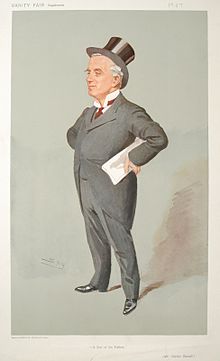
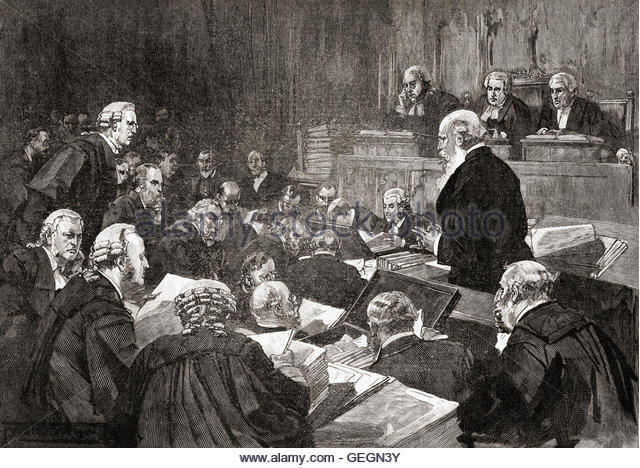
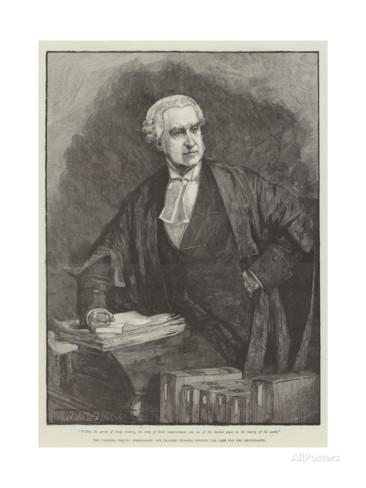
Born plain Charles Russell, in Newry, Co.Down, the man who would become Baron Killowen, and who would torment the infamous forger Richard Pigott in the witness box, in his defence of Charles Stewart Parnell, was one of five children. He was also the only sibling in the Russell family who did not enter the religious life. His three sisters all became nuns, his brother a Jesuit priest.

He was a highly successful Queen’s Counsel in London, a moderate nationalist MP, and rose to become Lord Chief Justice of England, the first Catholic to hold the office in centuries. However, it is for his forensic grilling of the dubious journalist, turncoat, and pornographer, Richard Pigott at the Times Commission hearings in 1889 that he is justly celebrated.

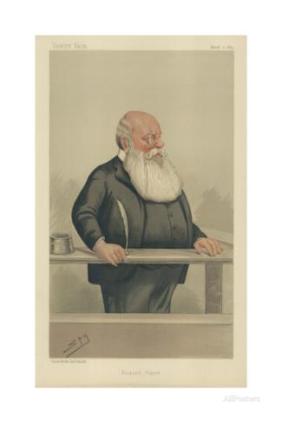
Pigott had fallen on hard times by the 1880s—he had, at one point, been a relatively prosperous newspaper proprietor who, in 1868, went to jail on a point of principle after a defence of the Manchester Martyrs in one of his newspapers. He had been affiliated to the Fenians, but accusations of his embezzlement of IRB funds put paid to that association. In 1881 he sold his newspapers to Parnell, but went through the four thousand pounds he received from the Land League, in short order.

Pigott had sold the Times a pup … at least twice over.  He had passed on, for payment, a letter that suggested Parnell supported those who carried out the brutal Phoenix Park murders of the Chief Secretary of Ireland, Lord Frederick Cavendish, and the Under Secretary, Thomas H.Burke, in May 1882. Parnell vehemently denied the veracity of the letter. A Commission was established which, in essence, pitched the Times newspaper against Parnell, and most of the senior members of his party.

the-cross-examination-of-richard-pigott-the-irish-journalist-during-gegn3y.jpg

The letter in question, published in facsimile by the Times in April 1887, was one of a number that had been forged, quite cleverly, by Pigott himself.  He had, however, left a couple of hostages to fortune in the material he had supplied to the Times. Pigott was not quite as literate as one might have expected a former newspaper editor to be. He was a dreadful speller.  Observers who closely examined the cache of correspondence he had provided to the Times noted a couple of howlers.  In one case, for example, he had spelt the word ‘hesitancy’ as h-e-s-i-t-e-n-c-y.

When he began his cross-examination of this crucial Times witness Russell puzzled the onlookers by handing Pigott a sheet of paper and asking him to write a number of words on it. One of those was ‘hesitancy’. He then casually took back the paper, glanced at it, and ignored it for most of the next two days.

Russell then proceeded to reduce Pigott to a gibbering wreck, catching him out in his elaborate system of deception. Before the future Lord Chief Justice was finished, most of the observers, and even the three learned presiding judges, had been reduced to tears of laughter, at Pigott’s many contradictions, and obvious lies.

Then, as a coup de grace, Russell returned to the mysterious page. After a few more barbed questions he pointed out that in one of the letters retained by the Times, and handed over to the defence under ‘discovery’, the word hesitancy had been mis-spelt. The erroneous spelling, he demonstrated, was precisely that chosen by Pigott the previous day, when asked to write the word on the enigmatic piece of paper. Pigott went a couple of stages beyond gibbering wreck, and no one in the court had the slightest doubt, but that he had forged all the letters upon which the Times depended to make its case.

Pigott fled shortly after the commission of inquiry adjourned, admitted his guilt in a letter to the tribunal, and shot himself dead in Madrid a few days later, in order to avoid arrest. Parnell subsequently sued the Times for defamation in a London libel court, and won £5000. In subsequent years, at public meetings, when a heckler wished to suggest that a platform speaker had ‘sold out’ or betrayed his cause, the aggrieved party would yell ‘spell hesitancy’ at the top of his voice.

Charles Russell, inquisitor extraordinaire, destroyed the credibility of the hapless forger, Richard Pigott one hundred and twenty-eight years ago, on this day.

thomas-walter-wilson-the-parnell-inquiry-commission-sir-charles-russell-opening-the-case-for-the-defendants.jpg