Some American music of the Great War

This is a guide to a small percentage of the music recorded in the USA which was related to the Great War. It is confined to material discussed by historians Glen Gendzel (San Jose State University) and John Borgonovo (University College, Cork) for a segment which did not make it into the final edit of a two part series I have compiled and presented for Lyric FM called ‘From Tipperary to Salonika: Ireland the the music of the Great War’. The programmes will be transmitted by Lyric in the Lyric Feature slot at 7.00 pm on Friday 13 February and Friday 20 February. You will be able to ‘listen back’ to the two broadcast programmes on the Lyric FM website [http://www.rte.ie/lyricfm/] and you will also be able to listen to Glen and John talk about songs like I didn’t raise my boy to be a soldier, Over there, Stay down here where you belong  and many more.
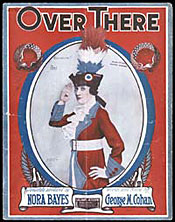
overthere-image2

Songs written in opposition to WW1 recruitment were, of their nature (because they were illegal under the Defence of the Realm Act) never published or widely performed in public.

One notable exception to the lack of published anti-recruiting material was, of course, the USA where, before its entry to the war in 1917, there was strong anti-war sentiment, particularly amongst Irish and German Americans.

There was also a vibrant if patchwork ‘left’ which was opposed to the imperial nature of the conflict. The latter strain was reflected in the tunes recorded in The Little Red Songbook, first produced in Spokane, Washington in 1909 by the Industrial Workers of the World, or the ‘Wobblies’. The famous Swedish-American labour activist Joe Hill contributed a number of songs, including an anti-war song Don’t take my papa away from me.

Typical of the genre was the song Christians at war by John F.Kendrick published in the March 1916 ‘Joe Hill Memorial’ edition of the Little Red Songbook [Hill had been dubiously convicted of murder in 1915]. It doesn’t pull too many punches

 Christians at war

Onward, Christian soldiers! Duty’s way is plain;

Slay your Christian neighbors, or by them be slain,

Pulpiteers are spouting effervescent swill,

God above is calling you to rob and rape and kill,

All your acts are sanctified by the Lamb on high;

If you love the Holy Ghost, go murder, pray and die.

A rather gentler example of the genre was I didn’t raise my boy to be a soldier with lyrics by Alfred Bryan and music by Al Piantadosi, published around the same time. This one centres around the figure of the [potentially] grieving mother.
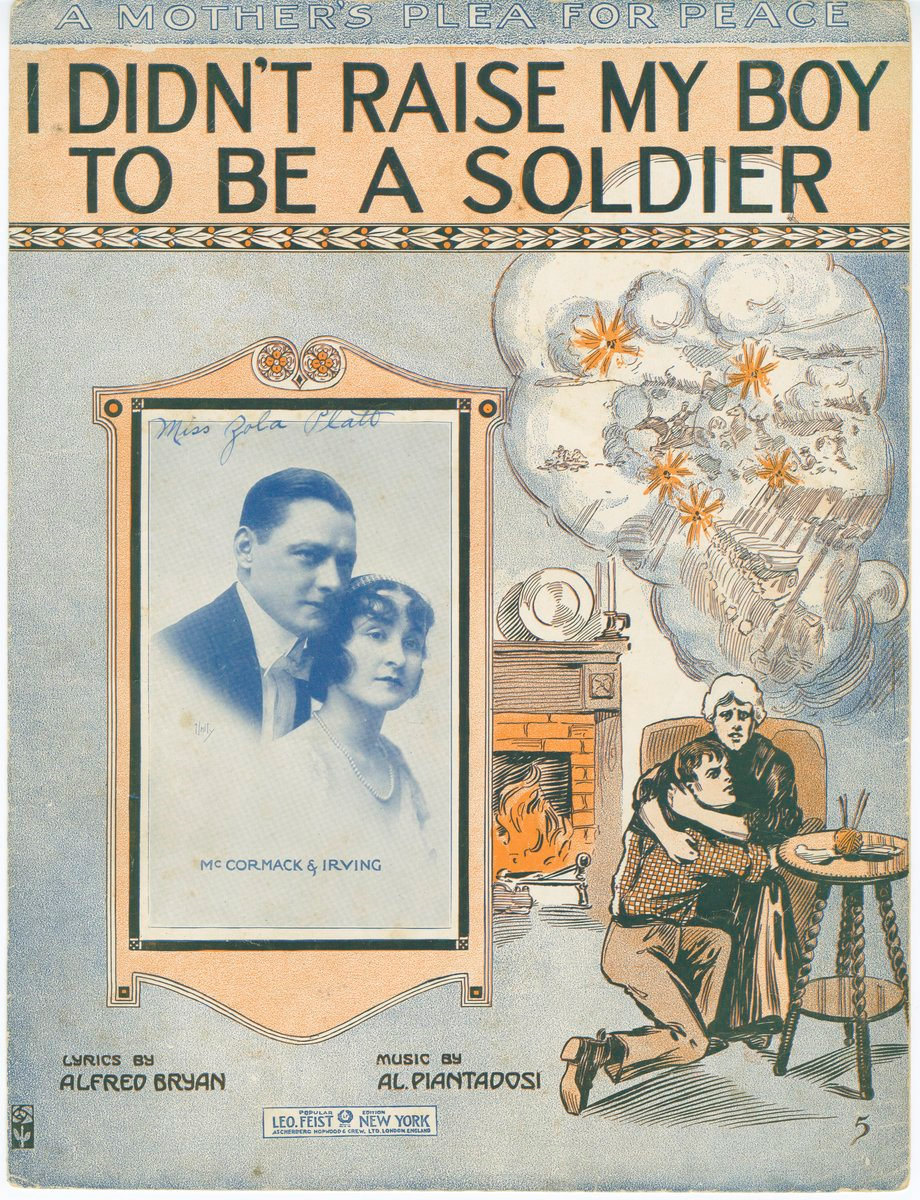
I_didn't_raise_my_boy_to_be_a_soldier1

It begins …

Ten million soldiers to the war have gone

Who may never return again,

Ten million mothers’ hearts must break

For the ones who died in vain.

Head bowed down in sorrow

In her lonely years

I hears a mother murmer thro’ her tears.

Then the chorus comes in …

I didn’t raise my boy to be soldier

I brought him up to be my pride and joy

Who dares to place a musket on his shoulder

To shoot some other mother’s darling boy?

Let nations arbitrate their future troubles

It’s time to lay the sword and gun away,

There’d be no war today

If mothers all would say:

“I didn’t raise my boy to be a soldier.”

The response of Theodore Roosevelt to the song was to suggest that the place for women who opposed war was “in China—or by preference in a harem—and not in the United States.”

After the US declaration of war in April 1917 the music industry – always quick to change direction and monetise – rapidly brought out songs like I didn’t raise my boy to be a coward and I didn’t raise my boy to be a slacker

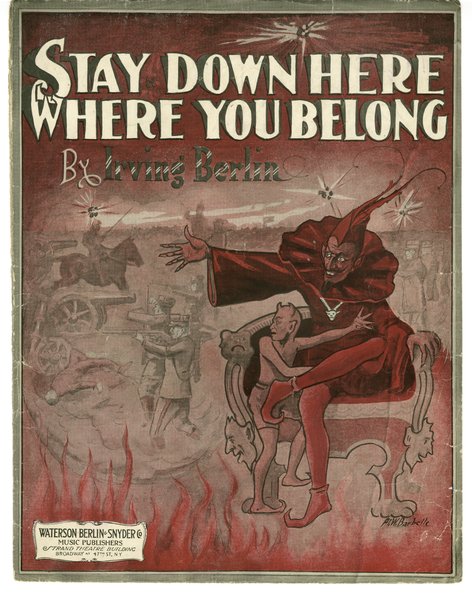
According to the publisher I didn’t raise my boy to be a soldier sold 700,000 copies in the first eight weeks of release. The first recording, by Morton Harvey, was coupled with an Irving Berlin song Stay Down Here where you belong which was recorded in an isolationist America in 1915 by Henry Burr

Stay down here where you belong
SCREEN

The lyrics depict a conversation between the devil and his son – the devil urges the son to “stay down here where you belong” because people on Earth do not know right from wrong. His son wants to go ‘up above, up above’.

The Devil advises …

[Refrain:]
Stay down here where you belong

The folks who live above you don’t know right from wrong

To please their kings they’ve all gone out to war

And not a one of them knows what he’s fighting for

‘Way up above they say that I’m a Devil and I’m bad

Kings up there are bigger devils than your dad

When the USA entered the war in April 1917 the song became acutely embarrassing for Berlin

– to Berlin’s constant irritation Groucho Marx refused to let Stay down where you belong go away and sang it regularly – according to Groucho, Berlin offered him $100 to stop singing the song – but he was still doing it in the 1970s and it was included on one of his final concert albums An Evening with Groucho[1] – there’s also a You Tube clip of him singing it on the Dick Cavett Show in 1971 – with, they both claimed, Irving Berlin watching on TV.  [https://www.youtube.com/watch?v=9WTkzBRbtZA&feature=kp]

In fairness Groucho was singing it in the 1970s in response to Vietnam not WW1 and said as much on the Cavett show – [where he confirmed the $100 dollar story]

Berlin atoned for Stay down here where you belong in 1918 with God bless America [originally written for military musical Yip Yip Yaphank – Yaphank was in Long Island, site of Camp Upton – a product of Berlin’s conscription into the US Army ‘Army takes Berlin’ was one waggish newspaper headline]–

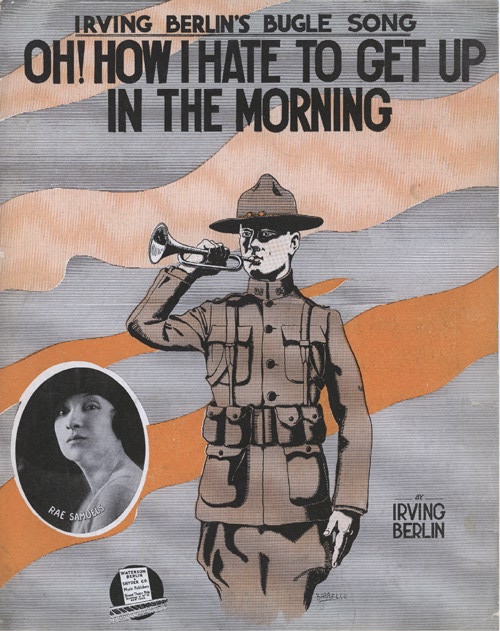
One of the songs in Yip Yip Yaphank possibly testifies to the greater acceptance of slightly more subversive material in the USA than GB – the show included the song How I hate to get up in the morning.
pb4

This included the lyric …

Someday I’m going to murder the bugler

Someday they’re going to find him dead

I’ll amputate his reveille

And step upon it heavily

And spend the rest of my life in bed

 Don’t blame the Germans

The thriving US anti-war song genre included Daddy please don’t let them shoot you, Don’t take my darling boy away and If they want to fight, all right, but neutral is my middle name.

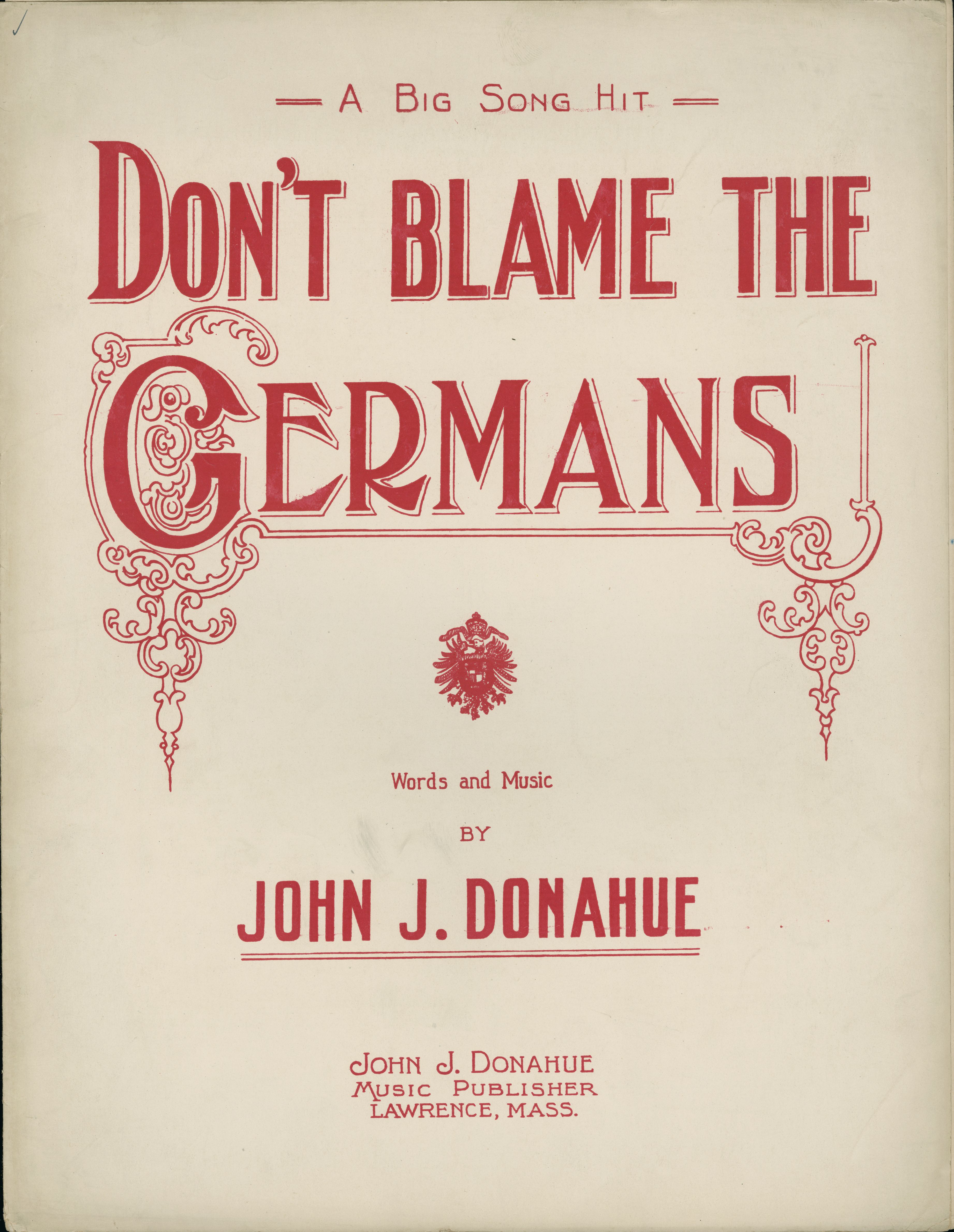
Perhaps the most interesting of all was Don’t blame the Germans written in 1915 by John J.Donahue – a song written by an Irish-American and obviously aimed at his own community and that of ethnic Germans in the USA. The song begins by appealing to the American sense of fair play with a major statistical porkie …
Dont-Blame-Germans-Cover

Don’t blame the Germans for it isn’t right

Remember they are one to five in this gigantic fight

With the Allies all against them, yet they hold their own

It’s hard to beat the Germans on the land or on the foam

It continues by appealing to Irish prejudices and to a revisionist trope that had emerged from Germany itself by 1915, the notion of ‘perfidious Albion’ really being at the heart of the conflict – that England was to blame for the war.

French and Belgians, misled by England’s greed

Must very soon surrender for they know they can’t succeed

It’s a pretty startling form of revisionism which even some German Americans probably realized was an obvious example of special pleading

Needless to say all these songs disappeared in April 1917 – other than Stay down here where you belong but that was thanks to Groucho Marx

[1] Life with Groucho, Arthur Marx, Popular Library Edition, 1960 p. 167
On This Day – Drivetime – 30 January 1846 – Birth of Katharine O’Shea (Parnell)

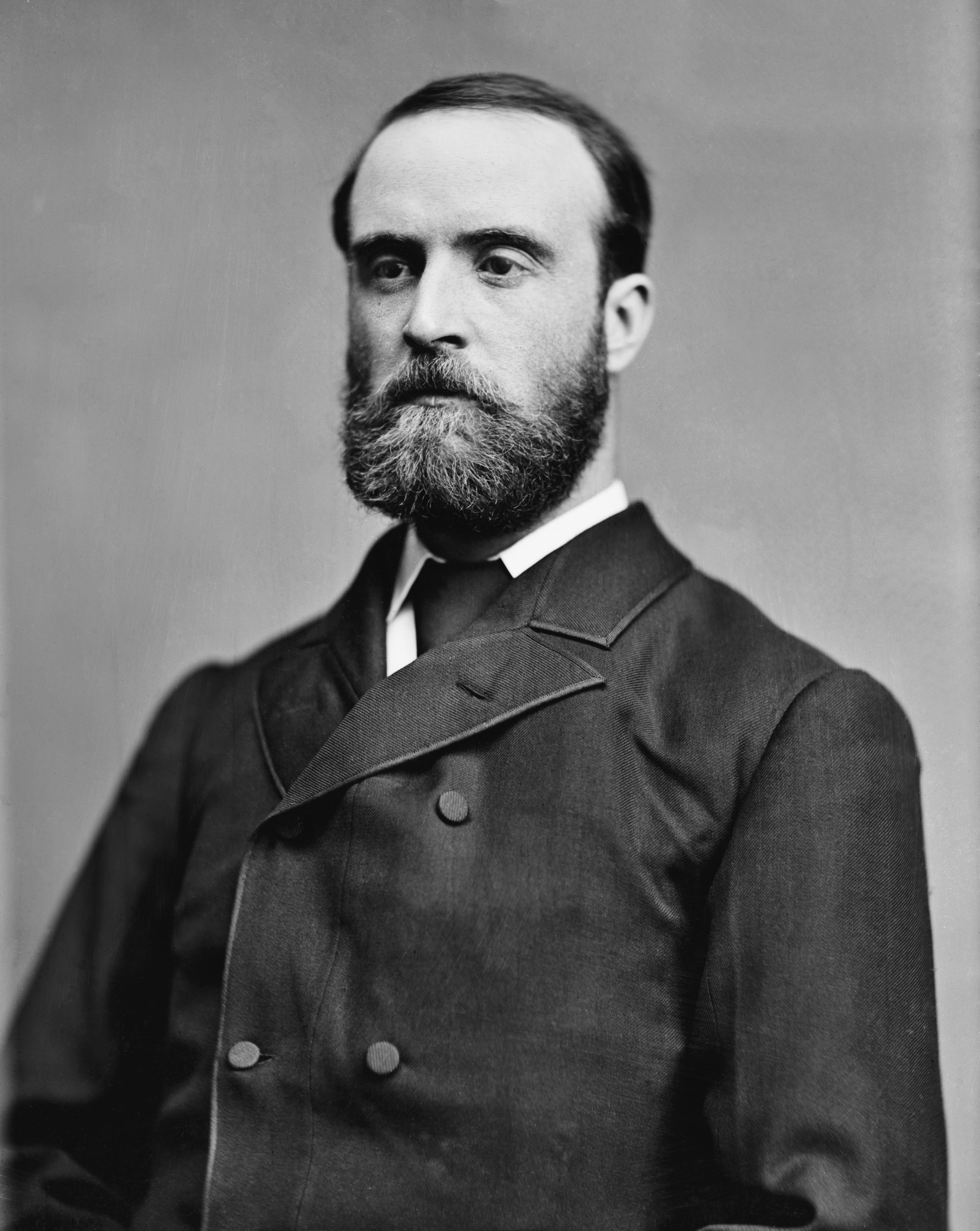
200px-KittyOSheaCharles_Stewart_Parnell_-_Brady-Handy

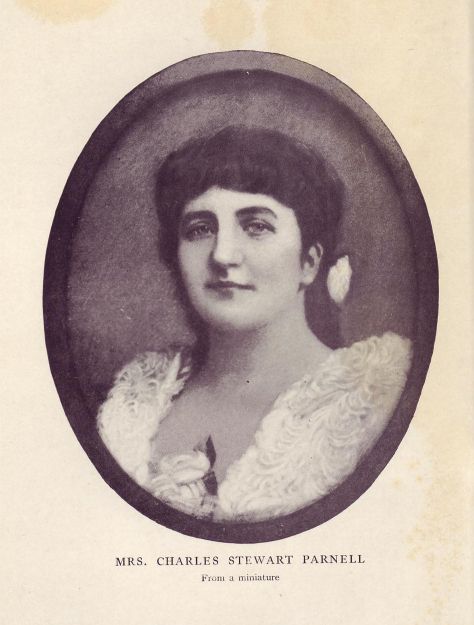
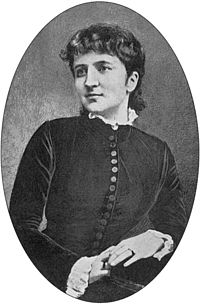
To this day she is known as Kitty, though her friends, family and London society in the late 19th century knew her as Katharine, or Kate. Although the name is innocuous today during the Victorian era it was meant to sting – in those times ‘kitty’ was a euphemism for a prostitute.

She is at the heart of one of the great ‘what ifs’ of Irish history, as in ‘what if Katharine O’Shea and Charles Stewart Parnell had never met?’

But they did. She was the wife, probably estranged, of one of the great Irish chancers of Victorian London, Captain William Henry O’Shea, once a dashing Hussar but more familiar today as a talentless political opportunist. Had O’Shea not been a failed banker he might well have found other ways in which to discommode his native country. As it was it was his failure as a politician that was to have more serious ramifications than his inadequacies as a financier.

In 1880 O’Shea was a rookie Irish MP, Parnell was the new leader of the Irish Parliamentary Party. O’Shea had an attractive wife and he obliged her to make herself useful in the advancement of his political ambitions. She was instructed to invite Parnell to a number of political soirees she organized on her husband’s behalf, or, more likely to keep the dodgy O’Shea at a disrtance. He pronounced his name O’Shee by the way, presumably to distinguish him from his common or garden countrymen of the same name. Parnell, however, was not one for the banality of opening invitations, or indeed letters in general, so to press her invitations she went in person. That, according to her own account, was when they fell in love. Parnell didn’t leave any account. He was as good at writing letters as he was at opening them.

The relationship blossomed rapidly and soon, they were, in effect, man and wife. She became his ‘Queenie’, he became her ‘King’. O’Shea rarely darkened the door of his wife’s boudoir but found out about their trysts rather quickly. He challenged Parnell to a duel but when, to his surprise, the Irish party leader accepted the challenge, the former Hussar backed down. He contented himself thereafter with squeezing every drop of political nectar he could from his wife’s lover and partner.

He looked away as the couple had three children together. His incentive, in addition to political advancement, was a hefty share in a large sum of money his estranged wife stood to inherit from an aged aunt. When the elderly lady finally passed on, and he was neatly cut out of the inheritance, he stopped looking away. He sued for divorce, no doubt full of the festive spirit, on Christmas Eve 1889.

The resulting court proceedings destroyed Parnell’s career. In the middle of a year of huge controversy in 1891 he only made things worse for himself politically when he married Katharine after the divorce was finalized. Humiliated by a series of futile and debilitating by-election campaigns an exhausted Parnell died in their house in Brighton in October, a month the highly superstitious Parnell always considered ill-starred.

Katharine Parnell, as she now was, then did a great service to a country she had never visited and much of whose population considered her to be a scarlet woman or an English spy who had destroyed their leader. In an act of generosity she waived her right to have Parnell buried in a south of England graveyard where she could join him when her own life ended. Instead she allowed him to be returned to Ireland and interred in Glasnevin cemetery in perhaps the biggest funeral the country had ever seen.

Katharine O’Shea, or Katharine Parnell as she chose to be called, was born five months before her second husband, Charles Stewart Parnell, 169 years ago, on this day.

Katherine_O_Shea

On This Day – Drivetime – Michael Collins takes possession of Dublin Castle 16 January 1922

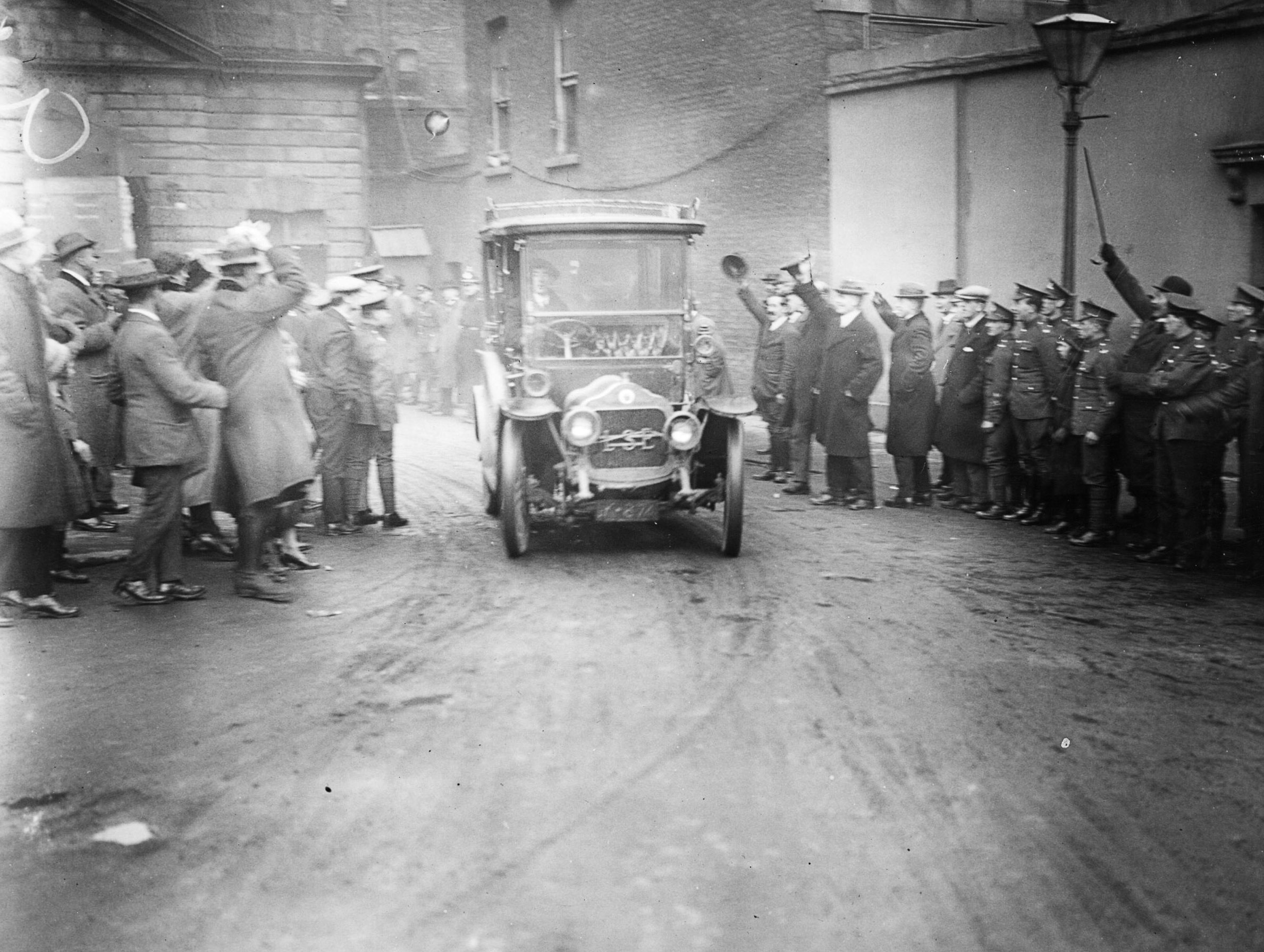
MichaelCollinsCarEnteringDublinCastleJanuary1922Unknown

Even though Michael Collins concluded, accurately, in December 1921, that, in agreeing to the terms of the Anglo Irish treaty, he had signed his own death warrant, without having appended his signature to the document on 6 December 1921 he would not have been able to participate in an event six weeks later that must have given him a great deal of satisfaction.

Once the Treaty was signed and ratified by Dail Eireann on 7 January, bar a port or two, the loan of some artillery to start the Civil War, and of course six counties, the British didn’t really hang about. The new rulers of Ireland were advised to be ready to take over Dublin Castle in mid January.

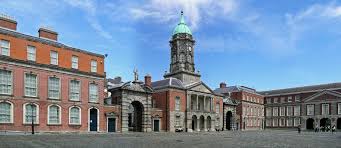
There could be no clearer indication of the actual intention of the British to leave the 26 county Irish Free State than the handing over of this sprawling monument to British rule in Ireland. For centuries Ireland had been governed from … ‘The Castle’. Members of the majority religion who co-operated with the British administration to their financial benefit were … ‘Castle Catholics’. Everything British that moved and had its being in Ireland emanated from … the Castle.

Built at the behest of King John in the 13th century to provide a base for the English conquest of the country from Dublin it had remained the nexus of English and then British rule and the abiding symbol of the colonization of Ireland.

It was from the Bermingham Tower in the Castle that the legendary escape of Red Hugh O’Donnell and Art O’Neill took place in the depths of the winter of January 1592. Art O’Neill perished in the Dublin Mountains but O’Donnell managed to make his way to the sanctuary of the O’Byrnes in Glenmalure, Co.Wicklow. Just over two hundred years later, in 1907, the Insignia of the Order of St.Patrick, known as the Irish Crown Jewels, were stolen from the Bedford Tower in an audacious robbery that has never been solved. Half of Dublin at the time knew who had stolen them. The problem was they nominated the other half of the city as the thieves.

The Castle might well have fallen during the upheavals of 1641, but it did not succumb to rebel control. Robert Emmett could conceivably have taken it in 1803 but dismally failed to do so. It was even more vulnerable in 1916 but the Volunteers failed to walk the ball into an open goal.

So Michael Collins, dressed impressively in his military uniform, must have savoured the moment when his staff car drove into the precincts of the complex of buildings whose fabric he had successfully managed to infiltrate during the Anglo-Irish war while, himself, managing to stay out of the clutches of its more sinister and homicidal operatives.

When Collins stepped out of his staff car he was greeted waspishly by the Lord Lieutenant, Lord Fitzalan. ‘You are seven minutes late, Mr.Collins’, observed His Majesty’s last Viceroy in Ireland. The Irish leader is said to have responded acidly, ‘We’ve been waiting over seven hundred years, you can have the seven minutes.’

Fitzalan, the first Catholic Lord Lieutenant since the reign of King James II then took Collins on an impromptu and largely irrelevant tour of the facility pointing out which keys opened which doors, before absenting himself and leaving Collins, literally, holding the fort.

Michael Collins took possession of Dublin Castle on behalf of the Irish provisional government 93 years ago, on this day.

images

On This Day – Drivetime – 9.1.1873 Birth of John J.Flanagan, hammer thrower

Irish_Whales_John_Flanagan_Martin_Sheridan_James_MitchellJohn_Flanagan_1910_Mecca_card_front2

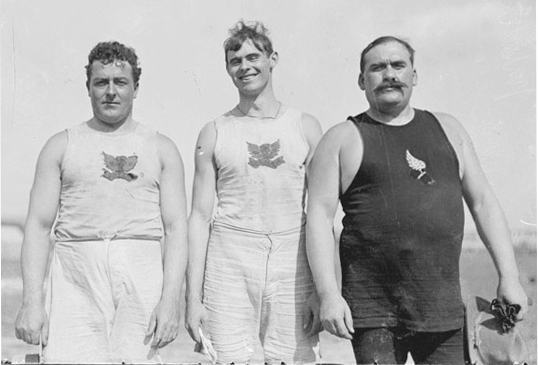
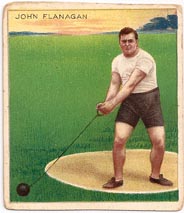
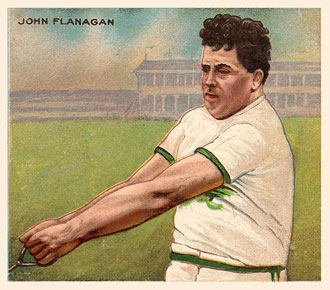
They were know, collectively, as the ‘Irish Whales’ John J. Flanagan, Matt McGrath, Jim Mitchell, Patrick J.Ryan and Con Walsh. In the early years of the 20th century these Irishmen, all domiciled in the USA, ruled the world of hammer throwing, winning five Olympic gold medals . But it was Flanagan, born in Kilbreedy, near Kilmallock, Co.Limerick, in 1873, who was primus inter pares.

Flanagan, who, for a successful field athlete, stood a relatively modest 5’10” tall, was something of an all-rounder who had already established his reputation in field sports before he emigrated to the USA in 1896. There he began to specialise in the hammer event which, in 1900, was included in the programme for the Paris Olympic Games. Flanagan, the world record holder, representing the USA, beat two other American throwers to take the first hammer gold with a throw of just over 51 metres. He was the only non-college American to win a medal at those games. Both the silver and bronze medallists in his event, Truxton Hare and Josiah McCracken were, for example, college football players.

He repeated the feat in the St.Louis games in 1904, taking gold, once again, from two Americans. His third and final gold medal, at the London Olympics in 1908, must have given him a great deal of satisfaction. An element in the crowd appeared to dislike the idea of an Irishman competing for the USA at the Olympic games, and made their feelings clear, vocally, by booing the Limerickman. Flanagan defied their disapproval to take the laurels with a throw of almost 52 metres. Fellow Irishman, Matt McGrath, took the silver, which must really have pleased the home crowd. There cup must have run over entirely when the bronze was hung around the neck of Con Walsh, competing for Canada.

Flanagan and McGrath (who won Olympic gold in 1912) were both members of the New York Police Department. Flanagan’s first posting was something of a sinecure. He worked in the Bureau of Licences where he had a lot of time on his hands which was mostly used for training at the Irish American Athletic Club in Queens.

Flanagan was a committed competitor no matter what the occasion. In 1905, for example, in a police sports meeting in New York he dominated the throwing events as expected. That, however, wasn’t enough for him, and to demonstrate that he possessed a turn of speed as well he entered and won the inelegantly titled Fat Man’s Race.

In 1910 he ended his career as one of New York’s finest after he was transferred to West 68th street and forced to walk a beat near Central Park.

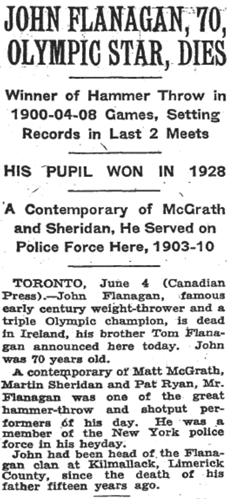
In all Flanagan, in addition to his three Olympic golds, won 9 US championships and set thirteen world records. In 1911 he returned to Ireland and a few years later took over the family farm on the death of his father. He died, aged 75, on 4 June 1938 in his native Limerick.

Inspired, no doubt, by his superhuman achievements there is a belief that Flanagan’s middle name was ‘Jesus’. This is how he appears on, for example, the Olympic.org website. But it seems his middle name was, in fact, the far humbler and more mundane, Joseph.

The first occasion on which the hammer event at the Olympic games was NOT won by an athlete competing for the USA was in 1928, when Pat O’Callaghan, throwing for Ireland, took the gold. That would have been an immensely satisfying moment for Flanagan, as he was O’Callaghan’s coach.

Irish-born Olympian, John J.Flanagan was born 141 years ago, on this day.

Flanagan_at_CP_cardFlanagan_obit

2014 in review

The WordPress.com stats helper monkeys prepared a 2014 annual report for this blog.

Here’s an excerpt:

The concert hall at the Sydney Opera House holds 2,700 people. This blog was viewed about 13,000 times in 2014. If it were a concert at Sydney Opera House, it would take about 5 sold-out performances for that many people to see it.

Click here to see the complete report.