On This Day- 25 May1895  Sentence is passed on Oscar Wilde

cropped_MI-oscar-wilde-black-and-white.jpg


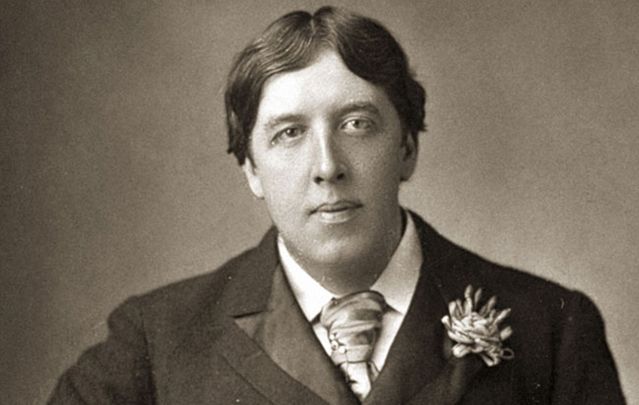
It took three trials to send Oscar Wilde to jail. He wasn’t even in the dock himself for the first one, but he might as well have been.

In the summer of 1891 Wilde, then thirty-eight years old, met, and fell in love with the twenty-two year Lord Alfred Douglas, an aspiring poet, known to have had a string of homosexual affairs while at university. Wilde showered the young man with gifts and affectionate letters. The first ‘wrinkle’ in the relationship came when Douglas gave away an old jacket, containing some of the letters, to a friend, down on his luck. They had to be bought back at a high price.
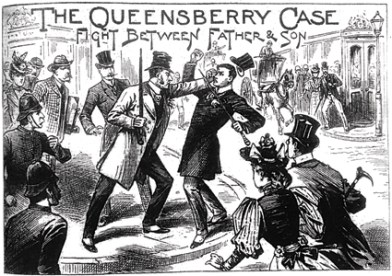
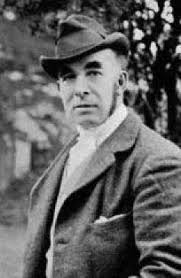
Books-Murray.jpgUnknown.jpeg

Then there was the matter of Douglas’s father, John Sholto Douglas, Eighth Marquess of Queensberry, one of the most malevolent and repulsive figures in late Victorian Britain, celebrated for devising a set of boxing rules that he had very little to do with. Queensberry was like a super-charged version of the Robert de Niro character in the Meet the Fockersmovie franchise.  He wasn’t very good at spelling either, on 18 February 1895, after having failed to disrupt the opening night of The Importance of Being Earnest, he showed up at Wilde’s London club and left a note, which read ‘To Oscar Wilde, posing as a so[m]domite’. But, he spoiled the effect somewhat by spelling sodomite incorrectly.

Wilde, against the advice of friends like George Bernard Shaw and Frank Harris, and with the encouragement of Alfred Douglas, known to one and all as ‘Bosie’, sued Queensberry for libel. The eminent barrister Edward Clarke, only agreed to take the case after Wilde assured him ‘on his word as an Englishman’ that he was not guilty of the offence of sodomy or of ‘gross indecency’. The latter had been made illegal in the 1895 Criminal Amendment Act. Wilde gave his word, but must have been exercising some form of Jesuitical ‘mental reservation’ because, of course, he wasn’t an Englishman.

Famously, his former Trinity College, Dublin rival, Edward Carson, eviscerated Wilde in the witness box, most notably when asking the playwright had he ever kissed a man named Walter Grainger. Wilde denied the charge. He should have left it there, but, ill-advisedly, added that, ‘He was a peculiarly plain boy’, by way of explanation for his failure to snog the lad. Before Carson could parade a slew of defence witnesses, all prepared to testify to having had homosexual relations with Wilde, Edward Clarke withdrew the libel charge against Queensberry.

The poet’s close friends now advised him immediately to take the next train to Paris. He even got judicial help. When the police had approached a London magistrate for a warrant to arrest the playwright, the magistrate, John Bridge, had delayed acceding to the request for long enough to allow Wilde to escape the country. But, he dallied too long. He was arrested and charged with twenty-five counts of ‘gross indecency’. In the dock with him was his alleged procurer, Alfred Taylor. The most notable moment in the first criminal trial was when Wilde was asked what Douglas had meant in a letter, when he described their relationship as a ‘love that dare not speak its name’. Wilde suggested, disingenuously, that Douglas had been referring to the Platonic affection of an older man for a younger one. Clarke’s closing statement was a work of genius, and was probably sufficient to ensure that the first trial resulted in a ‘hung jury’.

After that even Wilde’s former tormentor, Edward Carson, suggested that the Liberal government of Lord Rosebery, should ‘ease up on this fellow now’. But the authorities were especially zealous in pursuit of Wilde. The reason, other than to reinforce the message of the 1895 Criminal Law Amendment Act, and make an example of such a high profile figure, may reside in the obsessive and fanatical person of Queensberry, and the alleged vulnerability of the Prime Minister. Rosebery, while Foreign Minister under William Gladstone appears, himself, to have had an affair with a Douglas, Bosie’s brother Francis. After the suspected suicide of Francis Douglas a cache of incriminating letters was said to have emerged, and these were allegedly used by Queensberry to blackmail the Prime Minister into continuing the pursuit of Wilde through the criminal courts.

At the second criminal trial the prosecution ran a tighter ship, dropping some of the more dubious witnesses against Wilde. The strategy was successful, and this time Wilde was convicted and sentenced to two years hard labour. His conviction unleashed a lengthy period of official and societal reaction against homosexuality, a criminal offence that had often been tolerated prior to the trials of Oscar Wilde.

Sentence was passed in the criminal trial of Oscar Fingal O’Flahertie Wills Wilde one hundred and twenty-three years ago, on this day.
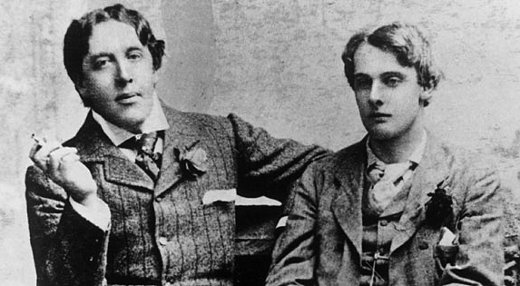
wi-1.jpg

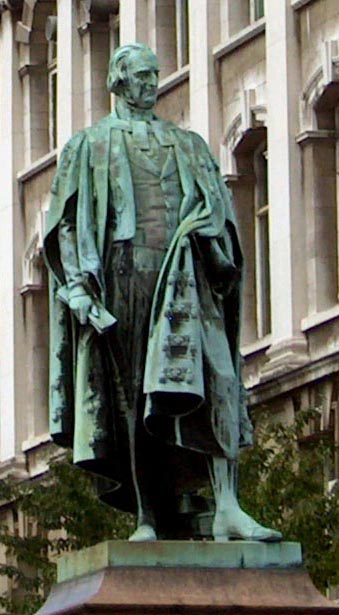
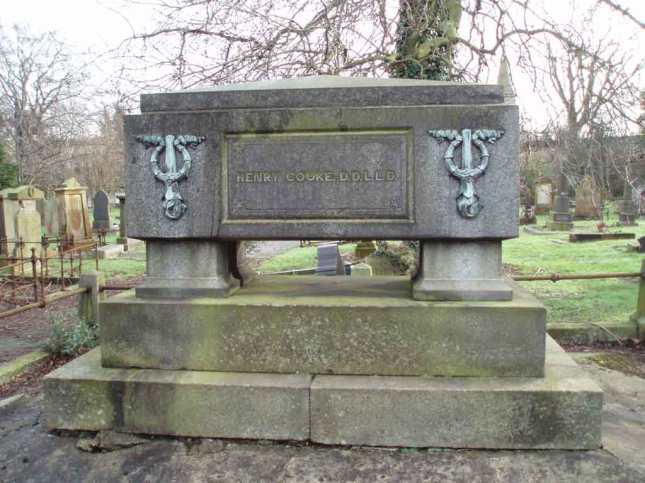
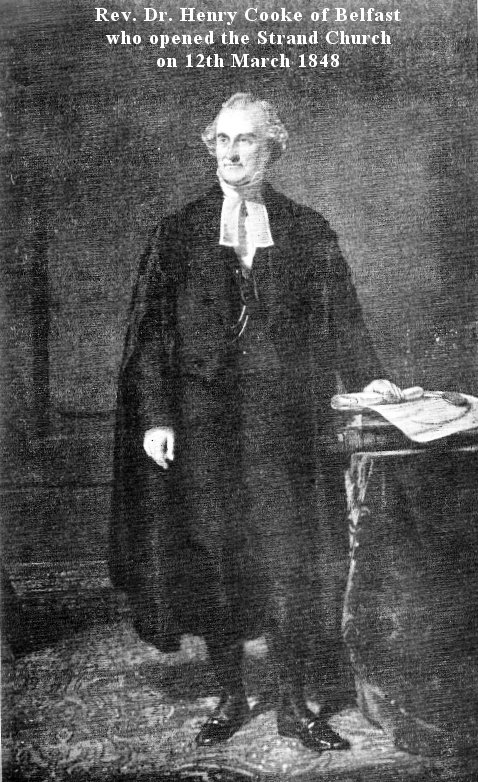
OTD-11.5.1788 Birth of Henry Cooke, Firebrand Presbyterian minister.

henry_cooke.jpg


He was the nineteenth century Ian Paisley, a powerful orator and head-turning demagogue committed to the notion of the Pope as an anti-Christ, the extirpation of secularism and Godlessness in all its pomps, and possessor of an honorary doctorate from an American university.

Henry Cooke came from a relatively humble background, with the advantage of a Presbyterian ‘mammy’ who nurtured his talents and drove him to achieve educational excellence. The pushy and adoring ‘mammy’ is far from being just an Irish Catholic phenomenon! Much of his erudition, however, may be down to his first teacher, described thus:


The teacher was . . a tall, lanky Scotchman, distinguished by an                                          enormous nose, a tow wig, a long coat of rusty black, leather tights, grey                               stockings, brogues, and a formidable hazle rod ..’


I’m sure, like me, that he got you at ‘hazel rod’. The prospect of some nasty corporal punishment may have been as influential as ‘the mammy’.

Cooke entered the University of Glasgow at an age when most Irish students would be looking ahead to their Junior Cert, and graduated from there at an age when they would be wondering how to fill out their CAO application. He was an ordained minister of the Presbyterian church by the age of twenty.

Cooke’s religious and professional life—which were one and the same thing really—were dominated by the impulse to make the Irish Presbyterian church, in essence, more Presbyterian. He wanted nothing to do with the Ulster non-conformist political radicals who had been the backbone of the United Irishmen’s rebellion in 1798. He also wanted to root out something called Arianism among dissenters. I’m not even going to get started on exactly what that was, except to say that it had something to do with a lukewarm acceptance of the Trinity, and that it was so esoteric a dispute that Jonathan Swift must have had something like it in mind when he wrote about the toxic political dispute in Lilliput over whether people should break off their breakfast egg at the ‘big end’ or the ‘little end’.

Cooke opposed the establishment of a non-denominational system of primary education in Ireland in 1831, which the British government of the day was keen to establish. Here he was, of course, ably assisted by his Roman Catholic, and Church of Ireland peers. Thanks a lot for that guys, it’s been a real boon for cross-community understanding.

He was also a determined enemy of the repeal of the Act of Union, and vigorously opposed Daniel O’Connell’s Repeal Association. When it was rumoured that the Liberator was coming to Belfast in 1841 to make his case, Cooke challenged him to a debate. O’Connell responded, like any good politician, by abusing his opponent, describing Cooke as ‘Bully Cooke … the Cock of the North.’ Cooke, in his turn, accused O’Connell of having skulked away from the challenge ‘beneath the meanness of a falsehood … it will pursue you like a shadow.’

When O’Connell finally did make it Belfast Cooke was the keynote speaker at a huge counter-demonstration attended by thirty-two MPs and, more worryingly, three hundred and thirty-five magistrates. A short while later grateful Ulstermen presented Cooke with a gift of £2000 (or nearly £200,000 in today’s money) for having seen off O’Connell and Repeal.

cooke1.jpg

Life wasn’t all a bed of rose petals for Henry Cooke though. Anyone who has ever spent half an hour writing something, and then lost it when Word crashed, will sympathise with what happened to the poor man. For seven years, he spent every spare hour working on a book called Analytical Concordance of Scripture. With a snappy title like that it was bound to be a huge seller. Full of the joys of authorship he brought the completed manuscript—the only copy—to London to be published. Yes, you’re right, you can see where this is going. He put up at a hotel for the night before handing over the book to his publisher. As you’ve probably guessed the hotel burned down taking the manuscript with it. He never got around to re-writing it, and the world was probably denied a racy, theological classic.

One of his last public appearances was at a Belfast rally against the disestablishment of Church of Ireland (of which he was not a member). This meant that he was one of the longest words in the English language, an ‘antidisestablishmentarianist’ – it was as close as he ever got to Arianism of any kind. He had the good fortune to pass away a few months before Gladstone finally disestablished the Church of Ireland in 1869.

Henry Cooke, fiery preacher and unlucky author, was born two hundred and thirty years ago, on this day.

cooke-henry.jpg


On This Day – 4.5.1836    The Ancient Order of Hibernians in America is founded


17362897_1269012399801840_3180449575143973633_n.jpg


Molly Malone may be the best-known Molly in Irish history, folklore or music, but despite her entrepreneurial spirit and wide wheelbarrow, she wasn’t nearly as important, influential, or reviled as Molly Maguire. Whether or not either of these iconic women actually existed, is a moot point, but in the case of Ms. Maguire the organization with which her name was associated, was a force to be reckoned with in Irish and Irish-American political life for much of the late nineteenth and early twentieth centuries.

One critic, a unionist, referred to the Ancient Order of Hibernians (often known as The Mollies) as ‘a bitterly sectarian and secret society with a long dark and cruel history’. You might respond, ‘well he was probably a member of the Orange Order, so what would expect him to say?’ But the distinguished nationalist MP William O’Brien referred to the Hibernians as a Frankenstein, and the Roman Catholic Cardinal Logue described it as ‘‘a pest, a cruel tyranny, and an organised system of blackguardism’, although his beef was as much to do with late night drinking and dancing, than politics

So, what was the nature of this monster, or fraternal Catholic organisation, depending on your point of view. Initially it was primarily an American Catholic body, which emerged at a time of anti-Catholic and anti-Irish sentiment in the USA. This was exemplified by the activities of the nativist and anti-immigrant Know Nothing Party, and attacks on churches and church property across the US east coast cities. Founded in New York in 1836 the Hibernians quickly moved into machine politics, and became an arm of the Democratic party, in organisations like Tammany Hall in New York city.

MolliesHistMarker.jpg

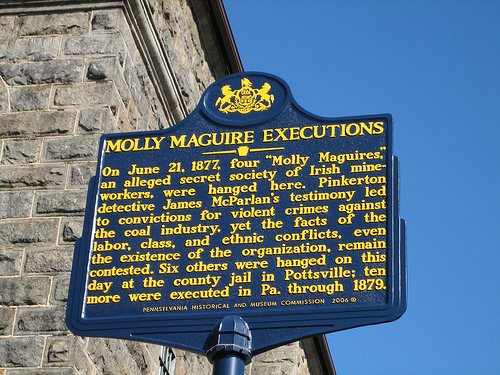
In the coal and anthracite regions of Pennsylvania its lodges or chapters were associated with the secretive militant labour group, the Molly Maguires, called after an Irish agrarian movement of tenant farmers, better known for shooting landlords, than ploughing or milking. In 1884, as Brendan Behan could have predicted, there was a split in the organisation – the reasons are far too tedious to rehearse and don’t really matter anyway as they kissed and made up again in 1898. At that stage, there were just under two hundred thousand Americans affiliated to the AOH.

AOH_Logo_2001.svg.png

In the late nineteenth century, the Ancient Order of Hibernians was imported from the USA and began to take hold in Ulster, where it was seen as a political and cultural counterweight to the loyalist Orange Order, and was organised along similar lines. Around this time, it acquired its eminence grise, in the form of the West Belfast Irish Parliamentary Party MP Joseph Devlin. Devlin was the archetypal party boss. If he had moved to the USA he probably would have become Mayor or Governor of New York, or ‘Boss’ of the corrupt but mightily effective Tammany Hall machine.

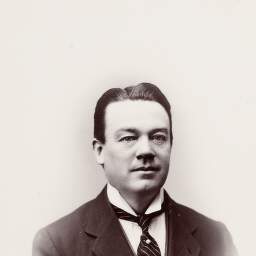
iipsrv.fcgi.jpeg

Instead he used the pietistic and nationalistic AOH as a power base for his dominance of Ulster nationalism and wielded a huge influence on the Irish Parliamentary Party, while it was under the leadership of John Redmond. So powerful was Devlin that not even the Sinn Fein landslide of 1918 could shift him. Almost all of the few surviving nationalist MPs were in Ulster, clinging on largely thanks to Devlin’s popularity and capable management.

The Irish and American branches of the organisation formally merged in 1902. Between then, and the outbreak of the Great War, the Irish section of the AOH grew from about five thousand members, mostly in Ulster lodges, to just short of one hundred thousand throughout the thirty-two counties.

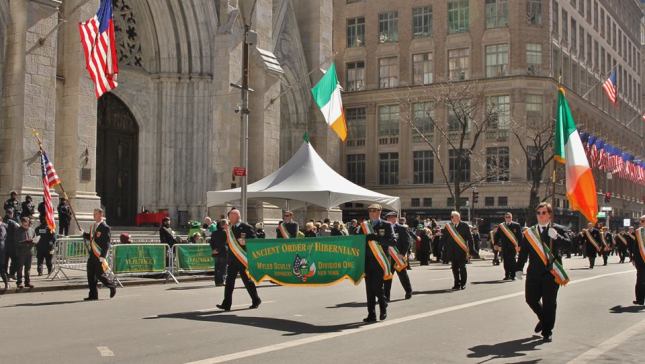
The AOH was never a radical organisation, although it could often be relied upon to resort to strong-arm tactics against loyalist or rival nationalist groups. It opposed Larkin and the Irish Transport and General Workers’ Union during the 1913 lockout. Larkin blamed the AOH for helping to prolong the strike. In the 1930s there was a strong Hibernian presence in the ranks of O’Duffy’s Blueshirts, and many Hibernians joined the Irish Brigade which fought for Franco in the Spanish Civil War. For a century and a half, until 1993, the AOH ran the New York St. Patrick’s Day parade with a rod of iron, ensuring that, for example, gay and lesbian groups were not allowed to parade.

On the plus side, it served as an effective protective force against American nativism, and has contributed hundreds of thousands of pounds and dollars to charitable causes.

The Ancient Order of Hibernians, in many ways a mirror image of the Orange Order, was founded in the notorious Five Points neighbourhood in New York, one hundred and eighty-two years ago, on this day.


On This Day 27.4.1827 Birth of Mary Ward


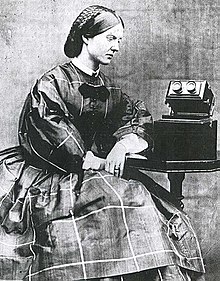
220px-Mary_Ward_by_microscope.jpg


What do the aristocratic amateur scientist Mary King Ward, and the working class Irishwoman, domiciled in London, Bridget Driscoll, have in common? The answer has something to do with the manner of their deaths, which took place twenty-seven years apart.

Mary King Ward was born in 1827 in Ferbane, Co. Offaly, then known as King’s County. The fact that her maiden name was King was a mere coincidence, though her extended family did own quite a lot of the county. She was home educated to a very high level by a family obsessed with the sciences.

Mary King was the cousin of William Parsons, Third Earl of Rosse, the man responsible for the building of the huge telescope ‘Leviathan’ in Birr Castle in the mid-nineteenth century. At the time of its construction it was the largest in the world. Mary shared her cousin’s interest in astronomy, but she was also an accomplished artist. Her sketches of ‘Leviathan’ were used long after her death in the restoration of the telescope. She was also fascinated by the other end of the ‘scope’ scale as well. She was obsessed with microscopes.

She was, of course, born into the wrong era. Half a century later, and she might have been able to study physics or biology at university. But Mary King had to rely on the scraps that fell from her association with Parsons. Through him she met, and later corresponded with, a number of scientists. She published her first book, Sketches with the microscope, privately, reckoning that no publishing house would accept a scientific work by a woman. It did so well that it was taken on board by a London publisher, and was reprinted eight times between 1858 and 1880. Before her death, in 1869, she wrote and illustrated numerous other scientific books and articles.

And that is how she would be remembered today, as a gifted amateur scientist born years before a time when she might have gained more recognition,  were it not for the manner of her tragic and untimely death at the age of forty-two.

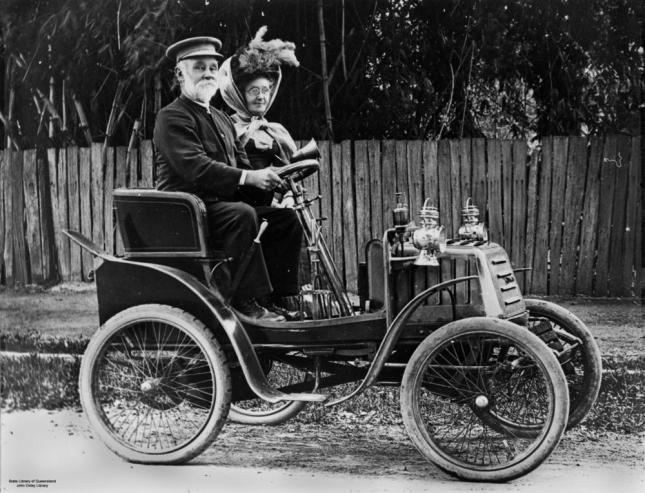
William Parsons, inveterate inventor and tinkerer, had built a steam-driven car. They were briefly popular but were huge, impractical and dangerous. They went into decline when speed limits of—wait for it—four miles an hour on country roads  and two miles an hour in cities, were imposed. Never again complain about the extension of the thirty-kilometre an hour speed limit in Dublin city centre. On 31 August 1869 Mary Ward was travelling in the Birr Castle steam-powered car with two of Parsons children, and her own husband, when she was thrown from the vehicle on a nasty bend, and killed almost instantly when the wheels of the car broke her neck. She thus became the first recorded fatal victim of a traffic accident anywhere in the world.

So where does her fellow countrywoman Bridget Driscoll come in? She was only forty-four years of age when she met a not dissimilar fate in the grounds of the Crystal Palace in London in 1896. She was crossing a road with her daughter Mary, when she was struck by a car that was being used to give demonstration rides. She thus became the first pedestrian death by automobile in the United Kingdom. One witness described the car, owned by the Anglo-French Motor Carriage Company, as being driven at a reckless speed, ‘in fact, like a fire engine’. The car’s maximum speed, however, was only eight miles an hour, so it cannot have been travelling that fast. The verdict of a coroner’s jury was one of ‘accidental death’ and no prosecution followed the tragedy. The coroner expressed the hope that ‘no such thing would ever happen again’—that was around six hundred thousand British road fatalities ago. Mary Ward had three sons and five daughters. Her great grand-daughter, the actor Lalla Ward, was once a regular on Doctor Who. Bridget Driscoll was a mother of three, two boys, and the daughter who witnessed her tragic and unnecessary death.

Mary King Ward, astronomer, biologist, author, and the very first of many millions of traffic fatalities in automobile history, was born one hundred and ninety-one years ago, on this day.

StateLibQld_1_95492_Out_driving_in_an_early_Linon_motor_car_in_Ipswich.jpg

On This Day – 20 April 1946 – The death of Hanna Sheehy Skeffington


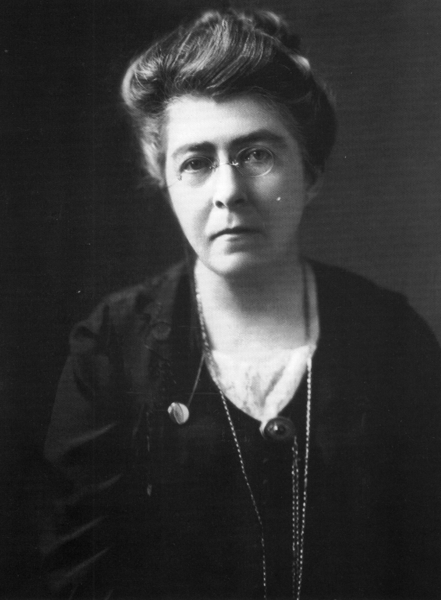
Hannasheehyskeff.jpeg

She is famous today as one of the widows of 1916 – which is unfortunate and extremely unfair, as, by that date, she had long been a highly significant figure in Irish political life in her own right.  It was the nature of her husband’s death, as much as the fact of her widowhood, that gave force to this particular association.

Johanna Mary Sheehy, better known as Hanna Sheehy, was born in Kanturk in Co. Cork in 1877. Her mother was Elizabeth McCoy, known to all and sundry as ‘Bessie’, depicted cruelly by James Joyce in Ulyseesas a ‘social climbing matriarch’. Her father, David Sheehy, was an ex-Fenian and a leading member of Parnell’s Irish Parliamentary Party, who served as an MP for thirty years. Shortly after his election to the House of Commons in 1885, the family moved to Dublin. One of her sisters, Mary, lusted after by Joyce, ended up marrying the poet and politician Thomas Kettle. One of her uncles, Father Eugene Sheehy, was known as the ‘Land League priest’ and had been tossed in prison for his activities during the Land War of 1879-82. All in all, an exceptionally interesting family. So, no pressure on young Hanna there.

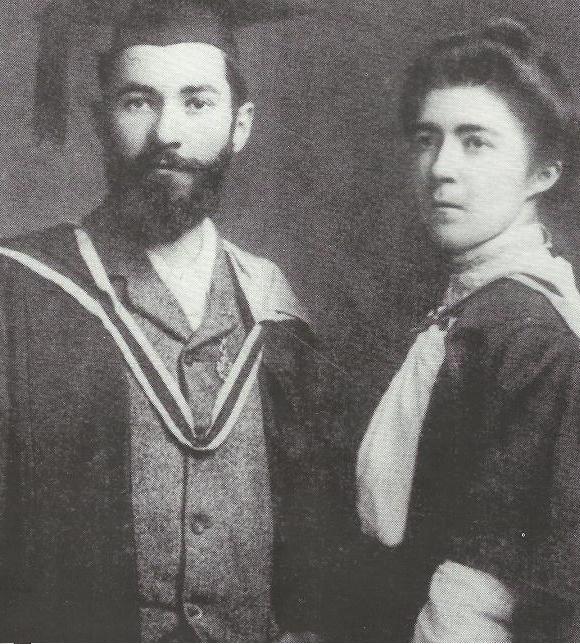
She began to show promise at the Royal University in the 1890s, graduating with a Master’s degree in 1902, the year before James Joyce took time off from being a seminal literary genius, to introduce her to her future husband, his college mate Frank Skeffington. The two were married in 1903, adopting the surname Sheehy Skeffington, to start off their life together on equal terms, much to the annoyance of Frank’s family, who figured Hanna should have been happy enough not to start life with a hyphen.


sheehyskeffington.jpg

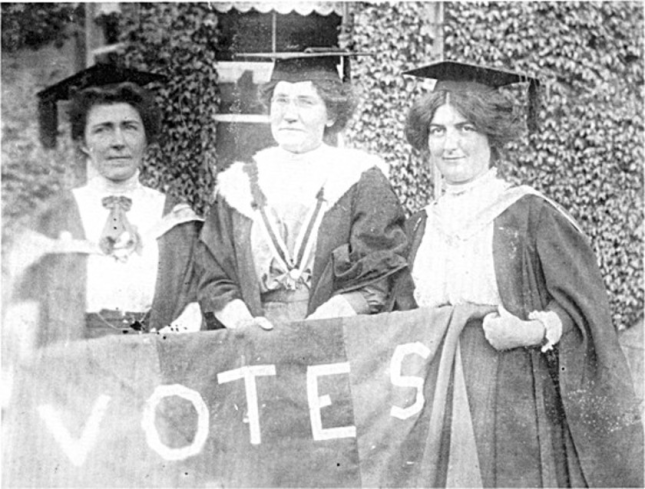
In 1908 they established, along with Margaret Cousins and her husband James, the Irish Women’s Franchise League, and the newspaper The Irish Citizen, both of which championed votes for women. In 1913 Hanna lost her teaching job after she was convicted and jailed for throwing stones in Dublin Castle during the suffragist campaign. While in jail she went on hunger strike, but was released under the terms of the Prisoners (Temporary Discharge for Ill Health) Act of 1913. As soon as her health had recovered, however, she was re-arrested. You can see why the legislation was nicknamed the Cat and Mouse Act. Unlike the British suffragist movement—and the famous Pankhurst family—which split over World War 1, the Irish equivalent—led by the Skeffington family—was unambiguous in its opposition to the Great War.

Hanna and Frank did not have much time together. He became the highest profile civilian casualty of the Easter Rising, when he was brutally murdered by firing squad on the orders of a demented British officer, Captain John Bowen Colthurst, from Cork. Hanna spent much of the rest of her life trying to secure justice for her murdered husband. Given that the criminal in the case was a British Army officer, and the victim was an Irish civilian, you can probably imagine how well that went. Put it this way, in 2016, the families of the men killed by Bowen Colthurst were still seeking an apology from the British government.

In 1917 Hanna was imprisoned in Holloway in London for Sinn Fein activities, one of many moderates who threw in their lot with that organization because of cack-handed British war-time policies in Ireland.

Hanna would have been immensely proud of her grand-daughter, the botanist Dr. Micheline Sheehy Skeffington who took on NUI Galway in a gender discrimination case in 2014. Had the university had the wisdom to consult its School of History on that occasion it might well have been advised to avoid taking on anyone of that name in a fight. Dr. Sheehy Skeffington won her case before the Equality Tribunal.

When Hanna died, in 1946, at the age of sixty-six, she joined her late husband in Glasnevin cemetery.

Hanna Sheehy Skeffington, firebrand, socialist, feminist and suffragist died seventy-two years ago, on this day.

34632943e1b66ceaa8838e1724052dc5.jpg.png