On This Day -15 April 1912 – The Titanic sinks on her maiden voyage

csm_05210__I_RMS_TITANIC_347cc45361.jpg

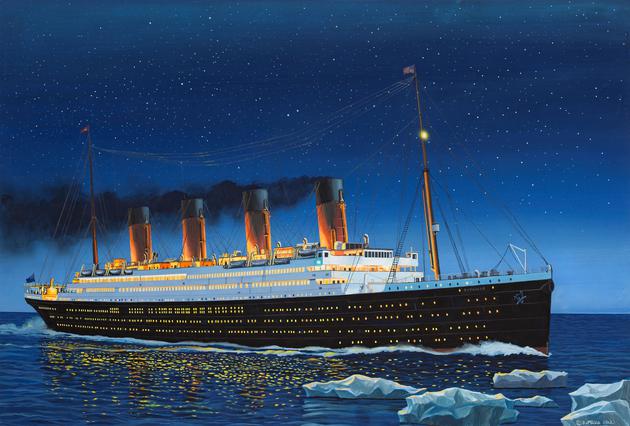
Nowadays we celebrate human disaster almost as much as success, except we call it commemoration. That’s the rationale behind the magnificent Titanic Experience in Belfast. Remembrance = tragedy + time. You’d have thought the citizens of Belfast would not be so keen to remind the world that the RMS Titanic, which sank in 1912 in the North Atlantic with the loss of 1513 lives was built in the Harland and Wolff shipyard in East Belfast. But somebody has to cater for our fascination with this doomed vessel so why not the descendants of the people who built it?

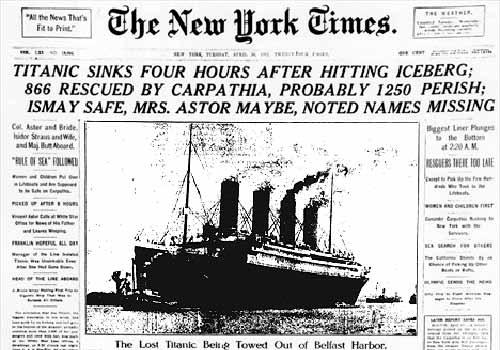
The facts of this marine catastrophe are well-known. The White Star liner R.M.S. Titanic was the largest ship afloat when it collided with an iceberg on its maiden voyage at 11.40pm on 14 April 1912 and, to the shock of all concerned, sank at 2.20 the following morning, bringing the majority of its passengers with it. Just as Belfast is the port associated with its birth Cork is the harbour closest to its demise.

The Titanic arrived in Cork Harbour on its maiden voyage from Southampton on Thursday 11 April. It was too big to land in Cobh so tenders were used to bring passengers on board. One of the travellers who had made the trip from England was the Jesuit priest Father Francis Browne one of the most enthusiastic amateur photographers of the early years of the 20th century. He was only booked for the first leg of the journey and spent most of the trip taking the last pictures ever seen of the ship and many of its passengers. An American couple offered to pay his way to New York and back. Browne telegraphed the provincial of the Jesuit order to seek permission. The response was rapid, terse and probably saved Browne’s life – the telegram read simply ‘Get off that ship’. Think of the amazing pictures we would have lost had Browne’s boss been a fuzzy indulgent type.

Even more fortunate was Titanic stoker John Coffey, a native of Cobh, or Queenstown as it was then known. Stricken by homesickness he sneaked off the ship by hiding among the mailbags being taken back by one of the tenders to the Cobh dock.

Among the more prominent citizens who went down with the ship were its designer, Thomas Andrews, its Captain, Edward Smith, the multi-millionaires John Jacob Astor and Benjamin Guggenheim, and the campaigning journalist W.T.Stead. The gazillionaire J.P.Morgan was also supposed to make the trip but cancelled at the last minute.

One prominent citizen who did not go down with the ship was J.Bruce Ismay, Managing Director of the White Star Line. That meant he was around to field all the awkward questions about how the apparently unsinkable should have succumbed to a mere iceberg. There were also a number of awkward questions about how he managed to survive the sinking to field the other awkward questions.


Most of the Irish passengers were travelling in third class – or steerage – having paid just over £7 for the privilege. Contemporary reports suggest that they were enjoying the trip until rudely interrupted by the iceberg. One account has Irish steerage passengers chasing a rat around the lower decks – presumably it was exercising that unerring rodent instinct and was already on its way to deserting the sinking ship.

In case this all seems like a remote historic event removed from us by over a century it should be pointed out that the last surviving passenger of the ill-fated vessel, Elizabeth Dean, died in 2009 aged 97. She had been a babe in arms when rescued.

Sorry to disappoint but Jack Dawson and Rose Calvert never sailed on the Titanic – they are both merely lucrative figments of the imagination of filmmaker James Cameron.

The R.M.S. Titanic, pride of the White Star line sank to the bottom of the Atlantic Ocean one hundred and four years ago, on this day.
 

titanic.jpg


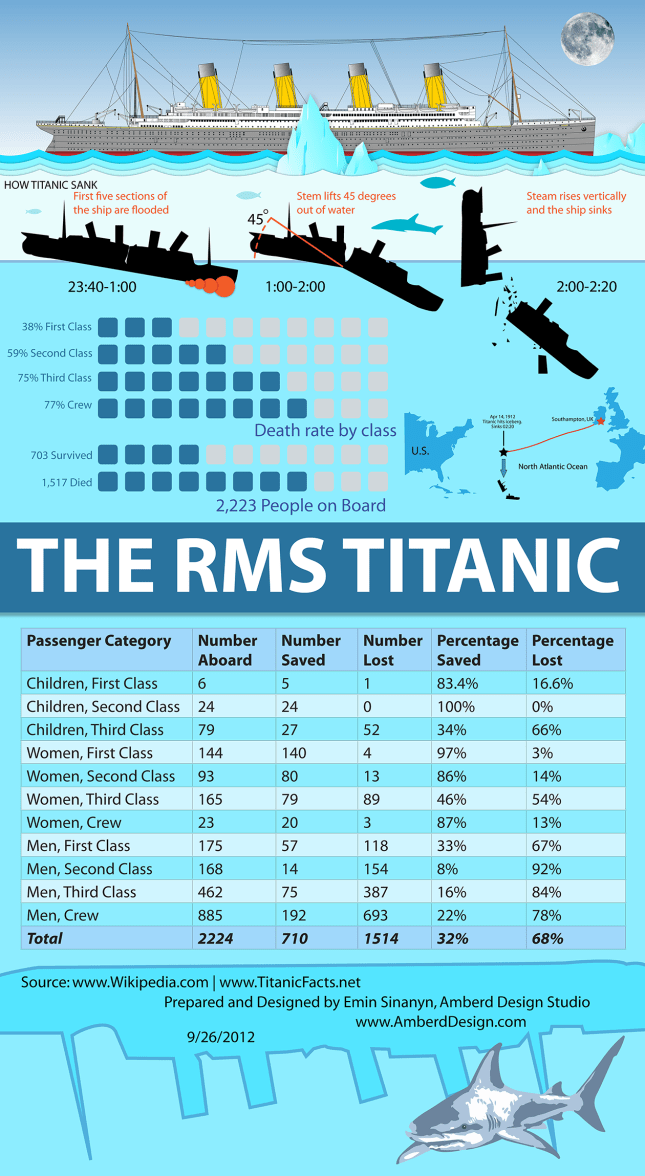
titanic-infographic.png


This wonderful infographic has been designed by Emin Sinanyan – if you want to see the full graphic (and more besides) go to …

http://www.amberddesign.com/portfolio/infographics/titanic-infographic.html


OTD – 8 April 1861 – John George Adair evicts 244 tenants on his estate at Derryveagh, Co. Donegal


Adair.jpg

If he is fondly remembered anywhere – a moot point – it is in the USA rather than the country of his birth. John George Adair is the kind of person who did little for his fellow countrymen and for his own reputation. Born in the 1820s, the son of a gentleman farmer from Laois, he once stood as a Tenant Rights candidate in a parliamentary election in the 1850s and was described by the Young Ireland newspaper the Nation as ‘a cultured young squire’. Which is rather ironic because by the 1860s he had journeyed about as far from the Tenant Rights cause as it was possible to travel and still remain on Planet Earth. Another irony was that he once trained as a diplomat. Had he pursued a career in this area he would have been to diplomacy what Donald Trump is to self-deprecation .

One account of his life has him buying up bankrupted post- Famine estates and evicting tenants wholesale. He was certainly responsible for one of the most notorious mass evictions in Irish history.

In 1857 he had begun to acquire land (around 30,000 acres) in the Glenveagh/Derryveagh area of Donegal. Later, in 1867, he would build the magnicent Glenveagh House on the land he had purchased. Exactly what prompted him to clear the estate is disputed. It may have been the murder of his steward, James Murray, in 1861 or it may have been an incident during which he was surrounded and intimidated by tenants while he exercised the hunting rights he claimed over their land. Whatever the cause, the outcome was a bitter and vindictive campaign in the course of which 244 men, women and children from forty-seven families were thrown out of their holdings and left to shift for themselves. Such was the outcry at the time that a charitable organisation, the Donegal Relief Committee, was formed which paid for the passage of most of the evictees to Australia, where they were given plots of land to work.

Tiring somewhat of his status as a member of the Irish landed gentry, and perhaps slightly chastened by the notoriety he had acquired even among his own often rapacious class, Adair established himself in New York in the mid-1860s. He married well – to Cornelia Wadsworth Ritchie of blue-blooded Connecticut stock – and began making a fortune that would enable him to divide his time between the USA and his Donegal estate.

Adair’s fame in America is based on his business association with one of the most significant figures of the American West, Charles Goodnight.

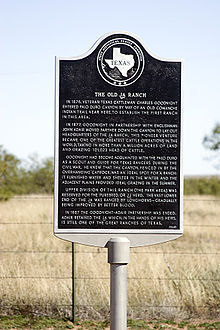
In the 1860s Goodnight, along with his partner Oliver Loving, had brought his cattle herd from the agriculturally depressed Texas as far north as Wyoming in search of a decent market price for his steers. In doing so they created what became known as the Goodnight–Loving Trail. As a rancher Goodnight had frequent need of capital. Adair had plenty of that and in the early 1880s Adair became a business partner of Goodnight in the JA Ranch in Palo Duro Canyon in Texas. Although Adair didn’t know the horns of a steer from the more unpleasant end of his anatomy the spread – which extended for more than 5000 square kilometres – was still given the initials of the Irish money-man.

Although Adair was, by and large, a ‘sleeping’ partner, he had clearly made this particular investment as something of an indulgence, an attempt to identify himself with the romance and adventure of the West. For example he and his wife insisted on accompanying Goodnight on the inaugural trip from Colorado to Texas with the cattle that would form the basis of their herd of over 100,000 steers. In the course of the journey the Adairs reported to their host that they had spotted a party of Indians through their field glass. Upon examination, an exasperated Goodnight discovered that what they had in fact seen was a rather less threatening US cavalry troop.

Adair became the butt of some cowboy practical jokes when the party reached Palo Duro. On one occasion, when he peremptorily ordered that a mount be saddled for him by a group of cowboys who were breaking in some wild horses, the hands picked out the meanest and most untameable beast for Goodnight’s investor. As luck would have it, when Adair mounted him the horse shrugged off the habits of a lifetime and behaved like a sweet natured Shetland pony. The two men fell out and the partnership ended some time before Adair’s death in 1885. The night before his burial a dead dog was thrown into Adair’s grave in his native Co. Laois.

John George Adair began the process of clearing the tenants off his Co. Donegal estate one hundred and fifty five years ago, on this day.


small.jpeg

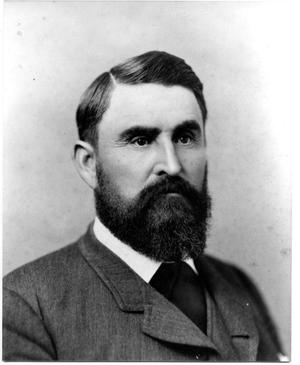
       CHARLES GOODNIGHT


PaloDuroAmarillo2013-032.jpg

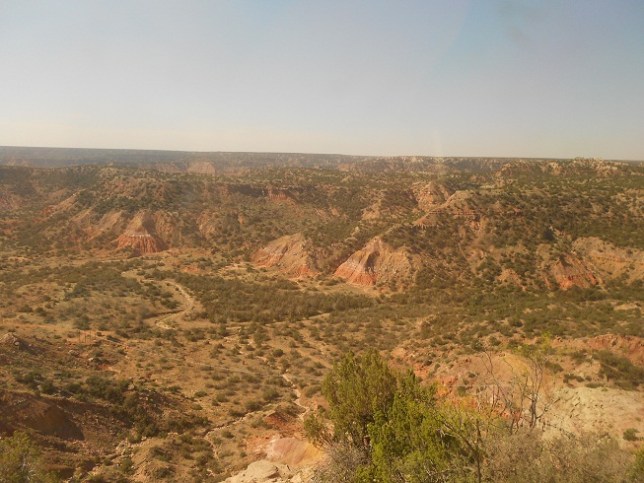
  JA RANCH, PALO DURO, TEXAS


220px-Palodurocanyonjaranchhistoricalsign.jpg


On This Day – 1 April 1872 The Birth of Irish-American bootlegger Katherine Daly


p-20196-ghm.jpg


She was born Katherine Rose Daly in Oakland, California in 1872. Her father, Bill Daly, was from Roscrea, Co. Tipperary,


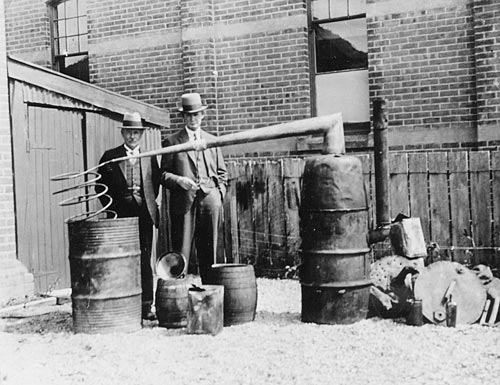
She was a wild child, one of twelve young Dalys, who was allowed to roam the heights around Oakland in her untutored youth. The knowledge she gained of the hills proved very useful to the family business. Her father manufactured what he called ‘poteen’ and his customers called ‘moonshine’ – Katherine’s intimate knowledge of her environment helped the Dalys to escape the clutches of the authorities who never seemed to be able to find the family’s illicit stills.


When the attentions of the forces of law and order became too intrusive the entire Oakland operation was moved in the 1880s to the boom town of Tombstone. However, the law eventually caught up with Bill Daly when he was killed in a shootout with Wyatt Earp not long after the infamous Gunfight at the OK Corral. Daly, a supporter of the Clantons and the McLaurys, the losers in that shoot out, simply chose the wrong side. His daughter Katherine, however, kept the family business going.

If some of this seems a bit familiar to you it might be because of a certain well known folk sing that tells the story of Katherine Daly’s life. It begins …

‘Come down from the mountain Katie Daly

Come down from the mountain Katie do

Oh can’t you hear us calling Katie Daly

We want to drink your Irish mountain dew


Her old man Katie came from Tipperary

In the pioneering year of forty-two

Her old man he was shot in Tombstone city

For making of the Irish mountain dew

Soon after her father’s death Katherine Daly, better known as Katie, escaped the Earps and betook herself to the Chicago. There she continued to manufacture moonshine for the next three decades. Prohibition in the 1920s should have been good to her. Her famous ‘mountain dew’ was streets ahead of the bathtub gin of Al Capone. But the notorious Italian-American hoodlum had more guns at his disposal than the ageing Katie.

After the St. Valentine’s Day massacre Katie headed back home to the west coast and began operating in San Francisco. There she made a fatal error. Had she confined her activities to the Bay Area who knows what she might have achieved.

But she got just a little bit too greedy and began shifting bootleg whisky across the state border into Nevada. This brought down on her head the ire of the burgeoning criminal element in the Silver State and enabled the very non-Irish FBI to take an interest in her activities as well. She was probably fortunate in that the Feds got to her first. Hence the verse of the song that goes …

Wake up and pay attention, Katie Daly,

I am the judge, that’s goin’ to sentence you,

And all the boys in court, have drunk your whiskey,

And to tell the truth dear Kate, I drank some too

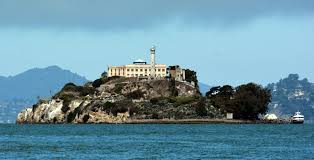
Katie went down for a fifteen year stretch. If you know the song well enough you will be aware that she did not survive her incarceration as the only female inmate of the notorious Alcatraz Island prison in San Francisco Harbour.

So off to jail, they took poor Katie Daly,

But very soon, the gates they opened wide,

An angel came, for poor old Katie Daly,

And took her, far across the great divide.

She may have derived some small satisfaction before her demise from the fact that she survived another famous inmate of Alcatraz, Alphonse ‘Scarface’ Capone who joined her on ‘The Rock’ after he was found guilty of evading Federal taxes.

Katherine Daly, bootlegger, distiller of Irish poteen based on an old Tipperary family recipe, was born one hundred and forty four years ago, on this day.

Unknown.jpeg


On This Day- 25 March 1840 – Birth of Myles Keogh


kickingbear.jpgUnknown.jpeg


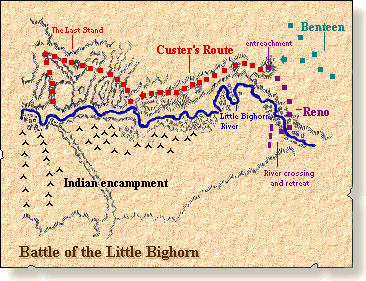
The Little Bighorn, which sounds like a bit of a contradiction in terms, is a river in the American state of Montana. It flows through mainly flat or gently undulating plains. As a river it is unremarkable. But it is not famous for the qualities of its drainage. It is infamous for what happened there on 25 & 26 June 1876 when a flamboyant, egotistical Cavalry officer, George Armstrong Custer, led his Seventh Cavalry to the worst, and last, military defeat ever inflicted on the US Army by the Plains Indian tribes, the Lakota and Cheyenne, at what they called The Battle of the Greasy Grass. No prizes for guessing what it was that greased the grass of the river’s banks.


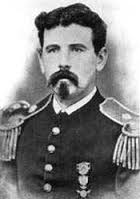
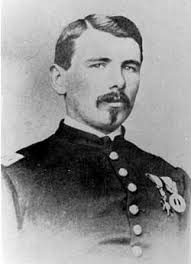
Five of the twelve companies of the 7th cavalry were wiped out on 25 June, including ‘I’ Company, led by Carlow-born Captain Myles Keogh, the most senior of thirty-two Irish-born fatalities in the battle.


Keogh, from Leighlinbridge, had found his way to his date with destiny by a circuitous route. He had, in 1860, as a twenty year old from a relatively prosperous Catholic family, volunteered for service in the army of the Pope. He wasn’t dressed in a striped uniform guarding the Vatican city, he was fighting, unsuccessfully, to save the Pope’s last remaining landed possessions in Italy. When the American Civil War broke out the Roman Catholic Archbishop of New York, John Hughes, recruited Keogh and a number of his colleagues, to join the Union Army. He served with distinction through most of the American Civil War as a cavalry officer, fighting at Fredericksburg and Gettysburg and rising to the rank of Lieutenant Colonel.


After the Civil War the American Army was greatly reduced in size but Keogh wanted to stay on. Like most other officers he lost his exalted war-time rank but was not demobilized. He was sent west to join Custer’s 7th Cavalry charged with keeping the peace on the great American Plains and ensuring that nations like the Lakota – better known as the Sioux – the Cheyenne, and the Blackfeet, behaved themselves and remained on the relatively useless patches of land that had been set aside for them as ‘reservations’.


Keogh was undoubtedly handsome, dynamic, vigorous and physically courageous. However, he was also described by some colleagues as intemperate, drunken and violent. Although he respected the Native Americans of the Plains as military opponents he had no time for their culture or way of life. He viewed them, quite simply, as savages who needed to be kept permanently in check.


He was part of an Army that had a huge Irish element. 10,000 soldiers were stationed in the American West, a quarter of whom were born in Ireland. The Irish influence can clearly be seen in Custer’s 7th Cavalry. The muster roll in 1876 included 126 Irish-born soldiers out of 822 members of the regiment. Keogh was the only officer. The regiments two marching tunes were the Irish airs ‘Garryowen’ and ‘The Girl I Left Behind Me’.


The story of Custer’s massive miscalculation in sending his six hundred strong force against an Indian village that contained up to 5,000 fighting men, has become the stuff of legend. He made things even worse for himself by dividing his command. Everyone who fought with Custer, died with Custer. The only survivor was Keogh’s horse Comanche. Keogh himself was killed a few hundred yards away from Last Stand Hill where his Colonel died. Although he is buried in New York state a gravestone bearing his name marks the spot where he perished, surrounded by the other members of Company ‘I’. For some reason Keogh’s body was one of the few not to have been mutilated by the victorious Sioux and Cheyenne. He wore a Papal medal, awarded in 1860 by a grateful Pope. This token may have been what saved his corpse from evisceration. The Lakota and Cheyenne, who wore pendants of all kinds to ward off evil spirits, may have been wary of the Pontiff’s decoration.


Captain Myles Walter Keogh, commanding officer of Company ‘I’ of the Seventh Cavalry was one of two hundred and sixty eight US cavalrymen to die at the Battle of the Greasy Grass or the Little Bighorn, he was born one hundred and seventy-six ago, on this day.


cu02.gifUnknown-2.jpeg


RTE – REFLECTING THE RISING


RTERTTRP-IMAGE1-2-768x420.jpg

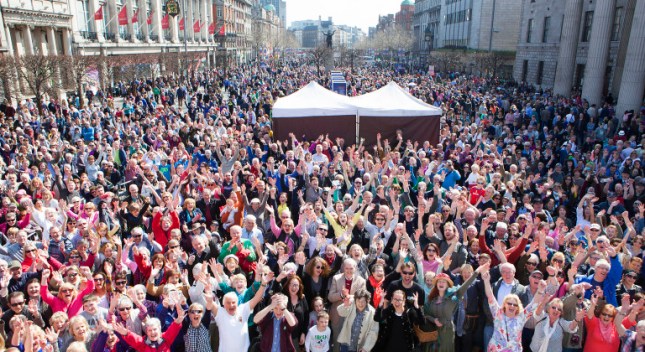
That was O’Connell Street last Easer Monday when RTE celebrated The Road to the Rising. That massive event will pale into insignificance when compared to RTE / Reflecting the Rising which begins at 11.00 on Easter Monday. Three quarters of a million people are expected to take part un hundreds of events – lectures, childrens events,  music, re-enactments, walks etc.

RTE Reflecting the Rising is taking over the city centre of Dublin for the day. There are events taking place in Trinity College, DIT, the Four Courts, St. Stephen’s Green, Merrion Square and many other venues.

Come along and join the fun.

I’ll be doing a three hour History Show  (10.00-1.00)from the Supreme Court (my one and only chance to be in such august surroundings) and I’ll also be giving two talks on Monday afternoon in the Four Courts, on the Courts Martial & executions of 1916 and on the Rising and the Four Courts.

https://1916.rte.ie/speaker/myles-dungan/