On This Day-Drivetime -26.9.1904 Death of Lafcadio Hearn

lg-lafcadio-hearn-1406

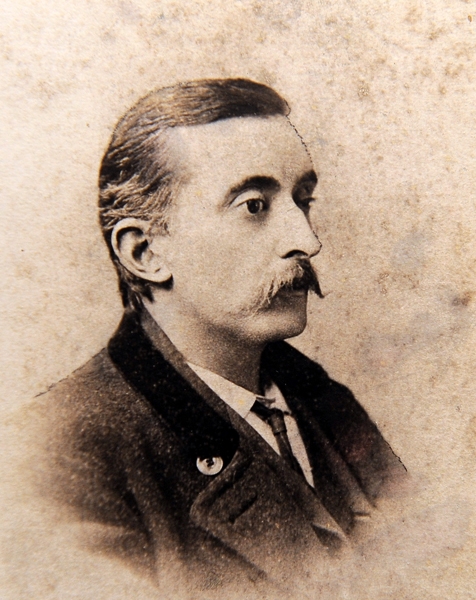
Though he could have claimed to be Greek and although the Japanese themselves might claim him and his writings, Patrick Lafcadio Hearn is indisputably Irish, although far better known in the Orient than he is here. Let’s face it, there aren’t many Irish authors who wrote under the pen name Koizumi Yakumo.

His middle name, Lafcadio, comes from the Greek island of his birth, Lefkada, were the great lyric poet Sappho is supposed to have commited suicide. He was the son of a British Army surgeon stationed on the island in 1850 when he was born there. But at the age of two his mother took him to Dublin and he spent his formative years in the suburb of Rathmines and his boyhood summers in Tramore, Co.Waterford. His Greek mother had some trouble adapting to Irish life – and presumably the Irish climate. Hearn’s childhood was not enhanced by suspicion of his extended family that he had been born out of wedlock and that his father and mother were not actually married. This was because his extended family was Protestant and did not hold with a marriage which had taken place in the Greek Orthodox church.

At the age of 19 Hearn said goodbye to Ireland and went to live in the USA. There he made a living as a journalist, first in Cincinnati and then in the party town of New Orleans. Prior to leaving Ohio Hearn had already acquired a reputation as a crime reporter, and became renowned for his coverage of a number of lurid murders. He also married an African American woman, Mattie Foley – which was still illegal at the time, 1875, a decade after the end of the Civil War, even in Northern states. They divorced in 1877.

Hearn spent a decade in New Orleans, immersing himself in Creole culture and writing about the French and Caribbean roots of the Louisiana city. He has had more books written about him than any other former New Orleans resident other than Louis Armstrong – though they have not proved that popular in the Big Easy as they are mostly in Japanese. His former home in the city, on Cleveland Avenue, has been preserved as an historical monument.

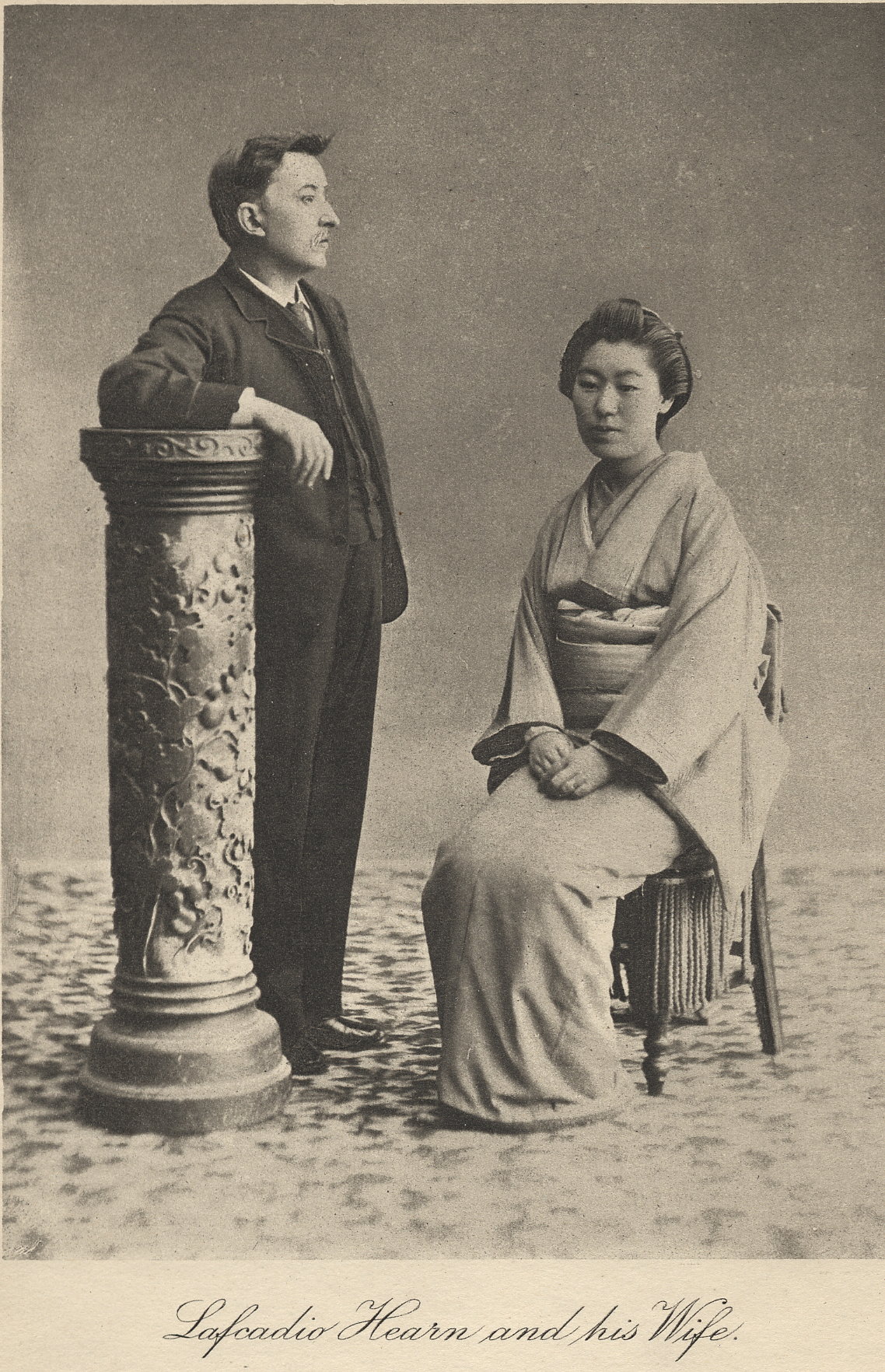
From New Orleans Hearn, now ion his forties, travelled to Japan in 1890. He settled at first in Matsue [Matt-sue-eh] in western Japan and married Koizumi Setsu, the daughter of an old noble samurai family. Between 1894 and his death in 1905 he produced more than 15 volumes of stories, poems, and non-fiction writings on his adopted country. He was one of the main foreign interpreters of the country as it began to open up to the outside world – and conquer parts of it. A volume of Hearn’s ghost stories, Kwaidan, was turned into a movie by the Japanese director Masaki Kobayashi in 2007.

Hearn may not be as well known in his native Ireland as he is in Japan but the creator of James Bond, Ian Fleming, had certainly heard of him. In his 1964 novel You Only Live Twice Fleming has the villain Blofeld ask Bond if he is familiar with the Japanese phrase ‘kirisute gomen’. Bond, lip curlingly responds, ‘Spare me the Lafcadio Hearn, Blofeld’. For the record ‘kirisute gomen’is what allowed samurai to kill any member of the lower orders without compunction if they looked sideways at them.

In March of this year [2014] it was announced that the Japanese government was to contribute to the construction of a Japanese garden in honour of the writer in Tramore.

Patrick Lafcadio Hearn, well-travelled writer, died 109 years ago, on this day.
Lafcadio_Hearn

On This Day -Drivetime – 29.8.1729 Birth of David La Touche

David-Diggues-La-Touche


Today the tale of a banker who didn’t manage to destroy the country while in pursuit a fat bonus. David La Touche, born in 1729, was the grandson of a Huguenot officer in the army of William of Orange.


La Touche married the cousin of the great 18th century Irish politician Henry Grattan, the man who had a parliament named after him, though it didn’t even last 20 years. Elizabeth Marlay – Mrs. La Touche – is unwittingly remembered today by thousands of Dubliners who live in the shadow of the Dublin mountains because of the park in Rathfarnham that is called after her. This was actually the home of the La Touche family for many years. Its grounds were laid out by David La Touche in the 1760s.


The house is modest enough by the standards of the day – it would merely be an annexe of Carton or Castletown – but it did have its own private theatre. There Henry Grattan and Henry Flood, champions of the quasi-independent Irish parliament of the late 18th century, once performed in Shakespeare’s Macbeth. Their involvement in a production of the infamous ‘Scottish play’ – bringer of bad luck to all who sail in her – may well have contributed to the Act of Union that saw their grand project go the way of the dinosaur and the dodo.


Despite having married Grattan’s relative La Touche had no qualms in voting for the abolition of Cousin Henry’s Patriot parliament. He was one of three La Touche brothers to sit in the Irish parliament. The others voted against the Act of Union. Many of those who supported the abolition of the Irish parliament were rewarded with large sums of money and posh titles, or at least posher titles than the ones they had already. After 1800 La Touche was still plain old David La Touche so he might well have voted to abolish the College Green parliament based on, shockingly, political conviction. He would also have been difficult to bribe as by then he didn’t need the money.


That was because he ran the family bank for a number of years. The La Touche bank had been established by David’s father, also called David La Touche – they weren’t very imaginative when it came to first names, possibly because the surname was more than sufficiently exotic for 18th century Ireland. The family bank was one of the few such institutions to survive a serious financial crisis in the 1750s. In the late 19th century it had the misfortune to be merged with the Munster Bank. Just over a decade later the Munster Bank – a forerunner of AIB – went bust while under the guardianship of the former politician William Shaw. But David La Touche also swam in the gene pool that became the Bank of Ireland.  In 1783 he helped to draft the charter of the Bank of Ireland, in which his family initially held a major shareholding – nothing like Sean Quinn in Anglo of course, but just under 10% nonetheless.


La Touche was also Deputy Grand Master of the Freemasons and not a fan of Catholic Emancipation. He voted against giving Catholics the vote in 1793.


David La Touche III, banker, politician, mason, was born 285 years ago, on this day.


On This Day-Drivetime -8.8.1781 James Gandon

 220px-James_Gandon_Painting


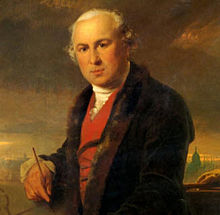
It’s odd to think that at the time the architect James Gandon moved from London to Dublin, the largest city in Ireland was also one of the largest in Europe. It was far from the political and economic backwater it became after that other ‘Flight of the Earls’ – in this case Anglo-Irish aristocrats –   in the aftermath of the passage of the Act of Union and the dissolution of the Irish Parliament in 1800.

Gandon first come to prominence by finishing second. In 1769, at the age of 26, he had entered a design for the competition for new Royal Exchange in Dublin. In case you’re scratching your head wondering ‘where is the Royal Exchange in Dublin?’ we call it City Hall these days. That competition was won by another British architect who settled in Ireland Thomas Cooley.

Gandon may have been unlucky on that occasion but he was much more fortunate in 1780 when Cooley, who was supposed to be responsible for the building of the Custom House, died suddenly before work had begun. Gandon was asked to step in and complete the job. He turned down a commission from member of the Russian Royal family to take on the challenge.

The Romanov’s loss was Dublin’s gain. However the population of the city would not have seen it that way at the time. The Custom House, which many Dubliners alleged was being built on a swamp, was the pet project of John Beresford, the most powerful man in Ireland in the late 18th century. Beresford could, more or less, ram through whatever project he wanted, but that didn’t make them popular with the taxpayers who had to foot the bill.

In order to avoid Gandon becoming collateral damage Beresford smuggled him into the country and put him up in his own house until the building was well under way and the project unstoppable. The eventual bill – footed by the taxpayers of course – was £200,000 – that’s around €40m in today’s money.

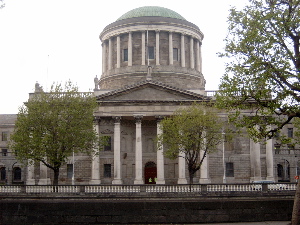
From 1780 to 1800 Dublin grew to be the fifth largest city in Europe and Beresford and Gandon were at the heart of many of the fine buildings that were constructed during that time. For a follow up to the Custom House Gandon designed the Four Courts – where, presumably, tax payers who hadn’t stumped for the Custom House could be indicted and jailed. Gandon also worked for the Wide Streets Commissioners in developing the cityscape with which we are familiar today.

Gandon also designed a number of private dwellings, the most notable of these are Emo Court in Co.Laois and Abbeville in north Dublin. The latter was the country home of Beresford but a couple of centuries later was acquired by another equally powerful Irish political figure Charles J.Haughey.

Despite the impressive architectural legacy he left behind Gandon was never popular while he worked in Dublin. His costly public buildings were resented by those who had to pay for their construction. He was frequently lambasted in the, largely unionist, press of the day. When the 1798 rebellion broke out Gandon figured he might become the victim of some nifty work with a pike and fled to London.

He did come back though and died in his house in Lucan in 1823. But the city he had helped to create was slowly destroyed by the Act of Union and the loss of the Irish parliament. By the end of the 19th century it had been surpassed in population and wealth by Belfast. It’s ironic that his two great creations survived the animosity of the late 18th century only to be destroyed in the revolutionary period of the early 1920’s.

The first stone was laid on the Custom House site 233 years ago, on this day.


 Fourcrtsfrnt


On This Day -Drivetime -1.8.1915 – 1915 – O’Donovan Rossa is buried in Glasnevin cemetery

 2014-07-30 16.42.30odonovan_rossa


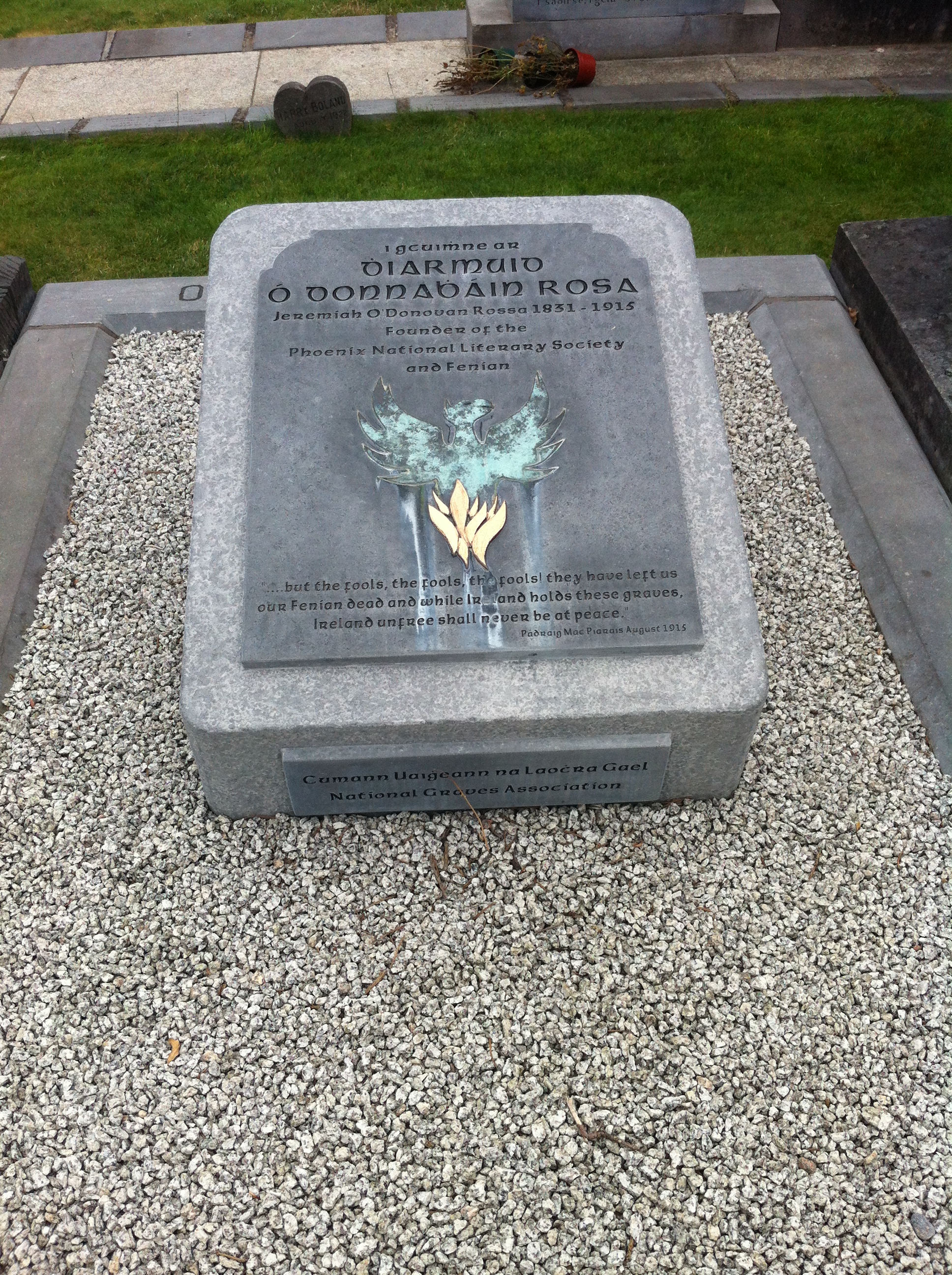
It might well be said of Jeremiah O’Donovan Rossa, that ‘nothing became his life like the leaving of it’. He would have been delighted to know that his interment in Glasnevin cemetery in 1915 launched the brief but remarkable career of another Irish revolutionary.

More about that later. Let’s first rewind to 1831, the year of Rossa’s birth in Rosscarberry, Co.Cork. Twenty-five years later he founded the Phoenix National and Literary Society. It may sound innocuous enough but its guiding principle was less about reading interesting books and more about the liberation of Ireland by force of arms. No messing about with elections or parliaments for O’Donovan Rossa. Later his society would affiliate with the Irish Republican Brotherhood and Rossa’s career as a revolutionary nationalist had properly begun.

Two years before the abortive Fenian rising of 1867 Rossa, along with a number of his colleagues who worked on the organisation’s newspaper, the Irish People, was arrested and jailed. In 1870, as part of a general amnesty, he was released. In his case, however, he had to agree, along with John Devoy, to emigrate to the USA and never come back.

Not that he was any less of a nuisance in America. Based in New York he founded a newspaper, the United Irishman. This was largely subscription based with subscribers – whom Rossa called his ‘tenants’ – paying what the editor described as a weekly ‘rent’ for the privilege and pleasure of reading his politically extreme outpourings. These went as far as advocating the murder of Irish landlords and even the likes of Prime Minister William Gladstone. Rossa also raised money, via what he called his Skirmishing Fund, to finance a bombing campaign in England. This was successfully launched in the early 1880s and caused much destruction, in London in particular. There was even one dynamite attack on the House of Commons. On many occasions the British government sought his extradition but his activities were seen as political actions rather than crimes by the US government. Had he been bombing Washington they might have seen things a bit differently. In 1885 he was shot and wounded by an Englishwoman, Iseult Dudley. The British government claimed that she had not been working for them. Well they would wouldn’t they.

Rossa died in June 1915 at the age of 83. He had actually returned twice to Ireland, in 1894 and 1904, astonishingly, with the approval of the British government. But his post mortem return in 1915 was possibly his finest hour. The IRB, in the shape of the old Fenian Tom Clarke, conscious of the potential propaganda value of a big nationalist funeral, asked Devoy to ship Rossa’s body back to Ireland.

After his cortege trailed through the crowded streets of Dublin – Dubliners always loved a big funeral – he was buried in Glasnevin Cemetry. As his coffin was being lowered into the ground a relatively unknown figure stepped out of the crowd and spoke over the grave. He warned the British government that …

They think that they have foreseen everything, think that they have provided against everything; but, the fools, the fools, the fools! — They have left us our Fenian dead, and while Ireland holds these graves, Ireland unfree shall never be at peace.

Had Rossa been in a position to do so he would have given loud war whoop in response. Patrick Pearse’s short oration, though utterly different in tone, has acquired something of the status of an Irish Gettysburg address. It was made 99 years ago, on this day.

On This Day-Drivetime-18.7.1822 – The new Theatre Royal in Dublin opens


 Unknown


Like the famed Horsemen of the Apocalypse there have been not one but four establishments named the Theatre Royal in Dublin since the first incarnation opened in Smock Alley in 1662. That particular version was managed in the 18th century by Thomas Sheridan, father of the playwright Richard Brinsley Sheridan who proved his Colganesque powers of persuasion by enticing the likes of David Garrick and Peg Woffington over to Dublin to perform.


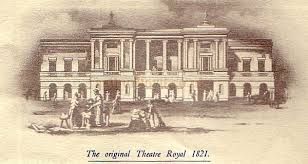
That manifestation of the Theatre Royal closed in 1787. It wasn’t until 1822 that another theatre of that name opened in Hawkins Street. It had 2000 seats and cost a gargantuan £50,000 to build. Its first claim to fame was that it became the scene of one of the most famous riots in a Dublin theatre – placing a decent third after the Abbey’s Playboy of the Western World disturbances of 1907 and the Plough and the Stars convulsions of 1926.


This particular flap has gone down in history as The Bottle Riot – it happened in December 1822 and was sparked by the perception that the Lord Lieutenant, Marquess Wellesley – brother of the Duke of Wellington – was insufficiently interested in keeping Catholics in their proper place. A disaffected spectator, spotting the Viceroy in his box, threw a bottle and then a rattle at Wellesley – presumably the latter projectile had come from his pram. As a result fighting broke out among the Orange and Green members of the audience. For the record, the play on stage, which became a bit of an irrelevance really, was Goldsmith’s She Stoops To Conquer. This was, in effect, how the Lord Lieutenant chose to react to the missile attack. In a bit of extreme over-reaction for the attack on his exalted personage he had three of the rioters charged with conspiracy to murder. Juries in Dublin at the time being overwhelmingly unionist, the charges did not stick.


Before Theatre Royal 2 burned to the ground in 1880 it had hosted, among others, Paganini, Jenny Lynd and the original Tyrone Power.


TR3 opened in 1897 on the site of its cremated predecessor – it too had a seating capacity of over 2000. One of its claims to fame was that, in 1906, a young Charlie Chaplin performed there as part of an act called The Eight Lancashire Lads. The other seven have never been heard of since. It was demolished in 1934.


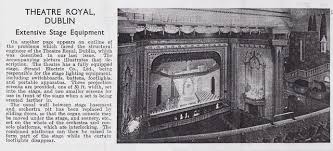
TR4 – the final horseman, was an impressive art deco building which could house almost 4000 paying patrons. Not that it did so with sufficent regularity. It was at a disadvantage because of its size and the lively competition from the nearby Gaiety and Olympia theatres. One of its most famous fixtures was its dance troupe, the Royalettes. Despite attracting international acts of the caliber of Gracie Fields, Jimmy Durante, George Formby, Max Wall and Judy Garland – and despite doubling as a cinema – the theatre found it hard to make ends meet.


The fourth and final Theatre Royal finally closed its doors in 1962, three hundred years after its Smock Alley incarnation. The magnificent art deco building was demolished and replaced by the magnificent multi storey office block Hawkins House home to the magnificent Dept of Health.


The second Theatre Royal, opened its doors 192 years ago, on this day.  


OTD-DT-18.7.1822 – The new Theatre Royal in Dublin opens


Like the famed Horsemen of the Apocalypse there have been not one but four establishments named the Theatre Royal in Dublin since the first incarnation opened in Smock Alley in 1662. That particular version was managed in the 18th century by Thomas Sheridan, father of the playwright Richard Brinsley Sheridan who proved his Colganesque powers of persuasion by enticing the likes of David Garrick and Peg Woffington over to Dublin to perform.


That manifestation of the Theatre Royal closed in 1787. It wasn’t until 1822 that another theatre of that name opened in Hawkins Street. It had 2000 seats and cost a gargantuan £50,000 to build. Its first claim to fame was that it became the scene of one of the most famous riots in a Dublin theatre – placing a decent third after the Abbey’s Playboy of the Western World disturbances of 1907 and the Plough and the Stars convulsions of 1926.


This particular flap has gone down in history as The Bottle Riot – it happened in December 1822 and was sparked by the perception that the Lord Lieutenant, Marquess Wellesley – brother of the Duke of Wellington – was insufficiently interested in keeping Catholics in their proper place. A disaffected spectator, spotting the Viceroy in his box, threw a bottle and then a rattle at Wellesley – presumably the latter projectile had come from his pram. As a result fighting broke out among the Orange and Green members of the audience. For the record, the play on stage, which became a bit of an irrelevance really, was Goldsmith’s She Stoops To Conquer. This was, in effect, how the Lord Lieutenant chose to react to the missile attack. In a bit of extreme over-reaction for the attack on his exalted personage he had three of the rioters charged with conspiracy to murder. Juries in Dublin at the time being overwhelmingly unionist, the charges did not stick.


Before Theatre Royal 2 burned to the ground in 1880 it had hosted, among others, Paganini, Jenny Lynd and the original Tyrone Power.


TR3 opened in 1897 on the site of its cremated predecessor – it too had a seating capacity of over 2000. One of its claims to fame was that, in 1906, a young Charlie Chaplin performed there as part of an act called The Eight Lancashire Lads. The other seven have never been heard of since. It was demolished in 1934.


TR4 – the final horseman, was an impressive art deco building which could house almost 4000 paying patrons. Not that it did so with sufficent regularity. It was at a disadvantage because of its size and the lively competition from the nearby Gaiety and Olympia theatres. One of its most famous fixtures was its dance troupe, the Royalettes. Despite attracting international acts of the caliber of Gracie Fields, Jimmy Durante, George Formby, Max Wall and Judy Garland – and despite doubling as a cinema – the theatre found it hard to make ends meet.


The fourth and final Theatre Royal finally closed its doors in 1962, three hundred years after its Smock Alley incarnation. The magnificent art deco building was demolished and replaced by the magnificent multi storey office block Hawkins House home to the magnificent Dept of Health.


The second Theatre Royal, opened its doors 192 years ago, on this day.  

 Unknown-1