OTD – DT – 9 May 1766 – execution of Thomas Lally


Image


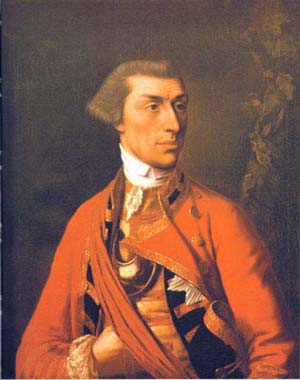
Thomas Arthur Lally was not quite as Irish as his name might suggest. He was born in France in 1702, son of Sir Gerald Lally from Tuam in Co.Galway, an Irish exile in France who had fought in the Jacobite wars. The family was said to be able to trace its Irish ancestry back to Conn of the Hundred Battles. Like his father Thomas Lally was destined for a military career. He joined the French Army in 1721 and rose to command his own regiment in the Irish Brigade at the celebrated French victory against the British at Fontenoy in 1745. He was immediately promoted to Brigadier.


That same year he accompanied Prince Charles Edward Stuart, aka Bonnie Prince Charlie but shared in the Young Pretender’s defeat and was forced to escape to France. While in Scotland he was given the titles of Earl of Moenmoyne, Viscount Ballymole and Baron Tollendally by Prince Charles. Not surprisingly, given the Stuart defeat, none of the titles is to be found in Burke’s Peerage.


When France’s umpteenth war with Britain broke out in 1756 Lally was given command of a French expedition to India – at the time France actually had Indian colonies of its own, the object was to get possession of those belonging to Britain – a project that initially met with some success. But things quickly began to go wrong for Lally’s under-resourced force. Lally was beaten in a number of encounters with British forces – among them was a defeat by fellow Irishman Eyre Coote – and retreated to the city of Pondicherry. There he withstood a lengthy siege before conceding defeat in January 1761 and handing the city back to the British. Lally was sent as a prestigious prisoner to Britain. He must have wondered who would be scapegoated in France for the humiliation of this defeat. Would it be members of the French ministry or perhaps even the King himself, Louis XV.


He soon found out that he was to be the scapegoat. While in Britain Lally discovered, to his chagrin, that he was being accused of treason in France based on the surrender of Pondicherry. Instead of biding his time in England he sought permission from his captors to return to France on parole to defend his reputation. He was imprisoned in France for two years before he was tried and found guilty and beheaded in 1766. This was in the days prior to the French revolution and the invention of the guillotine. The execution was carried out in front of a large crowd at the Place de l’Hotel de Ville in Paris. Lally was decapitated by sword. The infamous Marquis de Sade is said to have described the execution as botched, claiming that Lally had survived for more than a minute after the blow fell and had actually attempted to hold his head and neck together before he finally expired.


In his history of the French Revolution Thomas Carlyle describes Lally’s execution as judicial murder. He describes how Lally was transported through the streets of Paris to his place of execution with a gag around his mouth to ensure that he was unable to protest at the injustice of the sentence against him. Two years after Lally’s death he was posthumously pardoned by the new King, Louis XVI.


Thomas Arthur, Comte de Lally, was executed in Paris 248 years ago, on this day
 

Useful (but often unreadable) regimental histories of WW1 for those tracing their ancestors’ involvement in the Great War


Image


Regimental War Diaries – available in The National Archive (formerly the PRO) in Kew, London.


General Works

Bartlett, Thomas and Jeffrey, Keith, A Military History of Ireland (Cambridge, Cambridge University Press, 1996).

Bredin, General A.E.C., A History of the Irish Soldier (Belfast, Century Books, 1987).


Divisional and Regimental histories

Cooper, Bryan, The Tenth (Irish) Division in Gallipoli (Dublin, Irish Academic Press, 1993).

Cunliffe, Marcus, The Royal Irish Fusiliers, 1793-1968 (Oxford, Oxford University Press, 1970).


Denman, Terence, Ireland’s Unknown Soldiers: the 16th Irish Division in the Great War (Dublin, Irish Academic Press, 1992).


Fox, Sir Frank, The Royal Inniskilling Rifles in the World War (London, Constable, 1928).


Geoghegan, General S.C.B. Royal Irish Regiment (Army and Navy Press, 2007)

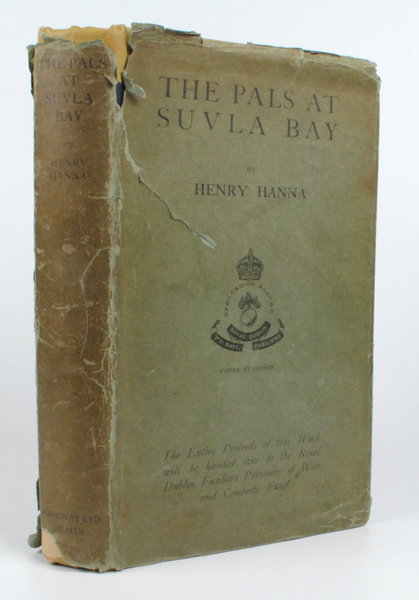
Hanna, Henry, The Pals at Suvla Bay (Dublin, Ponsonby, 1916).

Harris, Henry, Irish Regiments in the First World War (Cork, Mercier Press, 1968).


Hogarty, Patrick, The Old Toughs: A Brief History of the Royal Dublin Fusiliers, 2nd Battalion (Dublin, Private publication, 2001).


Jervis, Lt.Col. H.S., The 2nd Munsters in France, (Aldershot, Gale and Polden, 1922).


Kerr, J.Parnell, What the Irish Regiments Have Done (London, T.Fisher Unwin, 1916).


Kipling, Rudyard, The Irish Guards in the Great War, Vol.1. (London, Macmillan,1923).


McCance, Captain S., History of the Royal Munster Fusiliers: Volume II – from 1862-1922 (Aldershot, Gale and Polden,1927).

MacDonagh, Michael, The Irish at the Front (London, Hodder and Stoughton, 1916).

MacDonagh, Michael, The Irish on the Somme, (London, Hodder and Stoughton, 1917).


Rickard, Jesse Louisa, The Story of the Munsters at Etreux, Festubert, Rue du Bois and Hulluch (London, Hodder and Stoughton, 1918).


Taylor, James. W., The 1st Royal Irish Rifles in the Great War (Dublin, Four Courts Press, 2002).

Taylor, James. W., The 2nd Royal Irish Rifles in the Great War (Dublin, Four Courts Press, 2005).


Walker, G.A.C., The Book of the 7th Service Battalion – The Royal Inniskilling Fusiliers – from Tipperary to Ypres (Dublin, Brindley, 1920).


Whitton, Col.F.E., The History of the Prince of Wales Leinster Regiment, Vol.2 (Aldershot, Gale and Polden, 1926).


Wyly, Col. H.C., Crown and Company – The Historical Record of the 2nd Battalion, Royal Dublin Fusiliers, vol.2 1911-1922 (London, Humphreys, 1923)

Wylly, Col.H.C., Neill’s Blue Caps – Vol.3, 1914-1922 (Aldershot, Gale and Polden, 1923).


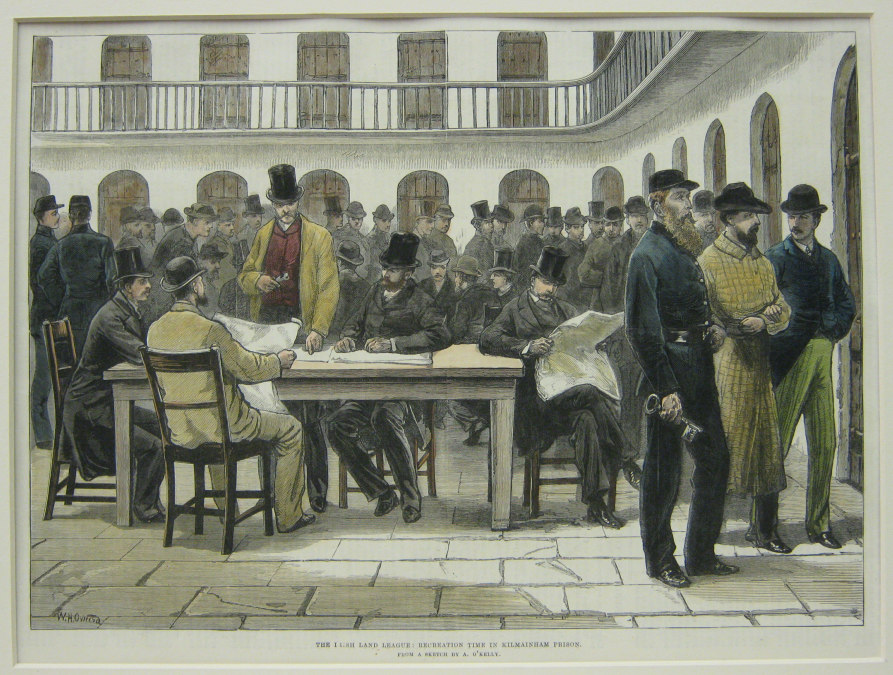
On This Day – Drivetime – 2 May 1882 – Kilmainham Treaty.

Image


Charles Stewart Parnell was known as The Uncrowned King of Ireland and Kings used to have the power to make treaties or at least send someone to conclude them in their place. But Parnell, in 1882, was partly responsible for the ‘Treaty That Wasn’t’. It became known as the Kilmainham Treaty, called after the impressive jail of that name rather than the salubrious suburb of Dublin 8.


The background was chaos in the Irish countryside as the eviction of tenants escalated when agricultural depression hit what we would now call ‘the developed world’. Ireland was, at the time, only included within the ambit of the developed world by default, as part of the United Kingdom. Evictions led, inevitably, to agrarian unrest – retaliation in the form of attacks on bailiffs, agents, and, occasionally, landlords themselves by Ribbonmen, members of agrarian secret societies. Not to mention assaults on so-called ‘land grabbers’ who moved onto the farms of families who had been evicted. The murder rate soared and the Royal Irish Constabulary found itself under huge pressure to make arrests and secure convictions in a rural environment where juries were not disposed to convict even the most obviously guilty Ribbonmen.


The British government response was, as always, to take a benign, far-sighted softly softly approach.


That’s actually completely untrue. They did what they normally did and imposed the sort of coercive measures that would never have been tolerated in England, Scotland or Wales. In fairness, however, they would probably have been unnecessary outside of stroppy old Ireland.


In essence Habeas Corpus was suspended. This meant the government dispensed with the need to bring anyone to trial and produce actual evidence of wrongdoing in order to convict them. It was sufficient merely to suspect that they had been up to no good to throw them in jail. One of the first victims was Parnell himself, arrested in Dublin by the famed Metropolitan policeman Superintendent John Mallon and detained at the pleasure of Her Majesty in Kilmainham Jail.


He resided there for six months, experiencing no difficulty whatever in keeping up a passionate correspondence with his partner of twelve months or so, Katharine O’Shea. Ultimately it was her ambitious husband who sprang the Uncrowned King. Always a man with an eye to the main chance William O’Shea brokered a deal whereby Parnell promised to do his best to rein in the agrarian extremists who were making things unpleasant for the poor landlords, while William Gladstone’s government agreed to introduce remedial legislation to improve the lot of impoverished tenant farmers. The alternative was a continuation of the anarchy that reigned while the entire Irish political leadership was in stir.


As an added extra Parnell tossed in a tasty morsel for the Liberal government in the shape of a potential future political alliance. That was the bit that stuck in the craw of many of Parnell’s supporters and led to both sides denying that the agreement ever existed. Gallons of cold water were poured over allegations that a deal had been done by both Parnell and Gladstone but O’Shea’s preening and the exponential increase in his normal level of smugness told insiders that some sort of compact had been arrived at to allow for the release of Parnell from jail. It was all a monumental waste of time because four days after Parnell got out of Kilmainham the Invincibles murdered Gladstone’s nephew Lord Frederick Cavendish – the new Chief Secretary, and his second in command Thomas H.Burke in Phoenix Park. And it was back to the messy status quo for another few years.


Charles Stewart Parnell was released from Kilmainham Jail on the basis of what might be described today as ‘certain agreed modalities’ but definitely not a treaty of any kind, 132 years ago, on this day.


Image

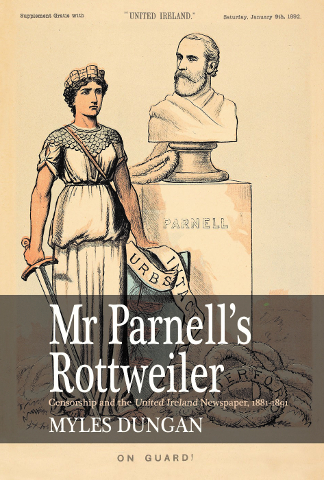
After launch of Mr.Parnell’s Rottweiler author apologizes abjectly for lack of canine content

Image


My thanks indeed to the Press Ombudsman John Horgan, a distinguished newspaper historian, for launching my latest tome last night and being very generous indeed in his comments.

I’d just like to clarify that the book has no canine content whatever and that Parnell did not, in fact, have a rottweiler. He was the owner of a red setter called Grouse. I realize this entirely jeopardizes the credibility of the volume.  The confusion is caused by my puerile attempted homage to the title of Roy Jenkins’s book on the House of Lords Mr.Balfour’s Poodle. Should any rottweiler lovers purchase a copy, assuming it reveals the truth about the relationship between the great Irish nationalist leader and their favourite breed of dog, I will be happy to reimburse them the cost of the paperback. If you bought the hardback you’re on your own. I’m not made of money and you should have checked the index for dog references first.

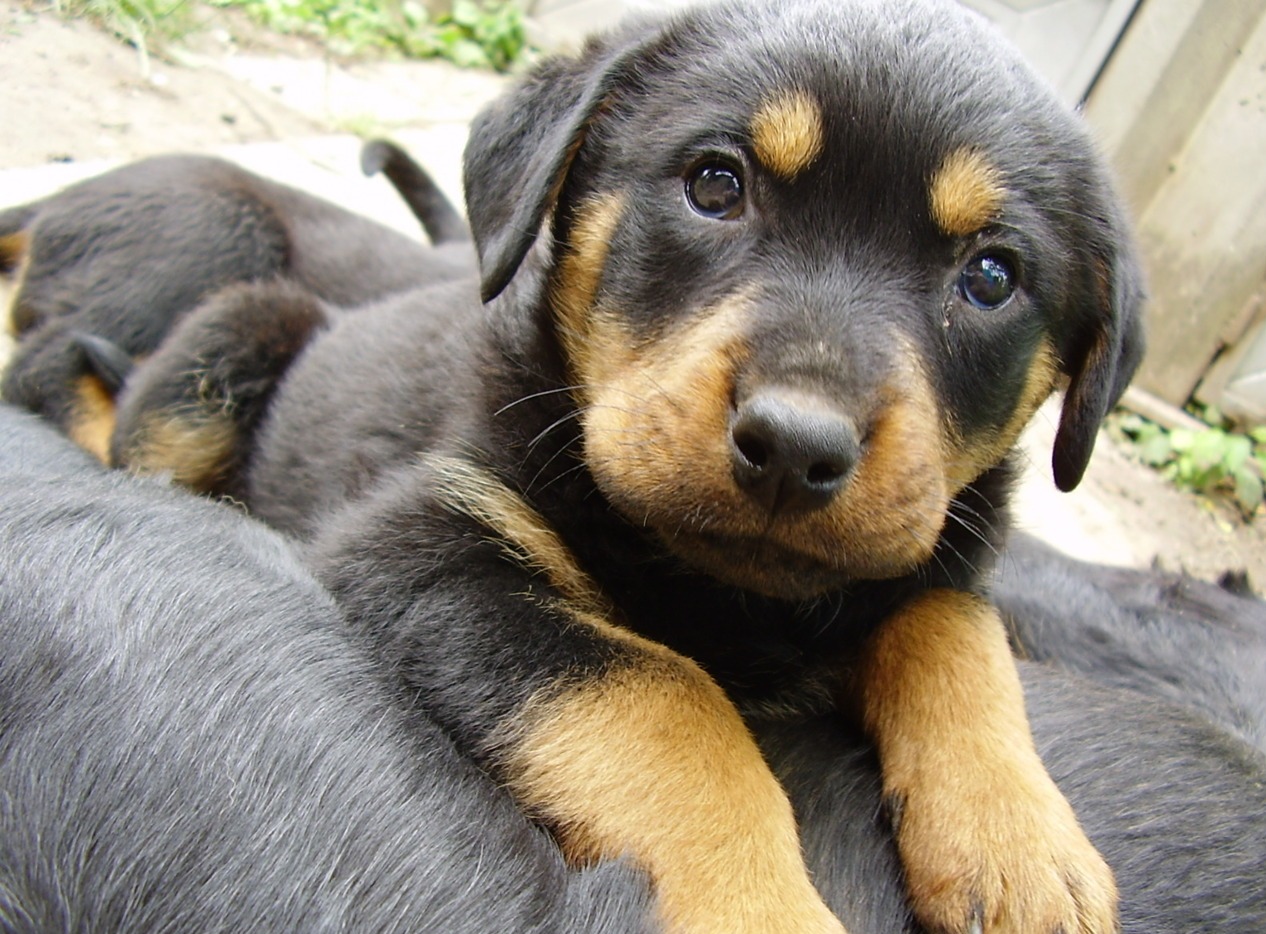
I would also like to apologize to all rottweilers for the invidious comparison with the Parnellite newspaper United Ireland. Rottweilers are soft, cuddly, pliable and docile when compared with United Ireland. The photographs below clearly illustrate this.


ImageImage


On This Day-Drivetime -25.4.1681 Murder of Redmond O’Hanlon the highwayman, tory and raparee.

Image


Nowadays a Tory is someone who sits on the government benches at Westminster. But three hundred years ago, before the term acquired its political connotation a Tory was a very different class of bandit entirely.


There was a man lived in the north, a hero brave and bold

Who robbed the wealthy landlords of their silver and their gold

He gave the money to the poor, to pay their rent and fee

For Count Redmond O’Hanlon was a gallant rapparee.


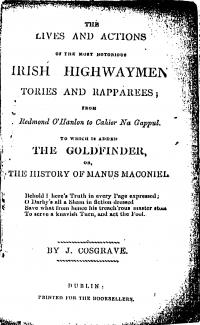
Thus begins Tommy Makem’s account of one of the most illustrious and iconic thieves in 17th century Ireland, Redmond O’Hanlon, the infamous Tory, highwayman, raparree or highway robber. Over the years O’Hanlon has acquired the characteristics of a Robin Hood and a Michael Dwyer – a fervent nationalist who believed in the re-distribution of wealth, other peoples. He was, of course, neither a nationalist or a socialist – the concepts being entirely unknown when he was in his pomp.


O’Hanlon, whose family had been wealthy Gaelic landowners before the intervention of Oliver Cromwell and others, was probably born in the vicinity of Slieve Gullion in South Armagh, and probably in the vicinity of 1640. Like so many members of the old Irish Catholic nobility he saw service in the armies of the King of France and returned to Ireland at the time of the restoration of King Charles II to the English throne. The resumption of the monarchy led to no similar improvement in the fortunes of the O’Hanlon clan so Redmond took to the hills to earn his living off the fortunes of those he saw as having dispossessed his family, the Anglo-Irish nobility.


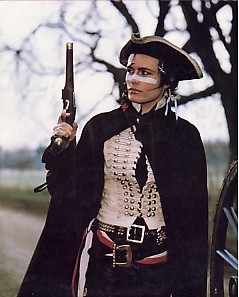
His operation was rather more sophisticated than simply standing in the middle of what passed for 17th century roads and hollering ‘Stand and deliver, your money or your life’ in the style of Adam Ant. He made quite a good living from a primitive protection racket. Those who paid him off were to be immune from the depredations of any of the raparees in his north Louth-south Armagh bailiwick. Should the local tories baulk at Redmond’s racket there was a simple ‘three strikes and you’re out’ policy. Anyone caught robbing one of O’Hanlon’s protectees was first warned off, thereafter they were fined for a second offence, and finally, if they did it again, they were murdered.


Naturally enough the authorities disapproved of this primitive pax Redmondica or perhaps tax Redmondica is more appropriate, and sent troops after him to pierce his protective mantle. O’Hanlon used a number of wily evasion techniques to elude capture, the most celebrated being the practice of reversing his horse’s shoes to send pursuers in the wrong direction. He was also known to reverse his and his accomplices clothing, revealing on the inside a red-coat lining that was good enough to confuse the gullible.


An inability to track Redmond resulted in the price on his head being raised consistently and repeatedly, leading to open season for a new breed of opportunist, the ‘Tory hunter’. This was a class of Wild West bounty hunter except six thousand miles to the east, two centuries earlier and with an Irish accent. When not pursuing Redmond with a view to claiming the considerable reward on his head planter families like the Cootes, of Cootehill in Co.Cavan kept their hands in by hunting and killing Catholic priests for pocket money.


Predictably the death of Redmond was an inside job. He was betrayed and shot by a kinsman Art McCall O’Hanlon who was in it for the reward. Pour encourager les autres Redmond’s head was placed on a spike outside Downpatrick jail after Art imitated nature and succumbed to the blandishment of piles of money.


Redmond O’Hanlon, Tory, raparee, extortionist and folk hero died 333 years ago on this day.


Image