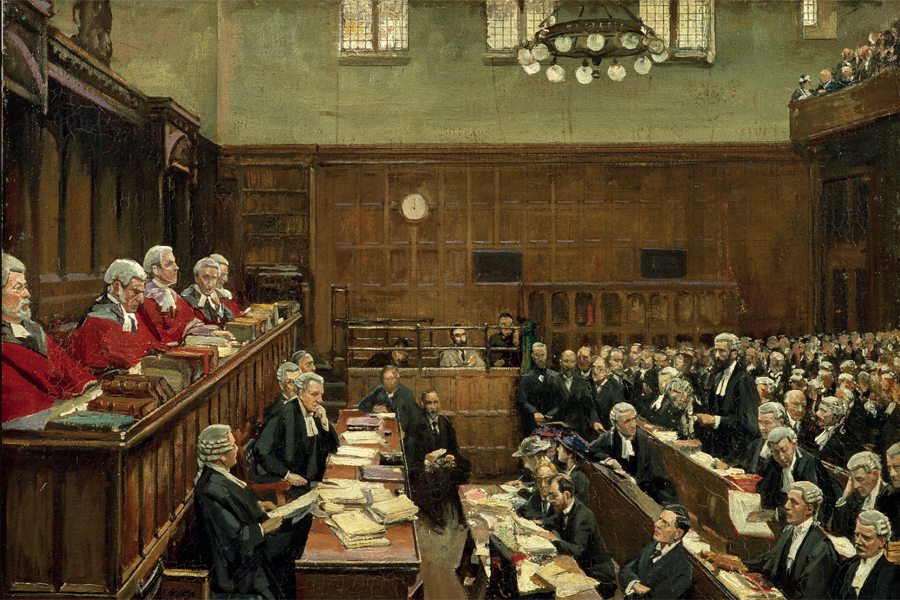
Sir John Lavery’s painting of the treason trial of Sir Roger Casement
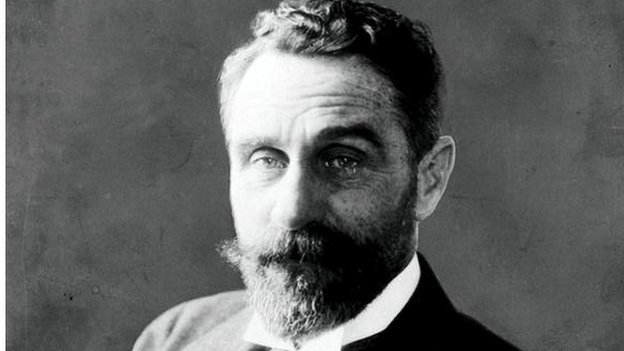
After the execution of the two surviving signatories of the 1916 Proclamation (James Connolly and Sean McDermott) on 12 May the Crown had one final score to settle with the leadership of the rising. Sir Roger Casement, career diplomat, humanitarian and British civil servant, had been the first of the leaders of the rising to be arrested. He was the last to be tried and executed.
The Asquith government had initially decided that he would be quickly court-martialled and shot. But, informed by the strong negative reaction to the executions in Dublin the Government began to be attracted to the idea of civil trial for treason. A form of ‘show trial’ in which ‘justice would be seen to be done’. The attraction was one of rehabilitation. Some of the international criticism drawn down on the heads of the Asquith government for the methods used to deal with the leaders of the rising (a system amounting to virtual drumhead courts martial) could be deflected by a robust and open prosecution of Casement.
There was, however, an unfortunate corollary embedded in the governmental logic. Their forum for the ex post facto validation of General Sir John Maxwell and the Dublin executions, would also become Casement’s platform for the justification of the rising and the lionization of its leaders. If they had looked back to the trial of Robert Emmet in Dublin in 1803 they could have been forewarned. Just because the result of both was a foregone conclusion did not mean they would not have to share the propaganda value of a public trial process.
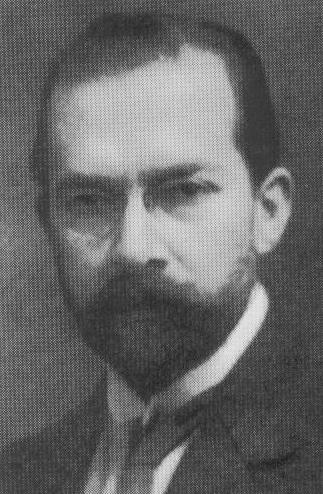
GEORGE GAVAN DUFFY
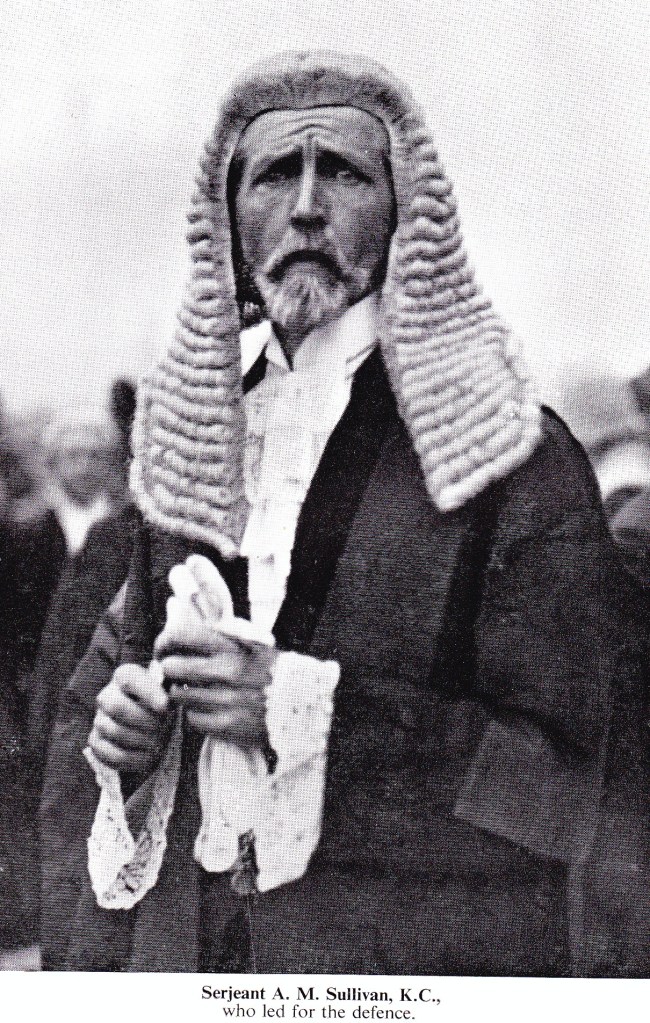
Casement’s defence was organized by George Gavan Duffy. Duffy was a successful London solicitor, the son of the Young Ireland leader, Charles Gavan Duffy. The Casement trial would prompt him to abandon his London legal practice and become a Sinn Fein MP in 1918. Gavan Duffy, with some difficulty, managed to engage the services of Serjeant A.M.Sullivan (the son of the former owner of the Nation newspaper, A.M.Sullivan) to defend Casement. No senior British-based barrister would take the brief.
Sullivan was a Crown law officer in Ireland but had been called to the English Bar and was, therefore, entitled to plead at the Old Bailey. Casement’s desire was to conduct a defence based on an acceptance of the facts of the case. However, he would emphatically deny that he was guilty of treason on foot of those facts. His contention would be that his loyalty was to an Irish republic not to the English Crown.
Sullivan, however, persuaded, or browbeat, his client into a more reductive line of defence. Casement was to be tried under the same treason statute—of the medieval King Edward III—as Robert Emmet had been.
This held that the crime of treason had been committed ‘if a man be adherent to the King’s enemies in his realm’. Sullivan would contend that Casement, in his dealings with the Germans, had not threatened the King in his own realm. There was a hopeful precedent in the case of Colonel Arthur Lynch. Lynch had been a leader of the Irish Brigade during the Boer War. A similar defence had been entered in his case but he had been convicted and sentenced to death. Lynch, however, had been reprieved. Sullivan was hoping for similar treatment for Casement.
But there was another reason for acceding to Sullivan’s insistence that his line of defence be adopted. Casement, famously, had recorded many of his homosexual exploits in a series of notebooks. These were in the possession of the prosecution. Adopting Sullivan’s defence strategy, a plea based on a technicality and on legal argument, would not allow the prosecution to introduce the diaries in evidence. Prodigious use was made of the ‘Black Diaries’ covertly, both before and after the trial, but they were not produced in the Old Bailey. However, much like Robert Emmet’s letters to Sarah Curran in 1803 they were allowed to hang in the air above the proceedings. In the case of Emmet the threat was that Sarah Curran would be prosecuted if he challenged the Crown’s evidence against him.
Casement’s trial opened on 26 June. Leading for the Prosecution was Sir Frederick Smith (formerly F.E. Smith) successor to Sir Edward Carson as Attorney General.
Witnesses were called who had been prisoners of war in the German camps from which Casement had hoped to recruit his Irish Brigade. All identified him but also acknowledged that they had been told that they would not be fighting for Germany but for Ireland. A number of witnesses identified Casement as having landed on Banna Strand.
After the prosecution case concluded Sullivan rose to enter a motion to have the indictment quashed. He argued that the allegation of treason was bad in law and that in order to secure a conviction it was essential that Casement should have been in the King’s realm when he attempted to persuade the Irish POWs to change allegiance.
The judges ruled otherwise. They held that a treasonable offence committed by one of His Majesty’s subjects was liable to trial under Common Law wherever that offence was committed. Sullivan’s strategy, unpromising from the outset, was now in tatters.
Sullivan’s address to the jury, in the light of the failure of his own defence strategy, now pivoted towards the defence originally advocated by his client, i.e. that he owed his loyalty to an Irish Republic and not the British Crown, so that he could not be guilty of treason.
In his own concluding remarks F.E.Smith reiterated the Crown’s allegation that ‘German gold’ was behind the rebellion [already denied by both Pearse and Casement] and concluded:
If those facts taken together, his journey to Germany, his speeches when in Germany, the inducements he held out to these soldiers, the freedom which he there enjoyed, the cause which he pursued in Ireland . . . satisfy you of his guilt, you must give expression to that view in your verdict.
The direction by the Lord Chief Justice [Rufus Isaacs, Lord Reading] to the jury left them with little alternative but to convict Casement. The jury took less than an hour to find Casement guilty of treason.
Casement now took advantage of the opportunity that had been denied Pearse, MacDonagh and Connolly and the other leaders of the rebellion, to offer an explanation of the objectives of the leadership of the Easter rising. His peroration was, arguably, the finest republican valedictory since that of Emmet more than a century before. He concluded …
Ireland is treated today among the nations of the world as if she were a convicted criminal. If it be treason to fight against such an unnatural fate as this, then I am proud to be a rebel, and shall cling to my “rebellion” with the last drop of my blood.
A failed appeal delayed Casement’s execution and allowed a head of steam to build up behind a campaign to have him reprieved. It was during this period that tactical use was made of the Black Diaries in order to influence newspaper coverage against Casement and dampen the enthusiasm of actual and potential supporters (such as John Redmond and George Bernard Shaw)
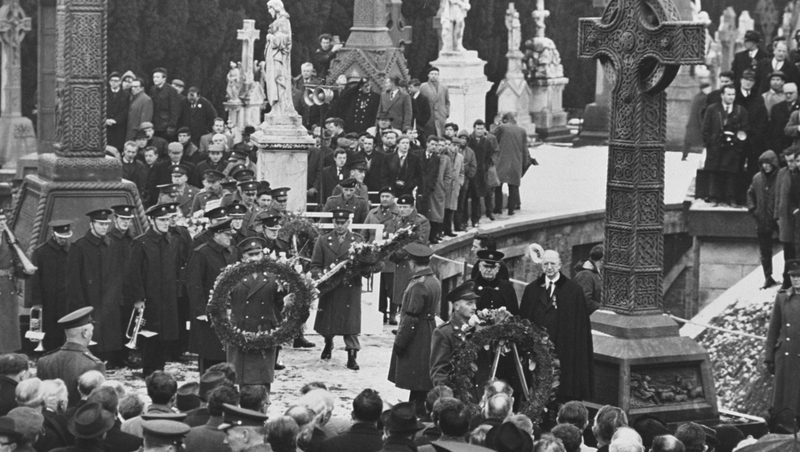
Casement was hanged in Pentonville Prison on 3 August, 1916. As with the other leaders of the Easter rising, his body was buried in quicklime in the prison cemetery. In 1965, a year before the country commemorated the fiftieth anniversary of the rising, Casment’s body was repatriated and interred in Glasnevin cemetery in Dublin. He was afforded a state funeral that was attended by President Eamon de Valera, the last surviving commandant of Easter Week.
There’s a moment in the Orson Welles classic film Citizen Kane when the main character, Charles Foster Kane— based on the newspaper and business tycoon William Randolph Hearst—is running for election as governor of New York. The editor of his New York daily has prepared two early editions, one of which will appear the morning after the result of the election is announced. One reads ‘KANE ELECTED’ the other reads ‘FRAUD AT THE POLLS’. With a long face he is forced to go with the latter when Kane loses (so did Hearst, in 1906).
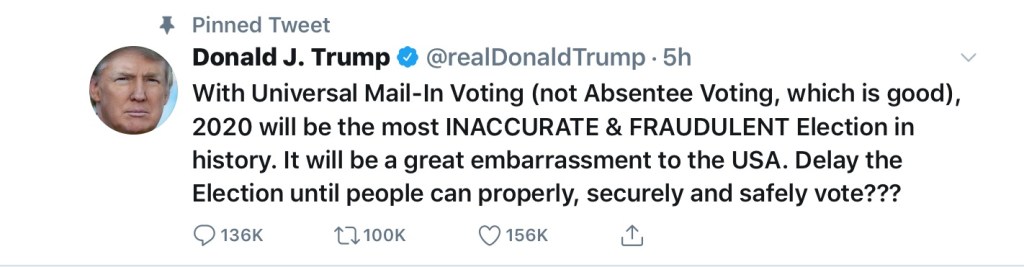
It appears from his tweet today—the one about the possibility of postponing the November Presidential election, not the 87 other ones—(this was written before midnight so that figure might no longer be accurate!)—that President Donald J. Trump is of a similar mindset. Either he will defeat Joe Biden in November, or he will have been the victim of massive electoral fraud, most of it coming via mail ballots.
So, what does history tell us about a) the postponement of a US Presidential election and b) US electoral fraud.
The first thing to be reiterated is that the President cannot release his inner spider yet again and sign another Executive Order to postpone/cancel/exclude/deport/pardon a Presidential election. He may be able to rename Mars as Planet Trump (I’m not sure if that actually happened but I saw it on Twitter) but according to Article 2 Clause 4 of something called the United States Constitution (apparently we have one too, but the UK hasn’t gotten around to it yet) …
‘The Congress may determine the Time of chusing the Electors, and the Day on which they shall give their Votes; which Day shall be the same throughout the United States.’
Americans seem to have adopted the standardised spelling of ‘choosing’ since the 18th century, so it’s probably only a matter of time before they overcome their loathing of the letter ‘U’ and begin to spell ‘labour’ ‘flavour’ and ‘savour’ properly as well.
As to the date, the American election has not always taken place on the first Tuesday after the 1 November. That practice began on 7 November 1848 when the USA staged the first national election that was held on the same day in every state. Zachary Taylor became President. (Me neither!) The 1848 election date was based on a snappily titled 1845 law – ‘An act to establish a uniform time for holding elections of electors of President and Vice President in all the states of the Union’ which did exactly what it said on the tin and settled on ‘the Tuesday next after the first Monday in November’. That is the way it was been ever since.
Any change would require an amendment to that act, approved by both Houses of Congress. To the Democrats, who have a majority in the House of Representatives, it is an non-runner, dead duck, non-starter, ‘just ain’t gonna happen’ – and even Republicans in the Senate have no stomach for such a move. Trump Enabler in Chief, Mitch McConnell has described the date as ‘set in stone’[1]
And even if it was postponed when would the USA go for a reset? No election (bar the first in 1788) has failed to take place in the final full year of a presidential term. This is not the Olympic games. Any postponement beyond the end of December would require a constitutional amendment. This would have to be ratified by 38 of 50 states! If you’ve been watching Mrs. America on the BBC you’ll have some idea how difficult it is to pass a constitutional amendment. (Spoiler Alert – I’ve probably just given away the fact that the Equal Rights Amendment was never enshrined in the US Constitution. Oops! Sorry).
And it’s not as if American Presidential elections haven’t gone ahead in spite of a few minor difficulties!
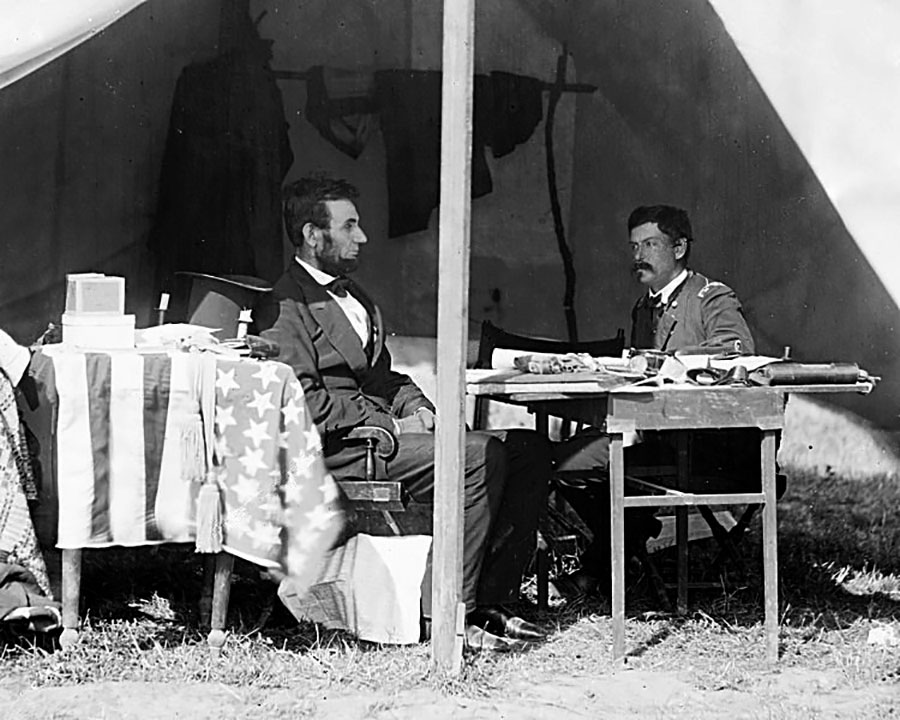
In 1812 James Madison and DeWitt Clinton had to face the electorate despite the USA being in the middle of a war with their former colonisers, the British. In 1864 Abraham Lincoln had to fight an election against one of his former Generals, George McClellan even though the Civil War was still raging.
Lincoln and McClellan in more convivial times
According to Michael Burlingame, Professor emeritus of History, Connecticut College:
‘No other democratic nation had ever conducted a national election during times of war. And while there was some talk of postponing the election, it was never given serious consideration, even when Lincoln thought that he would lose.’[2] Lincoln’s chances weren’t helped by a rebellion in his own party that threw up a charismatic third candidate in John C. Fremont. But the Lincoln Project was ultimately successful (fnarr, fnarr!)
Not to mention the fact that FDR was re-elected, for the seventeenth time, in 1944 during a global conflict.
Then there is the mail / absentee voting issue.
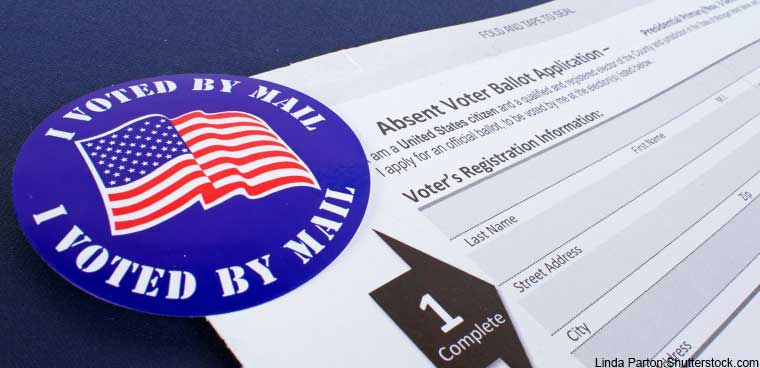
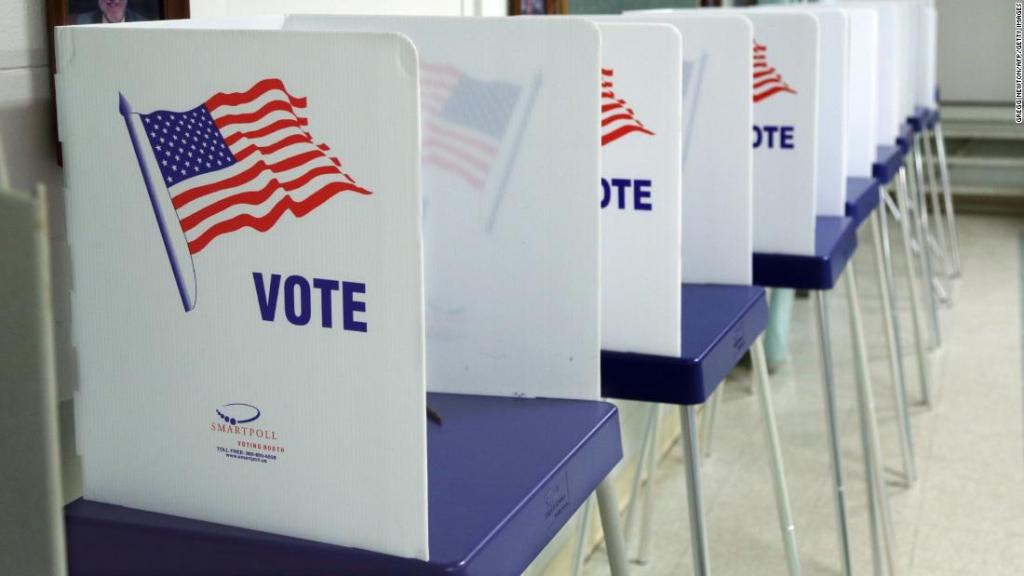
Is voting by mail more liable to produce a fraudulent result? Well, nearly 1 in 4 voters cast 2016 presidential ballots that way, and Trump won (albeit losing the popular vote by a narrow 3,000,000 margin). Being permitted to post off your ballot in October or November, rather than appearing in person to pull the lever, would make it less likely that electors would be required to die for their country, of Covid-19. It would also be more difficult for Cozy Bears, APT29 or whatever those talented Russian hackers are calling themselves now, to game the system. Not even Vladimir Putin is patient enough to stand over every postal voter and steal their ballot.
They’ve been voting by mail in Oregon since 1998 and out of over 15 million ballots cast the conservative Heritage Foundation detected fourteen cases of fraud.[3] That’s a rate of .0000009%. A study that was funded by by those celebrated bastions of Marxist/Leninism, the Carnegie Corporation of New York and the Knight Foundation, found an “infinitesimal” number of fraud cases in elections between 2000 and 2012. They detected a total of 2,068 illicit ballots cast, amounting to one in every 15 million eligible voters.[4] And those were not all mail-in voters, some of the fraud took place at election booths.
If about 150,000,000 Americans vote on 3 November that’s a potential incidence of around 10 fraudulent ballots nationwide. I’m sure the Democrats would be happy to ease President Trump’s mind by giving him a ten vote start? He can even take them all in Wisconsin or Minnesota if that helps.
BTW – President Trump himself voted by mail during New York City’s mayoral election in 2017. He cast an absentee ballot the following year, and again used a mail ballot in Florida’s primary election in 2020.[5] What’s that old saw about sauce, goose and ganders again? So, unless Democratic members of the House of Representatives are accidentally locked in a broom cupboard before a vote on electoral postponement, the poll will proceed as planned on 3 November.
Incidentally, the last time a Presidential election was held on 3 November was 1988, when a Republican incumbent (George H.W. Bush) was defeated after serving a single term in the White House. Just sayin’
Caveat – all sources cited here are, of course, fake news outlets, like Snopes.com, Reuters and NPR. So, you can safely take it all with a pinch of salt.
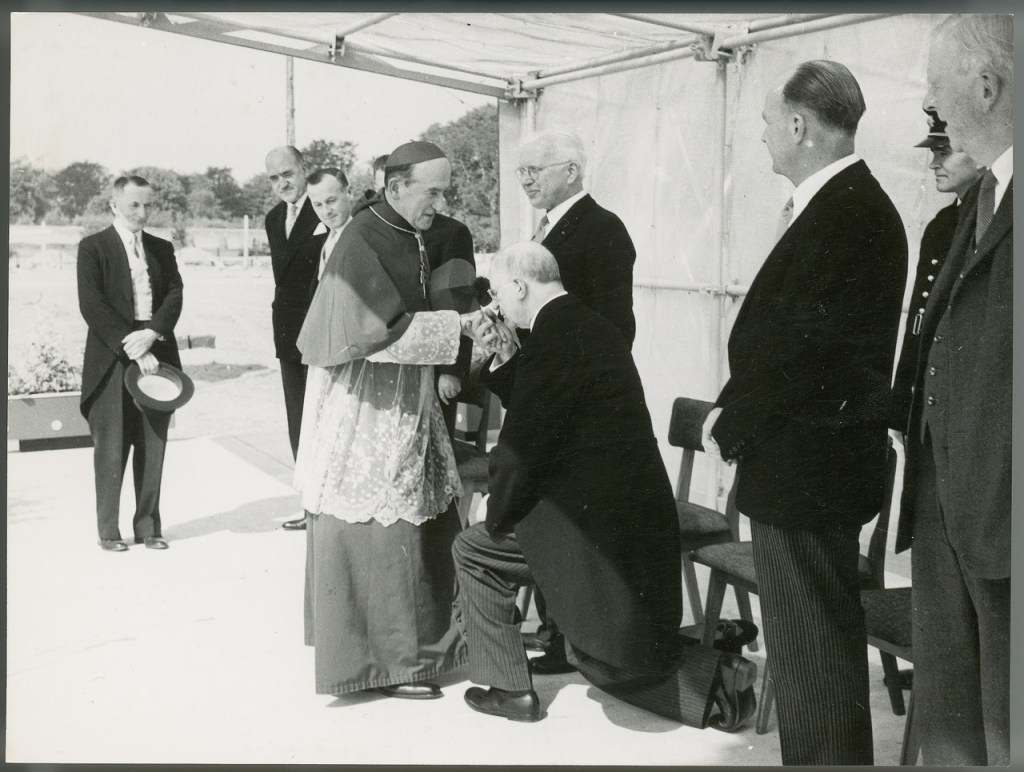
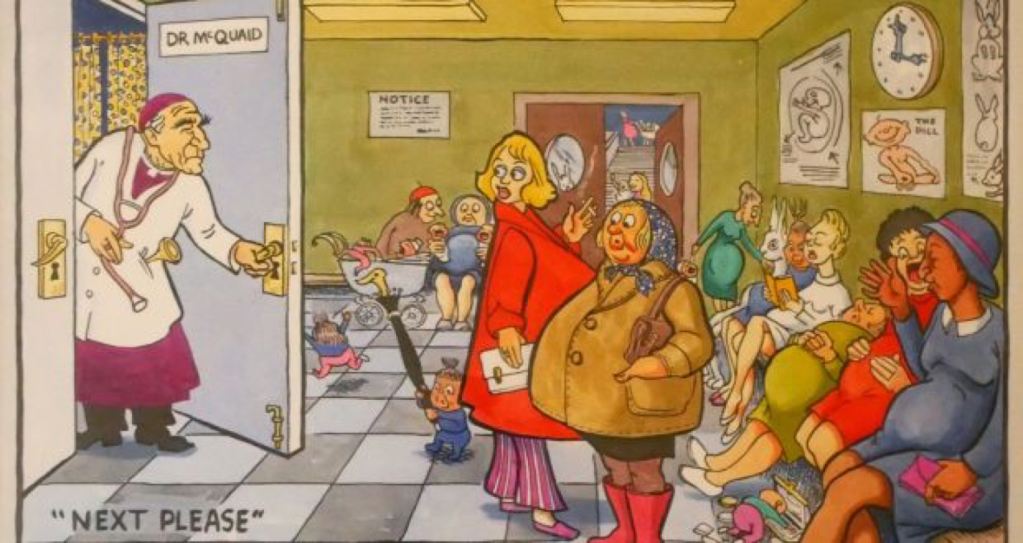
An unidentified Irish Head of State kneels before Archbishop John Charles McQuaid. Proper order!
Abject apologies for missing the 125th birthday of Archbishop John Charles McQuaid yesterday.
Here was a distinguished clergyman who might have been imported directly from the Spanish Inquisition to administer his particular brand of religious certitude on an Ireland whose abject politicians were only too willing to kiss his ring. (See photo above lest there be any doubt on that score)
McQuaid was a cleric who liked women to know they were welcome in his church, as long as they restricted their activities to making the sangitches and changing the flowers on the altar every week.
Mind you, Ireland has never lacked for misogynistic Archbishops of Dublin. Cardinal Cullen, in the 1870s tried to force the administration to withdraw scholarships and prizes based on examination results from female second level students. He was supported in this by Irish MPs. It was British MPs who ensured that Irish girls would continue to benefit from their hard work in preparing for exams.
His successor, Cardinal MacCabe —an Irish churchman much beloved of Dublin Castle—went through multiple phases of apoplexy at the sight of women attending Land League meetings and, holy horror of horrors, making platform speeches. In a pastoral letter to his archdiocesan clergy he advised them:
‘Very reverend dear fathers, set your faces against this dishonouring attempt, and do not tolerate in your sodalities the woman who so far disavows her birthright of modesty as to parade herself before the public gaze in a character so unworthy of a child of Mary.’
But, of course, the Daddy of them all when it came to clerical misogyny was the Ayatollah himself, Archbishop John Charles McQuaid (sadly he was denied a ‘red hat’ despite his sterling work on behalf of sixteenth century values). We don’t even need to grapple with the celebrated controversy over Noel Browne’s Mother and Child Scheme to bathe Dev’s favourite Archbishop and Constitutional Consultant in the cold light of female repression. Or even his role in the insertion of the infamous Article 41.2.1 in de Valera’s 1937 Constitution. (Just in case you need reminding about that one it went something like this …
‘In particular, the State recognises that by her life within the home, woman gives to the State a support without which the common good cannot be achieved.’
That’s all big politics. Let’s focus on the really petty stuff instead.
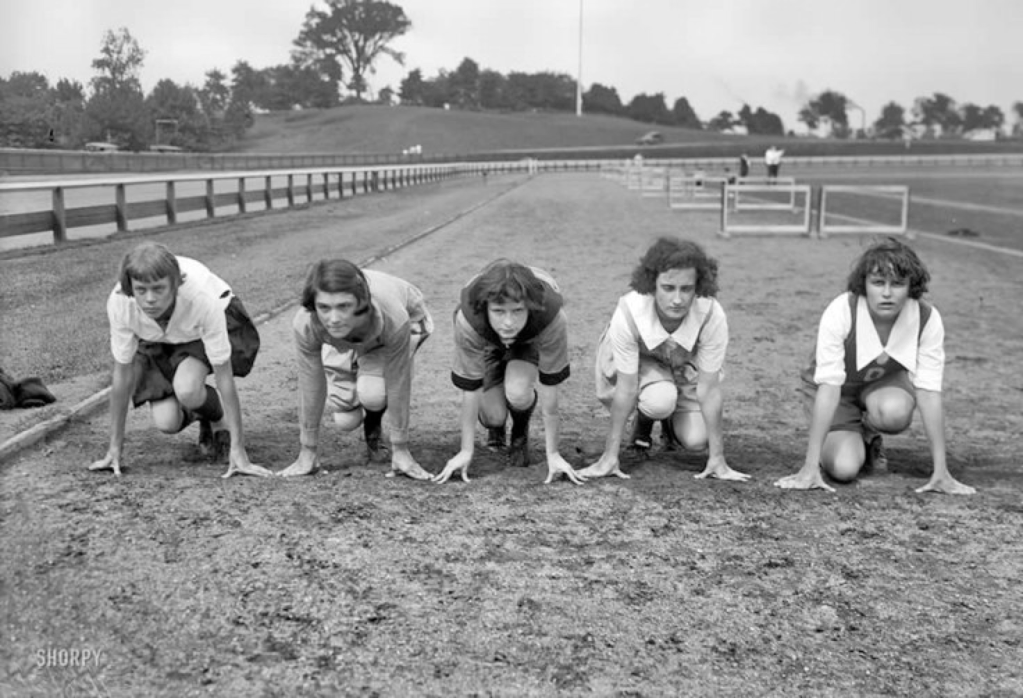
Take, for example, how he took issue, in 1934, with the notion of girls and women being allowed to compete in athletics. In 1928 women had been admitted to the Olympic Games for the first time but McQuaid came from the same school as the founder of the modern Olympiad, Baron Pierre de Coubertin, who believed that ‘women have but one task [in the Olympics] that of the role of crowning the winner with garlands’.
Not even for 11″ or so were women to be allowed compete in the national championships.
In 1934 the National Athletic and Cycling Association [grandparent of Athletics Ireland] was contemplating adding a women’s 100 yards dash to the national championships. McQuaid, then president of Blackrock College, (apparently this is an all-male rugby playing establishment somewhere in south Dublin) wrote a letter on the subject to the Irish Press newspaper on 24 February 1934 in which he observed that: ‘Mixed athletics and all cognate immodesties are abuses that right-minded people reprobate, wherever and whenever they exist.’
He then proceeded to invoke one of only two superior beings whom he acknowledged, by pointing out that ‘God is not modern; nor is his Law’. Women who sought to compete athletically in the vicinity of men were ‘un-Irish and un-Catholic’, and the entire phenomenon was a ‘social abuse’. He concluded by quoting from the only other superior being he recognised, the Pope (the one who never gave him a ‘red hat’), who was, apparently, of the opinion that:
‘…in athletic sports and exercises, wherein the Christian modesty of girls must be, in a special way, safeguarded … it is supremely unbecoming that they flaunt themselves and display themselves before the eyes of all.’
So that was pretty conclusive, God, the Pope and John Charles were on the same side. The NACA decided not to include female athletes … even over 100 yards. To their eternal shame the Irish Camogie Association supported McQuaid, although that may have been not unconnected with the fact that its secretary was a man. Sean O’Duffy—who was apparently not related to Ireland’s leading Fascist Eoin O’Duffy—promised that the Camogie Association:
‘…would do all in its power to ensure that no girl would appear on any sports ground in a costume to which any exception could be taken. If they remained Irish in the ordinary acception of the word they could not go wrong.’
Apparently the word ‘acception’ means ‘acceptation’ or ‘received meaning’. No, me neither!
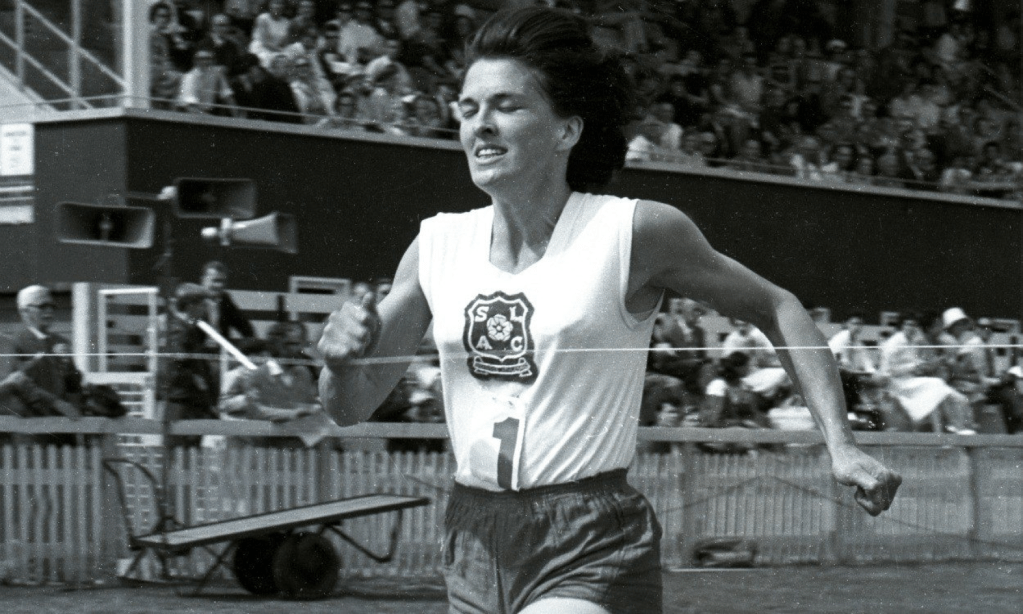
Not until 1956 did Maeve Kyle become Ireland’s first female athletics competitor at the Olympics. It probably helped that she was a Northern Protestant and, consequently, beyond redemption.
Maeve Kyle – avert your gaze Archbish!
Ten years later, having left Blackrock College, McQuaid was now Archbishop of Dublin with responsibility for all the clergy of the diocese, so, clearly, no longer associated with an institution dominated by testosterone. But he was still obsessed with female modesty, and in 1944 his attention had shifted from athletics to cycling – as in the menstrual cycles of women. In a letter to the parliamentary secretary to the Minister for Local Government and Public Health he shared his anguish about:
‘…the evidence concerning the use of internal sanitary tampons, in particular, that are called Tampax. On the medical evidence made available, the bishops very strongly disapprove of the use of these appliances, more particularly in the case of unmarried persons.’
Now, in fairness to the Archbishop, in using the words ‘unmarried persons’ he was obviously expressing concerns in relation to men who used tampons as well as women. One wonders had his eminence mistaken Tampax for Durex, both, after all, were highly sexualised products with the suspect letter ‘x’ in their names?
Or was his anxiety based on the fear that the tampon might, in addition to its medicinal / physiological purpose, be used by women in pursuit of sexual stimulation. Sexual pleasure and gratification was after all:
a) in the gift of men only.
b) an unfortunate (if unlikely) pre-requisite for the production of children.
c) never willingly experienced by truly Catholic women.
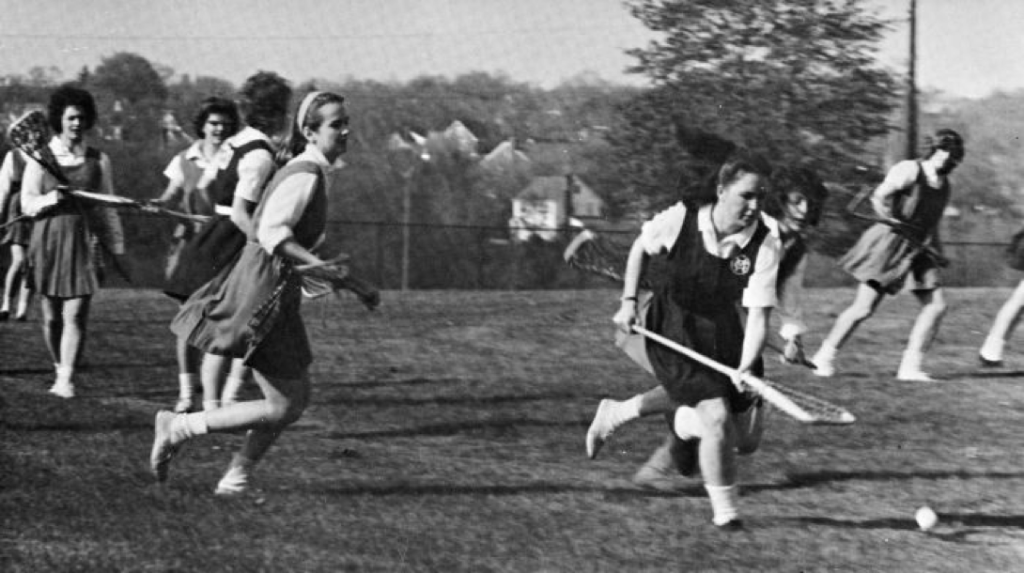
Staying with sport, the Archbishop was also concerned about the dangers of hockey for women – he feared that the frequent twisting movements would lead to infertility, or what he called ‘hockey parturition’. Female hockey players might conceivably—ok, pun intended—find themselves unable to perform the main function appropriate to their gender, i.e. reproduction. The sport of lacrosse, which he believed, for some baffling reason, to involve less midriff action, was encouraged in Roman Catholic girls’ schools in the Dublin archdiocese. The fact that lacrosse had originated among Native Americans using the heads of defeated opponents did not seem to occur to him as making it in any way unsuitable.
Lacrosse – far less midriff twisty than hockey, apparently
To accompany tonight’s History Show programme on ‘Women in the War of Independence’ below are contextualised extracts from Lily Mernin’s Bureau of Military History Witness Statement about her espionage activities on behalf of Director of Intelligence, Michael Collins during the War of Independence.
LILY MERNIN – INTELLIGENCE AGENT, DUBLIN CASTLE
BMH WS #441
From 1914-1922 Lily Mernin, a cousin of leading IRA propagandist, Piaras Beaslai, was employed as a typist in the Dublin District Garrison Adjutant’s office in the Lower Castle Yard. When Beaslai became aware of the precise nature of her work he spoke to Michael Collins about her. In 1918 Mernin met Collins for the first time.
Piaras Beaslai brought him to my home and introduced him to me as a Mr. Brennan. I did not know he was Collins at the time. He asked me would I be willing to pass out to him any information that might be of value which I would come across in my ordinary day’s work. I remembered he produced letters that he had intercepted concerning some of the typists and officers in the Castle, and things that were happening generally. I cannot remember exactly what they were. I promised to give him all the assistance that I possibly could.
The garrison adjutant for Ship St. barracks and Dublin District at the time was Major Stratford Burton. The work that he gave me to do was connected with Volunteer activities generally and, in addition, court martial proceedings on Volunteers was also given me to type. These dealt with the strength of the various military posts throughout Dublin district. Each week I prepared a carbon or typed copy, whichever I was able to get. Sometimes I would bring these to the office placed at my disposal at Captain Moynihan’s house, Clonliffe Road. He had a typewriter there and I typed several copies of the strength returns and any other correspondence which I may have brought with me that I thought would be of use. I left them on the machine and they were collected by some person whom I did not know. I had a latch key for the house and nobody knew when I came or went. It was arranged for me that if I had anything special requiring urgent delivery to the Intelligence staff that I would deliver it at Vaughan’s [Hotel] between certain hours and/or Maire ni Raghallaigh’s bookshop , Dorset St. and Captain Moynihan’s, Clonliffe Road. Another place where I left messages was at Collins’s shop Parnell St, the number I cannot remember.
I cannot recollect the exact nature of the letters and correspondence that I passed to the Intelligence staff. All I can say is that, in general, they dealt with the movement of troops, provisions for armoured trains or cars, and instructions and circulars to military units from GHQ.
Mernin proved extremely useful to Collins when it came to the identification of the Dublin accommodation of British agents, information that was to prove crucial to the assassinations on Bloody Sunday, 21st November, 1920.
Before the 21st November 1920, it was part of my normal duty to type the names and addresses of British agents who were accommodated at private addresses and living as ordinary citizens in the city. These lists were typed weekly and amended whenever an address was changed. I passed them on each week either to the address at Moynihan’s, Clonliffe Road or to Piaras Beaslai. The typing of the lists ceased after the 21stNovember 1920.
Apart altogether from using her access to written information Mernin, from time to time, was in a position to pass on useful office gossip to Collins.
There was a girl in the office who was the daughter of Superintendent Dunne of Dublin Castle. When he resigned she moved out of Dublin Castle to an address in Mount Street. Stopping at the same address were a number of men. Every morning she would come into the office she would tell us about them, she was puzzled to know who they were. Her brother also resided there with her and, apparently, he used to mix with them, and he discussed their conversation with her. She would report this conversation to us when she would come into the office in the morning. There was one fellow there by the name of McMahon who was very addicted to drink. While under the influence of drink he was, I believe, liable to talk a lot, and, mainly, his conversation concerned raids and arrests of ‘wanted’ IRA men. Whatever tit-bits of information that I could glean from Miss Lil Dunne I immediately passed it on to the Intelligence section. Suspicion was thrown in my direction one morning when Miss Dunne entered the office and excitedly said that her brother had been missing and that she thought he was held by the IRA, that somebody in the office had been giving information to the IRA concerning the conversation we had in the office about McMahon and Peel, British agents, who were lodging in the same house with her in Mount Street. However, I found myself in a predicament, but I remained cool and calm and bluffed my way out of it and said: “Who could be a spy?” and put the blame on her brother for talking too much. Sometime later the position was eased when Miss Dunne took ill and never again returned to Dublin Castle.All this information was, of course, passed on to the IRA Intelligence prior to the 21st November 1920.
After 21st November 1920, a number of British intelligence officers were drafted into Dublin Castle. A [4] new department was opened up in the Upper Castle Yard. My work did not bring me in contact with this department. I was asked by the IRA Intelligence Squad to get what information I could about the movements of these officers. These were mainly descriptive particulars for the purpose of identification, where they resided, and where they frequented, also the registration numbers of the motor cars used by them.
These Intelligence officers used come into our office. The three girls of the staff were curious to know who they were. Some of the girls would ask “Who was so-and-so that came in?” In this way, we got to know the names of the various Intelligence officers. Some of the girls in the office were very friendly with them and used to go around with them. General conversation would give a lot of information concerning their whereabouts, things that were said, etc. Any information obtained was immediately passed by me to IRA Intelligence.
On various occasions I was requested by members of the Intelligence Squad to assist them in the identity of enemy agents. I remember the first occasion on which I took part in this work was with the late Tom Cullen in 1919. Piaras Beaslai asked me to meet a young man who would be waiting at O’Raghallaigh’s bookshop in Dorset St and to accompany him to Lansdowne Road. I met this man, whom I later learned was Tom Cullen, and went with him to a football match at Lansdowne Road. He asked me to point out to him and give him the names of any British military officers who frequented Dublin Castle and GHQ. I was able to point out a few military officers to him whom I knew.
When I got to know the Auxiliaries better, I accompanied Frank Saurin (then known as Mr. Stanley) to various cafes where I identified for him some of the Auxiliaries whom I knew.
A footnote. The ‘Lil Dunne’ in question was a great aunt of the novelist Sebastian Barry, she is the main character in his novel On Canaan’s Side. Lily Mernin, who was referred to by Collins only as ‘the little gentleman’ also had social access to Auxiliary policemen based in Dublin Castle, members of the notorious ‘F’ company.
The Auxiliaries organised smoking concerts and whist drives in the Lower Castle Yard. I was encouraged by Frank Saurin, a member of the Intelligence Squad, to give all the assistance I could in the organisation of these whist drives for the sole purpose of getting to know the Auxiliaries and finding out all I possibly could about them. Frank Saurin had arranged with me that should any of the Auxiliaries see myself or any of the girls of the Castle home, he would have members of his squad hanging around Dublin Castle to identify them. However the Auxiliaries never did come past the Castle gate.
On one occasion I asked Frank for a reliable girl, whom I could trust, who would come along to the whist drives with me, to enable her to get to know these Auxiliaries and so prove a further source of identification. He sent along Miss Sally McCasey, who is now his wife. She did her work very well. She had a very charming manner and struck up a friendship quite freely.
L42
On at least one occasion Mernin brought the kind of intelligence to her relative, Piaras Beaslai, that he did not want to hear.
WS-042
One day a Sergeant from British Intelligence came into my office, carrying a lot of magazines – as I thought – bound together. I asked him what they were and he told me they were copies of “An tOglach” and would not part with them for five hundred pounds, as they were very valuable to them. I reported this to Piaras Beaslai the same night, not knowing he was the editor of “An tOglach” and wondered why he became so alarmed about it. I got the impression that some member of the IRA had been playing a double game.
From L to R: Mick McDonnell, Tom Keogh, Vinnie Byrne, Paddy O’Daly and Jim Slattery – five of the Twelve Apostles.
It was an élite unit established with a single intention, to kill.
Known colloquially as ‘The Twelve Apostles’, and by its own members, as ‘The Squad’ it was established with the sole purpose of carrying out the ‘executions’ of spies, informers, British agents, and Dublin policemen identified by the IRA’s own spies, informers and agents in GHQ Intelligence under the tutelage of Michael Collins and Liam Tobin.
Among its major sanguinary coups were the murders of DMP District Inspector William Redmond (21 January 1920), Resident Magistrate Alan Bell (26 March 1920) , the British spy John Charles Byrne(s) aka ‘John Jameson’ (March, 1920). Along with elements of the Dublin Brigade of the IRA the Squad also participated in the devastating ‘Bloody Sunday’ killings (21 November 1920). In that notorious operation between six and twelve imported British agents (the number of actual agents v collateral damage is disputed – but that’s an argument for another day) were assassinated on the morning of the bloodiest single twenty-four hour period in the history of the Anglo-Irish conflict.
One of the Squad’s principal antagonists, Dublin Castle spymaster Ormonde Winter (he wore a monocle that made him look more spymastery) imported fifty bloodhounds from England in an attempt to track down some of Collins’s professional (£4.10s a week) killers. That’s actual, not metaphorical bloodhounds. A convenient and well-advertised postal address in London, to which confidential information could be sent about the Squad’s membership–and anything else you might happen to know about the IRA—was ‘punked’ by Sinn Féin supporters who flooded it with letters pointing to leading Irish loyalists as republican terror suspects. Well what did they expect?
But who was the original leader of this carefully chosen elite unit?
You would think that an examination of the testimony of members of the Squad given to the Bureau of Military History in the late 1940s and 1950s would provide a straight answer to that question. In fact any such examination simply muddies the waters and leaves the reader scratching his head.
There are two candidates for the position, Mick McDonnell and Paddy O’Daly. Both have claimed the title, and in the case of O’Daly – who did lead the unit at one point—he even went so far as to deny that his rival claimant was ever a member of the Squad! Received wisdom has it that the leadership sequence went as follows, Mick McDonnell (late-1919 until mid-1920 when he emigrated to California), Patrick O’Daly (aka Paddy Daly) from the time of the departure of McDonnell to the USA until his own arrest in late November 1920, Jim Slattery as third Captain until the Custom House operation in May 1921 (in which he was wounded) effectively brought the days of the Squad to an end. However, there is also a variant of this received wisdom which has Slattery taking over from McDonnell and being succeeded by O’Daly. But surely the Bureau of Military History Witness Statements can sort out all anomalies? You’d think!
It is clear that both McDonnell and Daly were leading figures in the creation of the original group which—in an egregious example of Irish black humour—became known as the ‘Twelve Apostles’ because, although membership was never static, the ‘settled’ unit numbered a dozen young acolytes (with Collins as Redeemer) who were prepared to work well outside the remit of the ‘rules of engagement’.
It’s even difficult to establish a consensus when it comes to the precise origins—never mind the original hierarchical structure—of the Squad. As the ‘Apostles’ were not altar boys they weren’t exactly expected to be religious in their record-keeping. Successful ‘hits’ were not entered into a daily duty ledger. Most of the original members were sought out and interviewed, in the late 1940s and early 1950s, by the researchers of the Bureau of Military History, three decades and more after the life-changing events (life-ending for many of their targets) in which they had participated. Memories were on the wane, a lot of vinegar had passed under the bridge, egos had been inflated by years of official adulation, and reputations had to be protected for posterity.
So, when you read those statements there is very little agreement, more than thirty years after the event, about even the most basic questions, such as the ’where’, the ‘when’ and the ‘who’. Was the nascent Squad established in Parnell Square or Georges Street? Was it set up in May or September 1919? Were Michael Collins, Richard Mulcahy and Dick McGee present at the initiation? Was the killer with the choir boy looks, Vinnie Byrne, at the inaugural meeting (wherever and whenever it took place) or was he recruited shortly afterwards?
If such basic facts cannot be ascertained, where does that leave us with the more fundamental question about who was the man originally put in charge by Collins?
Mick McDonnell was certainly in no doubt about who was the first O/C of the Squad. In his BMH-WS (#225, p2) he talks about being appointed Captain / Quartermaster of the 2nd Battalion of the Dublin Volunteers shortly after his release from Frongoch prison camp in North Wales. He then adds, ‘I remained with the 2nd Battalion until I took over the Squad early in 1919.’ He insists the unit was established on 1 May 1919, but did not become a full-time, wage-earning team until 1920, probably just prior to his departure from Ireland.
He is also unambiguous about being in command of the operation which, had it been successful, would have constituted the biggest single Squad coup of the Anglo-Irish War. This was the 19 December 1919 attempt on the life of the Lord Lieutenant, Lord French, near Ashtown railway station, adjacent to Phoenix Park. McDonnell laid claim to the execution of that operation (a claim supported by others). ‘I was in charge of that ambush’ he insisted in his 1949 statement. He talks about issuing instructions to Paddy O’Daly – ‘I put Paddy Daly [sic] and four others inside the hedge with hand grenades … telling them to concentrate on the second car …’
Paddy O’Daly – not beloved in Kerry – in the uniform of the Civil War National Army
Equally emphatic, however, was Paddy O’Daly (who often appears in witness statements as plain ‘Daly’ but who signed his April 1949 statement as ‘O’Daly’). O’Daly had a distinguished career in the Anglo-Irish War and a controversial one in the fratricidal Civil War that followed. At the outset of the Civil War, Daly was the officer who refused to stop firing on the Four Courts in order to allow the Dublin Fire Brigade access to douse the flames that threatened the famous Gandon-designed landmark. He is supposed to have responded to the Chief Fire Officer, who made the request for a temporary ceasefire to help preserve the fabric of the building, that, ‘Ireland is more important than the fire at the Four Courts’.
As commander of the National Army forces in Kerry in 1923 he gained a reputation for ruthlessness. Soldiers under his command were responsible for some of the worst atrocities of that atrocious conflict. O’Daly is reputed to have said, ‘No one told me to bring any kid gloves, so I didn’t bring any.’ That he certainly didn’t. One of his ‘iron fist’ tactics was to force Republican prisoners to clear roads that were suspected of having been mined. National Army troops under his command were responsible for the horrific murders of eight Republican prisoners, blasted and machine-gunned to death at Ballyseedy in north Kerry.
O’Daly, in his second BMH-WS (#387 p 11) claims that the Squad was formed on 19 September, 1919 with Michael Collins and Richard Mulachy in attendance. A number of carefully selected Volunteers had been summoned to 46 Parnell Square (then known as Rutland Square) by 2nd battalion commandant Dick McKee. According to O’Daly’s account these were himself, Joe Leonard, Ben Barrett, Seán Doyle, Tom Keogh, Jim Slattery, Vinny Byrne and Mick McDonnell. However, according to Daly, ‘Michael Collins picked only four of us for the Squad that night, Joe Leonard, Seán Doyle, Ben Barrett and myself in charge.’
There were twelve ‘Apostles’ for most of the Squad’s operational phase (probably eight at the outset and an indeterminate number before the unit was rolled into the Dublin Guard after the Custom House debacle) – but there could only be one St. Peter. So, was it O’Daly or McDonnell? They can’t both have been telling the truth, the whole truth, etc.
Or can they? In the early days of the conflict, were there two squads?
While recollections after thirty years can be faulty or suspect the two contradictory statements smack of special pleading. McDonnell makes almost no reference to Daly other than in entirely subaltern role in the attempt on French’s life. O’Daly, however, appears to set out to discredit McDonnell and devalue his contribution to the Squad narrative. He even claims (see below) that McDonnell was never even a member of the Squad!
So, what do the witness statements of others involved in the operations of the Squad tell us about the chain of command? Do they clarify the status of McDonnell or O’Daly? Not really – they often merely add to the confusion.
Among the more prominent members of the Squad to have left witness statements, when approached to record their memories in the late 1940s and early 1950s, were Mick McDonnell, Paddy O’Daly, Jim Slattery, Joe Leonard, Vinnie Byrne, Charlie Dalton (mostly an ex officio member) and Bill Stapleton (who was only recruited after Bloody Sunday and who testified that ‘I believe a principal mover in the original Squad was Mick McDonald [sic]’- (BMH-WS #822, p.31).Of the others whose names often feature in the Squad’s foundation mythology, Seán Doyle was killed in the attack on the Custom House on 25 May 1921, Tom Keogh died in the Civil War, Ben Barrett, whose mental health broke down because of his involvement with the Squad (a personal tragedy he shared with Charlie Dalton) died in 1946, before the BMH could tap into his memory. However, Barrett applied for a Military Pension in 1924 citing O’Daly, not McDonnell, as the O/C of what he described as the ‘Special Squad (the original ASU)’ (W24SP138)
In his statement, BMH-WS #547, Joe Leonard confirms O’Daly’s version of events. He persists in calling McDonnell, ‘McDonald’ (he would have been given an opportunity to correct any errors in transcription of his testimony), acknowledges that the 2nd Battalion quartermaster was one of those at the top table of the inaugural meeting of the Squad [which he puts in ‘September’ in ‘44 Parnell Square’] and insists that O‘Daly was given command of the unit. He claims that McDonnell, Tom Keogh, Jim Slattery, and Vincent Byrne ‘wanted to join us but would not be allowed on that occasion as they were required elsewhere on their own work.’ He further claims that on the occasion of the attempted assassination of French, that McDonnell, Keogh, Slattery and Byrne were mere additions to the Squad’s retinue and not core members, (as was also the case with the Tipperary ‘Big Four’, Treacy, Breen, Robinson and Hogan, ‘on the run’ in Dublin at the time, who also took part – Breen was wounded) and that O’Daly was in charge of the operation.
It is the statement of Charlie Dalton, who was occasionally associated with the Squad before moving to the Intelligence Staff, that offers some clarification on the hierarchy within the unit. While Mick McDonnell did not live to make a promised second statement to the BMH, he had already made a prior statement to Dalton in 1948. On a visit from California that year he spent an evening with Dalton, who told the BMH in his own statement, that they passed some time ‘discussing matters about which he [McDonnell] said he would like me to have the correct facts.’ (BMH-WS #434, p40) That conversation completely revises the foundation myth of the Squad. McDonnell referred to a meeting of ‘selected Volunteers’ (as many as twenty) that took place at 42 North Great George’s Street. Those assembled were asked would they be willing to shoot members of ‘G’ division. ‘Most of those present refused to give an affirmative answer’ McDonnell told Dalton. However, he, Slattery, Keogh (McDonnell’s half-brother) and ‘probably, Vincent Byrne’ ‘stepped out of the ranks’ and expressed their willingness to become assassins.
Dalton told the BMH that in the course of his own association with the Squad he took his orders from McDonnell, but added that ‘I learned that in the initial stages a few jobs were carried out independently by Paddy Daly [sic], Joe Leonard and Ben Barrett … this would suggest that two squads operated in the early stages.’
Vinnie Byrne—who also took his orders from McDonnell in 1919-20, and definitely saw him as the leader of the Squad— adds a few wrinkles of his own by suggesting that he was not at the Parnell Square September meeting O’Daly described, or McDonnell’s alternative gathering in North Great George’s Street, but that his induction came at the end of November 1919 (probably 28 November) in McDonnell’s own house. There, while sitting at the fire with Jim Slattery and Tom Keogh, Byrne attested that he was asked directly by McDonnell ‘Would you shoot a man, Byrne?’ When the name of G-man, Detective John Barton was mentioned Byrne, who had ‘previous’ with Barton, rapidly shed any scruples he might have had about close-up assassination. That was how Byrne found himself involved in the first of many IRA ‘hits’ the following day.
Byrne’s testimony, however, (backed up in some details by that of Joe Leonard – BMH-WS #547, p.4)) does confirm why both O’Daly and McDonnell might have seen themselves as the major domo of the Squad, and, indeed, why, for a short period at least, both would have been entitled to view themselves thus. This is because, on the day he was murdered, Detective Johnny Barton was being dogged by two IRA hit squads, one led by McDonnell, the other by O’Daly. Often the Squad would divide itself in two, half acting as ‘shooters’ and the other half as ‘scouts’. But this was different. Each unit was unaware of the presence of the other until both had spotted and were following Barton. Neither Byrne nor Leonard specifies who fired the fatal shot that killed Barton as he approached DMP ‘G’ Division Headquarters in Great Brunswick Street (now Pearse Street Garda Station).
Byrne is far more specific when he discusses the chain of command in Ashtown on 19 December 1919. As far as Byrne was concerned McDonnell was in command of the attempt on the life of Lord French.
Jim Slattery’s statement (#445, p.2) probably reflects his personal attachment to McDonnell as much as Leonard’s indicates his own close relationship with O’Daly. Slattery was at McDonnell’s meeting in North Great George’s Street (No.35) where McDonnell and Dick McKee were calling the shots. There is no mention of Collins or Mulcahy being present. When the question was put by McKee and McDonnell about the potential assassination of DMP ‘political’ detectives, among those who did not demur, according to Slattery, were the witness himself, Tom Ennis (the first mention of Ennis as an original member of the Squad), Tom Keogh, O’Daly and Leonard.
Slattery also made reference to the sub-division of the early Squad. He answered to McDonnell—‘I looked upon him as the officer in charge of the section to which I was attached’—but acknowledged the existence of a separate unit under Daly. He recalled how McDonnell’s unit was ordered to kill the bothersome Detective Sergeant Patrick ‘The Dog’ Smith (Smyth)—this was done, not very expeditiously, on 30 July 1919, near his Drumcondra home. Smith survived being hit by a number of .38 bullets and died some days later, causing the balle de fusil du jour to become the .45 from then on. A .45 bullet could stop a horse, the .38 barely despatched the ‘Dog’, whose son watched his father being mown down near their house. (I mention that detail lest we get too sentimental about what Collins et al were asking the Squad to do)
Meanwhile, O’Daly’s platoon was sent after DMP Detective Daniel Hoey. Ironically it was Mick McDonnell who ended up murdering Hoey rather than O’Daly’s section. O’Daly acknowledged this in his witness statement (#387, p.11) before adding gratuitously that:
‘ Mick McDonnell was one of the best men in Dublin but he had one fault. He was always butting in, and on account of that he often did damage because he was too eager. He was not a member of the Squad.’
Which is patent nonsense and detracts, perhaps fatally, from the credibility of this element of O’Daly’s statement at least. When O’Daly made his two statements to the Bureau of Military History (#220 and #387) he had begun to mythologise his own role in the War of Independence. O’Daly’s claim is in stark contrast to the account left by Jim Slattery where Slattery avers that, ‘I took over control of the Squad after Mick McDonnell left’, which suggests that the actual sequence in which command of the Squad was assumed went – McDonnell, Slattery, O’Daly.
Please try and keep up down the back.
None of which really helps us much with the basic question, who was the St. Peter, the capo, the primus inter pares, of the original Squad when it undertook complex operations like the assassinations of DI Redmond and RM Alan Bell. Was it Mick McDonnell or Paddy O’Daly? The BMH-WS evidence, such as it is, either ignores the question entirely or reflects the personal affiliation to the two men of their subordinates. While each of the two potential ‘captains’ may have been in charge of a distinct section in the early days of the Squad, which of the two platoon commanders assumed the overall leadership when Collins decided it was time for his hit men to abandon their jobs and go full-time? It appears that you have to pay your money and take your choice. There is nothing definitive in the BMH witness statements of Squad veterans and, given the nature of the beast, there is little contemporary documentation covering the activities of what was a highly secretive and covert assassination squad. The members of the Squad did not walk the streets of Dublin carrying battle orders or regimental diaries in their jacket pockets which were later painstakingly archived. Most of the ‘archive’ was located between the prominent ears of Michael Collins. Some of the participants did write memoirs. Good luck with those. They were intended to be read in their own lifetimes. At least the BMH witness statements were not going to see the light of day until well after they were all dead.
If it was McDonnell who assumed overall command—and that is my own gut feeling—his leadership role was short-lived. By the autumn of 1920, well before the defining coup of the Anglo-Irish War—the Dublin assassinations of 21 November 1920—McDonnell was living in California.
Over the years there has been much speculation about the reason for McDonnell’s abrupt departure from Ireland in 1920. Was he sent on a secret mission to the USA by Collins? Was he exiled because of stress brought on by the death of Volunteer Martin Savage in the abortive attempt on the life of French, and because he was having an extra-marital affair, as alleged in his book on the Squad by Tim Pat Coogan. Coogan goes on to claim that Tom Keogh and Vinnie Byrne set out to kill McDonnell’s inamorata, or ‘that Jezebel’ as they referred to her.
McDonnell himself offers no explanation in his witness statement as to why he emigrated to the USA, where he ended up on the west coast. Coogan refers to his work for the McEnery family, and specifically for John P. McEnery, Superintendent of the United States Mint in San Francisco.
John McEnery’s son Tom, twice mayor of San Jose, is in no doubt whatever as to why McDonnell abandoned Ireland and travelled to California. It was to arrest the spread of a debilitating case of tuberculosis. Had McDonnell remained in Ireland in 1920 he might have been mown down, not by triumphant Auxiliaries or G-man, but by consumption.
At some point during the (War of Independence/Civil War) McDonnell must have felt that he had sufficiently recovered to return to the fray and wrote accordingly to Collins. The McEnery family still retain the response of Collins in their archive. McDonnell was told to stay where he was and look after his health. ‘Stay there with the fruit and sunshine and get healthy,’ wrote Collins with obvious affection for his former lieutenant, ‘I’ll let you know if I need you.’ In his missive Collins also made reference to Keogh and Leonard and told their erstwhile captain that both men were doing well.
Tom McEnery has also told me that a drink problem, developed to help cope with what we would now call post traumatic stress syndrome (PTSD), contributed to McDonnell’s death in Los Gatos in 1950. He has made a detailed study of McDonnell’s life, is currently writing a play on McDonnell’s participation in the 1919 IRA plot to murder members of the British cabinet, and is convinced that, as he put it, ‘O’Daly tried to improve himself at Mick’s expense.’
So, to conclude. The original Captain of the Squad might have been Michael McDonnell, Mick McDonald, Patrick O’Daly or Paddy Daly. There might have been two Squads, neither of which, initially, was aware of the existence of the other. There might have been two Squads that regularly collaborated. There might only have been one Squad of eight, twelve, or more members. It was established in May, July and September 1919 in North Great George’s Street and Parnell Square.
I’m glad to have cleared all that up satisfactorily.

 Myles Dungan
You must be logged in to post a comment.