On This Day – 29 April 1916 – Patrick Pearse agrees to unconditional surrender


pearse.jpggallery_30.png

With Elizabeth O’Farrell obscured                         Minus Elizabeth O’Farrell entirely


It was never going to be much more than a futile gesture to begin with, but few of those in the know, who gathered in Dublin on Easter Monday, 24 April 1916 for Irish Volunteer manoueuvers, would have expected the rebellion they had planned to last as long as a week. The failure of the German steamer the Aud to land 25,000 rifles and a million rounds of ammunition on Good Friday, the arrest of Roger Casement in Kerry and the decision of Volunteer commander Eoin MacNeill to countermand the order for units to assemble on Easter Sunday, had lengthened the odds against the Easter Rising being anything other than a brief skirmish.

That it lasted almost a week was down to British incompetence as much as it was to Irish luck or pluck. Though there were inefficiencies on both sides. While the rebels famously failed to take the wide-open Dublin Castle, the well-positioned Trinity College and the strategically important Crow Street Telephone exchange, the flower of the British administration in Ireland was enjoying the fleshpots of Fairyhouse Racecourse while they were being made fools of in Dublin.

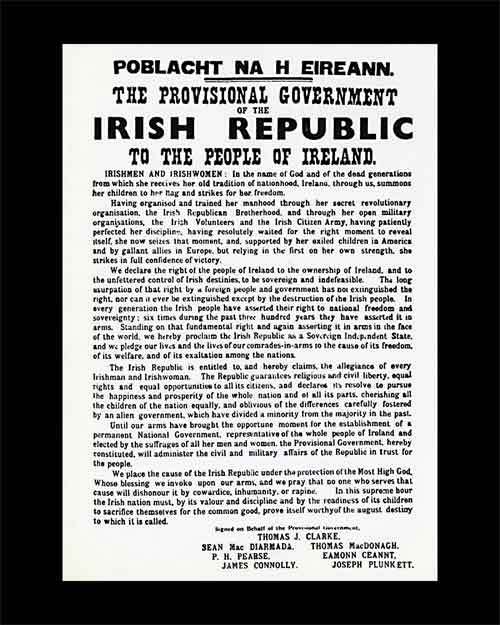
Two myths among many. Patrick Pearse did not read the proclamation of the Irish republic from the steps of the General Post Office. He read it from in front of the building. The GPO, then, and now, doesn’t have any steps. The document he was reading bore the signatures of the members of the Military Council of the Irish Republican Brotherhood and James Connolly representing the Irish Citizen’s Army. But it was not their death warrant. The document Pearse was reading was of no use to a prosecutor even in the drumhead courts-martial that followed the rebellion. The reason was simple – the names were printed. The authorities would have had to produce a signed original for it to be of any practical assistance in convicting the signatories.

Most of the fatalities incurred, as the British sought to take back the city of Dublin, were civilians, more than 250 of them. Forty of those were under the age of sixteen. One of the civilian fatalities was the pacifist Francis Sheehy Skeffington, brutally murdered on the orders of an insane British officer, Captain J.C. Bowen Colthurst from Cork as he went about thr city trying to prevent looting. 64 members of the Volunteers or the Irish Citizens Army lost their lives, as did 116 British soldiers. Most of those were from the Sherwood Foresters, picked off on Mount Street Bridge by a small unit sent from the nearby Bolands Mills by 3rd Battalion Commandant Eamon De Valera. When the Forester’s disembarked in Kingstown – now Dun Laoghaire – they were surprised to hear people speaking English. They assumed they’d just landed in wartime France.

James Connolly may or may not have claimed that capitalists would never destroy property even to end a rebellion – he is unlikely to have been sufficiently naïve to have ever said any such thing – but destroy it they did. Much of the centre of Dublin was laid waste by the shells of the gunboat Helga and British artillery stationed in Phibsborough and Trinity College.

The Volunteers’ Headquarters in the General Post Office was never actually taken by the British forces – it was abandoned by the Volunteers before its total destruction by shelling. Shortly after the evacuation of the GPO the rebel leadership bowed to the inevitable six days after the Rising began. That began a busy day for Nurse Elizabeth O’Farrell who was given the dangerous job of informing the other garrisons, most of which remained untaken, that the Rising was at an end.

Patrick Pearse agreed to an unconditional surrender one hundred years ago on this day.


On This Day – 11.3.1858 The birth of Thomas Clarke

Thomas-Clarke-returns-to-Dublin-1.jpg

When it comes to the issue of the organization of the 1916 insurrection we have to look well beyond the esoteric, if palpably sincere, philosophizing of Pearse and even the military nous and pragmatism of Connolly and look to the quiet man in the midst of the fury.

Thomas Clarke, the self effacing tobacconist, was the spine, the heart and the genius of the Easter Rising. While he was surrounded by capable and resourceful allies it was Clarke who drove the rebellion.

The first oddity associated with the life of Tom Clarke is his place of birth. He was actually born in England, in the Isle of Wight. The second was his association with the British Army. His father was a serving soldier. At the age of 20 Clarke made the decision that was to inform the rest of his life when he joined the Irish Republican Brotherhood in Dungannon, Co.Tyrone. Two years later he was forced to flee to the USA to avoid arrest.

For fifteen years of his life he was someone else. Clarke was sent from America to London in 1883 to lead the bombing campaign masterminded by O’Donovan Rossa. He did so under the alias Henry Wilson and it was under that name that he served fifteen years in British prisons after his arrest and conviction. While in jail he met the old Republican John Daly. After his release Clarke married Daly’s niece Kathleen. The family didn’t approve. She was twenty-one years younger than her husband and marriage to a felon, albeit a jailed Republican, was not exactly what they had in mind for their girl. In addition Clarke, after a tough decade and a half in prison, looked far older than his years.

After spending almost a decade in the USA the Clarkes returned to Ireland in 1907 and Tom opened a humble tobacconist’s shop in Dublin. While outwardly settled and legitimate in fact Clarke continued his work with the Irish Republican Brotherhood, most notably as a member of that organisation’s Military Council. He became a sort of mentor to the likes of Denis McCullough, Bulmer Hobson and, in particular, Sean McDermott. Because of his background as a convicted felon, however, Clarke steered clear of overt political involvement. He left it to others to infiltrate, at the highest level, organisations like the GAA, the Gaelic League and, from 1913, the Irish Volunteers.

In 1916 Clarke essentially became the link to the ‘old’ Fenians who had risen in 1867, although he himself was only a child at that time. Acting on the Republican axiom that ‘England’s difficulty is Ireland’s opportunity’ he was determined to take advantage of the outbreak of the Great War in 1914. He worked assiduously to make plans for a rising around the country with the IRB at its core using the Volunteers as their battering ram. A reluctant Hobson and McCullough were jettisoned along the way, the likes of Pearse, Connolly, Plunkett and McDonagh were recruited.

The seven members of the Military Council – Eamon Ceannt being the one often ignored – became signatories of the 1916 Proclamation. Clarke should probably have become President of the Provisional Government but preferred to leave that honour to the more flamboyant and better known Pearse. Clarke himself was an anonymous figure, familiar only to fellow revolutionaries and ‘G’ Division of the Dublin Metropolitan Police.

Clarke was stationed in the GPO during the Rising and was the second leader, after Pearse, to be executed. His last message to Kathleen ended with the words ‘we die happy’. Familiar photographs of Clarke depict a thin, bespectacled, old man. He was actually only fifty-nine years of age at the time of his death.

Thomas Clarke, conspirator, Republican, tobacconist and victim of a 1916 firing squad, was born one hundred and fifty-eight years ago, on this day.


8x10proclamationweb__31588.1321830785.1280.1280.jpg