On This Day 19.1.1760 Irish giants

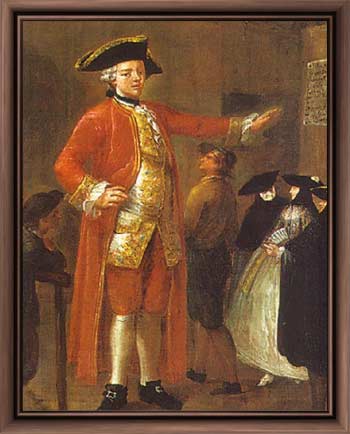
CORNELIUS McGRATH

corneliusmagrath.jpg

They tended not to live for very long, and, although people, quite literally, looked up to them, they were hardly treated with great respect, either in their lifetimes, or after their deaths.

Of the three most famous eighteenth century Irish giants, Charles Byrne and Cornelius McGrath died before they were twenty-four, while Patrick Cotter lived to the grand old age of forty-six.

McGrath, from Tipperary, reached the height of seven feet six inches at time when men of average height would have been two feet shorter. Between the age of fifteen and sixteen he shot up by twenty-one inches, causing him to suffer from chronic growing pains, from which the consumption of cider appears to have offered some relief. By the time he was sixteen he was already being exhibited for profit, mostly that of others. A portrait of McGrath exists in which he stands beside a Prussian grenadier—Prussians being reckoned as the tallest soldiers in Europe at the time—and McGrath towers over him.

His great height did enable the Tipperary giant to see much of Europe. He was, for example, painted by the artist Pietro Longhi in Venice in 1757, when he was twenty years old. But he didn’t have much longer to live, and when he died in 1760 his body was taken by a number of Trinity College Dublin students to the Department of Anatomy, where he was duly dissected. His skeleton is still retained there today, exhibited for anatomy students, despite many efforts to have his remains properly buried.

Born the year that McGrath died, were the celebrated Charles Byrne, and the even taller Patrick Cotter.
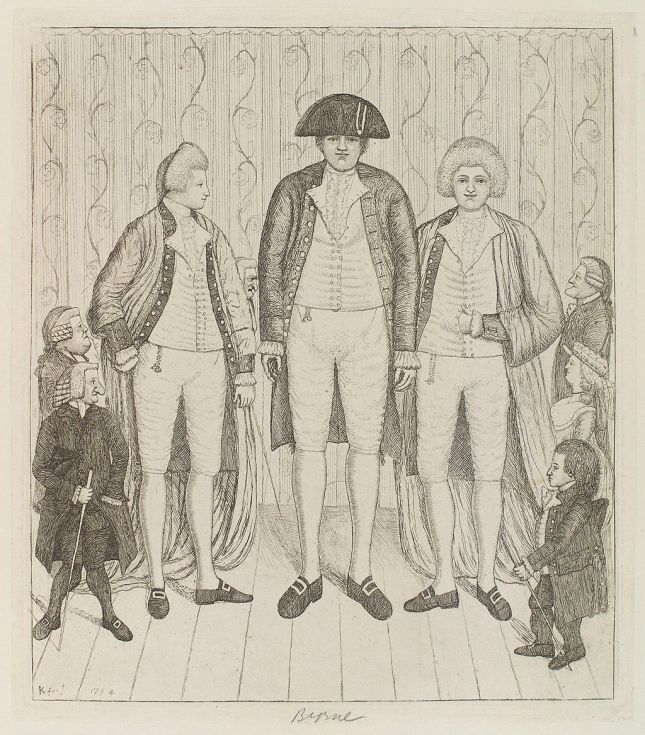
charlesbyrne (2).jpg1024px-Charles_Byrne;_James_Burnett,_Lord_Monboddo;_William_Richardson;_John_Bell;_Baillie_Kyd_by_John_Kay.jpg

CHARLES BYRNE

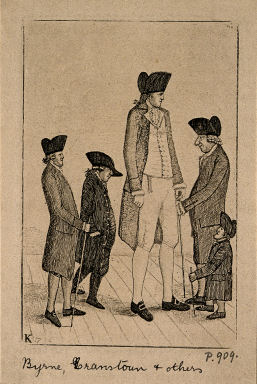
Byrne was born in Co.Derry and stopped growing when he reached seven feet seven inches, the same height as the tallest player in the history of the American National Basketball Association, the Romanian Gheorghe Muresan.  By the age of twenty-one he was already performing in a show in London which was built around him, called, predictably enough, The Giant’s Causeway. Within a year, however, he was dead.

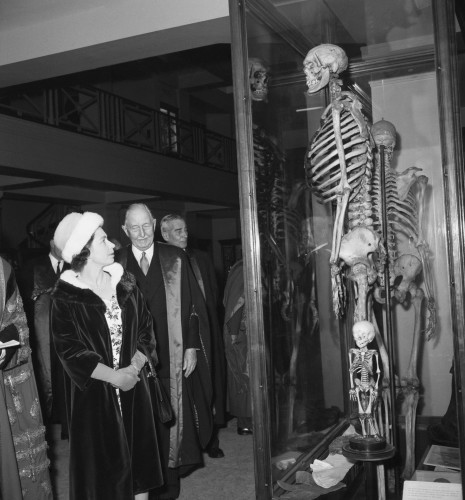
Byrne was aware before he died that the famous anatomist, John Hunter, had designs on his corpse. Hunter had already amassed a collection of notable ‘specimens’—his description—for his private museum. To thwart the acquisitive pathologist Byrne ordered that after his death his body should be deposited in a lead coffin, and buried at sea. When the Irish giant died in June 1783, after having had his life savings stolen from him by an enterprising pickpocket,  Hunter arranged for his body to be hijacked as it was being transported to the coast. It has been on display ever since in the museum named after Hunter in the Royal College of Surgeons in London. Numerous campaigns to have Byrne’s dying wish honoured have been ignored. Byrne might be said to have had the last laugh, however, as he was immortalised by Booker prize-winning novelist Hilary Mantel in The Giant, O’Brien in 1998.
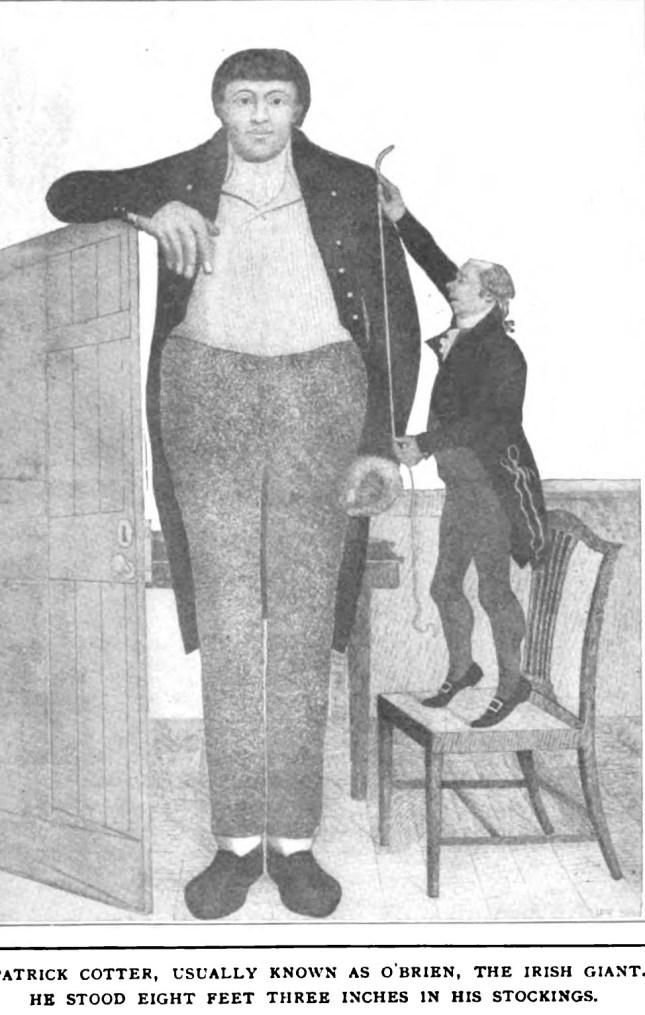
patrickcotterobrien (11).jpg

Patrick Cotter, born the same year as Byrne, 1760, is one of fewer than twenty people whose height has been verified at over eight feet. Based in Bristol, Cotter adopted the stage name O’Brien and was exhibited in the ubiquitous freak shows of the eighteenth century, until his death in 1806. He was more fortunate than McGrath and Byrne in that he lived longer than the other two combined, and, on his death, left a legacy of £2000. He also managed to avoid the post-mortem fate of his contemporaries. He was not anatomised, although he greatly feared that he would be and wanted to entombed in twelve feet of solid rock to thwart graverobbers. However, his body was exhumed three times, in 1906, in 1972—when he was officially measured at eight foot and one inch—and in 1986, after which he was cremated, thus finally and definitively avoiding the undignified fate of McGrath and Byrne.

Patrick Cotter, one of three celebrated but generally unfortunate Irish giants of the eighteenth century, was born two hundred and fifty-eight years ago, on this day
 

original.jpeg

Charles Byrne and someone of much lesser stature
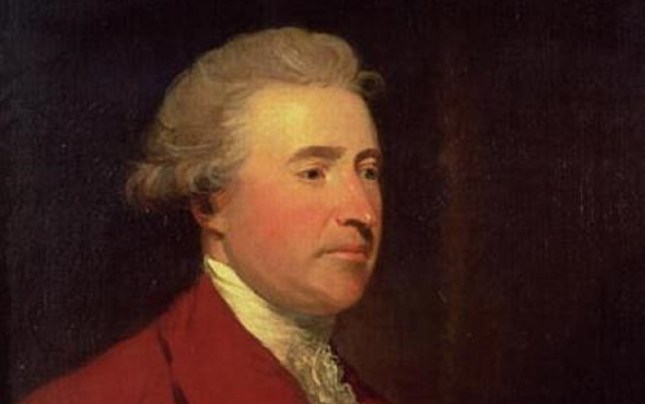
 

On This Day -12.1.1729  Birth of Edmund Burke


edmundburke


He may, or indeed he may not, have uttered the immortal phrase ‘The only thing necessary for the triumph of evil is for good men to do nothing’. He was a supporter of the American Revolution, and a horrified observer and opponent of the subsequent and extraordinarily bloody, French equivalent. He, and his father, were Anglican, although his mother and sister were Roman Catholic. In addition to which he was one of the greatest English statesmen of the eighteenth century. Except, as in many other instances, Edmund Burke was not English, but Irish.

He was born in Dublin in 1729, was educated at a Quaker school, and at Trinity College. In 1765 he was elected to the House of Commons for the constituency of Wendover, an infamous ‘pocket borough’ of barely one hundred voters, so-called because its representation—and it returned two MPs, not one—was in the pocket of Lord Fermanagh. By 1774, however, he had transferred to the constituency of Bristol where he actually had to fight genuine elections. But his advocacy of free trade with Ireland, and Catholic Emancipation, was not to the liking of the voters in the city at the centre of the British slave trade, and from 1780 onwards he was back in a pocket again, in the borough of Malton.

Burke quickly identified himself with the struggle of the American colonists, and the curtailment of the powers of the King at home. He also became part of a social circle that included the great lexicographer Samuel Johnson, the impecunious Irish playwright Oliver Goldsmith, the actor-manager David Garrick, and the artist Joshua Reynolds.

Initially he kept his powder dry when it came to the French Revolution, but as the rule of the guillotine took hold he wrote of revolutionary France that ‘the elements which compose human society seem all to be dissolved, and a world of monsters [is] produced in the place of it’. In his famous Reflections on the Revolution in France, published in November 1790, Burke had a go, not only at the event itself but at its radical British supporters. He also made a few pounds in the process, as the pamphlet went on sale for five shillings, and sold almost twenty thousand copies.

Many have said that Burke’s finest hour was his very personal campaign to impeach the chief factotum of the infamous East India Company, Warren Hastings. Except that it was a bit more than an hour. Burke’s opening speech in the trial of Hastings took four days. His response to the defence case took a further nine days.  Hastings was accused of corruption as Governor General of India, and of having enriched himself during his tenure there. One previous high profile impeachment had been that of the great servant of King Charles 1 in Ireland, Thomas Wentworth, Earl of Stafford. Despite the fact that it failed to impeach, Parliament found a way to execute Stafford anyway. Not that anyone was suggesting that Hastings should face the chop.

The entire procedure, which was in part a political trial designed by the Whigs to embarrass the ruling Tories, began in 1788 and didn’t end until 1795. The whole thing cost Hastings £70,000—which, according to a Bank of England inflation calculator, would be worth £8.5 million today. It all sounds very Tribunal-ish, doesn’t it.

Burke is seen by many historians as the father of English conservatism, but his opposition to British imperialism in Ireland, and India, often meant that he fell foul of the leading Tories of his day. He had lots of enemies, many of whom exploited his Irishness, and the suspicion that he was really a Roman Catholic all along, against him. One contemporary cartoon has Burke peeling a potato while sitting beside a chamber-pot claimed to be a true relic of St. Peter.

Burke, by the way, is also credited with being the first to observe that ‘those who don’t know history are doomed to repeat it.’ And, indeed, a lot of people have done both, ignored history and repeated Burke’s famous axiom.

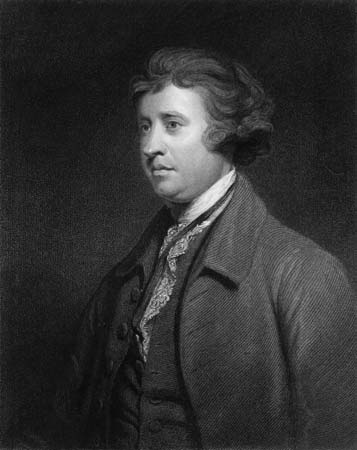
Edmund Burke, statesman, writer, orator and philosopher was born two hundred and eighty-nine years ago, on this day


102057-004-2A652FCD.jpg


On This Day – 29 December 1844 The birth of William Martin Murphy


William-Martin-Murphy-5

They were sometimes, for geographical reasons, known as the ‘Bantry band’. But their, often belligerent, Roman Catholic pietism also earned them the nickname ‘The Pope’s Brass Band’. Their leader may have been Timothy Healy, MP, but William Martin Murphy, entrepreneur, builder, railway-man, Member of Parliament, publisher, strikebreaker, and zealot, was one of the most influential forces within this group of Irish nationalist politicians who came from this beautiful part of west Cork.

Although Murphy inherited some wealth, and a viable building business, from his father, he quickly struck out on his own, and transformed a small fortune into a much larger one.  He turned up in some unexpected places early in his career. While he was known for having made large sums of money building railway lines in Africa, he was also on hand in Milltown Malbay, in January 1885, when Charles Stewart Parnell turned the first sod on the project that became the Ennis and West Clare Railway. Three years after breaking the resolve of the workers of the city of Dublin, he became president of the recently established Rathmines and Rathgar Musical Society. He was succeeded in this office by, in turn, his son and daughter.

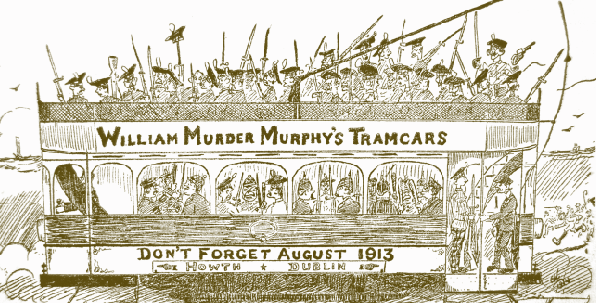
His ownership of the Dublin United Tramways Company, and his leadership of the Dublin employers in their successful fight against James Larkin and the Irish Transport and General Workers’ Union, renders Murphy infamous, or celebrated, to this day. By locking out workers who refused to sign a pledge not to join Larkin’s union Murphy, in effect, starved them—and their families—into submission.

But of almost comparable significance was his involvement in the newspaper business. This began long before his ownership of the Irish Independent newspaper. In 1891, in the midst of the major political rift caused by the O’Shea divorce, Dublin members of the Parnellite faction took over the offices of the Irish Parliamentary Party newspaper, United Ireland. They ejected of its acting editor, Matthias McDonnell Bodkin, from the premises, offering him the alternative of walking out unscathed, or to take his chances being tossed out the window. The anti-Parnellite faction, which included Murphy, needed a propaganda outlet to match United Ireland. Murphy’s money funded the short-lived National Press, although his name does not appear on the list of those who subscribed to the shareholding that established it.

The National Press was little more than a vehicle for the anti-Parnellite rhetoric and vitriol of Parnell’s greatest antagonist within his own party, Timothy Healy MP.  The newspaper was responsible for a series of controversial editorials. The first of these was entitled ‘Stop Thief’. In this Parnell was accused of the embezzlement of National League funds. The party leader, it was claimed, had, for a number of years, ‘been stealing the money entrusted to his charge’. [their italics] Parnell’s unwillingness to sue the newspaper for libel was exploited in further editorials as the week went on. Emboldened by the non-appearance of a writ, on 2 June the Press reminded its readers that:

“Thief” is an unmistakable word. We called Mr.Parnell a thief. We now repeat the epithet.’.

By the time of his death in October 1891 Parnell had still not sued.  While incarcerated in Galway jail the anti-Parnellite leader John Dillon wrote that:

Loathing is the only word that can express my feeling every time I open the National Press. If that spirit is to triumph, national politics will be turned into a privy.

Later Murphy guaranteed his dominance of the Irish newspaper market when he acquired the Irish Daily Independent in 1905. He would have enjoyed the further acquisition of the old Freeman’s Journal newspaper by his company in 1924, but by then he was dead. As he had passed away five years before, he was not around to enjoy the demise of the 160-year-old Irish Parliamentary Party newspaper.

One of Murphy’s few reversals was his convincing defeat in the 1892 general election for a Dublin constituency by the pro-Parnellite candidate William Field. Murphy lost by a 4:1 margin. Field, as luck would have it, though he ran one of the largest butcher’s businesses in the city, had a background in the labour movement. Though he often expressed his opposition to socialism Field can, arguably, be cited as the only representative of labour to have given William Martin Murphy a political hiding.

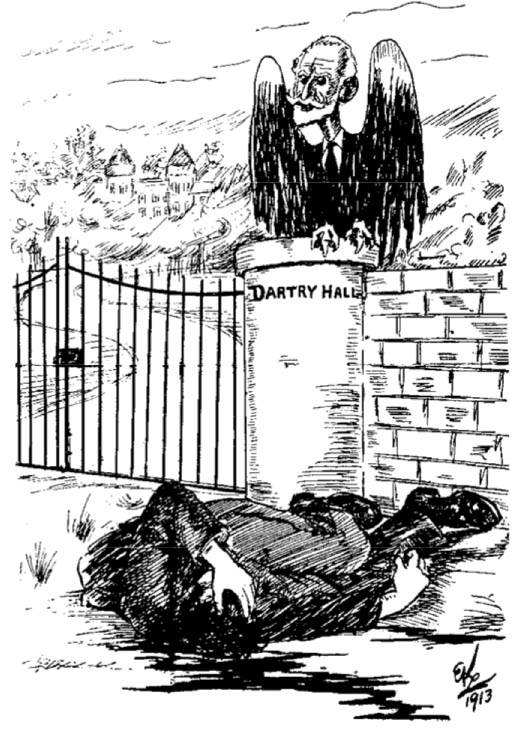
William Martin Murphy, dubbed William Murder Murphy by Dublin trade unionists in 1913, was born one hundred and seventy-three years ago, on this day.

[The two cartoons are by Ernest Kavanagh ‘EK’ – regular cartoonist of the Irish Worker]

d0454b4013fd44830ee203be673fe1a9.jpg


On This Day – Bishop Joseph Stock’s diary of the 1798 Rebellion


joseph-stock

The United Irishmen’s rebellion of 1798 was over—except that it wasn’t. Not quite. There would be a sting in the tail for the British authorities, who had already savagely put down the main uprisings in Antrim and Wexford, and minor eruptions elsewhere. They had been royally assisted by spies and informers, like Francis Magan and Francis Higgins, in anticipating the rebellion in Dublin. Their luck had held out in the winter of 1796 when a French fleet had been unable to land, due to adverse weather conditions at Bantry Bay.

But there was a fairer wind off the coast of Mayo on 22 August 1798 when, two months after the United Irishmen had otherwise been defeated, shot, piked, hanged, drawn and quartered, the French arrived in the form of a force of around 1000 men, led by General Jean Joseph Humbert. A little bit trop tard but better than jamais. The great Irish-American writer Thomas Flanagan called it The Year of the French in his epic novel. In reality it was much closer to ‘The Fortnight of the French’, a designation that lacks a bit of punch and drama. The intervention, initially successful, was all over by 8 September.

The French invasion force—dispatched on the basis of that age-old axiom that ‘the enemy of my enemy is my friend’—begat the short-lived Republic of Connacht, under the Presidency of the Mayo landowner John Moore. But it also spawned a fascinating captivity memoir, written by the incumbent Church of Ireland Bishop of Killala, Joseph Stock.

Stock, a fluent French speaker, was born in Dublin in 1740. The son of a wealthy merchant he was educated at Trinity College. He became a clergyman, and was briefly headmaster of Portora Royal School in Enniskillen, before becoming a bishop in January 1798. In 1776 he had published a biography of the great Irish cleric and philosopher, Bishop George Berkeley, a few years after his death.

Stock had the misfortune to be in the wrong place at the wrong time, when the French force arrived. He was captured, along with the British defenders of Killala. That evening he met Humbert. The encounter was extremely revealing. It was clear that Humbert had been led to believe that there would be considerable Irish aristocratic support for the invasion. He actually asked an establishment figure like the Church of Ireland Bishop of Killala if, as Stock puts it, ‘he chose to embrace the fortunate opportunity at once of serving himself and liberating his country.’ Stock politely declined the offer and chose to become a prisoner.

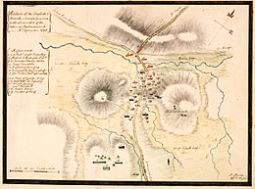
The French experienced initial success, notably in overpowering a British force at Castlebar in a skirmish that became known as ‘The Races of Castlebar’, because of the rapidity of the British retreat. This victory prompted uprisings in Longford and Westmeath. These were quickly put down by British troops and loyal Irish militia units. But, no poetry intended, it all came unstuck at Ballinamuck. There Humbert’s force, augmented by Irish rebels, was soundly defeated. The captured French were later exchanged for British prisoners of war, but many of the Irish were immediately executed. Stock demonstrated his personal loyalties by referring in his narrative to 8 September 1798 as ‘a day memorable for the victory at Ballinamuck.’

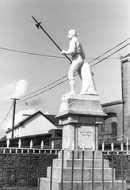
Humbert was later repatriated in a prisoner exchange, rejoined Napoleon’s army, and even fought against the British, alongside Andrew Jackson, in the American war of 1812. A street in Ballina is called after him, on it stands a monument erected in his honour.

Stock’s narrative of the rebellion was remarkably nuanced and even-handed for someone who was a Bishop of the Established Church, and who had been a prisoner of the rebels. He emphasised that there was little retribution of any kind on the part of the Irish rebels allied to the French force. The only killings took place in pitched battles. There was some looting and arson, but Stock points out that the depredations of the British forces were far greater than those of the United Irishmen. Stock chose to publish the memoir anonymously in 1800, which was, in retrospect, a wise move. All references to himself, or ‘Monsieur l’Eveque’, as Humbert called him, are in the third person. But he was quickly identified as its author, and subsequent imprints bore his name. His relative fairness probably did him no favours when it came to his subsequent clerical career.

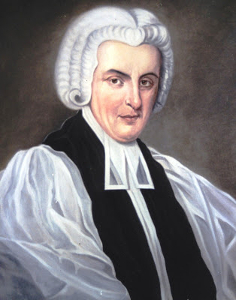
Bishop Joseph Stock, author of a fascinating memoir of one of the most colourful episodes of the 1798 rebellion, was born two hundred and seventy-seven years ago, on this day.


260px-Battle_of_Ballinamuck,_1798_(9675655157).jpgBallinamuckmemorial.jpg


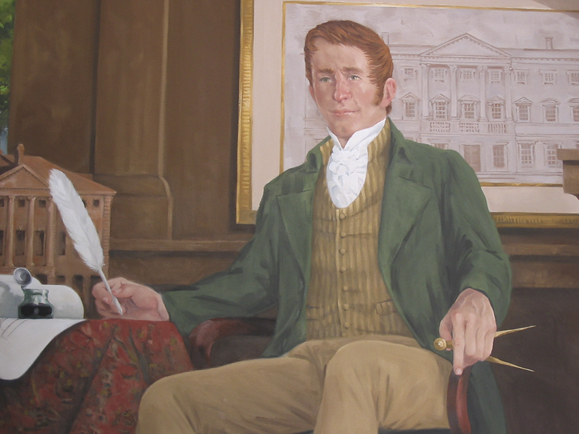
On This Day – 8 December 1831  Death of James Hoban, the architect of the White House

UnknownUnknown-1


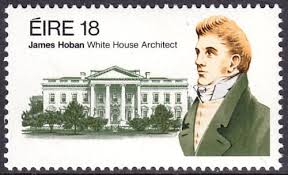
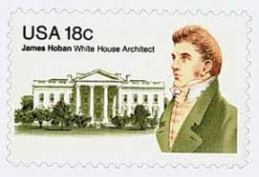
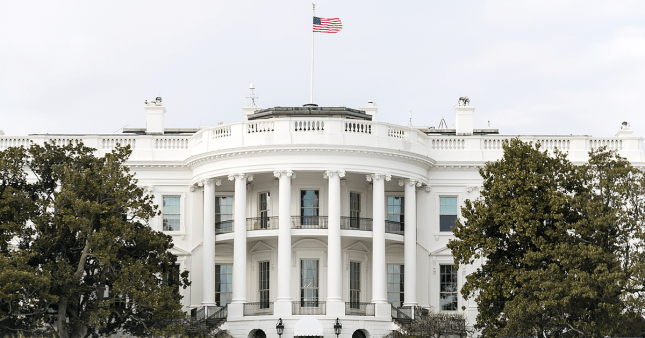
It’s one of the most celebrated addresses in the world—1600 Pennsylvania Avenue, North West, Washington D.C.—a large neo-classical building, bigger now than in its original incarnation, and it was designed by an Irish architect. The White House and James Hoban, are inextricably linked.

Hoban was born in 1755, in Callan, Co. Kilkenny—his actual date of birth was only definitively established last year with the release of millions of Irish Catholic baptismal records online. He worked as a wheelwright and a carpenter until he was in his twenties. When he showed promise as a scholar he was offered a place to study drawing and architecture in the Dublin Society’s Drawing School on Grafton Street. He worked on James Gandon’s Custom House project as an artisan, before emigrating to the USA in 1785. There he quickly established himself as an architect in Philadelphia, and later in South Carolina.

In 1791 the first US President, George Washington, then based in Philadelphia, had been impressed by the Charleston, South Carolina, County Courthouse, designed by Hoban, when he saw it while on a southern tour. He asked to meet the architect. The following year he chose Hoban’s design for the new Presidential mansion from among nine proposals, one of which had been submitted anonymously by Thomas Jefferson, his own Secretary of State.

JamesHoban-Architect-of-the-White-House.jpg

Hoban’s original competition entry, for which he won $500, and which does not survive, did not entirely meet with the approval of the man after whom the new Federal capital would be named. Washington asked Hoban to remove the third floor he had envisaged, and to widen the building from nine to eleven bays. Hoban, in putting together his final drawings, was influenced by the design of the town house of the Dukes of Leinster on Kildare Street in Dublin. Today we know this humble mansion as Leinster House. So, the annual delivery of a bowl of shamrock is not the only Irish influence on the White House.

Construction began in October 1792, with much of the manual labour being performed by slaves, at least three of whom belonged to the architect himself. Hoban was employed to supervise the construction, and used mostly immigrant Scottish craftsmen to build the sandstone walls. A layer of whitewash finished the job, giving the house its distinctive, though far from unique, colour. It took eight years to build, at a cost of $230,000 (around $3.5m today) and was ready for occupation, though still incomplete, in November 1800. This meant that John Adams, rather than its putative architect, Thomas Jefferson, became the first US President to work in the building. Washington, although he played a major role in its development, never lived there. Adams managed only four months in possession, and thought the mansion was too big. It wasn’t until the presidency of Theodore Roosevelt that the building became officially known as The White House.

The original construction, other than the façade, didn’t last long. The Americans fell out with their colonial masters in 1812, and went back to war. In 1814, the British set fire to the White House during their occupation of Washington D.C. It was rebuilt, again under Hoban’s supervision, and re-occupied, by President James Monroe in 1817, though the reconstruction wasn’t finally completed until two years before the architect’s death.  Hoban wasn’t responsible for the West Wing, or the iconic Oval office, which were much later additions.

His reputation being well-established in Washington Hoban saw no reason to leave the city, and he set up a lucrative practice there. He wasn’t at all hindered by his establishment of the first masonic lodge in Washington, with one J. Hoban as master. He went on to supervise the construction of the Capitol Building, and design the Great Hotel. Despite his stature, more than half a dozen of his signature buildings have been demolished, most in the eighteenth or nineteenth centuries. But despite the British in 1814, and Al Qaeda’s plans for United 93 back in 2001, the White House is still intact.

James Hoban, Kilkenny-born architect, and designer of the one of the world’s most iconic buildings, died, one hundred and eighty-six years ago, on this day.

og-image.png