On this day – 18 March 1847 Choctaw donation to Irish Famine victims


Choctaw-Honored-Irish.jpg

Although there was a respite from potato blight in 1847 the year is still remembered in Irish famine history as ‘Black ‘47’. So few potatoes had been planted that the absence of blight made little difference to a starving, diseased and demoralized people. Thousands more died or hunger and disease or chose the emigrant ship as the only possibility of escape. However, the plight of eight million Irish people was not being ignored, except, arguably, by the Liberal government of Lord John Russell in London. Money poured in from Britain, the continent of Europe, the USA and as far away as Australia.


In March of 1847 an unexpected donation arrived from the USA. While America had been the source of much of the famine relief funds that found their way to Ireland this particular charitable gift was different. It didn’t come from Irish-American migrants on the east coast of the USA. It didn’t even come from smaller pockets of Irish migrants in the MidWest or the West. It came from the state of Oklahoma, not a region generally favoured for settlement by the Irish diaspora.


The donation amounted to $170 and it was collected by members of the Choctaw Native American nation. Some sources give the sum involved as $710, but the amount actually donated is immaterial. Either way it was a huge sum of money for a nation of impoverished Native Americans consigned more than a decade before, to life on the comfortably sounding but demonically devised, reservation. The Choctaw probably empathized with the starving Irish because their own history had much of the tragic about it.


In the war of 1812, fought against the British, the Choctaws had aided the forces led by General Andrew Jackson in the struggle against the former colonial masters. Abject defeat could well have led to the end of the great American Democratic experiment – not that democracy proved to be of much use to the Choctaw. Their reward, in 1831, had been expulsion from their homes in the south-eastern USA during the self-same Andrew Jackson’s presidency, and banishment to the bad lands of Oklahoma. This forced transportation, known as the Trail of Tears had caused the deaths of almost half of the 20,000 or so Choctaw obliged to decamp to the mid-west. Their fate was later shared by the Cherokee, Chickasaw, Creek and Seminole nations, all forced into exile, starvation and cultural suppression. The white man wanted their land, and what the white man wanted he got. The punitive Treaty of Dancing Rabbit Creek signed in 1830, attended to the detail of the wholesale dispossession of the Choctaw. Similar barbed treaties achieved the same result with the other four so called ‘Civilised Tribes’.


1831 was one of the coldest winters on record and the Federal government was not about to waste valuable taxpayers money on providing adequate food, clothing and transportation to mere Indians to protect them from the elements during such an arduous trip westwards into the even colder interior.


So it’s not hard to see why the Choctaw, having heard of the Great Famine, empathised with the Irish people. What must have been more difficult was raising such a significant sum. Only in recent years has their generosity been recognized in Ireland but today, former president Mary Robinson is an honorary chieftain of the Choctaw nation and a plaque commemorating their charity has been erected outside Dublin’s Mansion House. Other monuments around the country recognize their immensely charitable gesture.


The Choctaw, originally from the modern state of Mississippi, more than earned their designation as one of the Five ‘Civilised’ tribes, when they set about collecting a charitable donation worth at least $100,000 in today’s money, to the relief of famine in Ireland, one hundred and sixty-nine years ago, on this day.
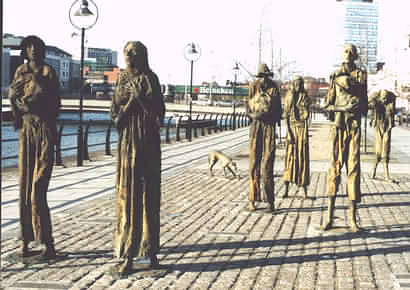
 

famine_emigrantsdublin.jpg2013aug09_famine_IMG_4684.jpg

On This Day – 11.3.1858 The birth of Thomas Clarke

Thomas-Clarke-returns-to-Dublin-1.jpg

When it comes to the issue of the organization of the 1916 insurrection we have to look well beyond the esoteric, if palpably sincere, philosophizing of Pearse and even the military nous and pragmatism of Connolly and look to the quiet man in the midst of the fury.

Thomas Clarke, the self effacing tobacconist, was the spine, the heart and the genius of the Easter Rising. While he was surrounded by capable and resourceful allies it was Clarke who drove the rebellion.

The first oddity associated with the life of Tom Clarke is his place of birth. He was actually born in England, in the Isle of Wight. The second was his association with the British Army. His father was a serving soldier. At the age of 20 Clarke made the decision that was to inform the rest of his life when he joined the Irish Republican Brotherhood in Dungannon, Co.Tyrone. Two years later he was forced to flee to the USA to avoid arrest.

For fifteen years of his life he was someone else. Clarke was sent from America to London in 1883 to lead the bombing campaign masterminded by O’Donovan Rossa. He did so under the alias Henry Wilson and it was under that name that he served fifteen years in British prisons after his arrest and conviction. While in jail he met the old Republican John Daly. After his release Clarke married Daly’s niece Kathleen. The family didn’t approve. She was twenty-one years younger than her husband and marriage to a felon, albeit a jailed Republican, was not exactly what they had in mind for their girl. In addition Clarke, after a tough decade and a half in prison, looked far older than his years.

After spending almost a decade in the USA the Clarkes returned to Ireland in 1907 and Tom opened a humble tobacconist’s shop in Dublin. While outwardly settled and legitimate in fact Clarke continued his work with the Irish Republican Brotherhood, most notably as a member of that organisation’s Military Council. He became a sort of mentor to the likes of Denis McCullough, Bulmer Hobson and, in particular, Sean McDermott. Because of his background as a convicted felon, however, Clarke steered clear of overt political involvement. He left it to others to infiltrate, at the highest level, organisations like the GAA, the Gaelic League and, from 1913, the Irish Volunteers.

In 1916 Clarke essentially became the link to the ‘old’ Fenians who had risen in 1867, although he himself was only a child at that time. Acting on the Republican axiom that ‘England’s difficulty is Ireland’s opportunity’ he was determined to take advantage of the outbreak of the Great War in 1914. He worked assiduously to make plans for a rising around the country with the IRB at its core using the Volunteers as their battering ram. A reluctant Hobson and McCullough were jettisoned along the way, the likes of Pearse, Connolly, Plunkett and McDonagh were recruited.

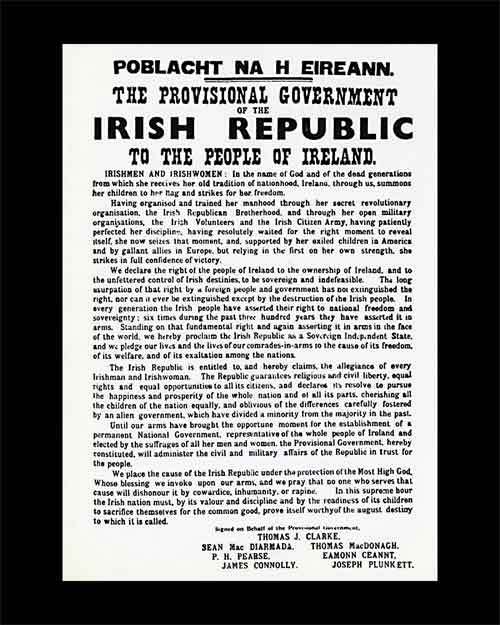
The seven members of the Military Council – Eamon Ceannt being the one often ignored – became signatories of the 1916 Proclamation. Clarke should probably have become President of the Provisional Government but preferred to leave that honour to the more flamboyant and better known Pearse. Clarke himself was an anonymous figure, familiar only to fellow revolutionaries and ‘G’ Division of the Dublin Metropolitan Police.

Clarke was stationed in the GPO during the Rising and was the second leader, after Pearse, to be executed. His last message to Kathleen ended with the words ‘we die happy’. Familiar photographs of Clarke depict a thin, bespectacled, old man. He was actually only fifty-nine years of age at the time of his death.

Thomas Clarke, conspirator, Republican, tobacconist and victim of a 1916 firing squad, was born one hundred and fifty-eight years ago, on this day.


8x10proclamationweb__31588.1321830785.1280.1280.jpg


On This Day – 4 March 1978 Death of Emmet Dalton


image.jpg

James Emmet Dalton, known to his friends as Emmet, might have ended up being better known for the distinguished company he kept rather than for anything he did himself, but he managed to avoid that unfortunate fate. Nonetheless the story of his life is dominated by two events in which he witnessed the deaths of two of this country’s most significant 20th century figures.


Dalton was born in America in 1898 to an Irish-American father and an Irish mother but the family moved back to Dublin when the young Emmet was just two years old.


His remarkable military career began in 1913 when he joined the Irish Volunteers. Note the date. He was fifteen years old at the time. He was still underage when he joined the British Army in 1915 as a second lieutenant in the Royal Dublin Fusiliers. He saw action at the Somme in September 1916 and it was here that he crossed paths with the first of those two great Irishmen, the poet, economist and politician Thomas Kettle. Kettle, a fellow officer, was a good friend of Dalton’s father. In an RTE radio interview given in the 1960s Dalton recalled how Kettle had read to him his most famous poem, the poignant sonnet ‘To My Daughter Betty a Gift From God’ a couple of days before the Battle of Ginchy. Kettle’s death in the battle was witnessed by Dalton, who himself won a Military Cross and was promoted to Major.


In an RTE television interview with Cathal O’Shannon, which took place in the year of his death, Dalton admitted to having been taken completely by surprise by the 1916 Rising and to have believed, as he put it himself, that ‘we thought it was madness’. He was, however, to become closely associated with one of the minor figures being swept up by the British Army in Dublin and transported to Frongoch camp in North Wales, a previously obscure London based IRB man by the name of Michael Collins.


Despite his opposition to the Rising when Dalton was demobilised in 1919 he quickly threw in his lot with the IRA. Putting his war experience to good use he became director of training. He also earned his corn by talking his way into Mountjoy Prison in an outrageous but ultimately failed attempt to spring the IRA leader Sean MacEoin.


His association with Collins brought him to London for the Anglo-Irish Treaty negotiations in late 1921 and, unsurprisingly given his huge admiration for Collins he took the pro-Treaty side in the Civil War. It was Dalton who commanded the artillery bombardment of Rory O’Connor’s rebel garrison in the Four Courts, the event that, in effect, precipitated the bitter fraternal conflict.


It was against Dalton’s advice that Collins made his final fateful journey to Cork in 1922. The killing of his mentor at Bealnablath on 22 August traumatised the young man, who, despite his seniority in military terms – he was a Major General – was still only twenty-four years old.


What do you do when you have been through eight years at the sharp end of continual warfare. In the case of Dalton you get into the film industry and eventually you set up Ardmore studios. This he did at the age of sixty, a time when most men would be thinking of slowing down. In this capacity he brought films like The Blue Max, The Spy Who Came in from the Cold and The Lion in Winter to the Co.Wicklow studio facility.


An interesting footnote, the Slievenamon, the ill-fated armoured car against which a desperate Dalton propped Collins as he tried to save his life at Bealnablath, later featured in an Ardmore based Hollywood movie, Shake Hands with the Devil, which starred James Cagney.


71551_player_podcast_series_1418051887_71550_656x500.jpg


Emmet Dalton died on his eightieth birthday – he was born one hundred and eighteen years ago on this day


On This Day – 26 February 1797 Bank of Ireland suspends gold payments


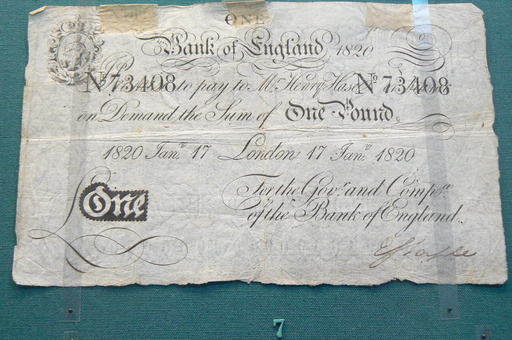
P1010536.jpg

There used to be an expression ‘it’s money in the bank’ but in the wake of the fiscal, financial and credit crises of 2008 we don’t use redundant and inaccurate phraseology like that anymore. That axiom that has gone the way of ‘it’s as safe as houses’ or ‘I’m a markets trader, trust me’. Today we think more in terms of

‘It’s money under the mattress’ or ‘It’s as safe … as this large amount of cash I’m carrying around in my pocket because the interest rate is higher on my backside than with an investment account’ .


Where did it all go wrong? Well maybe it started, in this country at least, in 1797, when the Bank of Ireland took an unprecedented step. In those days cash was King, and cash was gold, or silver. No gold, no goods, unless you were a member of the 10,000 or so landed aristocratic families who were allowedto run up debts. But you still had to settle those with gold at some point … didn’t you?


Anyway. It’s the end of the 18th century and, as usual, Britain is at war. Which is really to say that England is at war and everybody else is expected to chip in and help pay for it. In this case the opposition was provided, pretty much as usual – or comme d’habitude – by France. Where would England have been without France? Clearly, at war with somebody else.


What the British government required above all to conduct its war with Napoleon, was gold. There wasn’t enough to go around. There certainly wasn’t enough in the vaults of the Bank of England to be sending any of it over to the Irish. So, in 1797, the Bank of Ireland was obliged to stop issuing gold it didn’t have and rely on banknotes – already well established at that time – to keep money in circulation.


A few weeks later the stance taken by the Bank was approved of by Irish legislators in the Irish Parliament. Anyone starting to get a feeling of déjà vu here?


One of the noticeable patterns prior to the withdrawal of gold and the increased issuing of notes in its stead was the establishment in Ireland of a number of private banks who were allowed to issue their own notes. In 1799 there were eleven. In 1803, the year Robert Emmet was hanged, drawn and quartered for the sake of the economy, this number had increased to forty-one. That’s not forty-one branches mind you, that’s forty-one banks! Many of these subsequently went bust and destroyed the lives of their customers. In those days the partners who ran those financial institutions were identified on the banknotes they issued. This meant their clients could see the names, but unfortunately not the addresses, of the men who had screwed them when they went into liquidation.


Perhaps we should thank the Bank of Ireland for the fact that we are no longer weighed down with gold whenever we go to the supermarket or the pub. Their action in withdrawing the precious metal from circulation was certainly to the benefit of men’s clothing. Pockets are no longer subjected to excessive strain. Jackets are not weighed down by heavy metal, except in the case of men who wander around carrying Motorhead CDs. But, as we don’t have much to thank our banks about these days, let’s not bother.


The Bank of Ireland relieved itself of the necessity to issue payment in gold two hundred and nineteen years ago, on this day.


godley_bank_chertsey_surrey__1834.jpg


On This Day – 19 February, 1921 Percy Crozier quits the Auxies in disgust

Captain-Frank-Percy-Crozier.jpg

He’s the author of one of the most tastelessly titled autobiographies ever published The Men I Killed. He was a career soldier, a martinet, bounced a few big cheques in his day and then, in one of the great ‘Road to Damascus’ stories of the early twentieth century ended his life as a convinced pacifist. Frank Percy Crozier was nothing if not a mass of contradictions.


But probably his main contribution to Irish history came in 1921 when he confirmed what everybody in this country had known for at least twelve months, namely that the fine body of men he commanded, the RIC Auxiliary Division, was a haven for some of the lowest scum to have represented the interests of the King in Ireland. In essence he substantiated the axiom that the only creature lower than an ‘Auxie’ was a ‘Black and Tan’ by resigning from the force in disgust and returning to tend to his garden, write some books and give a few lectures.


So just who was this delicate flower whose stomach was turned by the extra-curricular activities of his own men? Well, it has to be said that, in the past he had not displayed a notable sensitivity or delicacy of feeling.


Crozier, born in Bermuda of British stock on New Year’s Day 1879, had served through the concentration camps of the Boer War before taking charge of one of the battalions of the 36th Ulster Division in the Great War. He became commanding officer of the 9th Royal Irish Rifles, covenanting loyalists from Protestant West Belfast. While Colonel of the battalion he took a particular interest in excessive drinking in the ranks – he was a reformed alcoholic – and the sexual antics of his charges. In the latter instance his concern was not merely puritanical, a soldier with venereal disease was a soldier out of the trenches and not doing his job, the job of dying horribly for King and Country.


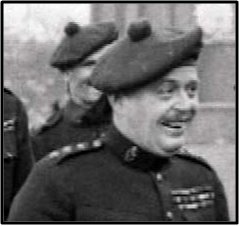
A small pudgy figure with a thin wispy moustache he was, in many respects, the epitome of the cartoon-British officer class. Crozier had the honour, if that is the word I’m after, of leading his men – he called them ‘my Shankhill boys’ – into battle on the infamous 1 July 1916 at the village of Thiepval on the first day of the greatest cock-up in British military history, the Battle of the Somme. Of course he shouldn’t have been in No Man’s Land at all, commanding officers were given strict instructions not to go ‘over the top’. Crozier was one of two Colonels in the 36th to ignore the order. In the heat of battle he recorded that he was obliged, on more than one occasion, to threaten the lives of sensible combatants whose response to the murderous German fusillade, was to turn tail and run back to their own trenches. Crozier, waving a revolver in the air, turned these potential deserters around and sent them back to almost certain death or injury.


Crozier survived the opening day of the Somme campaign and was recommended for a Victoria Cross. The men who had sought the safety of the trenches during the battle didn’t have a vote. He was told, through channels, that it was touch and go whether he would get a VC or a court martial for insubordination. A compromise was reached and he got neither! A highly successful recruiting officer for the 36th he once promised the family of one young soldier, with whom he happened to share a surname, that he would look after their son James. He discharged this obligation by subsequently officiating at the execution of young James Crozier for cowardice.


After the war, where he rose to the rank of Brigadier General, he assumed control of the force of British ex-servicemen sent in 1920, to stiffen the opposition of the Royal Irish Constabulary to the IRA. The RIC Auxiliary rapidly became just as unpopular as the better-known, but no better loved, RIC Special Reserve, or the infamous ‘Black and Tans’. He quickly became disillusioned with the levels of indiscipline and the predilection for drunken retaliation among the members of his force. In February 1921 he dismissed 21 Temporary Cadets, as they were officially known, for their depredations during raids on Trim and Drumcondra. When he was overruled by his own commanding officer, Chief of Police Henry Hugh Tudor, he submitted his resignation. Not the first time a Percy was slapped around by a Tudor.


This principled gesture cost him dearly. England expected … and Percy had not lived up to expectations. He was forced to resort to writing and lecturing to earn a living. He also became a convinced pacifist and supporter of the anti-war Peace Pledge Union established in Britain in 1934. Crozier died in 1937 at the age of 58.


Francis Percy Crozier, commanding officer of the RIC Auxiliary Division, resigned from his post in disgust at the behaviour of his own men, ninety-five years ago, on this day.


morris-london.jpg