OTD – 5  August 1901 Peter O’Connor sets the first World Long Jump record


Unknown-1.jpegPeterOConnor_1.jpg

Long jump records often stick around for quite a while. On May 25 1935 Jesse Owens jumped over twenty-six feet eight inches (8.13 metres) in Ann Arbor, Michigan creating a new world record. It stood for twenty-five years. For good measure within an inspired spell of forty-five minutes Owens also broke two other world records and equalled a fourth.  At the Mexico Olympics in 1968 Bob Beamon leaped a phenomenal twenty-nine feet two and a half inches to break the previous record by almost two feet. When he was told what he had done he collapsed in a heap and had to be helped to his feet by fellow competitors. That record stood for almost twenty-three years before being broken by Mike Powell.


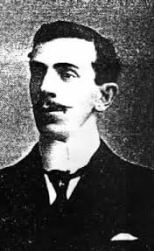
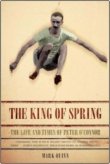
So a record that lasted a mere two decades isn’t a lot to get excited about. Unless you’re Irish. And even if you are you’ve probably never heard of Peter O’Connor. But he won two Olympic medals in 1906, one of them gold. As far as O’Connor was concerned he won them for Ireland but they are down in the record books as United Kingdom medals.


O’Connor was from Ashford in Wicklow, though he was born in England to an Irish family. A talented athlete he joined the GAA as a twenty-four year old in 1896 and three years later won All Ireland medals in the long jump, high jump and triple jump – then called the ‘hop, step and jump’. In those days the GAA did not just cater forwhat we now call Gaelic Games. Over the next decade O’Connor beat all comers, including the best Britain had to offer. In 1900 he was invited to join the UK Olympic team. He declined to invitation as his wish was to represent Ireland internationally.


His opportunity finally appeared to come in 1906. In that year the International Olympic Committee organized what were formally called the Intercalated Games in Athens. This was because the 1900 and 1904 Olympics in Paris and St. Louis had both been overshadowed by the parallel international expositions or World Fairs. The first games in 1896 in Athens had been the only truly successful ones up to that point. The idea was that the Olympics would return to their spiritual home in Greece every two years and would then be staged at some other international venue two years later. It never quite worked out and the experiment was only tried in 1906.


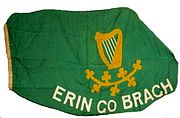
But it looked as if the Intercalated Games would accept the inclusion of an Irish team. So the rival GAA and Irish Amateur Athletic Association jointly nominated O’Connor, along with two other athletes, Con Leahy and John Daly, to compete under an Irish flag. This was a golden harp and shamrock on a green background bearing the legend ‘Erin go Bragh’. However the IOC reneged and permission for the three men to compete for Ireland was withdrawn. When they travelled to Athens and registered they were told they would have to represent the United Kingdom. With great reluctance the three athletes bowed to the inevitable.


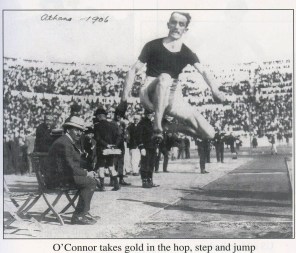
O’Connor went to the Games as long jump world record holder. He had leaped almost twenty-five feet in Dublin in 1901. In the Athens event, however, he was opposed by the previous holder of the world best mark, Myer Prinstein of the USA. The only judge at the event just happened to be the American team manager. O’Connor protested but was ignored. Prinstein won the gold, O’Connor finished second. At the medal ceremony O’Connor saw red … white and blue as the Union Jack was raised to mark his silver medal. Carrying the Irish banner he had brought to Athens he climbed up the pole and replaced the offending Union flag with the ‘Harp and Shamrock’. His compatriots Con Leahy and John Daly stood at the bottom of the pole just in case anyone might try and stymie the gesture.


Later O’Connor competed against Leahy in the hop, step and jump, his teammate having taken gold in the high jump. Here O’Connor won a gold medal of his own, Prinstein, champion in 1900 and 1904 was not placed.


O’Connor, by then thirty-four years old and clearly past his best, did not compete in any further Olympic Games. Undoubtedly his nationalism, which did not permit him to represent the United Kingdom until forced by circumstances to do so, denied him numerous Olympic medals in 1900 and 1904.


He settled in Waterford working as a solicitor and became a founder member of the Waterford Athletic Club. He died there in 1957 at the age of 85. His long jump world best set in 1901 stood as an Irish record until 1990, when it was finally broken by Carlos O’Connell. The first British competitor to beat O’Connor’s mark was the legendary Welsh athlete and Olympic gold medallist Lynn Davis, who didn’t lower it until 1962.


Peter O’Connor set a new long jump world record of twenty-four feet, eleven and three-quarter inches at the RDS in Dublin one hundred and fifteen years ago, on this day.


180px-Erin_Go_Bragh_flag.jpg41CB63YFD0L._SX331_BO1,204,203,200_.jpg


On This Day – 10 June 1997 Jimmy Kennedy is inducted into the Songwriters’ Hall of Fame


51jnMbJP75L._SY344_BO1,204,203,200_.jpg


It’s always interesting to discover the genesis of a popular and memorable poem or piece of music. You assume, for example, that William Wordsworth actually based his poem about daffodils – the one that begins with the immortal line ‘I wandered lonely as a cloud’ on a field of the bright yellow blooms. And you wouldn’t be too far off.


Then there’s the sultry pop song from the 1930s ‘South of the Border’ which simply has to have been written by someone after a romantic trip to Mexico. But that’s where you’d be wrong. Its inspiration was a postcard from Tijuana. The recipient of the card was Northern Ireland songwriter Jimmy Kennedy. The song may been voted one of the top 100 Western songs of all time by the Western Writers of America but Jimmy Kennedy was closer to Tyrone than Tijuana when he wrote it.


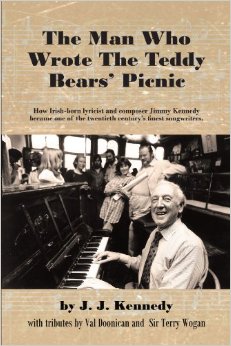
Kennedy was born near Omagh in 1902, son of a member of the Royal Irish Constabulary, as the force was known at that time. The family later moved to Portstewart in Derry, the seaside town that would inspire another of the writer’s classic numbers. He graduated from Trinity College in Dublin, taught for a while in England and then joined the Colonial Service. But he also moonlighted with a music publisher called Bert Feldman as a pen for hire. By the end of a career that lasted half a century he had written the lyrics for over 2000 songs, many of which became international hits. For a number of years he was the most successful non-American songwriter in the USA before being supplanted in the 1960s by a pair of young Liverpool composers named Lennon and McCartney.


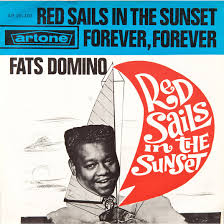
One of his earliest successes was with ‘Red Sails in the Sunset’. The song was inspired by the colourful sails of the yacht Kitty of Coleraine which Kennedy would often see off from his home sailing off the Derry coastline. One of the first recordings of the song, in 1935, was by Bing Crosby. Vera Lynn had a version the same year, Louis Armstrong in 1936, and Kennedy was on his way.


In 1907 a composer named John Walter Bratton had written a musical piece which his publishers entitled ‘The Teddy Bears Picnic’. But nobody thought to add lyrics until Kennedy got hold of it in 1932 and turned it into one of the most popular children’s songs of all time.


Kennedy spent the years 1939-1945 in the British Army – serving in the Royal Artillery where he reached the rank of Captain. German defences in 1939 included a chain of fortifications known as the Siegfried Line. Early in the war Kennedy wrote the comic song ‘We’re Going to Hang out the Washing on the Siegried line’ as a morale booster. The British didn’t actually get near the line until 1945 but the song was hugely popular with the troops and on the ‘home front’.


Kennedy won two Ivor Novello awards for his contribution to the music industry and an OBE in 1983. He died the following year aged 81.


Jimmy Kennedy songwriter extraordinaire was posthumously inducted into the Songwriter’s Hall of Fame nine years ago on this day.


images.jpeg


On This Day – 3 June 1836 – death of Barry Edward O’Meara, surgeon to Napoleon.

Unknown.jpeg


One of the most familiar quotes with which he is credited was ‘l’etat c’est moi’ – or ‘I am the state’. But by 1816 the state over which he ruled had shrunk to a corner of the small volcanic island of St. Helena in the South Atlantic. This was all that Napoleon Bonaparte could call his own after his escape from Elba, the raising of a new French Army and his final defeat at the hands of Wellington and Blucher at the Battle of Waterloo in 1815.

Sharing Napoleon’s exile in St. Helena was an Irishman, Barry Edward O’Meara, a British Navy surgeon. O’Meara was born in Newtownpark House in Blackrock, Co. Dublin in 1786. He studied medicine at Trinity and the Royal College of Surgeons and joined the army as a medic in 1804. He distinguished himself in fighting in Sicily before being court-martialled for his part in a duel in 1807. He had acted as a second to one of the participants and was kicked out of the army. What’s a young man to do? Well obviously … join the Navy. This he did almost immediately. He was still a naval surgeon in 1815 when he found himself in the right place at the right time.

Napoleon Bonaparte had been defeated at the Battle of Waterloo and was trying to escape to America where he would probably have made a fortune on the lecture circuit. Finding his way barred by a naval vessel called the HMS Bellerophon he surrendered to the commander of that ship. The vessel’s surgeon was Dr. Barry Edward O’Meara. The unemployed Emperor was impressed by the young Irishman’s linguistic and medical skills and invited him to act as his physician in the exciting new opportunity he was being offered by the British government on St. Helena. O’Meara accepted and over the next three years the two men became good friends.

O’Meara did not enter the arrangement wide-eyed and innocent. During his time with Napoleon he kept a diary with a view to future publication. The two men fared well enough on their new volcanic home under the first two post-war governors of the island. But then in April 1816 a fellow countryman of O’Meara’s. Sir Hudson Lowe from Galway, took over the position and proved himself to be a Francophobe martinet. He introduced a more spartan regime than that of his predecessors that only became even more restrictive when rumours reached the island of a plot to spring Napoleon yet again. O’Meara’s relationship with Lowe deteriorated rapidly and when he was asked to spy on Bonaparte by the Governor he returned to England.

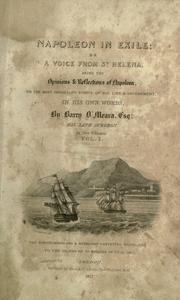
There in 1822 he wrote Napoleon in Exile, or A Voice From St. Helena in which the hero is the late emperor (Napoleon had died the previous year possibly of stomach cancer, possibly of arsenic poisoning) and the villain is Hudson Lowe. The volume led to his name being removed from the list of naval surgeons but also attracted much support, including that of Lord Byron.

O’Meara is believed to be the only doctor to have performed a surgical procedure on Napoleon. He extracted one of the Emperor’s wisdom teeth in 1817. When he died in 1836 the tooth was auctioned and fetched seven and a half guineas. It was sold again in 2005. This time it cost the buyer £13,000.

After his St. Helena experience O’Meara became a dental surgeon, married a sixty-six year old heiress at the age of thirty-seven and was one of the founders of the Reform Club in London. He died of complications following a chill contracted while attending a fund-raising meeting organized on behalf of fellow Reform Club member Daniel O’Connell. Some accounts have him catching his death of cold at one of O’Connell’s Monster meetings – a much less mundane demise I’m sure you’ll agree.

Dr. Barry Edward O’Meara, briefly and controversially physician to Napoleon Bonaparte died one hundred and eighty years ago, on this day.

5621421-M.jpg


On This Day – 27 May 1224 Death of Cathal O’Connor, King of Connacht


2000px-Kingdom_of_Connacht-900.svg.png

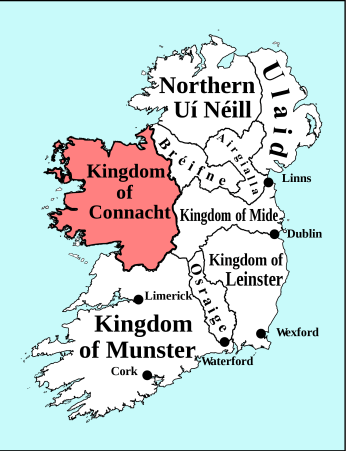
We hear a lot about the Red Hand of Ulster these days, but the province of Connacht had a Red Hand of its own. He was Cathal Crobhdearg O’Connor who ruled the region for almost thirty-five years at a time when a wet weekend of political domination was the lot of most Irish kings.


Cathal O’Connor was a born survivor who avoided the sudden and painful death he inflicted on many others by always knowing in which direction the wind was blowing. He succeeded his brother Rory, the last High King of Ireland, as ruler of Connacht in 1189. He and Rory were two of the twenty-five sons of Turlough O’Connor, a previous King of Connacht who survived five of his six wives. Irish royalty, unlike its insipid English counterparts, doesn’t do things by halves you see. We have to assume that Turlough probably had a few daughters as well but only one has been chalked up to his credit by the annalists.


Cathal came to power in the west at a time when the country was being overrun by the Norman invader, introduced into Ireland by Pope Adrian IV, the only English Pontiff, and his agent King Henry II. By the time Cathal assumed the throne of Connacht the Normans were well ensconced in neighbouring Leinster and were making inroads into his bailiwick too. He could have chosen the military route but generally adopted a conciliatory line instead. His first reign lasted ten years before he was usurped by the head of a rival O’Connor family, Cathal Carrach, his own nephew – I hope you’re still listening down the back. ‘Carrach’, by the way, translates as ‘scabby’ so we can assume that this Cathal – the usurper, not our boy – was not much to look at. Given his disposition it is also unlikely that anyone called him ‘Carrach’ to his pockmarked face.


Our Cathal O’Connor got the throne back from the other Cathal O’Connor in 1202 when he defeated and killed his blotchy relative in a battle near Boyle, Co. Roscommon. He kept the throne until his death in 1224, no mean achievement with the Normans eyeing the land west of the Shannon and sizing it up for castle building. Cathal wasn’t too picky about who he made alliances with as long as the deals done kept him in power. Sometimes he was hugger mugger with Thomond, sometimes with Tyrone, now and again he even hitched up with the Normans and on at least one occasion appealed to Dublin to restore his sovereignty.


His constant switches of allegiance resulted eventually in his recognition of the King of England as Lord of Ireland. He wrote a letter to Henry III in which he pointed out that he had offered ‘faithful and devoted service’ to his father, King John ‘of happy memory’. It is an egregious example of brown nosing the monarch as nobody in their right minds would ever describe the callous and useless King John as being ‘of happy memory’ – you would have needed a bad case of amnesia for that.


The Annals of Connacht are equally obsequious when it comes to outlining the merits of Cathal Crobhdearg. The annalists write of him as …


The king who carried out most plunderings and burnings against [those] who opposed him; the king who was the fiercest and harshest towards his enemies that ever lived; the king who most blinded, killed and mutilated rebellious and disaffected subjects;


But all the gory stuff was OK because he was also ..


The king who was most chaste of all the Kings of Ireland.


James Clarence Mangan both immortalized and romanticized Cathal Crobhdearg in his poem ‘A Vision of Connacht in the Thirteenth Century’ in which he writes of ‘Cathal Mór of the wine red hand’. The poem is about the passage from the Gaelic world to that of Anglo-Norman domination, with Cathal O’Connor as the main transitional figure.


Cathal Crobhdearg O’Connor, monarch and political meteorologist died seven hundred and ninety two years ago, on this day.

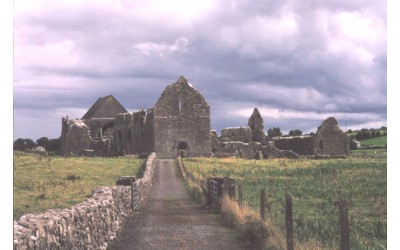
Knockmoy founded by king of connacht - ancestry.com-400x250.jpg


On This Day – 20 May 1762 – Birth of Sir Eyre Coote


Sir_Eyre_Coote_(born_1762).jpg


The expression ‘as bald as a coot’ is well-known in this part of the world. In the USA however the unfortunate bird, related to the moorhen, is familiar as the basis of an entirely different simile. In America you can be ‘as crazy as a coot’. The assumption has always been that the ‘coot’ in question is the common ‘mud hen’, often mistaken for a duck.


But what if the insane ‘coot’ to which the phrase refers is not the inoffensive animal but an eccentric Irish military type with a final ‘e’ to distinguish him from the water-loving bird? And the word ‘eccentric’ is not used idly. Because Sir Eyre Coote, born in Ireland in 1762, was adjudged to be merely ‘eccentric’ rather than completely ga-ga by a military board in 1816. More about that later.


He had the misfortune to be the nephew of, and share a name with, one of the greatest generals in the British Army, who, in the 18th century, ensured that England, rather than France, became a tea drinking nation when he pushed the French out of India. His nephew, also called Eyre Coote, joined the Army at the age of fourteen and quickly rose through the ranks, helped no doubt, to some extent by his name. Eyre Coote Junior first distinguished himself in the American War of Independence which began with a dispute over tea and ended with the United States of America abandoning that beverage for coffee. More significantly perhaps it also ended in the defeat of the British Army and the capture of Coote at the pivotal Battle of Yorktown when he was still only nineteen years of age.


Moving rapidly from opposition to the American colonists to the more traditional antagonism with the French, Coote became involved in a military operation designed to flood that part of the Netherlands occupied in 1798 by France. Flooding northern Holland proved to be relatively simple, getting away afterwards was a bit more difficult. A contrary wind meant that the ships intended to evacuate his force could not land and after losing more than a hundred of his men Coote was forced to surrender.


Shortly after that he inherited Uncle Eyre’s property and took a seat in the Irish House of Commons. That was pulled from under him by the Act of Union in 1800 and he went on to become Governor of Jamaica. Although he left that post in 1808 claiming the climate didn’t agree with him and affected his brain he must have had some fun while he was resident in the West Indies because the former US Secretary of State, General Colin Powell claims direct descent from him.


But it is for his unorthodox activities in the year of the Battle of Waterloo that Coote is most commonly remembered. He’d already given evidence of what might diplomatically be called ‘erratic decision making’ but he topped everything when, in November 1815 he wandered into the Mathematical School of Christ’s Hospital for Boys in London and offered some of the young inmates money – if they allowed him to flog them. A few volunteered. They were far more receptive when he suggested they might want to flog him. Three of the boys duly obliged and were paid three shillings. Discovered by a school nurse Coote was charged with indecent behaviour. He escaped jail by donating £1000 to the hospital, a somewhat disproportionate version of the use of the poor box for traffic offences in modern times. But despite avoiding a criminal charge he later found himself facing a Military Tribunal composed of three Generals.


There he was ruled not to be insane but to be merely ‘eccentric’. However, his conduct was adjudged to have been unworthy of an officer and he was dismissed from the Army. He had also been made a member of the Order of the Bath and he was stripped of that status as well. Clearly the membership of that august order had no time for flagellation.


Eyre Coote, soldier, politician, ancestor of General Colin Powell and keen flagellant was born two hundred and fifty four years ago, on this day.


800px-Quad_DH.jpg

Christ’s Hospital for Boys