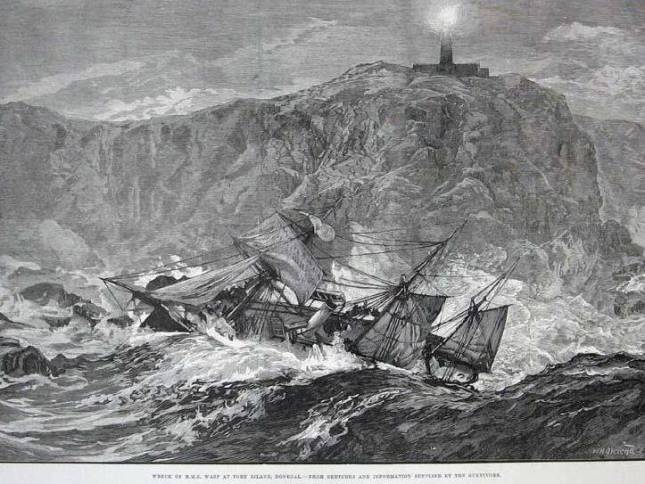
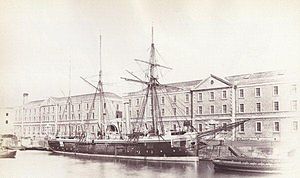
On This Day – 22 September 1884 The gunboat HMS Wasp is wrecked off Tory Island

Wreck of hms_wasp_1884.jpg


If you were asked, what is the most northerly Irish island, you would probably hazard a guess that it was Tory Island, off the coast of Donegal. And you wouldn’t be too far wrong. The correct answer is Inishtrahull—or the ‘island of the empty beach’—which lies ten kilometres north-east of Malin Head. It also boasts the most northerly lighthouse in Ireland, which was manned until 1987.

But the most significant event in the history of the island took place more than a century earlier, and involved the loss of fifty-two lives.

The HMS Wasp was a British naval vessel, of something called the ‘Banterer class’, built in 1880 in Barrow in Furness in Cumbria. It was one hundred and twenty-five feet long, and its on-board steam engine meant that it was capable of achieving a speed of almost ten knots. It was armed with two four-inch, and two six-inch guns, and was rigged with three masts. It also carried two machine guns. The Wasp was commissioned by the Royal Navy in 1881. It intersected with the story of Inishtrahull when it became an element of the Irish Land War of the 1880s and was used to transport personnel to offshore islands in order to enforce evictions there.

In September 1884 HMS Wasp was dispatched from Westport to Moville in Donegal, under the command of Lieutenant J.D. Nicholls. It was to collect a party of court officials, Royal Irish Constabulary policemen, and bailiffs, in Moville and transport them to Inishtrahull, in order to carry out a number of evictions at the behest of the local landlord, Sir Robert Bateson Harvey. The tenants were to be dispossessed for the non-payment of rents to the value of just over seventy-six pounds. Keep that figure in your head when you hear what happened.

On the morning of 22 September 1884, with fifty-eight sailors on board, the Wasp was off Tory Island. The commander and most of the crew members were asleep. Just before 4.00 a.m. the gunboat hit a reef, the hull was split, and the craft quickly began to take on water. It sank within fifteen minutes. Only six men were able to escape and make their way to Tory island, where they were looked after by locals.

Astonishingly, after having endured such an ordeal, all six were later court-martialled by the British Navy, but exonerated. The cause ascribed to the disaster was a lack of attention to the navigation of the vessel in dangerous waters.

Given the nature of the Wasp’s mission you might have expected a less than totally sympathetic response from nationalist Ireland. However, that was not the case. The ultra-nationalist United Ireland newspaper did point out, however, that the lost gunboat itself had cost £50,000 to build, and that the loss of fifty-two lives was of incalculable value, all for the sum of seventy-six pounds and five shillings in unpaid rent. The newspaper’s editorial was scathing.


May we therefore assume that Sir Robert Bateson Harvey will not again have a gunboat placed at his bailiff’s disposal for the asking, and the Government will not imperil their seamen’s lives and taxpayer’s property to please a landlord? The Crown have always declined in England to provide the landlords of the Isle of Skye with vessels to overawe the crofters.


Among the many ironies of the tragedy was the fact that the total population of the island of Inishtrahull in 1884 was fewer than fifty souls. The previous year HMS Wasp had been used to transport much needed food supplies to the island. Inishtrahull was finally evacuated in 1929 during the first years of the new government of the Irish Free State.

The HMS Wasp sank without begin able to launch its lifeboats, at a cost of fifty-two lives, one hundred and thirty-seven years ago, on this day.
 

Unknown.jpeg300px-HMS_Wasp_(1880).jpg


On This Day – 15 September 1803 Abraham Lincoln and Robert Emmet

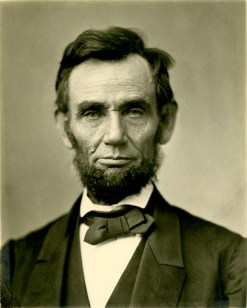
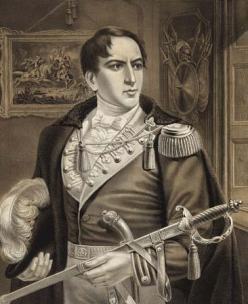
Abraham_Lincoln_O-77_matte_collodion_print.jpg133445-004-D9606C83.jpg


They are two very different orations. One is short, a mere two hundred and sixty-nine words, and lasting barely three minutes. The other is in excess of  three thousand words, and must have taken closer to half an hour to deliver. The longer speech was given by a man marked for a judicial death, the shorter by one who would be mown down by an assassin’s bullet.

Abraham Lincoln, sixteenth President of the United States of America, was born five years after the execution of the young rebel United Irishman, Robert Emmet, but the coincidental connections between the two men are compelling and inescapable.

Both were Republicans, both are perceived by their acolytes as martyrs. Emmet, a post-Enlightenment Irish Republican, atoned for the hapless nature of his one-day rebellion on 23 July, 1803 in Dublin, by making the single most famous, effective, and affecting speech in Irish nationalist history. Lincoln was one of the founder members of the anti-slavery Republican party, and its first successful Presidential candidate in 1860. His election precipitated the debilitating four-year American Civil War. His Gettysburg address was a model of rhetorical clarity, creativity and brevity.

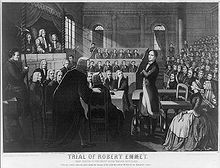
Emmet’s speech, made after his conviction for high treason in Green Street courthouse in Dublin, is famous for its passionate peroration, made as he faced death by hanging the following day.


Let no man write my epitaph: for as no man who knows my motives dare now vindicate them, let not prejudice or ignorance asperse them. Let them rest in obscurity and peace, my memory be left in oblivion and my tomb remain uninscribed, until other times, and other men, can do justice to my character. When my country takes her place among the nations of the earth, then, and not till then, let my epitaph be written.


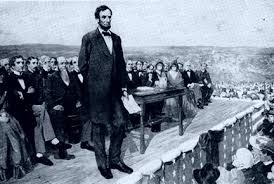
Lincoln’s Gettysburg Address, made on 19 November 1863 at the dedication of the Soldier’s National Cemetery at Gettysburg, Pennsylvania—scene of a bloody and decisive battle four and half months earlier—is more famous for its iconic opening line.


Fourscore and seven years ago our fathers brought forth on this continent a new nation, conceived in Liberty, and dedicated to the proposition that all men are created equal.


But, did Emmet’s speech influence the creation of the most famous short oration in history? Very likely. As a boy in Indiana (where his family had migrated from Kentucky) Lincoln is known to have learnt Emmet’s valedictory off by heart. As a gangly teenager he would often deliver it as a party piece, for dignitaries visiting Perry County, where he lived.

More than a quarter of a century later, at the first Republican National Convention, in New York, in 1856, where Lincoln was defeated for the party’s vice-presidential nomination, the convention Chairman was a New York Judge and politician, Robert Emmet, the Dublin-born nephew of his celebrated namesake.

In February, 1865 Lincoln, was reviewing the death sentence on a young Confederate spy. He was considering an appeal for the boy’s life from a Delaware Senator, Willard Saulsbury, who had once referred to the President as ‘a weak and imbecile man’. So, you would assume, not much hope there.

Saulsbury, however, was both frank and astute in his appeal to Lincoln. He wrote


You know I neither ask or expect any personal favor from you or your Administration … All I ask of you is to read the defence of this young man … compare it with the celebrated defence of Emmet, and act as the judgment and the heart of the President of the United States should act.


Saulsbury knew his man. The death sentence was duly commuted.

In 1939 the distinguished playwright Robert Sherwood, won a Pulitzer Prize for his play Abe Lincoln in Illinois. The significance of the play is in Sherwood’s middle name, Emmet. He was the great-great-grandnephew of the executed patriot. It was as if the Emmet family, having accepted the homage of the young Lincoln, was repaying the compliment.


Emmet would have been proud of the famous peroration of his celebrated acolyte.


We here highly resolve that these dead shall not have died in vain—that this nation, under God, shall have a new birth of freedom—and that government: of the people, by the people, for the people, shall not perish from the earth.


Robert Emmet, was awaiting trial and probably writing the signature speech that Abraham Lincoln would later learn by heart, two hundred and fourteen years ago, on this day.


Unknown.jpeg220px-Robert_Emmet_-_Trial.jpg


On This Day – 8 September 1852 The Irish Tenant League

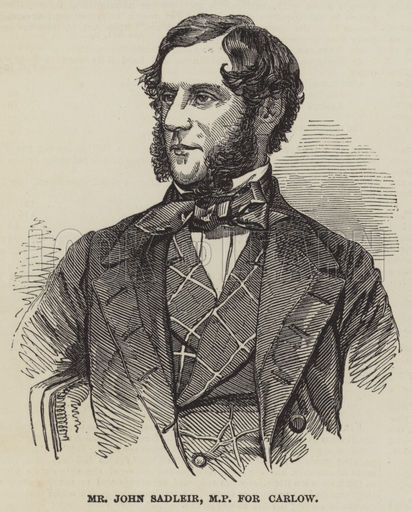
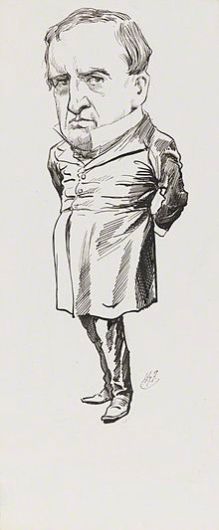
sadleir john swindler.jpgWilliam_Nicholas_Keogh_caricature_by_Harry_Furniss.jpg


Today the story of an Irish political party dedicated to the interests of large, comfortable and respectable farmers – but enough about Fine Gael, coincidentally founded eighty-four years ago today. Instead the story of an Irish political party dedicated to the interests of large, comfortable and respectable farmers. Turns out we’ve had quite a few over the years.

The Irish Tenant League was the posh cousin of the Land League of the 1880s. Someone like Michael Davitt would never have been allowed near the Tenant League. He was far too working class. But the League made the 1850s more interesting in Ireland than the decade might otherwise have been, and regularly rattled the cage of the British government, before sliding into the inevitable abyss of corruption and recrimination.

The League was established in 1850s in the wake of the Great Famine. Under the terms of the Encumbered Estates Acts a number of vulture funds were buying up distressed properties. Sorry, that’s actually more recent. Let me rephrase. A number of wealthy capitalists were acquiring bankrupt estates at knockdown prices and threatening to change the rules for sitting tenants. That’s the great thing about history. If you stick around for long enough it just keeps happening all over again.

The leading lights of the new organisation were Charles Gavan Duffy, the former Young Irelander, and the English-born journalist Frederick Lucas, editor of the progressive Catholic weekly newspaper, The Tablet.

It was the Tenant League, not its more illustrious and egalitarian successor, which came up with the three famous demands of the Irish agrarian movement, the ‘3 F’s’, dreaded by every student of Irish history. You could easily recall two, but damned if you could ever remember the third. For the record, they were ‘Fair rent, free sale and … em … em …yes,  fixity of tenure.’

The organisation of the League’s activities fell to another former Young Irelander, Newry-born John Martin, who would later precede Charles Stewart Parnell as MP for Meath. The League attracted the support of the rump of the late Daniel O’Connell’s Repeal Party in the House of Commons, and in 1852 managed to return fifty Tenant Right candidates to parliament. These included Gavan, Duffy, Lucas, the banker John Sadlier  from Tipperary, and the lawyer William Keogh, MP for Athlone. The Tenant League MPs were pledged not to align themselves with any British party which failed to endorse the ‘3 Fs’, and to refuse all political preferment.

Of course, it quickly went pear-shaped. A sectarian element intervened when a cohort of Tenant Leaguers decided that the cause of Catholic religious rights was more important than forcing agrarian reform. They broke off to form the Catholic Defence Association, nicknamed ‘The Pope’s Brass Band’. In response Frederick Lucas ill-advisedly took on the powerful Roman Catholic Cardinal-Archbishop of Dublin, Paul Cullen, and lost. Lucas died in October 1855, and the following month Gavan Duffy emigrated to Australia, where he became Prime Minister of the state of Victoria.

But it got even worse than that. Defying the pledge to remain aloof from political office, Sadleir and Keogh accepted positions in Lord Aberdeen’s coalition government, and joined that great anti-pantheon of Irish traitors whom we cherish to this day. Sadlier didn’t last long in office, he was gone by 1854, forced to resign when he was found guilty of trying to bring about the imprisonment of one of his bank’s customers. This errant depositor had failed to deliver on a promise to vote for Sadleir.   Two years later his Tipperary Bank went spectacularly bust and he committed suicide by drinking prussic acid.

It would be nice to report a similar fate for Keogh, instead he became a judge and handed down savage sentences to the Fenian leadership in 1867. It was left to William Gladstone, through his land legislation of 1870, and Davitt’s Land League of the 1880s, to bring into effect the principles of fair rent, free sale and … the other one.

A Dublin conference of the Irish Tenant League adopted an ill-starred policy of independent opposition in Parliament, one hundred and sixty-five years ago, on this day.


On This Day – 11 August 1796 Kilmainham Gaol in Dublin prepares to receive its first prisoners


images.jpegUnknown.jpeg


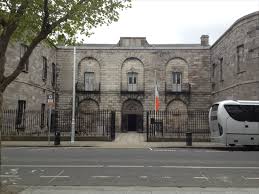
It’s such a huge tourist attraction today that it’s quite shocking to realise there were proposals as recently as the 1950s to demolish much of it. But Kilmainham Gaol survived intact to play a huge part in the current decade of centenaries.

It opened in 1796 and even then, it was a grim place, housing men, women, and children as young as twelve. Some were held there prior to transportation to Australia, others were lodged in the prison before their executions, some served many years there in dreadful conditions, often sharing a cell with up to four others.

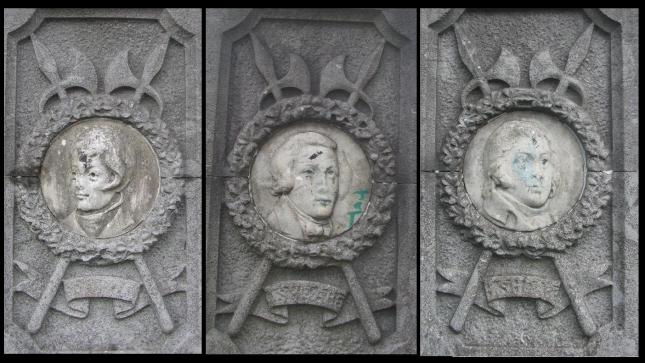
Almost every self-respecting nationalist, including some far removed from revolutionary politics, spent a spell at their Majesties’ pleasure in Kilmainham.  A number did so prior to being hanged or shot. The list of guests constitutes a distinguished club, Henry Joy McCracken, Oliver Bond, Napper Tandy, Robert Emmet, Michael Dwyer, William Smith O’Brien, Thomas Francis Meagher, Jeremiah O’Donovan Rossa, Charles Stewart Parnell, and Michael Davitt.

Attached to the Gaol was a magistrates’ court where cases would be despatched, or, if a serious crime was involved, the preliminary process leading to indictment would take place. It was here that the alleged killers of the Chief Secretary, Frederick Cavendish and his Under Secretary, Thomas Henry Burke, in Phoenix Park in 1882—the so-called Invincibles—appeared for remand hearings before being committed to Green Street court for trial. And it was here that they first realised the game was up, when one of their number, James Carey, presented himself as a prosecution witness. He had opted to turn state’s evidence to save his own skin. His first appearance at Kilmainham Magistrates’ Court was greeted with roars of rage from the dock. A reporter observed that one of the accused, Joe Brady:


Glared at him and stretched forward towards him [had he] been able to reach him, I believe he would have been torn to pieces, for Brady was a powerful young fellow, and for the moment he was for all the world like a tiger on the spring.


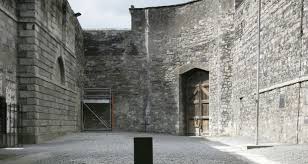
The prisoners were returned to their cells and a few weeks later Carey’s evidence sent five of them to the hangman, a seasoned veteran named William Marwood. His customary advice to his victims before they met their maker was, ‘Now then, hold your head back and you’ll die easy’. They were all executed in the Kilmainham Prison Yard, and their bodies were interred under the scaffold erected to hang them.

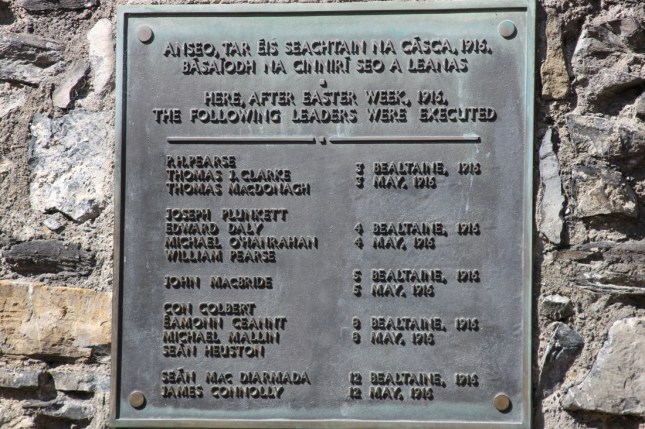
Three decades later it was the turn of the leaders of the 1916 Rising. Fourteen were executed there over a nine-day period in May. The first to die, on 3 May, were Patrick Pearse, Thomas Clarke and Thomas MacDonagh. They faced firing squads of twelve British soldiers, mostly drawn from the Sherwood Foresters, who had been badly cut up on Mount Street Bridge the previous week. There was little regard to sensitivities on either side. No Catholic priest was allowed to be present to minister to the prisoners, and the same firing squad—consisting mainly of young recruits—was expected to execute all three men. A number of female prisoners, including Countess Markievicz, were rudely awoken by the volleys from the stone-breakers’ yard.

After the establishment of the Irish Free State the prison continued to be used during the Civil War. Around six-hundred Republican prisoners were incarcerated there, many of them women. One of the last to be released was Eamon de Valera.

The prison was closed by the Free State government in 1929, and might well have been demolished in the 1930s, except it was deemed too expensive to do so. The work of organisations, like the Kilmainham Gaol Restoration Society, ensured that it was eventually taken over by the Office of Public Works, and became one of the most visited historical sites in Dublin.

It has also been a useful location for a number of films. These include the adaptation of Brendan Behan’s prison drama, The Quare Fellow, as well as the Michael Caine film The Italian Job, and Neil Jordan’s Michael Collins. Collins himself was fortunate, he never actually served time there.

Kilmainham Gaol was finally completed and prepared to accept its first prisoners two hundred and twenty-one years ago, on this day.


5284871_orig.jpg


On This Day – 14 July 1798 The Sheares brothers are hanged in Dublin

1798.jpg


Irish rebellions should probably all come equipped with something we could call an IQ. That’s an Informer Quotient. This is a scientific measure of how many British agents from among the ranks of the rebels it took to betray the insurrection.

The scale would go all the way from ‘Genius’ at one hundred and fifty, to Witless Imbecile at zero. Let’s take a couple of examples. Obviously the 1798 rebellion was so riddled with spies and informers that if it had been a boat it would have sunk in a calm and windless cup of tea. So, we’ll call that one hundred and fifty. Then, right at the other end of the scale, there’s the 1916 Rising. Here the rebels desperately tried to tip their hand repeatedly, even to the extent of calling the whole thing off in a newspaper advertisement, but the exceptionally dim British authorities had no idea what was going on under their noses. We’ll call that an IQ of zero.

Totally off the scale of course is the War of Independence where Michael Collins’s own spies and informers were tripping over each other in Dublin Castle. That would be a minus IQ of about fifty for the rebels.

But the prize for individual revolutionaries most beset by informers has to go to the United Irishmen, the Sheares brothers. It took not one, not two, but three spies to bring them down. Given the going rate for intelligence information in 1798 it must have cost the authorities almost as much as the bribes paid to pass the Act of Union two years later.

The brothers Sheares, John and Henry, from Cork were both lawyers who had witnessed the French revolution and the frequent use of the guillotine. On the boat back home from Calais they met an utterly disillusioned Daniel O’Connell, pledged to non-violent political action, based on the bloodthirsty slaughter he had observed in Paris. The Sheares brothers were not so easily put off. When they got back to Dublin in 1793 they joined the United Irshmen. Both began organizing in their native Cork.

Enter Spy Number 1. His name was Conway and he kept the Castle well informed of the activities of the brothers, while passing himself off as an enthusiastic supporter.  He gets the bronze medal.

While busying themselves in Cork the brothers were also part of the Dublin Society of the United Irishmen. Here their nemesis was Thomas Collins, another apparent republican fanatic but, in reality, a well-embedded British spy. Because he ratted on so many other prominent revolutionaries he gets the silver medal.

But the gold unquestionably goes to Captain Warnesford Armstrong. You’d think his name would have given him away. How could you be called Warnesford and not be a British spy? After the capture of most of the members of the United Irishmen’s Directory (note the French influence) in March 1798, John Sheares took over and ordained the date of 23 May for a nationwide uprising. Armstrong insinuated himself into the confidence of the brothers, to the point where he was a regular visitor to their house on Baggot street, and dandled the children of Henry Sheares on his treacherous knee. He recorded that he didn’t even have to take an oath in order to become a member of the United Irishman. Not that he would have let something as silly as an oath get in the way. John Sheares himself actually warned Armstrong not to come to the house on one occasion, because certain activists believed him to be in the act of betraying the movement, and were intent on murdering him!

Two days before the planned rising John and Henry Sheares were arrested, on information supplied by Armstrong, and put on trial. Armstrong himself, clearly pleased at his handiwork, testified against them. Despite being defended by the great advocate John Philpot Curran, it took the jury a mere seventeen minutes to convict.

John and Henry Sheares, victims of three separate informers, were hanged, drawn and quartered, two hundred and nineteen years ago, on this day.