On This Day – 1 April 1872 The Birth of Irish-American bootlegger Katherine Daly


p-20196-ghm.jpg


She was born Katherine Rose Daly in Oakland, California in 1872. Her father, Bill Daly, was from Roscrea, Co. Tipperary,


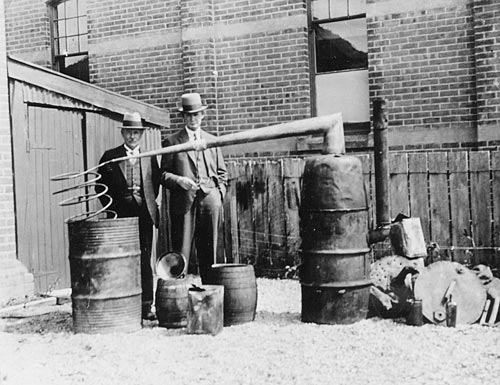
She was a wild child, one of twelve young Dalys, who was allowed to roam the heights around Oakland in her untutored youth. The knowledge she gained of the hills proved very useful to the family business. Her father manufactured what he called ‘poteen’ and his customers called ‘moonshine’ – Katherine’s intimate knowledge of her environment helped the Dalys to escape the clutches of the authorities who never seemed to be able to find the family’s illicit stills.


When the attentions of the forces of law and order became too intrusive the entire Oakland operation was moved in the 1880s to the boom town of Tombstone. However, the law eventually caught up with Bill Daly when he was killed in a shootout with Wyatt Earp not long after the infamous Gunfight at the OK Corral. Daly, a supporter of the Clantons and the McLaurys, the losers in that shoot out, simply chose the wrong side. His daughter Katherine, however, kept the family business going.

If some of this seems a bit familiar to you it might be because of a certain well known folk sing that tells the story of Katherine Daly’s life. It begins …

‘Come down from the mountain Katie Daly

Come down from the mountain Katie do

Oh can’t you hear us calling Katie Daly

We want to drink your Irish mountain dew


Her old man Katie came from Tipperary

In the pioneering year of forty-two

Her old man he was shot in Tombstone city

For making of the Irish mountain dew

Soon after her father’s death Katherine Daly, better known as Katie, escaped the Earps and betook herself to the Chicago. There she continued to manufacture moonshine for the next three decades. Prohibition in the 1920s should have been good to her. Her famous ‘mountain dew’ was streets ahead of the bathtub gin of Al Capone. But the notorious Italian-American hoodlum had more guns at his disposal than the ageing Katie.

After the St. Valentine’s Day massacre Katie headed back home to the west coast and began operating in San Francisco. There she made a fatal error. Had she confined her activities to the Bay Area who knows what she might have achieved.

But she got just a little bit too greedy and began shifting bootleg whisky across the state border into Nevada. This brought down on her head the ire of the burgeoning criminal element in the Silver State and enabled the very non-Irish FBI to take an interest in her activities as well. She was probably fortunate in that the Feds got to her first. Hence the verse of the song that goes …

Wake up and pay attention, Katie Daly,

I am the judge, that’s goin’ to sentence you,

And all the boys in court, have drunk your whiskey,

And to tell the truth dear Kate, I drank some too

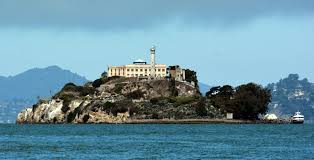
Katie went down for a fifteen year stretch. If you know the song well enough you will be aware that she did not survive her incarceration as the only female inmate of the notorious Alcatraz Island prison in San Francisco Harbour.

So off to jail, they took poor Katie Daly,

But very soon, the gates they opened wide,

An angel came, for poor old Katie Daly,

And took her, far across the great divide.

She may have derived some small satisfaction before her demise from the fact that she survived another famous inmate of Alcatraz, Alphonse ‘Scarface’ Capone who joined her on ‘The Rock’ after he was found guilty of evading Federal taxes.

Katherine Daly, bootlegger, distiller of Irish poteen based on an old Tipperary family recipe, was born one hundred and forty four years ago, on this day.

Unknown.jpeg


On This Day- 25 March 1840 – Birth of Myles Keogh


kickingbear.jpgUnknown.jpeg


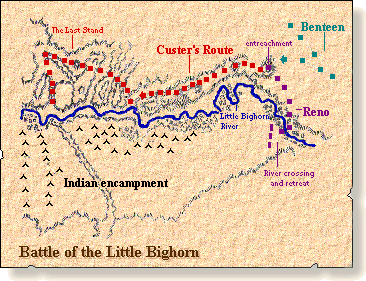
The Little Bighorn, which sounds like a bit of a contradiction in terms, is a river in the American state of Montana. It flows through mainly flat or gently undulating plains. As a river it is unremarkable. But it is not famous for the qualities of its drainage. It is infamous for what happened there on 25 & 26 June 1876 when a flamboyant, egotistical Cavalry officer, George Armstrong Custer, led his Seventh Cavalry to the worst, and last, military defeat ever inflicted on the US Army by the Plains Indian tribes, the Lakota and Cheyenne, at what they called The Battle of the Greasy Grass. No prizes for guessing what it was that greased the grass of the river’s banks.


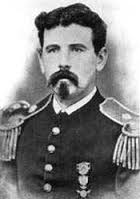
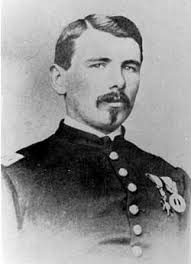
Five of the twelve companies of the 7th cavalry were wiped out on 25 June, including ‘I’ Company, led by Carlow-born Captain Myles Keogh, the most senior of thirty-two Irish-born fatalities in the battle.


Keogh, from Leighlinbridge, had found his way to his date with destiny by a circuitous route. He had, in 1860, as a twenty year old from a relatively prosperous Catholic family, volunteered for service in the army of the Pope. He wasn’t dressed in a striped uniform guarding the Vatican city, he was fighting, unsuccessfully, to save the Pope’s last remaining landed possessions in Italy. When the American Civil War broke out the Roman Catholic Archbishop of New York, John Hughes, recruited Keogh and a number of his colleagues, to join the Union Army. He served with distinction through most of the American Civil War as a cavalry officer, fighting at Fredericksburg and Gettysburg and rising to the rank of Lieutenant Colonel.


After the Civil War the American Army was greatly reduced in size but Keogh wanted to stay on. Like most other officers he lost his exalted war-time rank but was not demobilized. He was sent west to join Custer’s 7th Cavalry charged with keeping the peace on the great American Plains and ensuring that nations like the Lakota – better known as the Sioux – the Cheyenne, and the Blackfeet, behaved themselves and remained on the relatively useless patches of land that had been set aside for them as ‘reservations’.


Keogh was undoubtedly handsome, dynamic, vigorous and physically courageous. However, he was also described by some colleagues as intemperate, drunken and violent. Although he respected the Native Americans of the Plains as military opponents he had no time for their culture or way of life. He viewed them, quite simply, as savages who needed to be kept permanently in check.


He was part of an Army that had a huge Irish element. 10,000 soldiers were stationed in the American West, a quarter of whom were born in Ireland. The Irish influence can clearly be seen in Custer’s 7th Cavalry. The muster roll in 1876 included 126 Irish-born soldiers out of 822 members of the regiment. Keogh was the only officer. The regiments two marching tunes were the Irish airs ‘Garryowen’ and ‘The Girl I Left Behind Me’.


The story of Custer’s massive miscalculation in sending his six hundred strong force against an Indian village that contained up to 5,000 fighting men, has become the stuff of legend. He made things even worse for himself by dividing his command. Everyone who fought with Custer, died with Custer. The only survivor was Keogh’s horse Comanche. Keogh himself was killed a few hundred yards away from Last Stand Hill where his Colonel died. Although he is buried in New York state a gravestone bearing his name marks the spot where he perished, surrounded by the other members of Company ‘I’. For some reason Keogh’s body was one of the few not to have been mutilated by the victorious Sioux and Cheyenne. He wore a Papal medal, awarded in 1860 by a grateful Pope. This token may have been what saved his corpse from evisceration. The Lakota and Cheyenne, who wore pendants of all kinds to ward off evil spirits, may have been wary of the Pontiff’s decoration.


Captain Myles Walter Keogh, commanding officer of Company ‘I’ of the Seventh Cavalry was one of two hundred and sixty eight US cavalrymen to die at the Battle of the Greasy Grass or the Little Bighorn, he was born one hundred and seventy-six ago, on this day.


cu02.gifUnknown-2.jpeg


RTE – REFLECTING THE RISING


RTERTTRP-IMAGE1-2-768x420.jpg

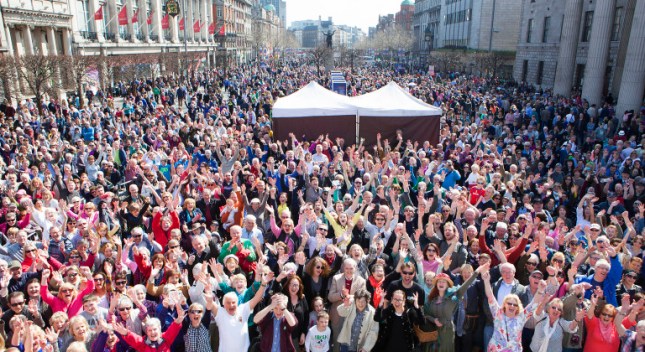
That was O’Connell Street last Easer Monday when RTE celebrated The Road to the Rising. That massive event will pale into insignificance when compared to RTE / Reflecting the Rising which begins at 11.00 on Easter Monday. Three quarters of a million people are expected to take part un hundreds of events – lectures, childrens events,  music, re-enactments, walks etc.

RTE Reflecting the Rising is taking over the city centre of Dublin for the day. There are events taking place in Trinity College, DIT, the Four Courts, St. Stephen’s Green, Merrion Square and many other venues.

Come along and join the fun.

I’ll be doing a three hour History Show  (10.00-1.00)from the Supreme Court (my one and only chance to be in such august surroundings) and I’ll also be giving two talks on Monday afternoon in the Four Courts, on the Courts Martial & executions of 1916 and on the Rising and the Four Courts.

https://1916.rte.ie/speaker/myles-dungan/

On this day – 18 March 1847 Choctaw donation to Irish Famine victims


Choctaw-Honored-Irish.jpg

Although there was a respite from potato blight in 1847 the year is still remembered in Irish famine history as ‘Black ‘47’. So few potatoes had been planted that the absence of blight made little difference to a starving, diseased and demoralized people. Thousands more died or hunger and disease or chose the emigrant ship as the only possibility of escape. However, the plight of eight million Irish people was not being ignored, except, arguably, by the Liberal government of Lord John Russell in London. Money poured in from Britain, the continent of Europe, the USA and as far away as Australia.


In March of 1847 an unexpected donation arrived from the USA. While America had been the source of much of the famine relief funds that found their way to Ireland this particular charitable gift was different. It didn’t come from Irish-American migrants on the east coast of the USA. It didn’t even come from smaller pockets of Irish migrants in the MidWest or the West. It came from the state of Oklahoma, not a region generally favoured for settlement by the Irish diaspora.


The donation amounted to $170 and it was collected by members of the Choctaw Native American nation. Some sources give the sum involved as $710, but the amount actually donated is immaterial. Either way it was a huge sum of money for a nation of impoverished Native Americans consigned more than a decade before, to life on the comfortably sounding but demonically devised, reservation. The Choctaw probably empathized with the starving Irish because their own history had much of the tragic about it.


In the war of 1812, fought against the British, the Choctaws had aided the forces led by General Andrew Jackson in the struggle against the former colonial masters. Abject defeat could well have led to the end of the great American Democratic experiment – not that democracy proved to be of much use to the Choctaw. Their reward, in 1831, had been expulsion from their homes in the south-eastern USA during the self-same Andrew Jackson’s presidency, and banishment to the bad lands of Oklahoma. This forced transportation, known as the Trail of Tears had caused the deaths of almost half of the 20,000 or so Choctaw obliged to decamp to the mid-west. Their fate was later shared by the Cherokee, Chickasaw, Creek and Seminole nations, all forced into exile, starvation and cultural suppression. The white man wanted their land, and what the white man wanted he got. The punitive Treaty of Dancing Rabbit Creek signed in 1830, attended to the detail of the wholesale dispossession of the Choctaw. Similar barbed treaties achieved the same result with the other four so called ‘Civilised Tribes’.


1831 was one of the coldest winters on record and the Federal government was not about to waste valuable taxpayers money on providing adequate food, clothing and transportation to mere Indians to protect them from the elements during such an arduous trip westwards into the even colder interior.


So it’s not hard to see why the Choctaw, having heard of the Great Famine, empathised with the Irish people. What must have been more difficult was raising such a significant sum. Only in recent years has their generosity been recognized in Ireland but today, former president Mary Robinson is an honorary chieftain of the Choctaw nation and a plaque commemorating their charity has been erected outside Dublin’s Mansion House. Other monuments around the country recognize their immensely charitable gesture.


The Choctaw, originally from the modern state of Mississippi, more than earned their designation as one of the Five ‘Civilised’ tribes, when they set about collecting a charitable donation worth at least $100,000 in today’s money, to the relief of famine in Ireland, one hundred and sixty-nine years ago, on this day.


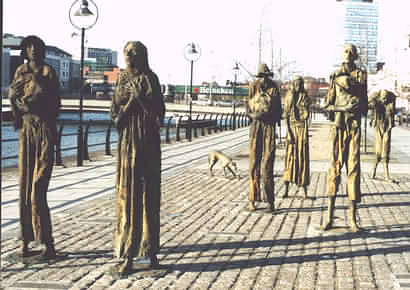
famine_emigrantsdublin.jpg2013aug09_famine_IMG_4684.jpg

On This Day – 11.3.1858 The birth of Thomas Clarke

Thomas-Clarke-returns-to-Dublin-1.jpg

When it comes to the issue of the organization of the 1916 insurrection we have to look well beyond the esoteric, if palpably sincere, philosophizing of Pearse and even the military nous and pragmatism of Connolly and look to the quiet man in the midst of the fury.

Thomas Clarke, the self effacing tobacconist, was the spine, the heart and the genius of the Easter Rising. While he was surrounded by capable and resourceful allies it was Clarke who drove the rebellion.

The first oddity associated with the life of Tom Clarke is his place of birth. He was actually born in England, in the Isle of Wight. The second was his association with the British Army. His father was a serving soldier. At the age of 20 Clarke made the decision that was to inform the rest of his life when he joined the Irish Republican Brotherhood in Dungannon, Co.Tyrone. Two years later he was forced to flee to the USA to avoid arrest.

For fifteen years of his life he was someone else. Clarke was sent from America to London in 1883 to lead the bombing campaign masterminded by O’Donovan Rossa. He did so under the alias Henry Wilson and it was under that name that he served fifteen years in British prisons after his arrest and conviction. While in jail he met the old Republican John Daly. After his release Clarke married Daly’s niece Kathleen. The family didn’t approve. She was twenty-one years younger than her husband and marriage to a felon, albeit a jailed Republican, was not exactly what they had in mind for their girl. In addition Clarke, after a tough decade and a half in prison, looked far older than his years.

After spending almost a decade in the USA the Clarkes returned to Ireland in 1907 and Tom opened a humble tobacconist’s shop in Dublin. While outwardly settled and legitimate in fact Clarke continued his work with the Irish Republican Brotherhood, most notably as a member of that organisation’s Military Council. He became a sort of mentor to the likes of Denis McCullough, Bulmer Hobson and, in particular, Sean McDermott. Because of his background as a convicted felon, however, Clarke steered clear of overt political involvement. He left it to others to infiltrate, at the highest level, organisations like the GAA, the Gaelic League and, from 1913, the Irish Volunteers.

In 1916 Clarke essentially became the link to the ‘old’ Fenians who had risen in 1867, although he himself was only a child at that time. Acting on the Republican axiom that ‘England’s difficulty is Ireland’s opportunity’ he was determined to take advantage of the outbreak of the Great War in 1914. He worked assiduously to make plans for a rising around the country with the IRB at its core using the Volunteers as their battering ram. A reluctant Hobson and McCullough were jettisoned along the way, the likes of Pearse, Connolly, Plunkett and McDonagh were recruited.

The seven members of the Military Council – Eamon Ceannt being the one often ignored – became signatories of the 1916 Proclamation. Clarke should probably have become President of the Provisional Government but preferred to leave that honour to the more flamboyant and better known Pearse. Clarke himself was an anonymous figure, familiar only to fellow revolutionaries and ‘G’ Division of the Dublin Metropolitan Police.

Clarke was stationed in the GPO during the Rising and was the second leader, after Pearse, to be executed. His last message to Kathleen ended with the words ‘we die happy’. Familiar photographs of Clarke depict a thin, bespectacled, old man. He was actually only fifty-nine years of age at the time of his death.

Thomas Clarke, conspirator, Republican, tobacconist and victim of a 1916 firing squad, was born one hundred and fifty-eight years ago, on this day.


8x10proclamationweb__31588.1321830785.1280.1280.jpg